


iRhythm Technologies presented data showing Zio LTCM's comparable performance in ECG monitoring between Asian and non-Asian patients at APHRS 2025.
Quiver AI Summary
iRhythm Technologies presented new research at the Asia Pacific Heart Rhythm Society (APHRS) and Japan Heart Rhythm Society (JHRS) conference, demonstrating the effectiveness of its Zio long-term ECG monitoring system in a diverse patient population. The large-scale study analyzed data from over 400,000 U.S. patients, revealing comparable monitoring performance between Asian (3.4% of the cohort) and non-Asian patients, with similar wear times and arrhythmia detection rates. Despite lower baseline prevalence of certain conditions in Asian patients, their detection rates for atrial fibrillation and overall arrhythmias matched those of non-Asian patients, and rates for repeat testing were low across both groups. The findings support the generalizability of Zio ECG monitoring in various populations, with implications for its future use in Japan as the country confronts a rising demand for advanced cardiac monitoring services. iRhythm is focused on further expanding clinical evidence and its monitoring services in Japan.
Potential Positives
- Presentation of significant new data supports the reliability and generalizability of iRhythm's Zio long-term ECG monitoring across diverse populations, strengthening its market position.
- Analysis of over 400,000 patients emphasizes comparable performance in arrhythmia detection and monitoring across Asian and non-Asian patients, enhancing the credibility of Zio's technology.
- The findings may facilitate expansion into the Japanese market, aligning with the country's increasing need for advanced cardiac monitoring solutions as its population ages.
- iRhythm's participation and contributions at the Asia Pacific Heart Rhythm Society (APHRS) conference highlight the company's commitment to advancing cardiac care knowledge and technology.
Potential Negatives
- Data presented in the release pertains only to Asian patients residing in the U.S., raising questions about the applicability of the findings to Japanese patients and potentially limiting the relevance of the data for the Japanese market.
- While the study showed comparable performance across patient groups, the lower baseline prevalence of certain conditions in Asian patients could suggest that the device's effectiveness may vary significantly in different populations or demographics, potentially impacting overall market confidence.
- The press release emphasizes ongoing collaborations and future studies, which may imply that current knowledge is insufficient, potentially leading to uncertainty among stakeholders about the immediate utility of the product in the market.
FAQ
What were the key findings of iRhythm's analysis at APHRS 2025?
The analysis showed comparable ECG monitoring performance between Asian and non-Asian patients, affirming the reliability of Zio's long-term monitoring.
How many patients were involved in the iRhythm study?
The study analyzed data from over 408,000 U.S. patients monitored using iRhythm's Zio ECG service.
What is the significance of Zio ECG monitoring in Japan?
Zio ECG monitoring is crucial due to Japan's aging population and high need for accurate arrhythmia detection.
How does Zio's performance compare with other monitoring options?
Zio ECG monitoring shows lower repeat testing rates and higher diagnostic yields compared to traditional wired Holter monitors.
What was the role of AI in iRhythm's presentation?
iRhythm experts discussed advancements in AI for ECG interpretation and its impact on long-term cardiac monitoring at APHRS 2025.
Disclaimer: This is an AI-generated summary of a press release distributed by GlobeNewswire. The model used to summarize this release may make mistakes. See the full release here.
$IRTC Insider Trading Activity
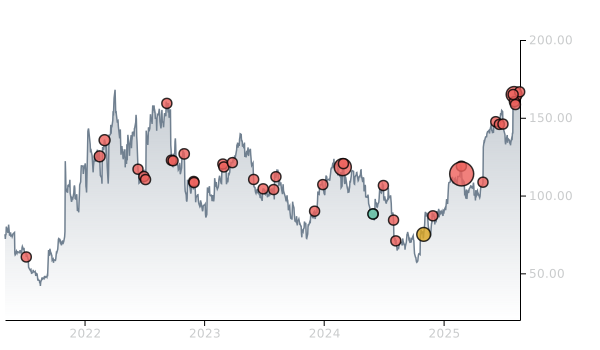
$IRTC insiders have traded $IRTC stock on the open market 27 times in the past 6 months. Of those trades, 0 have been purchases and 27 have been sales.
Here’s a breakdown of recent trading of $IRTC stock by insiders over the last 6 months:
- QUENTIN S. BLACKFORD (President and CEO) has made 0 purchases and 8 sales selling 44,059 shares for an estimated $7,388,098.
- DANIEL G. WILSON (Chief Financial Officer) has made 0 purchases and 3 sales selling 16,000 shares for an estimated $2,984,520.
- ABHIJIT Y TALWALKAR has made 0 purchases and 8 sales selling 10,624 shares for an estimated $1,764,342.
- CHAD PATTERSON (Chief Commercial Officer) has made 0 purchases and 4 sales selling 6,561 shares for an estimated $1,045,940.
- MINANG TURAKHIA (EVP, CMO & CSO) sold 1,420 shares for an estimated $206,482
- SUMI SHRISHRIMAL (EVP, Chief Risk Officer) sold 653 shares for an estimated $109,129
- MERVIN SMITH (EVP Strategic Business Ops) sold 616 shares for an estimated $101,245
- MARC WADE ROSENBAUM (Chief Accounting Officer) sold 226 shares for an estimated $35,918
To track insider transactions, check out Quiver Quantitative's insider trading dashboard.
$IRTC Hedge Fund Activity
We have seen 171 institutional investors add shares of $IRTC stock to their portfolio, and 160 decrease their positions in their most recent quarter.
Here are some of the largest recent moves:
- SANDS CAPITAL MANAGEMENT, LLC removed 679,417 shares (-23.3%) from their portfolio in Q3 2025, for an estimated $116,852,929
- ARROWSTREET CAPITAL, LIMITED PARTNERSHIP added 532,735 shares (+6415.4%) to their portfolio in Q3 2025, for an estimated $91,625,092
- UBS AM, A DISTINCT BUSINESS UNIT OF UBS ASSET MANAGEMENT AMERICAS LLC added 532,472 shares (+87.6%) to their portfolio in Q3 2025, for an estimated $91,579,859
- SLATE PATH CAPITAL LP removed 365,400 shares (-100.0%) from their portfolio in Q2 2025, for an estimated $56,256,984
- POLAR CAPITAL HOLDINGS PLC added 334,558 shares (+24782.1%) to their portfolio in Q3 2025, for an estimated $57,540,630
- CAPITAL RESEARCH GLOBAL INVESTORS removed 323,128 shares (-21.4%) from their portfolio in Q3 2025, for an estimated $55,574,784
- PRICE T ROWE ASSOCIATES INC /MD/ added 313,394 shares (+1194.0%) to their portfolio in Q3 2025, for an estimated $53,900,634
To track hedge funds' stock portfolios, check out Quiver Quantitative's institutional holdings dashboard.
$IRTC Analyst Ratings
Wall Street analysts have issued reports on $IRTC in the last several months. We have seen 8 firms issue buy ratings on the stock, and 0 firms issue sell ratings.
Here are some recent analyst ratings:
- BTIG issued a "Buy" rating on 10/31/2025
- Needham issued a "Buy" rating on 10/31/2025
- Canaccord Genuity issued a "Buy" rating on 10/31/2025
- JP Morgan issued a "Overweight" rating on 10/31/2025
- Citigroup issued a "Buy" rating on 10/31/2025
- Baird issued a "Outperform" rating on 10/10/2025
- Wells Fargo issued a "Overweight" rating on 08/01/2025
To track analyst ratings and price targets for $IRTC, check out Quiver Quantitative's $IRTC forecast page.
$IRTC Price Targets
Multiple analysts have issued price targets for $IRTC recently. We have seen 13 analysts offer price targets for $IRTC in the last 6 months, with a median target of $205.0.
Here are some recent targets:
- Allen Gong from JP Morgan set a target price of $240.0 on 10/31/2025
- David Saxon from Needham set a target price of $244.0 on 10/31/2025
- Marie Thibault from BTIG set a target price of $215.0 on 10/31/2025
- Joanne Wuensch from Citigroup set a target price of $242.0 on 10/31/2025
- David Roman from Goldman Sachs set a target price of $202.0 on 10/31/2025
- William Plovanic from Canaccord Genuity set a target price of $212.0 on 10/31/2025
- Richard Newitter from Truist Securities set a target price of $205.0 on 10/15/2025
Full Release
- iRhythm Technologies presented new data during the joint Asia Pacific Heart Rhythm Society (APHRS) and Japan Heart Rhythm Society (JHRS) scientific sessions.
-
Large-scale analysis of more than 400,000 patients
1
supports the consistency and generalizability of Zio long-term ECG monitoring (LTCM) performance across populations; median wear and analyzable time among patients identified as Asian (3.4% of the cohort) were comparable to those of non-Asian patients, and findings were consistent with Zio LTCM performance previously reported in the published CAMELOT
2
and AVALON
3
studies.
SAN FRANCISCO, Nov. 21, 2025 (GLOBE NEWSWIRE) -- iRhythm Technologies, Inc. (NASDAQ:IRTC) today announced new data presented in a podium session at the 18th Asia Pacific Heart Rhythm Society (APHRS) and Japanese Heart Rhythm Society (JHRS) 2025 Joint Scientific Session in Yokohama, Japan, held November 12–15.
The investigators, led by Dr. Hiro Kawata, compared device compliance, performance, arrhythmia detection, and repeat-testing rates between Asians and non-Asians in a large cohort of U.S. patients. The study, titled “Comparative Analysis of Arrhythmia Detection and Clinical Outcomes in Asian and Non-Asian Populations Using Ambulatory Cardiac Monitoring,” analyzed 408,470 U.S. patients monitored between 2018 and 2022 using iRhythm’s Zio ® long-term continuous ECG monitoring (LTCM) service for up to 14 days.
The analysis evaluated whether monitoring performance differs between patient groups, given that racial and cultural differences, including factors such as skin type, skin preparation, device tolerability, and lifestyle, may impact compliance and effectiveness in ambulatory cardiac monitoring.
Key Findings
- Comparable performance across populations: Median wear time (13.6 vs. 13.0 days) and analyzable ECG duration (12.9 vs. 12.2 days) were consistent between Asian and non-Asian patients, with Asians representing 3.4% of the full cohort.
- Consistent diagnostic yield: Despite lower baseline prevalence of atrial fibrillation (AF), heart failure, and coronary artery disease, patients of Asian race showed a similar AF detection rate (14.0% vs. 14.3%). The total arrhythmia yield was also comparable for both groups (79.8% vs. 82.9%).
-
Low repeat testing:
Repeat monitoring rates were low and similar among Asian and non-Asian groups (14.8% vs. 15.4%). This finding is consistent with published CAMELOT
2
and AVALON
3
analyses, which showed lower repeat testing with Zio long-term continuous monitoring compared with other ambulatory monitoring services.
The analysis leveraged Zio ECG data linked to medical claims data which enabled a comprehensive assessment of patient race, comorbidities, and outcomes across a large, diverse population. The findings demonstrate that racial and cultural characteristics—such as variations in skin type, daily activities, and device wear behaviors—were not associated with meaningful differences in wear time, analyzable time, or arrhythmia detection yield, supporting the consistency of long-term continuous ECG monitoring performance across diverse patient populations.
“These findings show that factors such as skin type, lifestyle, and adherence did not affect wear time, analyzable time, or arrhythmia detection, indicating the device performs equally well in Asian patients,” said Dr. Hiro Kawata, Consulting Medical Director for iRhythm Technologies and presenting author, who has practiced in both Japan and the United States. “The consistency observed between Asian and non-Asian patients affirms the reliability and generalizability of this 14-day continuous monitoring approach, such as with the Zio system, and contributes to the growing clinical experience supporting its use in Japan.”
“These findings provide encouraging evidence that the Zio ECG Recording and Analysis System performs reliably in Asian patients,” said Dr. Itsuro Morishima, Ogaki Municipal Hospital, Ogaki, Japan, and co-author. “Although these results are based on Asians residing in the United States and further confirmation is needed to determine whether the same performance is observed in Japanese patients, they provide valuable insight into its potential utility in Japan. When considered alongside the extensive global clinical and real-world evidence supporting the Zio long-term continuous monitoring system, these data provide important context for its use in Japanese clinical practice. As the use of Zio expands in Japan, the accumulating real-world experience will help guide appropriate adoption in everyday care.”
Expanding Evidence in Japan Amid Growing Need for Advanced Cardiac Monitoring
As Japan’s population ages, the burden of arrhythmias continues to rise, making the country the second-largest market worldwide for ambulatory cardiac monitoring, with approximately 1.6 million tests prescribed annually.
To support clinicians and patients in meeting the growing need for accurate arrhythmia detection and management, iRhythm introduced the Zio ® ECG Recording and Analysis System in Japan (known as the Zio ® ECG monitoring service outside of Japan) through exclusive distribution partner Senko Medical Instrument Co., Ltd. The Zio ECG system enables up to 14 days of continuous, uninterrupted ECG monitoring and leverages a deep-learned artificial intelligence (AI) algorithm approved by Japan’s Pharmaceuticals and Medical Devices Agency (PMDA). It represents a significant advancement over other ambulatory cardiac monitoring options in Japan, including wired Holter monitors that capture only 24 to 48 hours of data and other patch-based devices limited to 7 days or less of use. 4
In Japan, iRhythm is collaborating with leading investigators to expand evidence across local patient populations, clinical settings, and monitoring practices. While these efforts are underway, the findings presented at APHRS 2025 provide meaningful context for clinicians and demonstrate how Zio LTCM performs in Asian patients.
This analysis also adds to the growing body of evidence supporting the clinical performance of the Zio LTCM service across diverse patient populations. The C ardiac A mbulatory M onitor E va L uation of O utcomes and T ime to Events (CAMELOT) study 2 evaluated a U.S. Medicare patient population (1.3% Asian) and found that Zio LTCM had the highest yield of specified arrhythmia diagnoses and the lowest likelihood of repeat testing among the monitoring services assessed. These results were further supported by the A ssessment of V ariation in A mbu L atory Cardiac M ON itoring (AVALON) study, 3 a subsequent analysis of a younger, commercially insured patient population (2.1% Asian), which demonstrated similar findings.
Together with more than 135 peer-reviewed publications, over 2 billion hours of curated heartbeat data, and more than 12 million patient reports generated since the company’s inception, these findings reinforce iRhythm’s ongoing efforts to advance the detection and management of cardiac arrhythmias worldwide.
To learn more about iRhythm and the Zio ® LTCM service in Japan, please visit irhythmtech.com/jp/ja . For additional information about iRhythm, please visit its corporate website at i rhythmtech.com .
Additional iRhythm Scientific Participation at APHRS 2025
iRhythm experts also contributed to APHRS 2025 sessions focused on advances in artificial intelligence (AI), long-term ECG monitoring, and population-level arrhythmia detection. Dr. Mintu Turakhia, Chief Medical and Scientific Officer and EVP of Advanced Technologies, delivered multiple oral presentations, including a keynote lecture on the future of AI for ECG interpretation and prediction. He also spoke on global perspectives in AI-enabled cardiac monitoring and the role of long-term monitoring in population health. In addition, Dr. Turakhia and Dr. Itsuro Morishima co-presented a session highlighting advancements in long-term ECG monitoring with the Zio system.
About iRhythm Technologies, Inc.
iRhythm is a leading digital health care company that creates trusted solutions that detect, predict, and prevent disease. Combining wearable biosensors and cloud-based data analytics with powerful proprietary algorithms, iRhythm distills data from millions of heartbeats into clinically actionable information. Through a relentless focus on patient care, iRhythm’s vision is to deliver better data, better insights, and better health for all. Outside of Japan, iRhythm offers its Zio
®
portfolio of cardiac monitoring solutions in Austria, the Netherlands, Spain, Switzerland, the United States, and the UK – and remains dedicated to bringing access to its advanced cardiac monitoring to even more patients, clinicians and healthcare systems around the world.
Media Contact
Kassandra Perry
[email protected]
Investor Contact
Stephanie Zhadkevich
[email protected]
__________________________________
1
Kawata H et al. Clinical Performance of a Long-Term Continuous ECG Monitoring System in Asian and Non-Asian Patients: A Large-Scale Real-World Analysis of Over 400,000 Patients. Asia Pacific Heart Rhythm Society (APHRS) Scientific Sessions, November 13, 2025; Yokohama, Japan.
2
Reynolds MR, et al. Comparative effectiveness and healthcare utilization for ambulatory cardiac monitoring strategies in Medicare beneficiaries. Am Heart J. 2024 Mar;269:25-34
3
Russo P et al.
Clinical and Economic Burden of Cardiac Arrhythmias in Patients with Type 2 Diabetes.
J Health Med Econ Vol. 11 No. 1:151
4
Ikeda T, et al. 2025 Japanese Heart Rhythm Society / Japanese Circulation Society Consensus Statement on the Appropriate Use of Ambulatory and Wearable Electrocardiographs. J Arrhythm. 2025 May 23;41(3):e70059