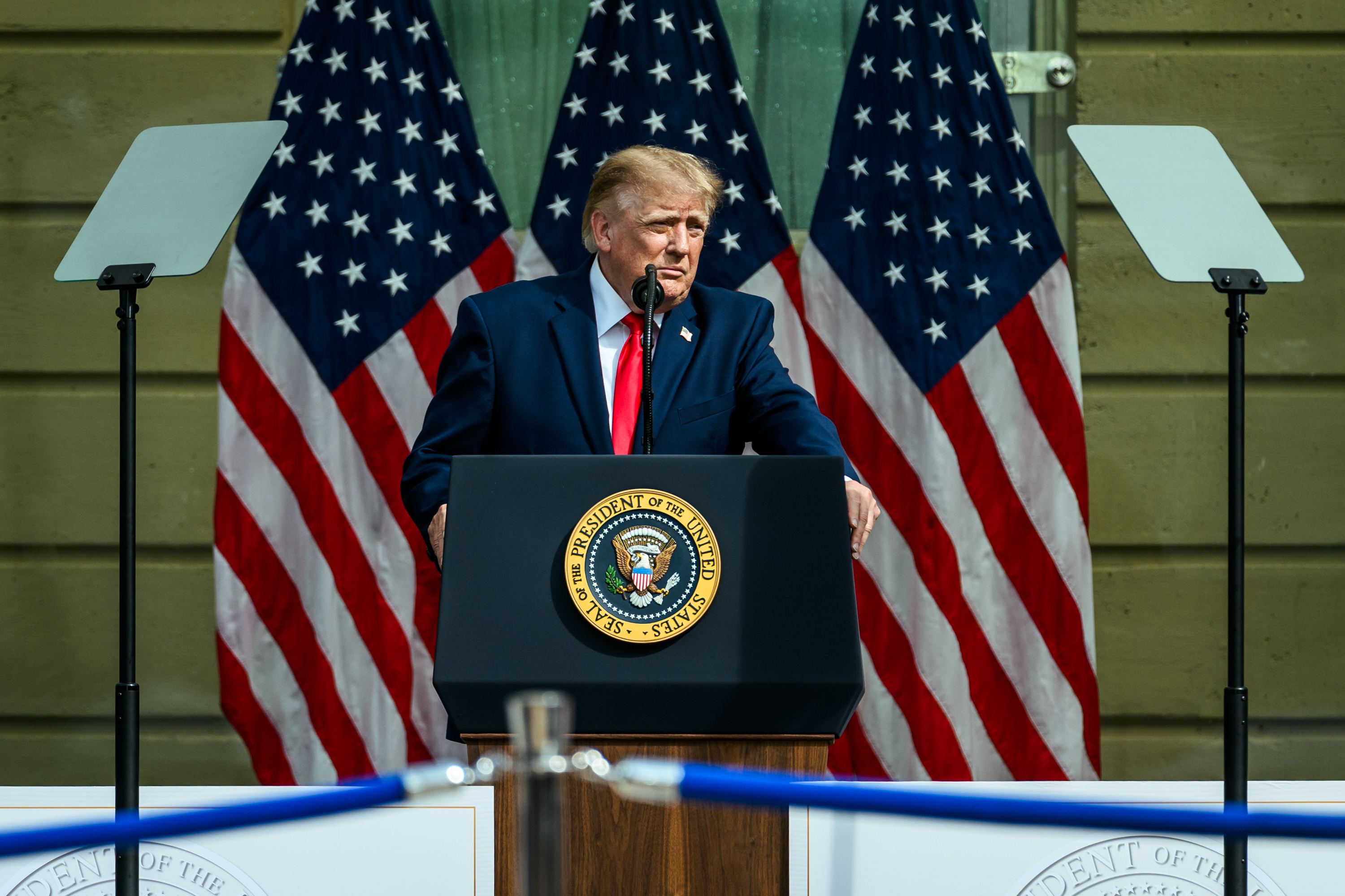

The Supreme Court recently struck down federal laws that set caps on political party spending for candidates’ campaigns, reversing a 2001 decision and contesting that spending limits violated the First Amendment.
For Senate nominees, limits ranged from $130,600 to $4,071,800 depending on the state’s voting-age population, while limits for House nominees were $65,300 unless a state has only one representative, which bumped the limit to $130,600.
Money spent on campaigns can be very indicative of a candidate’s success, so what trends have we seen in campaign finance history, and will the Supreme Court’s decision revolutionize political spending?
First, how are political parties earning and spending funds?
Despite Republicans’ support of removing limits on party spending, the RNC and other national committees’ share of spending on coordinated expenditures has remained low, while it has made up one of the largest portions of DNC spending since 2020.
The total receipts for Republican Party committees in 2024 were well below those of the years immediately preceding and ensuing, but individual contributions still took up the majority (nearly 60%). So far for the 2026 election, individual contributions make up about half of the total receipts.
For Democrats, in the 2026 election cycle, independent expenditures account for just above 60% of total receipts. In 2024, it was around half of total contributions, and for the 2022 cycle, it exceeded 70%. Generally, individual, or direct, contributions to political party committees take up the majority.

So, with that money, where does most of it go?
Well, with the Democratic Party committees, FEC data shows historically transfers to state and local party committees were one of the highest disbursements, besides operating expenses, during midterm election cycles. In contrast, transfers to other national committees were higher during presidential election cycles. Notably, coordinated expenditures were also a larger portion of disbursements during the 2026 election.
Republicans, on the other hand, spent the majority on operating costs not disclosed in FEC campaign finance tracking data. Following, transfers to other committees and direct contributions to campaigns were large shares of disbursements.
In support of the ruling to strike down coordinated expenditure limits, the National Republican Senatorial Committee said it would put more effort into coordinated expenditures, so coordinated expenditures will almost certainly rise for Republican party committees.

With the cap removed, party spending on coordinated expenditures will almost certainly rise, meaning there could also be a rise in overall spending over the next couple of election cycles.
Congressional candidates see earnings rise
Since 2014, collective candidate campaign finance activity has seen a general upward trend, with combined earnings tripling over the past decade. Spending and cash on hand have grown more conservatively, but have still seen moderate growth.
Candidates’ earnings and cash on hand have dipped during presidential years, likely due to spending priorities geared towards presidential candidates rather than congressional candidates. Spending, however, has maintained stable growth despite concurrent presidential elections.

FEC data dating back to 2012 reveal over half of combined earnings have typically been attributed to individual contributions (direct donations), which is on par with what party committees’ earnings have historically been. PACs and party committees follow, but the FEC still caps direct donations from those committees, so they maintain a relatively smaller portion of earnings than individual donations.
Coordinated expenditures, which is what the NRSC vs. FEC addressed, are not included in candidate spending and earnings because that money is spent in coordination with parties for operating and advertisement costs, not donated directly to a campaign. Even with the recent ruling, direct donations from committees to candidates are still capped, meaning individual direct contributions will likely continue to dominate candidates’ earnings.
Super PACs cannot donate directly, but influence remains strong
We looked at political party committees, and we looked at candidates’ spending and earnings. But one of the most influential entities in the political finance landscape is Super PACs (Independent Expenditure-Only Political Committees). Unlike typical PACs, Super PACs cannot donate directly to a campaign, but can funnel massive amounts of money into independent operating and advertising costs to heavily support or oppose candidates.
For example, Super PACs can spend millions on television campaigns that explicitly support or oppose a candidate. But it would be done entirely independent of a candidate’s campaign. So, a candidate may benefit from Super PAC spending while remaining independent of any advertisements aired.
Super PACs often have very wealthy donors, and without caps on spending and earnings, their earnings have soared, as shown below. Since the 2020 election cycle, their earnings more than doubled. But spending has remained more modest, instead growing their cash on hand for future election cycles.

While collectively Super PACs have the most cash on hand compared to other PACs, Hybrid PACs are earning and spending over twice as much. Hybrid PACs maintain two distinct accounts. Their contributions accounts are subject to FEC regulations and caps because those funds are directly donated to candidates. But non-contribution accounts are a similar idea to Super PACs — they accept and spend money without limits, but it must be done independently. For the 2026 cycle, Hybrid PACs' non-contribution accounts have received $3.2 billion and spent about $2.7 billion, while their cash on hand sits at only $800 million compared to Super PACs’ $1.2 billion.