

Heartflow's FUSION trial shows a 44% reduction in unnecessary invasive heart procedures using FFRCT analysis alongside standard imaging.
Quiver AI Summary
Heartflow, Inc. announced significant findings from the FUSION trial, presented at the European Society of Cardiology Congress 2026, which demonstrated that incorporating Heartflow's FFRCT Analysis with standard coronary computed tomography angiography (CCTA) significantly reduced unnecessary invasive heart procedures by 44%. This independent randomized trial, funded by the Dutch National Health Care Institute, involved 528 patients and revealed that the Heartflow approach not only minimized unnecessary catheterizations but also maintained essential rates of coronary revascularization. The results underscore the challenge in determining the clinical significance of blockages detected by CCTA and highlight how Heartflow's AI-driven technology enhances decision-making in patient care by providing a clear understanding of blood flow dynamics. The trial, a pivotal study in the field, strengthens the integration of Heartflow FFRCT Analysis into routine clinical practice, ultimately improving patient outcomes and addressing the ongoing challenge of unnecessary invasive procedures in cardiology.
Potential Positives
- Heartflow's FUSION trial results demonstrate a 44% reduction in unnecessary invasive heart procedures, highlighting the effectiveness of their technology in improving patient care.
- The study's findings, published in a reputable journal (Journal of the American College of Cardiology), enhance Heartflow's credibility and could boost investor confidence.
- Heartflow FFRCT Analysis has been validated at critical clinical decision points, reinforcing its importance and potential for routine integration into clinical practice.
- The technology is backed by more than 15 years of clinical research, establishing Heartflow as a leader in AI-driven solutions for coronary artery disease management.
Potential Negatives
- Despite the positive trial results, the reliance on Heartflow FFRCT Analysis indicates that standard CCTA is insufficient on its own, potentially undermining established diagnostic protocols.
- The statement emphasizes a gap in current diagnostic practices, which may raise concerns among healthcare providers about the reliability of existing methods without Heartflow’s technology.
- Heartflow's technology is only validated for a specific subset of patients (those with documented stenosis over 50%), which may limit its applicability and raise questions about its effectiveness in broader patient populations.
FAQ
What were the key findings of the FUSION trial?
The FUSION trial showed a 44% reduction in unnecessary invasive heart procedures when using Heartflow FFRCT Analysis alongside CCTA.
How does Heartflow FFRCT improve diagnosis of coronary artery disease?
Heartflow FFRCT Analysis creates a personalized 3D model that quantifies blood flow, addressing critical diagnostic gaps in interpreting CCTA results.
What is the significance of the 44% reduction in invasive procedures?
This reduction indicates that Heartflow FFRCT can help avoid unnecessary invasive catheterizations while maintaining patient safety and care quality.
Who funded the FUSION trial?
The FUSION trial was independently funded by the Dutch National Health Care Institute through its 'Potentially Promising Care' program.
How many patients participated in the FUSION trial?
A total of 528 patients with stable chest pain participated in the FUSION trial across twelve hospitals in the Netherlands.
Disclaimer: This is an AI-generated summary of a press release distributed by GlobeNewswire. The model used to summarize this release may make mistakes. See the full release here.
$HTFL Insider Trading Activity
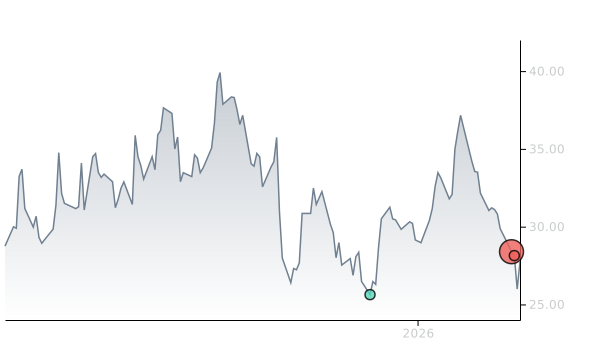
$HTFL insiders have traded $HTFL stock on the open market 21 times in the past 6 months. Of those trades, 0 have been purchases and 21 have been sales.
Here’s a breakdown of recent trading of $HTFL stock by insiders over the last 6 months:
- CAPITAL LIFE SCIENCES INVESTORS, LLC BAIN has made 0 purchases and 4 sales selling 2,000,000 shares for an estimated $58,898,336.
- JOHN C.M. FARQUHAR (Chief Executive Officer) has made 0 purchases and 11 sales selling 249,738 shares for an estimated $8,502,909.
- CAMPBELL ROGERS (Chief Medical Officer) has made 0 purchases and 5 sales selling 156,723 shares for an estimated $4,126,605.
- JULIE A CULLIVAN sold 9,122 shares for an estimated $228,050
To track insider transactions, check out Quiver Quantitative's insider trading dashboard. You can access data on insider stock transactions through the Quiver Quantitative API insider transaction endpoint.
$HTFL Hedge Fund Activity
We have seen 140 institutional investors add shares of $HTFL stock to their portfolio, and 66 decrease their positions in their most recent quarter.
Here are some of the largest recent moves:
- WELLINGTON MANAGEMENT GROUP LLP removed 4,118,057 shares (-34.4%) from their portfolio in Q2 2026, for an estimated $120,823,792
- BLACKROCK, INC. added 3,735,163 shares (+255.4%) to their portfolio in Q2 2026, for an estimated $109,589,682
- BAILLIE GIFFORD & CO removed 3,005,998 shares (-100.0%) from their portfolio in Q2 2026, for an estimated $88,195,981
- BAIN CAPITAL LIFE SCIENCES INVESTORS, LLC removed 2,000,000 shares (-19.1%) from their portfolio in Q2 2026, for an estimated $58,680,000
- NUVEEN, LLC added 1,329,929 shares (+5722.8%) to their portfolio in Q2 2026, for an estimated $39,020,116
- POINT72 ASSET MANAGEMENT, L.P. added 1,182,928 shares (+219.7%) to their portfolio in Q2 2026, for an estimated $34,707,107
- STATE STREET CORP added 1,015,345 shares (+225.4%) to their portfolio in Q2 2026, for an estimated $29,790,222
To track hedge funds' stock portfolios, check out Quiver Quantitative's institutional holdings dashboard. You can access data on hedge funds moves and 13F filings through the Quiver Quantitative API 13F endpoint.
$HTFL Analyst Ratings
Wall Street analysts have issued reports on $HTFL in the last several months. We have seen 1 firms issue buy ratings on the stock, and 0 firms issue sell ratings.
Here are some recent analyst ratings:
- William Blair issued a "Outperform" rating on 05/04/2026
To track analyst ratings and price targets for $HTFL, check out Quiver Quantitative's $HTFL forecast page.
$HTFL Price Targets
Multiple analysts have issued price targets for $HTFL recently. We have seen 4 analysts offer price targets for $HTFL in the last 6 months, with a median target of $37.0.
Here are some recent targets:
- Gene Mannheimer from Freedom Capital Markets set a target price of $37.0 on 07/01/2026
- Larry Biegelsen from Wells Fargo set a target price of $37.0 on 05/15/2026
- William Plovanic from Canaccord Genuity set a target price of $37.0 on 05/15/2026
- Robbie Marcus from JP Morgan set a target price of $35.0 on 03/19/2026
Full Release
SAN FRANCISCO, Aug. 28, 2026 (GLOBE NEWSWIRE) -- Heartflow, Inc. (Heartflow) (Nasdaq: HTFL), the leader in AI technology for diagnosing and managing coronary artery disease (CAD), today announced late-breaking one-year results from an independent randomized clinical trial proving the Heartflow FFR CT Analysis safely and significantly reduced unnecessary invasive heart procedures by 44% (p < 0.001).
Presented as Late-Breaking Science at the European Society of Cardiology (ESC) Congress 2026, FUSION trial, funded by the Dutch National Health Care Institute, demonstrates that standard coronary computed tomography angiography (CCTA) alone drives overutilization of invasive catheterizations. 1 By adding Heartflow FFR CT Analysis to standard CCTA scans, clinicians dramatically reduced diagnostic catheter lab procedures. The FUSION study has been published simultaneously in the Journal of the American College of Cardiology (JACC) .
CCTA is the primary first-line test recommended by both European (ESC) and U.S. (ACC/AHA) guidelines for evaluating patients with suspected CAD. However, visual assessment of CCTAs is limited to assessing anatomy and whether plaque is present; it cannot determine lesion-specific physiology or whether a blockage significantly restricts blood flow to the heart. This diagnostic uncertainty frequently leads physicians to refer patients for invasive coronary angiography (ICA), a hospital procedure where a catheter is threaded through an artery, normally in the groin or arm, to get into the heart to assess blocked or narrowed blood vessels. 1, 2 , 3 , 4
These findings show Heartflow FFR CT - the only AI platform prospectively validated against invasive gold standard - bridges this critical diagnostic gap. By applying advanced AI and computational fluid dynamics to standard CT scans with documented narrowings, Heartflow creates a personalized 3D model that quantifies blood flow within the coronary arteries. 5
“CCTA is established as the optimal first-line diagnostic test for coronary artery disease as it is noninvasive, but when anatomical scans show intermediate stenosis, determining whether that blockage is clinically significant remains a critical challenge,” said Alexander Hirsch, M.D., principal investigator of the FUSION trial and associate professor of cardiology at Erasmus MC in Rotterdam, Netherlands. “The FUSION trial shows that adding Heartflow lesion-specific physiology makes CCTA even more powerful and improves diagnostic efficiency. It gives clinicians the clarity to know which patients require further invasive testing, safely avoiding unnecessary invasive catheterizations while maintaining excellent patient outcomes.”
One-Year FUSION Results
Enrolling 528 patients with stable chest pain across twelve hospitals in the Netherlands, FUSION is an independent randomized controlled trial funded through the Dutch government’s Zorginstituut Nederland ‘Potentially Promising Care’ program. The study evaluated Heartflow FFR CT Analysis across diverse scanner vendors in both academic and community hospital settings, with blinded, independent clinical event adjudication.
Key 1-year findings include:
- A sustained 44% relative reduction in unnecessary ICA was demonstrated at one year in the Heartflow pathway compared to the CCTA-only group (22% [57/263] Heartflow vs. 39% [103/265] CCTA alone; p < 0.001), consistent with the 90-day primary endpoint results (18% [48/263] vs. 33% [87/265] CCTA alone; p < 0.001).
- Overall rates of ICA were significantly lower at one year in the Heartflow pathway compared to the CCTA-only group (43% [114/263] Heartflow vs. 61% [161/265] CCTA alone; p < 0.001).
- Rates of coronary revascularization remained identical across groups (20% [52/263] vs. 20% [53/265]; p = 0.948), proving that safely reducing diagnostic cath lab procedures did not prevent patients from receiving necessary intervention.
- There were no significant differences in safety endpoints between pathways, including major adverse cardiac events (MACE), ICA complications, or stroke.
Validating Heartflow FFR CT at Critical Clinical Decision Points
While previous randomized controlled trials, such as FORECAST and PRECISE, evaluated the pathway of CCTA and Heartflow FFR CT in broader patient populations early in the diagnostic pathway, FUSION is the first randomized trial to test Heartflow FFR CT Analysis at a pivotal clinical junction: immediately following a CCTA scan that identifies anatomically obstructive stenosis, a decision point recently affirmed in the 2026 SCCT/SCAI expert consensus statement and endorsed by the ACC. 6 , 7 As an independent, government-funded study with no industry involvement in trial design or analysis, FUSION delivers robust, unbiased evidence supporting the routine integration of Heartflow FFR CT Analysis into everyday clinical practice. The landmark findings build on more than 15 years of rigorous clinical research across major trials, further establishing Heartflow FFR CT as the leading and most extensively validated CT-FFR technology in cardiology. 5,6,7, 8
“One of the persistent challenges in cardiology has been accurately identifying, prior to catheterization, which patients have disease severe enough to warrant an invasive procedure,” said Campbell Rogers, M.D., F.A.C.C., Chief Medical Officer at Heartflow. “The FUSION data demonstrate that our technology can meaningfully address this challenge, providing physicians with more precise insight into a patient's disease burden after CCTA has documented stenosis over 50%. This allows care teams to direct invasive procedures to the patients most likely to benefit, while sparing others the risk and burden of a catheterization they may not require.”
About Heartflow’s Technology and Research
Heartflow’s technology is redefining precision diagnostic testing and management for coronary artery disease (CAD) through clinically-proven AI and the world’s largest coronary imaging dataset. Heartflow has been adopted by more than 1,800 institutions globally and continues to strengthen its commercial presence to make this cutting-edge solution more widely available to an increasingly diverse patient population. Backed by American College of Cardiology and American Heart Association (ACC/AHA) guidelines and supported by more than 625 peer-reviewed publications, Heartflow has redefined how clinicians manage care for over 750,000 patients worldwide. 2 Key benefits include:
- Unmatched proprietary data pipeline: Built from the world’s largest database of more than 200 million annotated CTA images, Heartflow’s data foundation powers advanced AI models that deliver highly accurate, reproducible diagnostic insights across diverse patient populations.
- Extensive clinical and real-world validation: Heartflow’s AI-driven solutions have been validated through clinical evidence in over 200 studies assessing over 365,000 patients. Heartflow is the only AI platform prospectively validated against invasive gold standards and demonstrated through real-world evidence to improve patient outcomes. 9 , 10 , 11 , 12 Proven in real-world practice with reproducibility and accuracy, Heartflow’s coronary CTA image acceptance rates exceed 97%.
- Seamless clinical integration via upgraded workflow: Heartflow delivers final quality-reviewed analyses instantly upon order, enabling clinicians to move from diagnosis to decision without delay.
- Quality system, global security and patient-data integrity compliance: Heartflow meets or exceeds leading international standards, including HITRUST, SOC 2 Type 2, MDSAP, ISO 13485, and ISO 27001.
About Heartflow, Inc.
Heartflow is transforming coronary artery disease from the world’s leading cause of death into a condition that can be detected early, diagnosed accurately, and managed for life. The Heartflow One platform uses AI to turn coronary CTA images into personalized 3D models of the heart, providing clinically meaningful, actionable insights into plaque location, volume, and composition and its effect on blood flow — all without invasive procedures. Discover how we’re shaping the future of cardiovascular care at heartflow.com .
Media Contact
Elliot Levy
[email protected]
Investor Contact
Nick Laudico
[email protected]
1
Patel MR, et al. Low Diagnostic Yield of Elective Coronary Angiography. N Engl J Med 2010; 362:886-895. (Demonstrating >50% non-obstructive rate in usual care elective caths).
2
Gulati M, et al. 2021 AHA/ACC/ASE/CHEST/SAEM/SCCT/SCAI Guideline for the Evaluation and Diagnosis of Chest Pain. Circulation 2021; 144:e368–e454.
3
Vrints C, et al. 2024 ESC Guidelines for the Management of Chronic Coronary Syndromes. Eur Heart J 2024; 00:1–105.
4
Tonino PA, et al. Fractional Flow Reserve versus Angiography for Multivessel Evaluation (FAME). N Engl J Med 2009; 360:213-224.
5
Taylor CA, et al. Computational Fluid Dynamics Applied to Coronary Computed Tomography Angiography. J Am Coll Cardiol 2013; 61(22):2233-2241.
6
Curzen N, et al. Fractional Flow Reserve Derived From Computed Tomography in Suspected Stable Angina: The FORECAST Trial. Eur Heart J 2021; 42(37):3807-3818.
7
Douglas PS, et al. A Clinical Pathway to Optimize the Diagnostic Workup of Patients With Suspected CAD: The PRECISE Randomized Trial. JAMA Cardiol 2023; 8(7):643–652.
8
15-Year Evidence Base includes DISCOVER-FLOW (JACC 2011), DeFACTO (JAMA 2012), NXT (JACC 2014), PLATFORM (Eur Heart J 2015), and ADVANCE Registry (Eur Heart J 2019).
9
Narula, et al. EHJ CVI 2024.
10
Danad, et al. JAMA Cardiol 2017.
11
Fairbairn et al. Coronary CT Angiography Plaque as a Predictor of Death, Cardiovascular Death and Myocardial Infarction. Presented at AHA 2025. (Real-world study with n=7,899 patients, higher TPV results in increased cardiovascular death and MI).
12
Madsen KT, et al. ADVANCE-DK 7-year. Presented at TCT Scientific Sessions 2024. (n=900 patients determined a 2.5x increase in cardiovascular events or deaths at 7 years).