


Zoom Virtual Agent 3.0 enhances automation, improving customer issue resolution and reducing repeat contacts, while integrating AI-driven workflows.
Quiver AI Summary
Zoom Communications, Inc. has launched Zoom Virtual Agent 3.0 (ZVA), an advanced virtual agent designed to enhance customer service automation by resolving issues more effectively and reducing the need for repeat contacts. Stemming from consumer dissatisfaction with chatbots—43% reporting failures to resolve issues—the new ZVA offers improved AI capabilities and a new execution architecture for handling complex, multi-step workflows. It allows for seamless transitions to human agents, ensures complete visibility into its operations, and learns from resolved interactions to improve future responses. With anticipated features like multimodal capabilities for interpreting documents and proactive engagement, ZVA aims to redefine customer service interactions in what Zoom calls the "resolution economy," where the focus is on first-contact resolution rather than just speed. The launch addresses the challenges of traditional virtual agents and aims to foster more connected and trust-building relationships between companies and their customers.
Potential Positives
- Introduction of Zoom Virtual Agent 3.0 enhances customer service automation capabilities, addressing key consumer frustrations related to chatbots.
- Achievements, such as a reduction in no-match rates from 35% to 0%, demonstrate significant improvements in the accuracy of customer request interpretations.
- Implementation of ZVA has led to a 30% increase in self-service tool deflection rates within three months, saving substantial agent hours and promoting operational efficiency.
- The new features position Zoom competitively within the evolving "resolution economy," focusing on first-contact resolution and enhancing overall customer experience through innovative AI capabilities.
Potential Negatives
- Despite the introduction of new virtual agent capabilities, a significant 43% of consumers still report that chatbots fail to resolve their issues, highlighting a potential gap in the efficacy of Zoom's new offerings.
- The reliance on automated systems may lead to dissatisfaction among users who encounter disjointed virtual agent experiences, as these agents are described as potentially getting "stuck in silos" and unable to transfer full context to human agents, which could harm customer trust.
- The press release emphasizes the company's reliance on automation amidst growing pressure to cut costs and increase efficiency, which could indicate a reactive rather than proactive strategy in customer service management.
FAQ
What is Zoom Virtual Agent 3.0?
Zoom Virtual Agent 3.0 is an advanced automated customer service solution that enhances AI capabilities for effective issue resolution and seamless handoffs to human agents.
How does Zoom Virtual Agent improve customer service efficiency?
ZVA reduces customer effort and minimizes repeat contacts by automating complex workflows and providing continuous learning from human resolutions.
What are the new features of Zoom Virtual Agent 3.0?
New features include an enhanced AI execution framework, agent journey transparency, multimodal LLM intelligence, continuous learning, and proactive outbound engagement.
How does Zoom Virtual Agent handle customer interactions?
ZVA automates multi-step workflows, interprets user inputs, and performs business actions, ensuring smooth interactions and fast resolutions without repeating information.
What benefits has Zoom experienced with Virtual Agent 3.0?
Internally, Zoom has seen a drop in query misunderstanding and increased deflection rates, resulting in significant time savings for their customer support teams.
Disclaimer: This is an AI-generated summary of a press release distributed by GlobeNewswire. The model used to summarize this release may make mistakes. See the full release here.
$ZM Insider Trading Activity
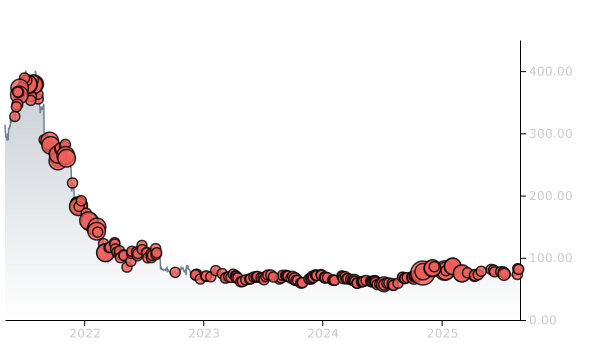
$ZM insiders have traded $ZM stock on the open market 79 times in the past 6 months. Of those trades, 0 have been purchases and 79 have been sales.
Here’s a breakdown of recent trading of $ZM stock by insiders over the last 6 months:
- ERIC S. YUAN (Chief Executive Officer) has made 0 purchases and 46 sales selling 704,390 shares for an estimated $59,333,312.
- MICHELLE CHANG (Chief Financial Officer) has made 0 purchases and 4 sales selling 42,373 shares for an estimated $3,512,741.
- APARNA BAWA (Chief Operating Officer) has made 0 purchases and 4 sales selling 22,665 shares for an estimated $1,827,413.
- VELCHAMY SANKARLINGAM (Pres. of Engineering & Product) has made 0 purchases and 6 sales selling 20,418 shares for an estimated $1,731,870.
- SANTIAGO SUBOTOVSKY has made 0 purchases and 19 sales selling 17,325 shares for an estimated $1,461,335.
To track insider transactions, check out Quiver Quantitative's insider trading dashboard.
$ZM Revenue
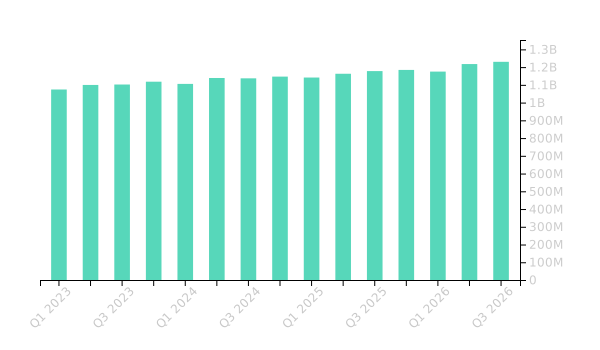
$ZM had revenues of $1.2B in Q3 2026. This is an increase of 4.44% from the same period in the prior year.
You can track ZM financials on Quiver Quantitative's ZM stock page.
$ZM Hedge Fund Activity
We have seen 427 institutional investors add shares of $ZM stock to their portfolio, and 365 decrease their positions in their most recent quarter.
Here are some of the largest recent moves:
- UBS AM, A DISTINCT BUSINESS UNIT OF UBS ASSET MANAGEMENT AMERICAS LLC removed 7,563,303 shares (-72.6%) from their portfolio in Q4 2025, for an estimated $652,637,415
- NEWLANDS MANAGEMENT OPERATIONS LLC removed 3,760,588 shares (-100.0%) from their portfolio in Q3 2025, for an estimated $310,248,510
- AQR CAPITAL MANAGEMENT LLC added 3,718,186 shares (+43.9%) to their portfolio in Q4 2025, for an estimated $320,842,269
- FMR LLC added 1,439,621 shares (+13.9%) to their portfolio in Q4 2025, for an estimated $124,224,896
- T. ROWE PRICE INVESTMENT MANAGEMENT, INC. removed 1,231,810 shares (-28.7%) from their portfolio in Q4 2025, for an estimated $106,292,884
- QUANTINNO CAPITAL MANAGEMENT LP added 1,148,277 shares (+inf%) to their portfolio in Q4 2025, for an estimated $99,084,822
- VANGUARD GROUP INC added 1,029,623 shares (+4.0%) to their portfolio in Q4 2025, for an estimated $88,846,168
To track hedge funds' stock portfolios, check out Quiver Quantitative's institutional holdings dashboard.
$ZM Analyst Ratings
Wall Street analysts have issued reports on $ZM in the last several months. We have seen 7 firms issue buy ratings on the stock, and 0 firms issue sell ratings.
Here are some recent analyst ratings:
- Citigroup issued a "Buy" rating on 01/12/2026
- Wedbush issued a "Outperform" rating on 11/25/2025
- RBC Capital issued a "Outperform" rating on 11/25/2025
- Rosenblatt issued a "Buy" rating on 11/25/2025
- Jefferies issued a "Buy" rating on 11/25/2025
- Needham issued a "Buy" rating on 11/25/2025
- Benchmark issued a "Buy" rating on 09/18/2025
To track analyst ratings and price targets for $ZM, check out Quiver Quantitative's $ZM forecast page.
$ZM Price Targets
Multiple analysts have issued price targets for $ZM recently. We have seen 14 analysts offer price targets for $ZM in the last 6 months, with a median target of $93.5.
Here are some recent targets:
- Tyler Radke from Citigroup set a target price of $106.0 on 01/12/2026
- James Fish from Piper Sandler set a target price of $91.0 on 01/05/2026
- Thomas Blakey from Cantor Fitzgerald set a target price of $87.0 on 11/25/2025
- Samad Samana from Jefferies set a target price of $105.0 on 11/25/2025
- Meta Marshall from Morgan Stanley set a target price of $92.0 on 11/25/2025
- Mark Murphy from JP Morgan set a target price of $90.0 on 11/25/2025
- Rishi Jaluria from RBC Capital set a target price of $100.0 on 11/25/2025
Full Release
- New virtual agent capabilities reduce customer effort, prevent repeat contacts, and give service leaders confidence to scale automation
- With 43% of consumers saying chatbots fail to resolve their issues, Zoom Virtual Agent 3.0 can help organizations close that gap
SAN JOSE, Calif., Feb. 24, 2026 (GLOBE NEWSWIRE) -- Today Zoom Communications, Inc. (NASDAQ: ZM) unveiled Zoom Virtual Agent 3.0 (ZVA), the next evolution in agentic automation. ZVA introduces a new execution architecture and expanded AI capabilities designed to resolve customer issues end to end, seamlessly hand off to human agents, and help enterprises shift from transactional service interactions to connected customer relationships.
Organizations face growing pressure to automate more customer service interactions as volumes rise and cost efficiency becomes a priority. Enterprises are entering what Zoom calls the “resolution economy,” where competitive advantage is defined not by speed, but by first-contact resolution, reduced repeat contacts, and end-to-end workflow completion. Yet disjointed virtual agents can get stuck in silos, unable to seamlessly transfer full context to human agents, creating bottlenecks for complex issues. A recent Morning Consult report commissioned by Zoom found that the top three chatbot frustrations among the groups surveyed are failure to resolve the issue (43%), getting stuck in a loop (38%), and having to repeat information (37%).
“Agentic AI was just the beginning,” said Chris Morrissey, general manager of Zoom CX. “Zoom Virtual Agent 3.0 orchestrates multi-step workflows across systems, continuously learns from human resolutions, and provides full transparency into every agentic action. This allows organizations to confidently automate complex interactions. It’s more than a product update, it’s another step toward more connected customer relationships, where AI and humans work together to resolve issues faster and build trust.”
What's new in Zoom Virtual Agent 3.0
The next evolution of Zoom Virtual Agent operates across voice and chat, and introduces a new execution architecture designed to automate complex, cross-system interactions with enterprise governance. Unlike competing solutions focused primarily on conversational containment, ZVA is built for execution and resolution, securely orchestrating multi-step actions across systems with observability, control, and measurable outcomes. The following new features are now available:
- Enhanced AI execution framework: Zoom Virtual Agent 3.0 is built on the latest Zoom AI Companion 3.0 architecture, allowing multi-step workflows to run across compatible CRM, billing, order management, and other enterprise systems with full observability and governance. This extends Zoom’s agentic AI capabilities by enabling full-cycle resolution rather than just single-step responses.
- Agent journey transparency and governance enhancements: Account admins can now see the data sources, decision logic, and workflow paths behind automated actions. CX teams can audit performance, troubleshoot breakdowns, and refine automation policies, enabling responsible scaling without sacrificing adherence or control.
The following next-generation enhancements, expected to be generally available in Spring 2026, will expand ZVA’s ability to handle more complex workflows while improving reliability, oversight, and operational efficiency:
- Multimodal large language model (LLM) intelligence: ZVA will be able to interpret and act on customer-submitted documents, images, and structured identifiers such as serial numbers and forms. By extracting relevant data directly from visual and document inputs, the virtual agent can automate service scenarios that previously required manual review, helping reduce customer effort and the need for escalation.
- Continuous learning: When integrated with Zoom Contact Center, ZVA extracts insights from escalated engagements that human agents successfully resolved and applies those validated recommendations, with oversight and controls, to similar future requests. This creates a structured feedback loop based on human-agent resolutions, reducing repeat contacts and improving resolution consistency over time.
-
Proactive outbound engagement:
The virtual agent can initiate contact, confirm updates, and complete tasks based on known events. This helps organizations resolve issues before customers reach out, reducing inbound volume and customer effort.
Zoom Virtual Agent in action
Modern customer issues rarely fit into a single scripted response. Zoom Virtual Agent (ZVA) is designed to move beyond basic automation, including authenticating users, interpreting inputs, orchestrating backend systems, and completing real business actions within a single, connected workflow.
By reducing repetitive steps and minimizing handoffs, ZVA helps increase first-contact resolution while lowering handling time and operational effort. An example of this is below:
-
Scenario: End-to-End Warranty Fulfillment
- When a customer submits a warranty claim, ZVA can authenticate the user, extract a serial number from an uploaded image, validate eligibility across backend systems, schedule device pickup, initiate a replacement order, and confirm shipment, all within one continuous interaction.
-
If escalation is required, the complete workflow history, including verified inputs and actions already taken, transfers seamlessly to a live agent. The customer does not need to repeat information or restart the process, accelerating resolution and improving the overall experience.
Raising the bar for resolution
As organizations automate more interactions to manage rising volumes and cost pressures, performance is increasingly measured by resolution quality — not containment rates alone. In the resolution economy, automation must accurately interpret intent, execute across systems, and meaningfully reduce operational load.
Zoom is already seeing measurable results internally after implementing the latest updates to ZVA in its own virtual agents:
- Query understanding accuracy: Zoom’s no-match rate (the percentage of total conversation turns in which a virtual agent failed to understand the user's input) has dropped from 35% to 0%, meaning almost all customer requests are accurately interpreted on the first attempt, reducing repeat queries and friction.
- Significant time savings: On Zoom’s billing team, deflection rates (measuring the percentage of customer support inquiries resolved through self-service tools) rose from 0% to 30% in just three months, saving over 1,000 agent hours per month.
Zoom Virtual Agent 3.0 reflects Zoom’s broader ambition to power intelligent, connected customer experiences where AI and human agents work together to complete complex interactions with speed, transparency, and trust. This is automation designed not just to scale, but also to earn trust with every interaction.
See Zoom Virtual Agent in action
Read the Zoom blog to see how ZVA supports Zoom’s own customers by improving resolution at scale, and stop by Zoom’s booth (#519) at Enterprise Connect 2026, March 10–12 in Las Vegas, to see a live demo.
About Zoom
Zoom (NASDAQ:ZM) provides the AI-first, open work platform built for human connection and purposefully designed to move conversations to completion. From entrepreneurs to global enterprises, customers choose Zoom to seamlessly collaborate, communicate, and drive outcomes across meetings, chat, phone, contact center, events, and more — all with the built-in assistance of Zoom AI Companion. Founded in 2011, Zoom is headquartered in San Jose, CA. For more information, visit zoom.com .
Zoom Public Relations
Travis Isaman
[email protected]