U.S. employers face challenges with retirement readiness in defined contribution plans, prompting a need for reevaluation and improved analytics.
Quiver AI Summary
The WTW 2026 Defined Contribution Survey reveals that U.S. employers recognize the importance of defined contribution plans but struggle to determine if these plans effectively prepare employees for retirement. Of 547 surveyed plan sponsors, 60% defined retirement readiness primarily in terms of income replacement, timely retirement, and retirement confidence. With shifting priorities emphasizing enhanced employee experiences and improved retirement outcomes, many employers are re-evaluating their retirement plan governance and design to close what WTW terms a "retirement outcomes gap." They are increasingly using analytics and exploring artificial intelligence to enhance plan support and personalize employee communications. The survey suggests actionable steps for employers, including defining retirement readiness, using data-driven insights to address support needs, reallocating resources from administration to outcomes, and providing better support during the transition to retirement.
Potential Positives
- WTW identified a significant opportunity for improvement in retirement outcomes, emphasizing its role as a leader in advising employers on enhancing defined contribution plans.
- The survey highlights a strong employer interest in utilizing advanced analytics and AI to enhance retirement plan effectiveness, positioning WTW as a key partner in this evolution.
- Recognizing the "retirement outcomes gap" showcases WTW's ability to address critical industry challenges, potentially attracting new clients seeking to improve their retirement readiness initiatives.
- The findings suggest a proactive shift among employers towards more personalized support for employees, aligning with WTW's data-driven approach to enhancing workforce strategies.
Potential Negatives
- Employers are increasingly concerned about the "retirement outcomes gap," indicating a significant mismatch between expectations for retirement plans and their actual performance, which could undermine WTW's credibility as a provider of retirement solutions.
- Many sponsors reported that existing defined contribution plans do not adequately prepare employees for retirement, suggesting potential deficiencies in WTW's consulting and advisory services.
- The reliance on advanced analytics and AI for improving retirement outcomes indicates that WTW may be perceived as not having fully effective traditional methods at their disposal, raising concerns about their ability to adapt effectively to market demands.
FAQ
What is the retirement readiness gap identified in the WTW survey?
The retirement readiness gap refers to the difference between employer expectations and the effectiveness of defined contribution plans in preparing employees for retirement.
How are employers currently measuring retirement readiness?
Employers define retirement readiness through criteria such as income replacement, retiring on time, and overall retirement confidence.
What actions are employers taking to address retirement plan outcomes?
Employers are reassessing plan governance, updating plan designs, and enhancing participant support to improve retirement outcomes.
What role does AI play in improving retirement plans?
Employers are increasingly willing to use AI for plan analytics, automating processes, and personalizing employee communications to enhance retirement readiness.
How significant is the importance of workforce planning in retirement readiness?
Employers link retirement readiness objectives to broader workforce goals, impacting attraction, retention, and timely transitions within the workforce.
Disclaimer: This is an AI-generated summary of a press release distributed by GlobeNewswire. The model used to summarize this release may make mistakes. See the full release here.
$WTW Insider Trading Activity
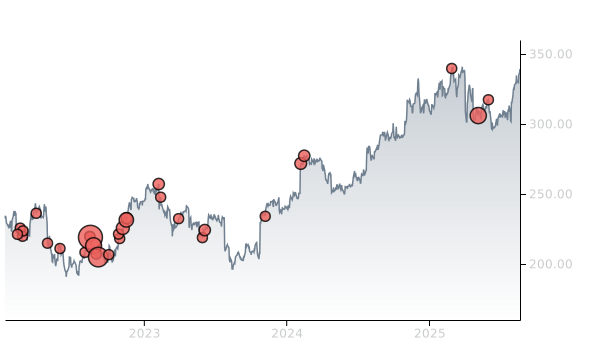
$WTW insiders have traded $WTW stock on the open market 2 times in the past 6 months. Of those trades, 1 have been purchases and 1 have been sales.
Here’s a breakdown of recent trading of $WTW stock by insiders over the last 6 months:
- MATTHEW FURMAN (General Counsel) sold 3,000 shares for an estimated $912,008
- LUCY CLARKE (President of Risk & Broking) purchased 1,896 shares for an estimated $499,340
To track insider transactions, check out Quiver Quantitative's insider trading dashboard. You can access data on insider stock transactions through the Quiver Quantitative API insider transaction endpoint.
$WTW Revenue
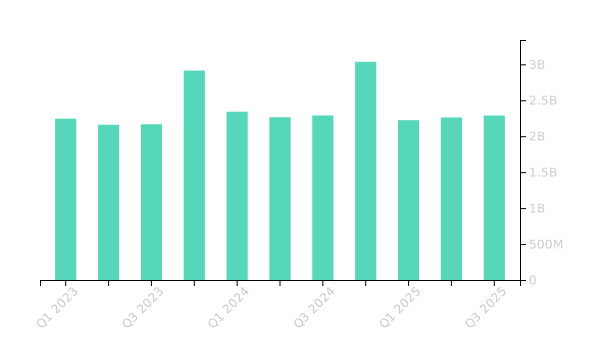
$WTW had revenues of $2.5B in Q2 2026. This is an increase of 9.07% from the same period in the prior year.
You can track WTW financials on Quiver Quantitative's WTW stock page.
You can access data on WTW stock through the Quiver Quantitative API.
$WTW Hedge Fund Activity
We have seen 294 institutional investors add shares of $WTW stock to their portfolio, and 390 decrease their positions in their most recent quarter.
Here are some of the largest recent moves:
- CITADEL ADVISORS LLC added 552,964 shares (+2591.9%) to their portfolio in Q1 2026, for an estimated $160,746,634
- BARROW HANLEY MEWHINNEY & STRAUSS LLC removed 527,903 shares (-71.0%) from their portfolio in Q1 2026, for an estimated $153,461,402
- BAUPOST GROUP LLC/MA removed 464,475 shares (-34.2%) from their portfolio in Q1 2026, for an estimated $135,022,882
- DODGE & COX added 406,889 shares (+5.9%) to their portfolio in Q1 2026, for an estimated $118,282,632
- HARRIS ASSOCIATES L P added 404,593 shares (+7.2%) to their portfolio in Q1 2026, for an estimated $117,615,185
- WELLINGTON MANAGEMENT GROUP LLP removed 367,827 shares (-98.2%) from their portfolio in Q1 2026, for an estimated $106,927,308
- FRANKLIN RESOURCES INC added 356,711 shares (+697.4%) to their portfolio in Q1 2026, for an estimated $103,695,887
To track hedge funds' stock portfolios, check out Quiver Quantitative's institutional holdings dashboard. You can access data on hedge funds moves and 13F filings through the Quiver Quantitative API 13F endpoint.
$WTW Analyst Ratings
Wall Street analysts have issued reports on $WTW in the last several months. We have seen 1 firms issue buy ratings on the stock, and 0 firms issue sell ratings.
Here are some recent analyst ratings:
- BMO Capital issued a "Outperform" rating on 05/01/2026
To track analyst ratings and price targets for $WTW, check out Quiver Quantitative's $WTW forecast page.
$WTW Price Targets
Multiple analysts have issued price targets for $WTW recently. We have seen 12 analysts offer price targets for $WTW in the last 6 months, with a median target of $342.5.
Here are some recent targets:
- Yaron Kinar from Mizuho set a target price of $361.0 on 07/09/2026
- Ryan Tunis from Cantor Fitzgerald set a target price of $344.0 on 07/09/2026
- Elyse Greenspan from Wells Fargo set a target price of $341.0 on 07/09/2026
- Meyer Shields from Keefe, Bruyette & Woods set a target price of $381.0 on 07/08/2026
- Brian Meredith from UBS set a target price of $382.0 on 07/08/2026
- Alex Scott from Barclays set a target price of $303.0 on 07/07/2026
- Matthew Heimermann from Citigroup set a target price of $300.0 on 05/06/2026
Full Release
NEW YORK, Aug. 03, 2026 (GLOBE NEWSWIRE) -- U.S. employers are facing a clear retirement readiness challenge: they value defined contribution (DC) plans, but many still lack a precise view of whether those plans are helping employees retire on time and with confidence. That is according to the WTW 2026 Defined Contribution Survey from WTW (NASDAQ: WTW), a leading global advisory, broking and solutions company. In the survey of 547 U.S. plan sponsors, 60% have a working definition of retirement readiness, split among income replacement (40%), retiring on time (39%) and retirement confidence (39%) (sponsors could select more than one option).
The finding underscores what WTW calls a retirement outcomes gap, now a growing business concern for employers. Employers are asking their DC plans to deliver more than ever: enhancing the employee experience (69%) and improving retirement outcomes (63%) top their objectives for the next two years, and three in four rank retirement savings as a core or top priority within total rewards. But many plans are still measured, governed and delivered for a different era, leaving a gap between what employers expect and what their plans are built to achieve. Sponsors are reassessing governance, resources and plan design to move beyond commitment to impact.
“The retirement outcomes gap is a call to action,” said
Chris West, Senior Managing Director and Defined Contribution Strategy Leader, WTW
. “Employers have invested heavily in retirement programs, but the next challenge is proving these programs are moving employees closer to retirement readiness. Advanced analytics can help sponsors see where gaps are emerging and what actions may matter most, leading to more impactful solutions and better outcomes.”
The survey shows where plans stall, and where employers are starting to act:
- Averages hide the people at risk. Sponsors often monitor aggregate, plan-level metrics such as participation rates, but fewer break results down by employee group, where gaps in access, savings behavior and outcomes are often most visible.
- Plan design is being retooled for impact. Half of sponsors say minor or moderate retirement plan design updates are needed. As cost pressures persist, employers are looking for changes that make plans more relevant, flexible and aligned with retirement readiness goals.
- Plan governance continues to evolve. Closing the retirement outcomes gap will require many sponsors to rebalance time and resources spent on administration and governance. One in five sponsors are looking to delegate future delivery support, transferring administration and fiduciary responsibilities so their teams can spend more time on strategy focused on improving participant outcomes.
-
Support stops before the finish line.
Plans have gotten better at helping employees accumulate savings, but support diminishes when it matters most: the transition into retirement, when workers face critical decisions about their readiness and the prospective distribution and investment options that determine whether savings become sustainable income. To enhance support, 3 out of 10 sponsors are planning to offer an in-plan retirement income solution.
The stakes extend beyond the benefits department. When employees do not feel ready to retire, they often do not, whatever their account balance says, and delayed retirements ripple into workforce planning, succession and talent costs. Employers in the survey consistently tie their retirement objectives to broader workforce goals, including attraction, retention and timely workforce transitions.
The retirement outcomes gap has new urgency as workers are increasingly confronted with large, abstract retirement savings targets. For many Americans, the workplace DC plan is their primary retirement vehicle, which puts employers at the center of translating those headline numbers into something a worker can act on.
“Headlines keep telling workers they need a specific amount of retirement savings. Even retirement professionals struggle to say what the numbers mean until they are translated into a monthly lifestyle,” said Dave Amendola, Managing Director and Intellectual Capital and Innovation Leader, Defined Contribution Strategy, WTW . “That is the gap employers are wrestling with: helping employees understand what their savings actually mean and supporting confident decisions that help convert an account balance into retirement income.”
Employers also see AI as part of the answer, in certain areas. Nearly four in five (79%) are willing to use artificial intelligence (AI) for plan analytics, 73% to automate routine processes and 72% to personalize employee communications. Willingness wanes as stakes rise: 37% for compliance and risk management, 33% for recordkeeper oversight and 29% for fiduciary governance, with data privacy and security the most common reservation (74%). The pattern reflects where accountability sits: sponsors are more comfortable when AI provides education, as opposed to when it touches fiduciary responsibilities.
“Employers are most comfortable using AI where it can make retirement programs more responsive, efficient and insight driven,” West said. “The opportunity is to use these tools to better engage participants, streamline administration and help sponsors understand where plan design, investment strategy and participant support can have the greatest impact.”
The survey suggests four steps for closing the retirement outcomes gap: define retirement readiness in measurable terms, use enhanced plan data and AI-enabled analytics to identify where support is needed, shift time and resources from administration toward outcomes, and extend more personalized support through the transition into retirement.
The complete findings are available in the WTW 2026 Defined Contribution Survey report .
About the survey
The WTW 2026 Defined Contribution Survey is based on responses from 547 U.S. employers that sponsor a defined contribution plan. Fieldwork was conducted between April 15 and May 22, 2026. Respondents skew large: over 60% hold at least $1 billion in DC plan assets, 42% have 10,000 or more employees, and 72% also manage a defined benefit plan.
About WTW
At WTW (NASDAQ: WTW), we provide data-driven, insight-led solutions in the areas of people, risk and capital. Leveraging the global view and local expertise of our colleagues serving 140 countries and markets, we help organizations sharpen their strategy, enhance organizational resilience, motivate their workforce and maximize performance. Working shoulder to shoulder with our clients, we uncover opportunities for sustainable success, and provide perspective that moves you. Learn more at wtwco.com.
Media contact
Dan Mahoney, Pierpont, [email protected], 970.405.8060
Arnelle Sullivan, WTW, [email protected]