


TransUnion reports a $3.3 billion exposure for U.S. lenders due to rising synthetic identity fraud in 2024.
Quiver AI Summary
TransUnion's recent research highlights a rising threat of synthetic identity fraud in the U.S., with lenders facing over $3.3 billion in exposure for 2024. As synthetic identities become more sophisticated, blending real and fabricated information, traditional detection methods struggle to identify them, particularly as these false identities often exhibit behaviors similar to legitimate consumers. To combat this, TransUnion emphasizes the importance of utilizing comprehensive data analysis to detect potential fraud at the account creation stage. Key indicators such as the absence of real-life attributes or specific public records can elevate the likelihood of identifying synthetic identities. TransUnion’s Synthetic Fraud Model is designed to proactively analyze these indicators, helping organizations streamline their processes and enhance fraud detection while protecting against financial losses. The company stresses that as fraudsters adapt their tactics, lenders must remain vigilant in employing advanced tools to safeguard their operations.
Potential Positives
- TransUnion's new research highlights the significant financial risk posed by synthetic identity fraud, emphasizing the necessity for lenders to adopt advanced detection tools.
- The introduction of TransUnion's Synthetic Fraud Model positions the company as a leader in fraud prevention, enabling organizations to proactively identify synthetic identities and streamline their processes.
- By leveraging behavioral characteristics and public data, TransUnion's model enhances accuracy in fraud detection while also improving operational efficiency for lenders.
- The emphasis on protecting customers and minimizing financial losses underscores TransUnion's commitment to fostering trust in financial transactions, aligning with their mission of providing "Information for Good®."
Potential Negatives
- The press release highlights a significant rising trend in synthetic identity fraud, indicating vulnerabilities within financial institutions that must be addressed urgently.
- TransUnion's emphasis on the need for advanced detection tools suggests that current methods employed by lenders may be insufficient, raising concerns about their existing fraud prevention measures.
- The release points to a $3.3 billion exposure for lenders, which may negatively impact their financial stability and confidence in the market.
FAQ
What is synthetic identity fraud?
Synthetic identity fraud involves creating fake identities using a mix of real and fabricated data, making them hard to detect.
How much exposure did U.S. lenders face from synthetic identities in 2024?
U.S. lenders faced over $3.3 billion in exposure due to synthetic identities for the year ending 2024.
What characteristics can help identify synthetic identities?
Key traits include a lack of vehicle ownership, no known relatives, and absence of voter registrations, among others.
How does TransUnion's Synthetic Fraud Model help organizations?
This model analyzes public data indicators to proactively identify synthetic identities and enhance fraud detection accuracy for lenders.
Why is it challenging to detect synthetic identities?
Synthetic identities often mimic real consumer behavior, making it difficult for traditional verification methods to distinguish them from legitimate identities.
Disclaimer: This is an AI-generated summary of a press release distributed by GlobeNewswire. The model used to summarize this release may make mistakes. See the full release here.
$TRU Insider Trading Activity
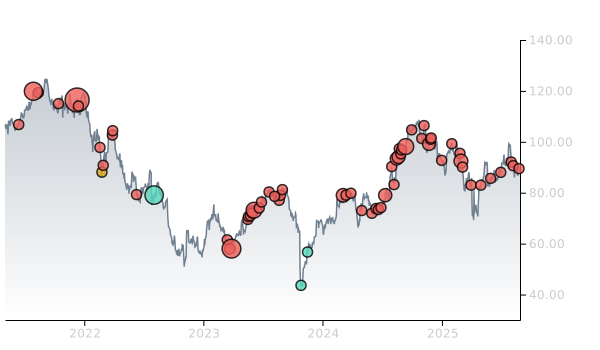
$TRU insiders have traded $TRU stock on the open market 10 times in the past 6 months. Of those trades, 0 have been purchases and 10 have been sales.
Here’s a breakdown of recent trading of $TRU stock by insiders over the last 6 months:
- STEVEN M CHAOUKI (President, US Markets) has made 0 purchases and 6 sales selling 6,000 shares for an estimated $515,650.
- HEATHER J RUSSELL (EVP, Chief Legal Officer) sold 5,337 shares for an estimated $480,383
- JENNIFER A. WILLIAMS (SVP, Chief Accounting Officer) has made 0 purchases and 3 sales selling 1,972 shares for an estimated $178,935.
To track insider transactions, check out Quiver Quantitative's insider trading dashboard.
$TRU Hedge Fund Activity
We have seen 288 institutional investors add shares of $TRU stock to their portfolio, and 335 decrease their positions in their most recent quarter.
Here are some of the largest recent moves:
- CAPITAL INTERNATIONAL INVESTORS removed 2,704,048 shares (-68.5%) from their portfolio in Q2 2025, for an estimated $237,956,224
- INDEPENDENT FRANCHISE PARTNERS LLP added 2,530,335 shares (+119.5%) to their portfolio in Q2 2025, for an estimated $222,669,480
- FMR LLC removed 2,400,212 shares (-58.4%) from their portfolio in Q2 2025, for an estimated $211,218,656
- SOUTHPOINT CAPITAL ADVISORS LP added 2,200,000 shares (+inf%) to their portfolio in Q2 2025, for an estimated $193,600,000
- T. ROWE PRICE INVESTMENT MANAGEMENT, INC. added 1,839,690 shares (+53.9%) to their portfolio in Q2 2025, for an estimated $161,892,720
- MERITAGE GROUP LP added 1,639,949 shares (+38.3%) to their portfolio in Q2 2025, for an estimated $144,315,512
- WILLIAM BLAIR INVESTMENT MANAGEMENT, LLC added 1,394,813 shares (+41.7%) to their portfolio in Q2 2025, for an estimated $122,743,544
To track hedge funds' stock portfolios, check out Quiver Quantitative's institutional holdings dashboard.
$TRU Analyst Ratings
Wall Street analysts have issued reports on $TRU in the last several months. We have seen 5 firms issue buy ratings on the stock, and 0 firms issue sell ratings.
Here are some recent analyst ratings:
- Needham issued a "Buy" rating on 09/03/2025
- Wells Fargo issued a "Overweight" rating on 07/25/2025
- BMO Capital issued a "Outperform" rating on 07/25/2025
- Oppenheimer issued a "Outperform" rating on 05/22/2025
- Stifel issued a "Buy" rating on 04/25/2025
To track analyst ratings and price targets for $TRU, check out Quiver Quantitative's $TRU forecast page.
$TRU Price Targets
Multiple analysts have issued price targets for $TRU recently. We have seen 7 analysts offer price targets for $TRU in the last 6 months, with a median target of $112.0.
Here are some recent targets:
- Kyle Peterson from Needham set a target price of $115.0 on 09/03/2025
- Kevin Mcveigh from UBS set a target price of $105.0 on 07/25/2025
- Ryan Griffin from BMO Capital set a target price of $118.0 on 07/25/2025
- Jason Haas from Wells Fargo set a target price of $118.0 on 07/25/2025
- Owen Lau from Oppenheimer set a target price of $108.0 on 07/08/2025
- Shlomo Rosenbaum from Stifel set a target price of $112.0 on 04/25/2025
- Manav Patnaik from Barclays set a target price of $85.0 on 04/04/2025
Full Release
CHICAGO, Sept. 17, 2025 (GLOBE NEWSWIRE) -- With synthetic identities now linked to a record number of newly opened accounts, U.S. lenders faced more than $3.3 billion in exposure for the year ending 2024. This alarming trend underscores the urgent need for financial institutions such as auto lenders, mortgage lenders and credit unions to harness all available data to detect and prevent synthetic identity fraud at the point of account creation. New research from TransUnion (NYSE: TRU) reveals that key traits and behavioral characteristics found in public data can play a critical role in identifying these deceptive identities before they pose a risk.
Synthetic identities are carefully constructed using a blend of authentic and fabricated information—often incorporating stolen Social Security numbers, fictitious names, digital contact details and behavioral patterns that mimic legitimate consumer activity. These identities are engineered to appear credible and frequently bypass traditional identity verification systems, making them particularly difficult to detect using conventional methods.
There is no single blueprint for how criminals perpetrate synthetic identity fraud, which adds to its complexity. Increasingly, organizations face the challenge of distinguishing genuine customers from synthetic ones, especially when these false identities exhibit consistent, low-risk behavior that closely mimics that of real individuals. To stay ahead of evolving threats, organizations must leverage advanced detection tools capable of isolating and analyzing specific traits, behavioral patterns and characteristics that are frequently associated with synthetic identities.
“While the presence of living characteristics such as vehicle ownership, voter registration or familial connections is not a definitive solution to detecting synthetic identities, it represents an important piece of the broader identity puzzle,” said Steve Yin, senior vice president and global head of fraud at TransUnion. “These attributes alone cannot confirm authenticity, but when combined with credit header data, they offer valuable context that contributes to forming a clear picture of identity. By isolating and evaluating these elements, organizations can strengthen their ability to differentiate between real and synthetic identities with greater precision.”
There are a number of living characteristics that, when present, indicate an identity to be significantly more likely to be synthetic. For example, no known relatives and no motor vehicle registrations occur in 30-50% of all synthetic identities and increase the likelihood of being synthetic by up to 7x vs. legitimate identities. Other top characteristics that raise red flags include missing voter and vehicle registrations or having no record of property ownership on file. Notably, every synthetic identity analyzed showed no open bankruptcies, making it a universal trait among them.
TransUnion’s Synthetic Fraud Model is designed to proactively identify a wide range of public data indicators, along with numerous other risk factors, to help uncover synthetic identities before they can cause financial harm. By analyzing these signals early in the customer journey, the model enables organizations to take preventive action with greater confidence and precision.
At the same time, the model enhances operational efficiency by reducing the need for manual reviews and minimizing customer friction. This allows lenders to streamline their processes while improving fraud detection rates—catching more fraudulent activity with greater accuracy and speed, and ultimately protecting both their customers and their bottom line.
Yin added, “Just as fraudsters relentlessly exploit every tactic available to pursue their deceptive financial objectives, lenders must be equally vigilant and proactive in their defense. Solutions like TransUnion’s Synthetic Fraud Model empower lenders to detect risk at every stage of the customer lifecycle—starting with account creation—by identifying the absence of real-life attributes, helping to prevent fraud and minimize financial losses.”
To learn more about strategies to protect from digital risk with a clear picture of identity, click here . To learn more about how TransUnion’s TruValidate Synthetic Fraud Model can help lenders detect synthetic identity fraud while increasing approval rates for legitimate customers throughout the customer lifecycle, click here .
About TransUnion (NYSE: TRU)
TransUnion is a global information and insights company with over 13,000 associates operating in more than 30 countries. We make trust possible by ensuring each person is reliably represented in the marketplace. We do this with a Tru™ picture of each person: an actionable view of consumers, stewarded with care. Through our acquisitions and technology investments we have developed innovative solutions that extend beyond our strong foundation in core credit into areas such as marketing, fraud, risk and advanced analytics. As a result, consumers and businesses can transact with confidence and achieve great things. We call this Information for Good
®
— and it leads to economic opportunity, great experiences and personal empowerment for millions of people around the world.
http://www.transunion.com/business
.
| Contact | Dave Blumberg |
| TransUnion | |
| [email protected] | |
| Telephone | 312-972-6646 |