

Rocket Lab introduces silicon solar arrays for scalable space-based data centers, reducing reliance on critical minerals and enhancing power generation.
Quiver AI Summary
Rocket Lab Corporation has announced the launch of advanced silicon solar arrays aimed at supporting gigawatt-scale space-based data centers, which address the limitations of traditional terrestrial data centers in terms of power constraints and environmental impact. These silicon solar arrays offer a cost-effective solution for powering space operations and reducing reliance on critical minerals like gallium arsenide and germanium. By creating modular, lightweight, and radiation-hardened solar modules, Rocket Lab enhances its capability as a fully integrated space power supplier, paving the way for future space infrastructure and data processing ecosystems. This initiative aligns with the company's expansion in semiconductor manufacturing, reinforced by a $23.9 million award under the U.S. CHIPS and Science Act, positioning Rocket Lab as a leader in the evolving landscape of space-based technologies.
Potential Positives
- Introduction of advanced silicon solar arrays to support the development of gigawatt-scale space-based data centers, positioning Rocket Lab as a leader in innovative space infrastructure.
- Reduction of reliance on constrained critical mineral supply chains by using silicon, ensuring more stable production capabilities amidst geopolitical challenges.
- Strategic expansion supported by the U.S. CHIPS and Science Act, enhancing domestic semiconductor production which aligns with national interests in technology and security.
- Flexibility of hybrid solar array solutions combining high efficiency and silicon cells, allowing Rocket Lab to cater to a wide range of mission requirements, thereby increasing market competitiveness.
Potential Negatives
- The press release highlights reliance on critical resources (gallium arsenide and germanium), indicating vulnerability in supply chains, which could pose challenges for future production.
- Despite the announcement of silicon solar arrays, it does not address any specific actions or strategies to mitigate geopolitical supply chain risks now or in the future.
- The emphasis on "forward-looking statements" suggests potential uncertainty in the company's projections and plans, which could affect investor confidence.
FAQ
What are Rocket Lab's new silicon solar arrays designed for?
They are designed to power gigawatt-scale space-based data centers in orbit, addressing power constraints on terrestrial data centers.
How do silicon solar arrays benefit space-based data centers?
They provide low cost per watt, are lightweight and modular, and reduce reliance on critical mineral supply chains.
What advantages do hybrid solar arrays offer?
Hybrid arrays combine high efficiency and silicon cells, enabling customizable solutions for different mission requirements regarding size, weight, power, and cost.
What impact will space-based data centers have on technology?
They will serve as the backbone of future computing infrastructure, enhancing data processing and storage capabilities beyond Earth.
How is Rocket Lab expanding its semiconductor production?
Rocket Lab received a $23.9 million award under the U.S. CHIPS and Science Act to enhance semiconductor production capabilities in New Mexico.
Disclaimer: This is an AI-generated summary of a press release distributed by GlobeNewswire. The model used to summarize this release may make mistakes. See the full release here.
$RKLB Insider Trading Activity
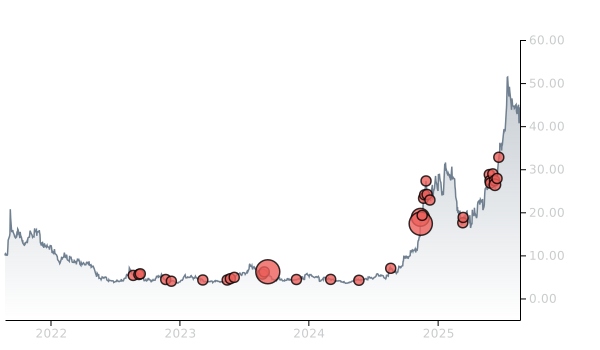
$RKLB insiders have traded $RKLB stock on the open market 126 times in the past 6 months. Of those trades, 0 have been purchases and 126 have been sales.
Here’s a breakdown of recent trading of $RKLB stock by insiders over the last 6 months:
- PETER BECK (CEO) has made 0 purchases and 25 sales selling 5,018,857 shares for an estimated $269,325,511.
- ADAM C. SPICE (Chief Financial Officer) has made 0 purchases and 17 sales selling 2,371,134 shares for an estimated $150,985,730.
- MATTHEW OCKO has made 0 purchases and 12 sales selling 1,873,097 shares for an estimated $90,280,094.
- FRANK KLEIN (Chief Operations Officer) has made 0 purchases and 21 sales selling 196,339 shares for an estimated $11,627,067.
- MERLINE SAINTIL has made 0 purchases and 9 sales selling 143,500 shares for an estimated $11,489,000.
- JON A OLSON has made 0 purchases and 20 sales selling 90,605 shares for an estimated $5,130,467.
- ARJUN KAMPANI (SVP General Counsel &) has made 0 purchases and 12 sales selling 79,770 shares for an estimated $3,583,635.
- NINA ARMAGNO has made 0 purchases and 9 sales selling 27,314 shares for an estimated $1,862,972.
- EDWARD H. FRANK sold 2,500 shares for an estimated $193,471
To track insider transactions, check out Quiver Quantitative's insider trading dashboard.
$RKLB Revenue
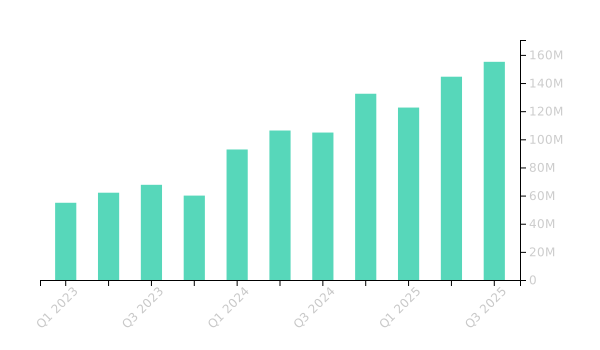
$RKLB had revenues of $155.1M in Q3 2025. This is an increase of 47.97% from the same period in the prior year.
You can track RKLB financials on Quiver Quantitative's RKLB stock page.
$RKLB Hedge Fund Activity
We have seen 500 institutional investors add shares of $RKLB stock to their portfolio, and 330 decrease their positions in their most recent quarter.
Here are some of the largest recent moves:
- VK SERVICES, LLC removed 8,323,617 shares (-100.0%) from their portfolio in Q4 2025, for an estimated $580,655,521
- BAILLIE GIFFORD & CO added 5,725,536 shares (+47.2%) to their portfolio in Q4 2025, for an estimated $399,413,391
- VANGUARD GROUP INC added 5,610,469 shares (+13.4%) to their portfolio in Q4 2025, for an estimated $391,386,317
- UBS AM, A DISTINCT BUSINESS UNIT OF UBS ASSET MANAGEMENT AMERICAS LLC removed 4,403,335 shares (-72.1%) from their portfolio in Q4 2025, for an estimated $307,176,649
- JPMORGAN CHASE & CO added 4,122,175 shares (+74.0%) to their portfolio in Q4 2025, for an estimated $287,562,928
- TIDAL INVESTMENTS LLC removed 3,749,041 shares (-97.3%) from their portfolio in Q4 2025, for an estimated $261,533,100
- MORGAN STANLEY removed 2,929,182 shares (-41.1%) from their portfolio in Q4 2025, for an estimated $204,339,736
To track hedge funds' stock portfolios, check out Quiver Quantitative's institutional holdings dashboard.
$RKLB Analyst Ratings
Wall Street analysts have issued reports on $RKLB in the last several months. We have seen 3 firms issue buy ratings on the stock, and 0 firms issue sell ratings.
Here are some recent analyst ratings:
- B of A Securities issued a "Buy" rating on 01/20/2026
- Morgan Stanley issued a "Overweight" rating on 01/16/2026
- Needham issued a "Buy" rating on 12/23/2025
To track analyst ratings and price targets for $RKLB, check out Quiver Quantitative's $RKLB forecast page.
$RKLB Price Targets
Multiple analysts have issued price targets for $RKLB recently. We have seen 7 analysts offer price targets for $RKLB in the last 6 months, with a median target of $85.0.
Here are some recent targets:
- Anthony Valentini from Goldman Sachs set a target price of $69.0 on 01/20/2026
- Ronald Epstein from B of A Securities set a target price of $120.0 on 01/20/2026
- Kristine Liwag from Morgan Stanley set a target price of $105.0 on 01/16/2026
- Ryan Koontz from Needham set a target price of $90.0 on 12/23/2025
- Erik Rasmussen from Stifel set a target price of $85.0 on 12/22/2025
- Michael Leshock from Keybanc set a target price of $75.0 on 10/17/2025
- Peter Arment from Baird set a target price of $83.0 on 10/16/2025
Full Release
LONG BEACH, Calif., Feb. 26, 2026 (GLOBE NEWSWIRE) -- Rocket Lab Corporation (Nasdaq: RKLB) (“Rocket Lab” or “the Company”), a global leader in launch services and space systems, today announced the introduction of advanced silicon solar arrays designed to power gigawatt-scale space-based data centers spanning kilometers in orbit.
Terrestrial-based data centers are power-constrained, land-intensive, and consume significant volumes of water for cooling. Space-based data centers are freed from these environmentally intensive and resource-heavy constraints by taking advantage of the abundant space in orbit, the cold space environment, and the limitless energy of the sun. Power is the gating factor to the scalability of data centers on orbit and Rocket Lab's silicon solar arrays deliver low cost per watt at industrial scale, enabling gigawatt-class power generation in space using mass-manufacturable, lightweight, and modular systems that can scale economically as orbital compute demand rises.
Space solar power explained: Solar cells capture energy from the sun to generate the electricity needed to power satellites on orbit. Typically, these cells have been made of gallium arsenide and germanium due to these materials’ ability to withstand the harsh radiation environment of space. Both are critical minerals for which supply is constrained by evolving geopolitical challenges. The stark reality is that the satellite industry is projected to grow seven times by 2035 , space-based data centers are on the horizon, and solar power supply chains are at risk of failing to keep up. A new solution is needed now, not years or decades into the future, and silicon is the answer.
Rocket Lab already boasts the world’s largest installed production capacity for gallium arsenide and germanium based solar arrays, and now the company has taken the future-proofing step of introducing silicon-based solar arrays to its production capabilities. Designed for constellation scale production, the arrays feature radiation hardened solar cell modules that are flexible and lightweight. This is crucial to supporting a variety of stowage and deployment methods tailored to any mission requirements. As the world’s only fully vertically integrated space power supplier, Rocket Lab already streamlines production and delivers cost efficiencies by offering solar cells, solar cell assemblies, and solar modules, solar panel substrates, complete solar panels and entire solar array wings, all integrated under one roof. Adding a space-qualified silicon solution to the Rocket Lab portfolio reduces reliance on critical mineral supply chains, mitigates potential vulnerabilities, and enables the ambitious and revolutionary space capabilities of the future including mega constellations and data centers on orbit.
Rocket Lab has taken the additional step of developing a hybrid solar array solution that incorporates both high efficiency and silicon solar cells, an approach that leverages the benefits of both solar cell technologies and enables adaptable and scalable solutions for any mission. When size, weight, power or performance are at a premium, high efficiency cells are enabling. When cost, schedule or constellation scale are required, silicon cells can meet the demand. When these factors must be traded off and balanced, hybrid arrays enable a combination of the two to deliver optimum performance at a compelling value.
“Space-based data centers are the next frontier in computing infrastructure, and reliable solar power systems will form the backbone of this revolution,” said Peter Beck, Rocket Lab Founder and CEO. “Rocket Lab's silicon solar arrays are designed to meet the unique challenges of operating in space while delivering the performance needed to support the growing demand for data processing and storage beyond Earth’s atmosphere.
Brad Clevenger, President of Rocket Lab USA, said: “We are at a pivotal moment in space power capability and the time for leadership is now. Space infrastructure is now as critical to the economy, national security, and daily life as roads, electricity, and running water. Introducing silicon solar arrays at constellation scale is Rocket Lab taking an essential and industry-leading step toward ensuring the ongoing security and growth of America’s space capabilities.”
This strategic decision builds on Rocket Lab’s semiconductor manufacturing expansion supported by the U.S. CHIPS and Science Act. In October 2025, Rocket Lab announced a $23.9 million CHIPS award to expand semiconductor production capabilities in Albuquerque, New Mexico, further bolstering its mission to deliver secure, high-performance, and domestically produced technologies.
+ Rocket Lab Media Contact
[email protected]
+ About Rocket Lab
Rocket Lab is a leading space company that provides launch services, spacecraft, payloads and satellite components serving commercial, government, and national security markets. Rocket Lab’s Electron rocket is the world’s most frequently launched orbital small rocket; its HASTE rocket provides hypersonic test launch capability for the U.S. government and allied nations; and its Neutron launch vehicle in development will unlock medium launch for constellation deployment, national security and exploration missions. Rocket Lab’s spacecraft and satellite components have enabled more than 1,700 missions spanning commercial, defense and national security missions including GPS, constellations, and exploration missions to the Moon, Mars, and Venus. Rocket Lab is a publicly listed company on the Nasdaq stock exchange (RKLB). Learn more at
www.rocketlabcorp.com
.
+ Forward Looking Statements
This press release contains forward-looking statements within the meaning of the Private Securities Litigation Reform Act of 1995. We intend such forward-looking statements to be covered by the safe harbor provisions for forward looking statements contained in Section 27A of the Securities Act of 1933, as amended (the “Securities Act”) and Section 21E of the Securities Exchange Act of 1934, as amended (the “Exchange Act”). All statements contained in this press release other than statements of historical fact, including, without limitation, statements regarding our launch and space systems operations, launch schedule and window, safe and repeatable access to space, Neutron development, operational expansion and business strategy are forward-looking statements. The words “believe,” “may,” “will,” “estimate,” “potential,” “continue,” “anticipate,” “intend,” “expect,” “strategy,” “future,” “could,” “would,” “project,” “plan,” “target,” and similar expressions are intended to identify forward-looking statements, though not all forward-looking statements use these words or expressions. These statements are neither promises nor guarantees, but involve known and unknown risks, uncertainties and other important factors that may cause our actual results, performance or achievements to be materially different from any future results, performance or achievements expressed or implied by the forward-looking statements, including but not limited to the factors, risks and uncertainties included in our Annual Report on Form 10-K for the fiscal year ended December 31, 2025, as such factors may be updated from time to time in our other filings with the Securities and Exchange Commission (the “SEC”), accessible on the SEC’s website at
www.sec.gov
and the Investor Relations section of our website at
www.rocketlabcorp.com
, which could cause our actual results to differ materially from those indicated by the forward-looking statements made in this press release. Any such forward-looking statements represent management’s estimates as of the date of this press release. While we may elect to update such forward-looking statements at some point in the future, we disclaim any obligation to do so, even if subsequent events cause our views to change.