Radware launches Agent Trust Management to enhance security for AI agents in multi-cloud environments, ensuring controlled interactions with applications.
Quiver AI Summary
Radware has announced the launch of Radware Agent Trust Management, a solution that enhances the security of AI agents interacting with applications in the evolving AI agent economy. As organizations increasingly deploy AI agents, they face challenges in managing access while protecting sensitive data. The new solution captures AI agents' declared intent, continuously assesses their actions for alignment with that intent, and allows organizations to control their activities beyond simple allow-or-block decisions. Radware’s approach helps companies maintain visibility and control over AI agent interactions, which is crucial in various industries, including e-commerce, finance, and travel. The solution is now part of Radware's Cloud Application Protection services, designed to address the unique governance and trust requirements of AI agents.
Potential Positives
- Introduction of Radware Agent Trust Management addresses the growing need for secure interactions between AI agents and applications, positioning Radware as a leader in this emerging segment.
- The solution enhances organizational control over AI agent activities, providing businesses with more refined governance compared to traditional allow-or-block models.
- Radware's analysis indicates that 77% of organizations are deploying AI agents, showcasing a significant market opportunity for Radware's new solution.
- Radware Agent Trust Management is available now, enhancing Radware’s existing cloud application protection services and demonstrating the company's commitment to innovative security solutions.
Potential Negatives
- While Radware introduces a new product, the press release highlights a significant lack of visibility regarding AI agents, with only 17.2% of organizations reporting full visibility. This suggests that there may be widespread challenges in the market that Radware's solutions alone may not address.
- The press release contains a lengthy list of potential risks and uncertainties that could impact the company's future performance, including intense competition, reliance on independent distributors, and risks associated with artificial intelligence technologies. This raises concerns about the company's market positioning and ability to navigate these challenges.
- Radware's emphasis on the need for better control over AI agents indicates a growing concern about security vulnerabilities, which could imply that existing solutions may not be adequate to protect organizations from emerging threats.
FAQ
What is Radware Agent Trust Management?
Radware Agent Trust Management is a solution for securely managing AI agents' interactions with applications in multi-cloud environments.
Why do organizations need AI agent management solutions?
Organizations must manage AI agents to prevent data breaches while harnessing the benefits of agent-driven interactions.
How does Radware ensure agent trust?
Radware assesses agent trust by capturing declared intent and continuously evaluating actions for consistency with that intent.
What capabilities does Radware Agent Trust Management provide?
It offers visibility into AI agent activity, multi-signal identification, continuous trust assessment, and permission-based governance.
Who can benefit from Radware's new solution?
Organizations in sectors like e-commerce, financial services, and travel can benefit from enhanced control over AI agent interactions.
Disclaimer: This is an AI-generated summary of a press release distributed by GlobeNewswire. The model used to summarize this release may make mistakes. See the full release here.
$RDWR Insider Trading Activity
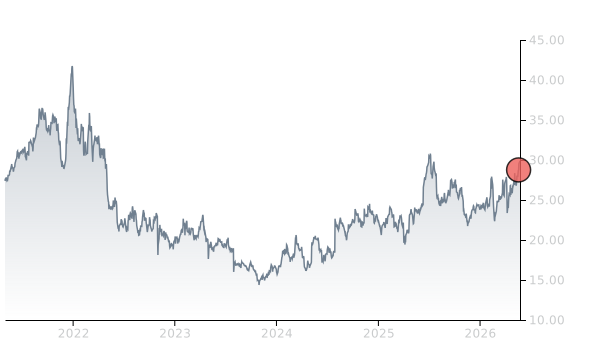
$RDWR insiders have traded $RDWR stock on the open market 6 times in the past 6 months. Of those trades, 1 have been purchases and 5 have been sales.
Here’s a breakdown of recent trading of $RDWR stock by insiders over the last 6 months:
- DAVID MELEH AVIV (Chief Technology Officer) sold 15,000 shares for an estimated $460,650
- GABRIEL MALKA (Chief Operating Officer) has made 0 purchases and 2 sales selling 13,500 shares for an estimated $405,000.
- RIVKAH GOLDRIECH (Chief People Officer) has made 0 purchases and 2 sales selling 2,125 shares for an estimated $64,562.
- GUY AVIDAN (Chief Financial Officer) purchased 2,000 shares for an estimated $50,420
To track insider transactions, check out Quiver Quantitative's insider trading dashboard. You can access data on insider stock transactions through the Quiver Quantitative API insider transaction endpoint.
$RDWR Hedge Fund Activity
We have seen 70 institutional investors add shares of $RDWR stock to their portfolio, and 64 decrease their positions in their most recent quarter.
Here are some of the largest recent moves:
- DEUTSCHE BANK AG\ removed 844,368 shares (-97.4%) from their portfolio in Q2 2026, for an estimated $26,057,196
- MORGAN STANLEY removed 641,645 shares (-21.0%) from their portfolio in Q2 2026, for an estimated $19,801,164
- ARTISAN PARTNERS LIMITED PARTNERSHIP removed 375,200 shares (-13.6%) from their portfolio in Q2 2026, for an estimated $11,578,672
- MAN GROUP PLC removed 324,896 shares (-86.5%) from their portfolio in Q2 2026, for an estimated $10,026,290
- PENSERRA CAPITAL MANAGEMENT LLC removed 223,133 shares (-7.6%) from their portfolio in Q2 2026, for an estimated $6,885,884
- FIRST TRUST ADVISORS LP removed 195,737 shares (-19.2%) from their portfolio in Q2 2026, for an estimated $6,040,443
- SUMMIT PARTNERS PUBLIC ASSET MANAGEMENT, LLC removed 195,000 shares (-100.0%) from their portfolio in Q2 2026, for an estimated $6,017,700
To track hedge funds' stock portfolios, check out Quiver Quantitative's institutional holdings dashboard. You can access data on hedge funds moves and 13F filings through the Quiver Quantitative API 13F endpoint.
Full Release
MAHWAH, N.J., Sept. 29, 2026 (GLOBE NEWSWIRE) -- Radware ® (NASDAQ: RDWR), a global leader in AI and application security and delivery solutions for multi-cloud environments, today introduced Radware Agent Trust Management , a new solution designed to help organizations participate more securely in the emerging AI agent economy by facilitating how trusted AI agents interact with their applications.
As AI agent traffic grows, organizations face a new challenge: blocking agents can result in lost business, while allowing them unrestricted access can expose applications, sensitive data and business processes to new risks. Radware Agent Trust Management addresses this challenge by directly capturing their declared intent, continuously assessing whether their actions remain consistent with that intent and controlling what they are permitted to do. This is designed to move businesses beyond broad allow-or-block decisions and more securely capture the value of agent-driven interactions.
“AI agents are fundamentally changing how applications are accessed and used,” said David Aviv, chief technology officer at Radware. “Organizations need to be able to embrace this shift while maintaining visibility and control over agent activity. Agent Trust Management enables them to establish trust and control what agents can do, so they can participate in the agent economy while protecting critical applications, business processes and data.”
According to Radware’s H1 Global Threat Analysis Report, 77% of organizations are actively deploying or implementing AI agents, yet only 17.2% report full visibility into the AI agents operating within their environments. AI agents are increasingly interacting with applications across industries and performing tasks that can involve sensitive data, transactions and critical business processes. In e-commerce and retail, agents can research products and complete transactions; in financial services, they can interact with applications involving sensitive information and financial activities; and in travel and hospitality, they can search, make bookings and interact with inventory, pricing and loyalty programs. Radware Agent Trust Management is designed to assist organizations in supporting these emerging use cases while maintaining greater visibility and control over how AI agents interact with their applications.
Identifying an AI agent alone does not establish whether it can be trusted. Even a verified agent can have malicious intent, deviate from its stated purpose or attempt harmful actions. Radware Agent Trust Management is designed to go beyond relying solely on identity and observed behavior by also directly capturing an agent’s declared intent through active conversation and continuously evaluating whether its actions remain consistent with that intent. This helps organizations distinguish legitimate agent interactions from potentially harmful activity.
Key capabilities of Radware Agent Trust Management include:
- Understand AI agent activity and intent. Prompt-aware, session-level visibility provides insight into an agent’s identity, declared intent, actions and navigation path, supporting security teams in investigating activity and making informed policy decisions.
- Identify agents across the ecosystem. Multi-signal identification combines request headers, client-side behavioral signals and direct agent responses to identify and classify both Web Bot Auth-compliant and non-compliant agents. Standards-compliant agents are cryptographically verified.
- Continuously assess whether agents can be trusted. Radware captures declared intent through active conversation and uses AI-based behavioral analysis, prompt profiling and anomaly detection to assess whether an agent’s activity remains consistent with that intent. Trust assessments evolve as new signals emerge.
- Control what agents are permitted to do. Permission-based governance is designed to enable organizations to control access to specific workflows, providing more granular options beyond broad allow-or-block decisions. For example, an organization can permit an agent to browse while restricting sensitive actions such as login or checkout.
Radware Agent Trust Management is available now as part of Radware Cloud Application Protection services, extending Radware’s bot management capabilities to address the distinct visibility, trust assessment and governance requirements of AI agents.
For more information, visit Radware Agent Trust Management . Additional product materials, including the solution brief, are available from Radware.
About Radware
Radware ® (NASDAQ: RDWR) is a global leader in application and AI security and delivery solutions for multi-cloud environments. The company’s cloud application, infrastructure, API and AI security solutions use AI-driven algorithms for precise, behavior-based, real-time protection against sophisticated web, application and DDoS attacks, API abuse, business logic threats and malicious bots. Radware delivers end-to-end API security, including discovery, posture management, testing and runtime protection, along with advanced protection for AI agents and models. Enterprises and carriers worldwide rely on Radware to address evolving cyberthreats, protect their brands and business operations, and reduce costs. For more information, please visit the Radware website.
Radware encourages you to join our community and follow us on Facebook , LinkedIn , the Radware Blog , X and YouTube . ©2026 Radware Ltd. All rights reserved. Any Radware products and solutions mentioned in this press release are protected by trademarks, patents and pending patent applications of Radware in the U.S. and other countries. For more details, please see https://www.radware.com/LegalNotice/ . All other trademarks and names are property of their respective owners.
Radware believes the information in this document is accurate in all material respects as of its publication date. However, the information is provided without any express, statutory or implied warranties and is subject to change without notice. The contents of any website or hyperlinks mentioned in this press release are for informational purposes and are not part of this press release.
Safe Harbor Statement
This press release contains “forward-looking statements” within the meaning of the Private Securities Litigation Reform Act of 1995 and other U.S. securities laws. Any statements that are not statements of historical fact, including statements about Radware’s plans, objectives, expectations, beliefs, projections, future financial performance, business strategies, market opportunities and developments in its industry, are forward-looking statements. In some cases, forward-looking statements can be identified by words such as “believe,” “expect,” “anticipate,” “intend,” “estimate,” “plan,” “project,” “forecast” and “target,” and similar expressions, as well as future or conditional verbs such as “will,” “should,” “would,” “may” and “could.” For example, statements in this press release about the capabilities, benefits, availability and intended use of Radware Agent Trust Management and related competitive differentiation and market positioning are forward-looking statements.
Because such statements deal with future events, they are subject to various risks and uncertainties that could cause actual results to differ materially from those expressed or implied. Factors that could cause or contribute to such differences include global market and economic conditions; dependence on independent distributors; supply-chain disruptions; reliance on a limited number of vendors; the ability to attract and retain qualified personnel; intense competition; the ability to develop and enhance solutions; defects, vulnerabilities or failures in products and services; risks associated with artificial intelligence technologies and evolving regulatory frameworks; information-technology failures or security breaches; hosting or cloud-service disruptions; interoperability risks; global operations; and geopolitical risks, including instability in the Middle East and Israel.
These factors are not exhaustive. For a more detailed description of risks and uncertainties affecting Radware, please refer to Radware’s Annual Report on Form 20-F and other reports filed with or furnished to the U.S. Securities and Exchange Commission from time to time. Forward-looking statements speak only as of the date on which they are made, and, except as required by applicable law, Radware undertakes no obligation to update or revise them. Radware’s public filings are available from the SEC’s website or on Radware’s website.
Media Contact:
Gina Sorice
[email protected]
Investor Contact:
Yisca Erez
[email protected]