

Radware announces AI Xploit Shield, a service providing rapid protection against newly discovered application vulnerabilities.
Quiver AI Summary
Radware announced the launch of AI Xploit Shield, a service designed to protect applications and APIs from newly discovered vulnerabilities in real time. As AI models like Mythos enhance the speed of vulnerability discovery, organizations are struggling to keep up with threats due to the shrinking window between vulnerability identification and exploitation. AI Xploit Shield addresses this gap by automating the creation of custom protections for organizations, allowing them to block attacks without altering their existing software. This service aims to provide rapid protection while patches are being developed and tested, thus reducing operational risks and ensuring consistent security across various environments. Radware will also host a webinar to showcase how AI Xploit Shield can help mitigate exploit risks during the period between vulnerability discovery and patch deployment.
Potential Positives
- Radware has launched AI Xploit Shield, a new innovative service that addresses the growing threat of application and API exploitation, positioning the company as a leader in proactive cybersecurity solutions.
- The service offers automated, tailored protections for organizations, allowing them to defend against new vulnerabilities in near real-time, which enhances overall cybersecurity resilience.
- AI Xploit Shield helps reduce operational risks by providing security teams with the necessary time to validate and deploy fixes, thus minimizing rushed production changes in high-pressure situations.
- By expanding Radware’s AI-powered cloud security platform, the launch strengthens the company’s positioning in a rapidly evolving market and showcases its commitment to leveraging AI for advanced security solutions.
Potential Negatives
- The press release highlights the urgent security challenges organizations face due to the rapid increase in newly discovered vulnerabilities, implying that existing solutions may not be sufficient, which could raise concerns about Radware's current offerings.
- The mention of various geopolitical tensions and economic conditions affecting Radware's business indicates vulnerability to external factors that could impact future performance negatively.
- The statement about Radware’s previous net losses and the possibility of incurring future losses suggests financial instability that could concern investors and stakeholders.
FAQ
What is AI Xploit Shield by Radware?
AI Xploit Shield is a new service that provides rapid protection for applications and APIs against newly discovered vulnerabilities.
How does AI Xploit Shield enhance application security?
The service generates tailored protections automatically, closing the gap between vulnerability discovery and patch deployment.
Why is traditional patching insufficient for vulnerability management?
Traditional patching can be delayed by testing requirements and system dependencies, leaving organizations exposed to exploitation.
What environments does AI Xploit Shield support?
AI Xploit Shield delivers consistent protection across cloud, hybrid, and on-premises environments.
How can organizations learn more about AI Xploit Shield?
Organizations can register for a webinar that demonstrates how to use AI Xploit Shield to reduce exploit risk effectively.
Disclaimer: This is an AI-generated summary of a press release distributed by GlobeNewswire. The model used to summarize this release may make mistakes. See the full release here.
$RDWR Insider Trading Activity
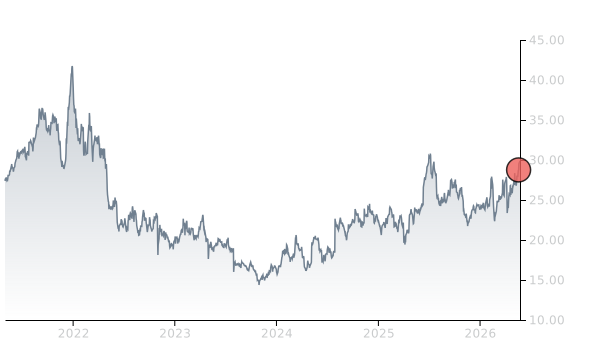
$RDWR insiders have traded $RDWR stock on the open market 2 times in the past 6 months. Of those trades, 0 have been purchases and 2 have been sales.
Here’s a breakdown of recent trading of $RDWR stock by insiders over the last 6 months:
- GABRIEL MALKA (Chief Operating Officer) sold 7,000 shares for an estimated $210,000
- RIVKAH GOLDRIECH (Chief People Officer) sold 1,375 shares for an estimated $40,562
To track insider transactions, check out Quiver Quantitative's insider trading dashboard. You can access data on insider stock transactions through the Quiver Quantitative API insider transaction endpoint.
$RDWR Hedge Fund Activity
We have seen 50 institutional investors add shares of $RDWR stock to their portfolio, and 77 decrease their positions in their most recent quarter.
Here are some of the largest recent moves:
- DEUTSCHE BANK AG\ added 564,048 shares (+186.5%) to their portfolio in Q1 2026, for an estimated $14,845,743
- FIRST TRUST ADVISORS LP removed 541,726 shares (-34.7%) from their portfolio in Q1 2026, for an estimated $14,258,228
- NEUBERGER BERMAN GROUP LLC added 502,852 shares (+47.2%) to their portfolio in Q1 2026, for an estimated $13,235,064
- MORGAN STANLEY added 435,908 shares (+16.6%) to their portfolio in Q1 2026, for an estimated $11,473,098
- POLAR CAPITAL HOLDINGS PLC added 302,828 shares (+inf%) to their portfolio in Q1 2026, for an estimated $7,970,432
- RENAISSANCE TECHNOLOGIES LLC removed 237,795 shares (-14.6%) from their portfolio in Q1 2026, for an estimated $6,258,764
- ARTISAN PARTNERS LIMITED PARTNERSHIP removed 219,498 shares (-7.4%) from their portfolio in Q1 2026, for an estimated $5,777,187
To track hedge funds' stock portfolios, check out Quiver Quantitative's institutional holdings dashboard. You can access data on hedge funds moves and 13F filings through the Quiver Quantitative API 13F endpoint.
Full Release
MAHWAH, N.J., June 16, 2026 (GLOBE NEWSWIRE) -- Radware ® (NASDAQ: RDWR), a global leader in application security and delivery solutions for multi-cloud environments, today announced AI Xploit Shield , a new service that provides organizations with rapid protection for their applications and APIs from exploitation of newly discovered vulnerabilities. As emerging frontier AI models like Mythos from Anthropic accelerate vulnerability discovery, organizations face a growing challenge: the volume of newly discovered vulnerabilities is dramatically accelerating while the window between vulnerability identification and exploitation is shrinking. Together, these trends are widening the gap between discovery and remediation and making it increasingly difficult for organizations to keep pace with emerging threats.
"The challenge is no longer simply finding vulnerabilities. It's protecting applications before those vulnerabilities can be exploited," said Gabi Malka, chief operating officer, Radware. "Organizations cannot depend on patching alone. They need a way to quickly translate vulnerability intelligence into protection while remediation efforts are underway."
While patching remains essential, testing requirements, legacy systems, concerns about production downtime following software upgrades, and third-party dependencies can delay remediation, leaving organizations exposed during the gap between vulnerability discovery and patch deployment. AI Xploit Shield closes that gap by automatically generating protections tailored to each organization's applications, APIs, exposure and environment. Delivered through virtual patching, these protections help block exploitation attempts without modifying the underlying application or software. Unlike traditional virtual patching approaches that rely on generic signatures or manually created rules, AI Xploit Shield leverages AI models to generate, test and deploy tailored protections at scale and in near real time.
Radware AI Xploit Shield is designed to:
• Enable automated generation and deployment of customer-specific shields for newly discovered vulnerabilities at scale.
• Provide rapid protection for web applications and APIs while software patches are being tested and deployed.
• Reduce operational risk by giving security teams time to validate and deploy fixes without rushing emergency production changes.
• Deliver consistent protection across cloud, hybrid, and on-premises environments.
AI Xploit Shield expands Radware’s AI-powered cloud security platform. Radware’s cloud security platform leverages AI to secure web applications and APIs and provides security for AI agents and AI-powered applications. AI Xploit Shield is purpose-built to protect web applications and APIs from exploitation of newly discovered vulnerabilities, helping organizations reduce exploit risk while remediation efforts are underway.
Radware will host a webinar demonstrating how organizations can use AI Xploit Shield to reduce exploit risk during the period between vulnerability discovery and patch deployment. Register for: The Mythos Effect: Closing the AI-Driven Exposure Window .
For more information about Radware AI Xploit Shield, visit here .
About Radware
Radware® (NASDAQ: RDWR) is a global leader in application security and delivery solutions for multi-cloud environments. The company’s cloud application, infrastructure, API, and AI security solutions use AI-driven algorithms for precise, behavior-based, real-time protection against sophisticated web, application, and DDoS attacks, API abuse, business logic threats, and malicious bots. Radware delivers end-to-end API security, including discovery, posture management, testing, and runtime protection, along with advanced protection for AI agents and models. Enterprises and carriers worldwide rely on Radware to address evolving cyberthreats, protect their brands and business operations, and reduce costs. For more information, please visit the Radware website.
Radware encourages you to join our community and follow us on: Facebook , LinkedIn , Radware Blog , X , and YouTube .
©2026 Radware Ltd. All rights reserved. Any Radware products and solutions mentioned in this press release are protected by trademarks, patents, and pending patent applications of Radware in the U.S. and other countries. For more details, please see: https://www.radware.com/LegalNotice/ . All other trademarks and names are property of their respective owners.
Radware believes the information in this document is accurate in all material respects as of its publication date. However, the information is provided without any express, statutory, or implied warranties and is subject to change without notice.
The contents of any website or hyperlinks mentioned in this press release are for informational purposes and the contents thereof are not part of this press release.
Safe Harbor Statement
This press release includes “forward-looking statements” within the meaning of the Private Securities Litigation Reform Act of 1995. Any statements made herein that are not statements of historical fact, including statements about Radware’s plans, outlook, beliefs, or opinions, are forward-looking statements. Generally, forward-looking statements may be identified by words such as “believes,” “expects,” “anticipates,” “intends,” “estimates,” “plans,” and similar expressions or future or conditional verbs such as “will,” “should,” “would,” “may,” and “could.” For example, when we say in this press release that AI Xploit Shield is designed to help organizations reduce exploit risk during the period between vulnerability discovery and patch deployment, we are using forward-looking statements. Because such statements deal with future events, they are subject to various risks and uncertainties, and actual results, expressed or implied by such forward-looking statements, could differ materially from Radware’s current forecasts and estimates. Factors that could cause or contribute to such differences include, but are not limited to: the impact of global economic conditions, including as a result of the state of war declared in Israel in October 2023 and instability in the Middle East, the war in Ukraine, tensions between China and Taiwan, financial and credit market fluctuations (including elevated interest rates), impacts from tariffs or other trade restrictions, inflation, and the potential for regional or global recessions; our dependence on independent distributors to sell our products; our ability to manage our anticipated growth effectively; our business may be affected by sanctions, export controls, and similar measures, targeting Russia and other countries and territories, as well as other responses to Russia’s military conflict in Ukraine, including indefinite suspension of operations in Russia and dealings with Russian entities by many multi-national businesses across a variety of industries; the ability of vendors to provide our hardware platforms and components for the manufacture of our products; our ability to attract, train, and retain highly qualified personnel; intense competition in the market for cybersecurity and application delivery solutions and in our industry in general, and changes in the competitive landscape; our ability to develop new solutions and enhance existing solutions; the impact to our reputation and business in the event of real or perceived shortcomings, defects, or vulnerabilities in our solutions, if our end-users experience security breaches, or if our information technology systems and data, or those of our service providers and other contractors, are compromised by cyber-attackers or other malicious actors or by a critical system failure; our use of AI technologies that present regulatory, litigation, and reputational risks; risks related to the fact that our products must interoperate with operating systems, software applications and hardware that are developed by others; outages, interruptions, or delays in hosting services; the risks associated with our global operations, such as difficulties and costs of staffing and managing foreign operations, compliance costs arising from host country laws or regulations, partial or total expropriation, export duties and quotas, local tax exposure, economic or political instability, including as a result of insurrection, war, natural disasters, and major environmental, climate, or public health concerns; our net losses in the past and the possibility that we may incur losses in the future; a slowdown in the growth of the cybersecurity and application delivery solutions market or in the development of the market for our cloud-based solutions; long sales cycles for our solutions; risks and uncertainties relating to acquisitions or other investments; risks associated with doing business in countries with a history of corruption or with foreign governments; changes in foreign currency exchange rates; risks associated with undetected defects or errors in our products; our ability to protect our proprietary technology; intellectual property infringement claims made by third parties; laws, regulations, and industry standards affecting our business; compliance with open source and third-party licenses; complications with the design or implementation of our new enterprise resource planning (“ERP”) system; our reliance on information technology systems; our ESG disclosures and initiatives; and other factors and risks over which we may have little or no control. This list is intended to identify only certain of the principal factors that could cause actual results to differ. For a more detailed description of the risks and uncertainties affecting Radware, refer to Radware’s Annual Report on Form 20-F, filed with the Securities and Exchange Commission (SEC), and the other risk factors discussed from time to time by Radware in reports filed with, or furnished to, the SEC. Forward-looking statements speak only as of the date on which they are made and, except as required by applicable law, Radware undertakes no commitment to revise or update any forward-looking statement in order to reflect events or circumstances after the date any such statement is made. Radware’s public filings are available from the SEC’s website at
www.sec.gov
or may be obtained on Radware’s website at
www.radware.com
.
Media Contact:
Gina Sorice
Radware
[email protected]