

Radware's survey reveals organizations are rapidly adopting AI but lag in implementing necessary security measures to protect it.
Quiver AI Summary
Radware has published its 2026 Cyber Survey, revealing that while organizations are rapidly adopting AI technologies, they are lagging in implementing adequate security measures to protect these environments. Conducted by Osterman Research, the survey shows that a significant majority of organizations (83%) are utilizing generative AI or large language models, yet only 17% have complete visibility over AI-driven processes. With the rise of AI, threat actors are increasingly exploiting vulnerabilities, leading to a rise in application-layer attacks, where 71% of organizations report monthly DDoS incidents. The findings stress the urgent need for enhanced visibility and coordinated security across AI, applications, and APIs to address sophisticated threats effectively. Radware plans to discuss these findings in a webinar on July 30.
Potential Positives
- Radware highlights a significant market trend, indicating that 83% of organizations are widely adopting generative AI and large language model functionality, presenting a substantial market opportunity for its security solutions.
- The press release emphasizes the increasing business impact of application-layer and API-targeted DDoS attacks, indicating a growing demand for Radware's cybersecurity solutions to address these issues.
- Radware will host a webinar to discuss the survey's findings, providing a platform to engage with potential clients and showcase its thought leadership in application and AI security.
Potential Negatives
- The survey indicates that 83% of organizations are adopting generative AI faster than they can secure it, highlighting a potential vulnerability in enterprise security that could reflect negatively on Radware's credibility in providing solutions.
- Only 17% of organizations have full visibility into AI agents or processes, which may suggest a lack of comprehensive solutions from Radware amidst rising AI security threats.
- 71% of organizations experience application-layer or API-targeted DDoS attacks monthly or more often, indicating a critical and widespread security challenge that Radware needs to address effectively to maintain client trust.
FAQ
What does the 2026 Cyber Survey cover?
The survey addresses new trends in AI, API, and application security, highlighting challenges and adoption rates among organizations.
How fast are organizations adopting AI according to the survey?
The survey reveals that 83% of organizations are widely using generative AI or LLM functionality.
What security challenges do AI technologies present?
AI introduces new security challenges, including difficulties in visibility and governance, as well as threats from AI-driven attacks.
What is the financial impact of application-layer DDoS attacks?
The average cost of downtime from application-layer DDoS attacks rose to approximately $451,800 per hour.
When is Radware's webinar about the survey findings?
Radware will host the webinar on July 30 at 11:00 AM EDT to discuss the survey's key findings.
Disclaimer: This is an AI-generated summary of a press release distributed by GlobeNewswire. The model used to summarize this release may make mistakes. See the full release here.
$RDWR Insider Trading Activity
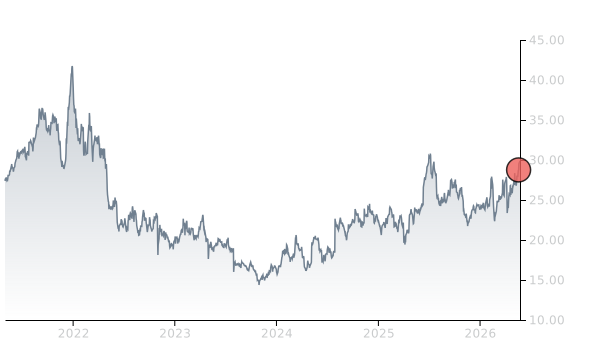
$RDWR insiders have traded $RDWR stock on the open market 3 times in the past 6 months. Of those trades, 0 have been purchases and 3 have been sales.
Here’s a breakdown of recent trading of $RDWR stock by insiders over the last 6 months:
- GABRIEL MALKA (Chief Operating Officer) sold 7,000 shares for an estimated $210,000
- RIVKAH GOLDRIECH (Chief People Officer) has made 0 purchases and 2 sales selling 2,125 shares for an estimated $64,562.
To track insider transactions, check out Quiver Quantitative's insider trading dashboard. You can access data on insider stock transactions through the Quiver Quantitative API insider transaction endpoint.
$RDWR Hedge Fund Activity
We have seen 46 institutional investors add shares of $RDWR stock to their portfolio, and 51 decrease their positions in their most recent quarter.
Here are some of the largest recent moves:
- DEUTSCHE BANK AG\ added 564,048 shares (+186.5%) to their portfolio in Q1 2026, for an estimated $14,845,743
- FIRST TRUST ADVISORS LP removed 541,726 shares (-34.7%) from their portfolio in Q1 2026, for an estimated $14,258,228
- NEUBERGER BERMAN GROUP LLC added 502,852 shares (+47.2%) to their portfolio in Q1 2026, for an estimated $13,235,064
- MORGAN STANLEY added 435,908 shares (+16.6%) to their portfolio in Q1 2026, for an estimated $11,473,098
- POLAR CAPITAL HOLDINGS PLC added 302,828 shares (+inf%) to their portfolio in Q1 2026, for an estimated $7,970,432
- RENAISSANCE TECHNOLOGIES LLC removed 237,795 shares (-14.6%) from their portfolio in Q1 2026, for an estimated $6,258,764
- ARTISAN PARTNERS LIMITED PARTNERSHIP removed 219,498 shares (-7.4%) from their portfolio in Q1 2026, for an estimated $5,777,187
To track hedge funds' stock portfolios, check out Quiver Quantitative's institutional holdings dashboard. You can access data on hedge funds moves and 13F filings through the Quiver Quantitative API 13F endpoint.
Full Release
MAHWAH, N.J., July 21, 2026 (GLOBE NEWSWIRE) -- Radware ® (NASDAQ: RDWR), a global leader in AI and application security and delivery solutions for multi-cloud environments, today released its 2026 Cyber Survey: New Trends in AI, API and Application Security . Based on a global survey conducted by Osterman Research on behalf of Radware, the survey found that organizations are adopting AI faster than they are implementing the security controls needed to protect their environments.
Security professionals are accustomed to security models aligned with traditional layers of the technology environment, including the network, application and data layers. The emerging AI layer presents a new set of challenges. As enterprises expand their use of generative AI, large language models (LLMs), AI agents and autonomous workflows, the survey indicates that threat actors are using AI to discover vulnerabilities, evade defenses and accelerate attacks. The survey found many organizations lack the visibility and governance needed to effectively secure AI, applications and APIs.
"The emerging AI layer presents a new set of security challenges that may not be addressed with isolated point solutions," said Connie Stack, chief growth officer, Radware. "Organizations need visibility across AI, applications and APIs to identify and respond to emerging threats faster."
Among the survey's key findings:
- Organizations are deploying AI faster than they can protect it. 83% of organizations are making widespread use of GenAI or LLM functionality, and 96% expect to implement AI agents or autonomous workflows within 12 months. Yet only 17% have full visibility into AI agents or AI-driven processes.
- AI traffic is creating a new access-control challenge. Only 14% of organizations have full visibility into AI crawler traffic, while 76% have experienced a negative impact from AI crawler traffic or AI agents.
- Application development continues to outpace API security. Nearly half (48%) of organizations update APIs for production use daily or more frequently. Yet only 19% have a fully automated and continuously updated API inventory, and just 24% conduct comprehensive API security testing across the full lifecycle.
- The business impact of application attacks continues to grow. 71% of organizations experience application-layer or API-targeted DDoS attacks monthly or more often. The average cost of downtime from an application-layer DDoS attack increased 23% year over year to $7,530 per minute, or approximately $451,800 per hour.
-
Security operations are not moving fast enough.
Only 21% of organizations report the highest level of readiness to manage application security incidents, while the average resolution time for significant API, bot or DDoS-related incidents is 2.8 hours.
The survey’s findings underscore the growing need for organizations to strengthen visibility, governance and coordinated security across AI, applications and APIs as they prepare for increasingly sophisticated AI-driven threats.
The 2026 Cyber Survey: New Trends in AI, API and Application Security is based on research conducted by Osterman Research among 377 organizations worldwide. Download the survey here .
Webinar
Radware will also host a webinar on July 30 at 11:00 AM EDT, highlighting the survey's key findings, emerging trends and recommendations for strengthening AI, application and API security.
Register for the webinar here .
About Radware
Radware ® (NASDAQ: RDWR) is a global leader in application security and delivery solutions for multi-cloud environments. The company’s cloud application, infrastructure, API, and AI security solutions use AI-driven algorithms for precise, behavior-based, real-time protection against sophisticated web, application, and DDoS attacks, API abuse, business logic threats, and malicious bots. Radware delivers end-to-end API security, including discovery, posture management, testing, and runtime protection, along with advanced protection for AI agents and models. Enterprises and carriers worldwide rely on Radware to address evolving cyberthreats, protect their brands and business operations, and reduce costs. For more information, please visit the Radware website.
Radware encourages you to join our community and follow us on: Facebook , LinkedIn , Radware Blog , X , and YouTube .
©2026 Radware Ltd. All rights reserved. Any Radware products and solutions mentioned in this press release are protected by trademarks, patents, and pending patent applications of Radware in the U.S. and other countries. For more details, please see: https://www.radware.com/LegalNotice/ . All other trademarks and names are property of their respective owners.
Radware believes the information in this document is accurate in all material respects as of its publication date. However, the information is provided without any express, statutory, or implied warranties and is subject to change without notice.
The contents of any website or hyperlinks mentioned in this press release are for informational purposes and the contents thereof are not part of this press release.
Safe Harbor Statement
This press release contains “forward-looking statements” within the meaning of the Private Securities Litigation Reform Act of 1995 and other U.S. securities laws. Any forward-looking statements made herein that are not statements of historical fact, including statements about Radware’s plans, objectives, expectations, beliefs, projections, future financial performance, business strategies, market opportunities, and developments in our industry, are forward-looking statements. In some cases, forward-looking statements can be identified by words such as “believe,” “expect,” “anticipate,” “intend,” “estimate,” “plan,” “project,” “forecast,” “target,” and similar expressions, as well as future or conditional verbs such as “will,” “should,” “would,” “may,” and “could.” For example, when we say in this press release that organizations are expected to implement AI agents or autonomous workflows within 12 months, or that the need for coordinated security across AI, applications and APIs is expected to grow, we are using forward-looking statements.
Because such statements deal with future events, they are subject to various risks and uncertainties that could cause actual results to differ materially from those expressed or implied in such forward-looking statements. Factors that could cause or contribute to such differences include, but are not limited to: the impact of global market and economic conditions; our dependence on independent distributors; disruptions in our supply chain, including shortages of components or manufacturing capacity; our reliance on a limited number of vendors; our ability to attract, train and retain qualified personnel; intense competition in the cybersecurity and application delivery markets; our ability to develop new solutions and enhance existing solutions; risks related to defects, vulnerabilities or failures in our products or services, including cybersecurity incidents affecting our systems or those of our customers; risks associated with the use of artificial intelligence technologies, including evolving regulatory frameworks, litigation exposure and reputational considerations; risks related to our information technology systems, including failures, disruptions or security breaches; outages, interruptions, or delays in hosting or cloud-based services; risks related to the interoperability of our products; risks associated with our global operations; and geopolitical risks, including instability in the Middle East and Israel.
These factors are not exhaustive. For a more detailed description of the risks and uncertainties affecting Radware, please refer to Radware’s Annual Report on Form 20-F and other reports filed with or furnished to the Securities and Exchange Commission (SEC) from time to time.
Forward-looking statements speak only as of the date on which they are made, and, except as required by applicable law, Radware undertakes no obligation to update or revise any forward-looking statements to reflect events or circumstances after the date of such statements. Radware’s public filings are available from the SEC’s website at www.sec.gov or on Radware’s website at www.radware.com .
Media Contact:
Gina Sorice
Radware
[email protected]