

Nasdaq Verafin's report reveals a $4.4 trillion global financial crime crisis, driven by technological advancements and private sector collaboration.
Quiver AI Summary
Nasdaq Verafin has published its 2026 Global Financial Crime Report, revealing that illicit financial activities have surged by $1.3 trillion since 2023, totaling an estimated $4.4 trillion globally. This increase in financial crime, driven by technological advancements and the misuse of AI, has led to significant losses, including $579.4 billion from fraud scams and bank fraud. In response, Nasdaq Verafin is pledging to enhance collaboration within the private sector to combat financial crime, in partnership with the UN Office on Drugs and Crime. The report highlights the urgent need for collective action among financial institutions and other sectors to address the growing complexity of financial crime and improve defenses against these escalating threats. The company will initiate this collaboration with a summit in October 2026, focusing on actionable strategies.
Potential Positives
- Nasdaq Verafin's release of the 2026 Global Financial Crime Report highlights their leadership in financial crime management, showcasing their commitment to addressing the rising threats of fraud and scams.
- The company's pledge to collaborate with the United Nations Office on Drugs and Crime signifies an important step towards mobilizing collective action in the private sector to combat financial crime.
- More than 2,750 financial institutions utilize Nasdaq Verafin's solutions, indicating a strong market presence and trust in their technology for fraud detection and management.
- The report's comprehensive insights, based on proprietary data and feedback from financial crime professionals, position Nasdaq Verafin as a thought leader in the industry, enhancing their credibility and visibility.
Potential Negatives
- The report highlights an alarming surge in financial crime, with losses from fraud scams totaling $579.4 billion globally, suggesting that the company is operating in an increasingly dangerous environment that could undermine its efforts and reputation.
- 90% of financial crime professionals surveyed reported an increase in AI-driven attacks, indicating that the tools and technologies Nasdaq Verafin employs may be less effective than anticipated against modern threats.
- The mention of a full-blown financial crime crisis raises concerns about the efficacy of existing financial crime management solutions, possibly impacting investor confidence in the company's offerings.
FAQ
What is the main focus of the 2026 Global Financial Crime Report?
The report analyzes the scope and scale of financial crime, especially the rise of fraud losses and criminal networks leveraging technology.
How much did global financial crime activity increase since 2023?
Illicit financial activity surged by $1.3 trillion, reaching an estimated total of $4.4 trillion worldwide.
What role is AI playing in financial crime?
Criminal networks are using AI to enhance scam tactics and launch sophisticated attacks, significantly increasing fraud losses.
How is Nasdaq Verafin combating financial crime?
Nasdaq Verafin is pledging to support UNODC efforts through private sector collaboration and hosting summits to address emerging threats.
What resources does Nasdaq Verafin provide to financial institutions?
Nasdaq Verafin offers technology solutions for Fraud Detection, AML/CFT Compliance, Customer Management, and Information Sharing, used by over 2,750 institutions.
Disclaimer: This is an AI-generated summary of a press release distributed by GlobeNewswire. The model used to summarize this release may make mistakes. See the full release here.
$NDAQ Insider Trading Activity
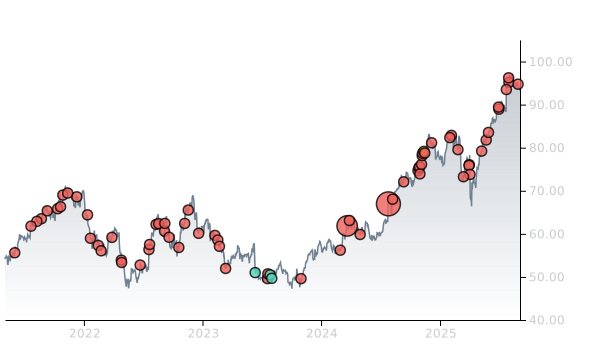
$NDAQ insiders have traded $NDAQ stock on the open market 5 times in the past 6 months. Of those trades, 1 have been purchases and 4 have been sales.
Here’s a breakdown of recent trading of $NDAQ stock by insiders over the last 6 months:
- AB INVESTOR purchased 200,000 shares for an estimated $15,835,040
- JOHN ZECCA (EVP, Global CLO) sold 4,500 shares for an estimated $450,045
- BRYAN EVERARD SMITH (EVP, CPO) sold 4,633 shares for an estimated $419,610
- JEREMY SKULE (EVP, CSO) has made 0 purchases and 2 sales selling 4,210 shares for an estimated $370,416.
To track insider transactions, check out Quiver Quantitative's insider trading dashboard.
$NDAQ Revenue
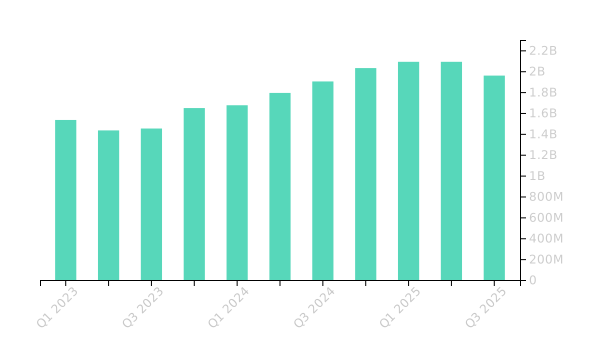
$NDAQ had revenues of $2.1B in Q4 2025. This is an increase of 4.63% from the same period in the prior year.
You can track NDAQ financials on Quiver Quantitative's NDAQ stock page.
$NDAQ Congressional Stock Trading
Members of Congress have traded $NDAQ stock 3 times in the past 6 months. Of those trades, 3 have been purchases and 0 have been sales.
Here’s a breakdown of recent trading of $NDAQ stock by members of Congress over the last 6 months:
- REPRESENTATIVE APRIL MCCLAIN DELANEY has traded it 3 times. They made 3 purchases worth up to $115,000 on 10/22, 10/09, 09/19 and 0 sales.
To track congressional stock trading, check out Quiver Quantitative's congressional trading dashboard.
$NDAQ Hedge Fund Activity
We have seen 547 institutional investors add shares of $NDAQ stock to their portfolio, and 524 decrease their positions in their most recent quarter.
Here are some of the largest recent moves:
- UBS AM, A DISTINCT BUSINESS UNIT OF UBS ASSET MANAGEMENT AMERICAS LLC removed 10,418,342 shares (-73.8%) from their portfolio in Q4 2025, for an estimated $1,011,933,558
- MORGAN STANLEY added 3,567,843 shares (+62.6%) to their portfolio in Q4 2025, for an estimated $346,544,590
- NUVEEN, LLC added 2,736,322 shares (+82.0%) to their portfolio in Q4 2025, for an estimated $265,778,955
- HARRIS ASSOCIATES L P added 2,716,280 shares (+46.0%) to their portfolio in Q4 2025, for an estimated $263,832,276
- WINSLOW CAPITAL MANAGEMENT, LLC added 2,568,537 shares (+inf%) to their portfolio in Q4 2025, for an estimated $249,481,998
- WELLINGTON MANAGEMENT GROUP LLP removed 2,143,068 shares (-5.4%) from their portfolio in Q4 2025, for an estimated $208,156,194
- BANK OF AMERICA CORP /DE/ added 1,759,982 shares (+25.4%) to their portfolio in Q4 2025, for an estimated $170,947,051
To track hedge funds' stock portfolios, check out Quiver Quantitative's institutional holdings dashboard.
$NDAQ Analyst Ratings
Wall Street analysts have issued reports on $NDAQ in the last several months. We have seen 3 firms issue buy ratings on the stock, and 0 firms issue sell ratings.
Here are some recent analyst ratings:
- Barclays issued a "Overweight" rating on 01/30/2026
- JP Morgan issued a "Overweight" rating on 01/30/2026
- Morgan Stanley issued a "Overweight" rating on 01/15/2026
To track analyst ratings and price targets for $NDAQ, check out Quiver Quantitative's $NDAQ forecast page.
$NDAQ Price Targets
Multiple analysts have issued price targets for $NDAQ recently. We have seen 7 analysts offer price targets for $NDAQ in the last 6 months, with a median target of $108.0.
Here are some recent targets:
- Bill Katz from TD Cowen set a target price of $106.0 on 02/26/2026
- Michael Cyprys from Morgan Stanley set a target price of $116.0 on 01/30/2026
- Ashish Sabadra from RBC Capital set a target price of $108.0 on 01/30/2026
- Michael Cho from JP Morgan set a target price of $101.0 on 01/30/2026
- Benjamin Budish from Barclays set a target price of $115.0 on 01/30/2026
- Alex Kramm from UBS set a target price of $120.0 on 01/12/2026
- Patrick O'Shaughnessy from Raymond James set a target price of $100.0 on 10/13/2025
Full Release
Criminal Networks Leverage Technological Advancements to Drive Fraud Losses of Over Half a Trillion Dollars Worldwide
To Accelerate Efforts to Combat Fraud and Scams, Nasdaq Verafin to Announce Pledge to Catalyze Private Sector Collaboration with UN Office on Drugs and Crime
NEW YORK, March 11, 2026 (GLOBE NEWSWIRE) -- Nasdaq Verafin has released its 2026 Global Financial Crime Report , the second edition of a comprehensive research initiative that provides insights into the scope and scale of financial crime worldwide. Combining proprietary data modeling, a survey of more than 500 financial crime professionals, and in-depth interviews with senior executives, this report provides the company’s most rigorous analysis of industry threats, priorities, and opportunities to date.
The 2026 Global Financial Crime Report found that since 2023 illicit financial activity has surged by $1.3 trillion, pushing the scale of the global financial crime epidemic to an estimated $4.4 trillion. With a compound annual growth rate of 19.2% over two years, this growth in the scope, scale, and evolution of financial crime fundamentally threatens the integrity of the financial system, powering insidious and destabilizing crimes such as human trafficking and terrorism. As trillions of dollars in illicit funds flowed through the financial system, there was significant growth across every measured typology, with illicit flows reaching:
- $1.1 trillion in drug trafficking activity, with annualized growth of 17.1%
- $528.5 billion in human trafficking, with annualized growth of 23.5%
-
$16.2 billion in terrorist financing, with annualized growth of 18.8%
In addition, fraud scams and bank fraud schemes led to $579.4 billion in losses globally. Notably, losses from fraud scams are growing more than twice the rate of bank fraud, reaching $62 billion and growing at a compound annual growth rate of 19.3% over the last two years. Powering this dramatic rise in scam losses is the widespread use of AI by criminal networks, who leverage advances in technology to exploit vulnerabilities in the financial system. The speed at which this new threat has saturated the market is alarming – 90% of the financial crime professionals surveyed in this report noted an increase in AI-driven attacks at their institution over the past two years.
“We are currently in the midst of a full-blown financial crime crisis, powered by criminal networks that are leveraging AI to super-charge scam playbooks and operating with the scale and coordination of multinational corporations,” said Stephanie Champion, Executive Vice President and Head of Nasdaq Verafin . “While AI has emerged as a key tool for criminals, the industry recognizes the potential of the technology to become its most valuable asset in the fight against financial crime. Cutting-edge technology, combined with improved public-private and private-private collaboration creates a network effect, magnifying the reach of our collective efforts and helping remove criminals from the financial system for good.”
Financial institutions are on the front lines of the fight against financial crime, but they cannot defeat criminal threats alone. The scale and complexity of today’s crisis require collective action across every sector impacted by the financial crime ecosystem. Embedded throughout the 2026 Global Financial Crime Report are spotlights on organizations demonstrating coordinated action in the fight against financial crime. The organizations highlighted in this report offer a blueprint for what successful collaboration looks like between the public and private sector, as well as between financial institutions and across industries.
To further advance collaborative efforts in the fight against financial crime, Nasdaq Verafin is announcing a pledge to support the efforts of the United Nations Office on Drugs and Crime (UNODC) to combat financial crime and fraud by mobilizing collective action within the private sector. Nasdaq Verafin, with the substantive contribution of UNODC, will host a series of convenings of private sector leaders at the center of the fight against financial crime, beginning with a special in-person summit on October 20 th at the Nasdaq MarketSite in New York. The convenings will include workshops and roundtables focused on emerging threats and actionable steps for improving cross-sector collaboration to fight fraud, scams, and money laundering.
The 2026 Global Financial Crime Report was produced by Nasdaq Verafin in collaboration with Celent and Oliver Wyman, leveraging a custom data model developed from public and private sources to calculate scale of global crime.
To read the full report and learn more about Nasdaq Verafin’s pledge to fight financial crime, please visit: https://verafin.com/nasdaq-verafin-global-financial-crime-report .
About Nasdaq Verafin
Nasdaq Verafin provides Financial Crime Management Technology solutions for Fraud Detection and Management, AML/CFT Compliance and Management, High Risk Customer Management, Sanctions Screening and Management, and Information Sharing. More than 2,750 financial institutions, representing $11 trillion in collective assets, use Nasdaq Verafin to prevent fraud and strengthen AML/CFT efforts. Visit www.verafin.com to learn more.
Cautionary Note Regarding Forward-Looking Statements:
Information set forth in this release contains forward-looking statements that involve a number of risks and uncertainties. Nasdaq cautions readers that any forward-looking information is not a guarantee of future performance and that actual results could differ materially from those contained in the forward-looking information. Forward-looking statements can be identified by words such as “will,” “may”, and other words and terms of similar meaning. Such forward-looking statements include, but are not limited to, statements related to future activities and results. Forward-looking statements involve a number of risks, uncertainties or other factors beyond Nasdaq’s control. These risks and uncertainties are detailed in Nasdaq’s filings with the U.S. Securities and Exchange Commission, including its annual reports on Form 10-K and quarterly reports on Form 10-Q which are available on Nasdaq’s investor relations website at http://ir.nasdaq.com and the SEC’s website at www.sec.gov. Nasdaq undertakes no obligation to publicly update any forward-looking statement, whether as a result of new information, future events or otherwise.
© 2024 Nasdaq, Inc. All rights reserved. Nasdaq®, the Nasdaq logo, and Nasdaq Verafin™ are trademarks or service marks of Nasdaq, Inc. or its subsidiaries.
Media Contacts:
Nick Eghtessad
+1.929.996.8894
[email protected]
Jonny Blostone
+44 (0) 7345 776 179
[email protected]
NDAQF