


Equifax Canada's Q4 2025 report reveals rising financial delinquencies, regional disparities, and increasing business debt amid economic challenges.
Quiver AI Summary
Equifax Canada's Q4 2025 data reveals a split landscape across sectors and regions, with financial trade delinquencies rising by 9.02% year-over-year to 3.52% nationally, while industrial trade delinquencies fell by 25.52% to 4.65%. The Canadian Small Business Health Index declined by 2.4%, indicating increasing vulnerability among businesses due to rising debt loads, despite fewer businesses missing payments overall. Ontario recorded the highest delinquency rate at 3.88%, primarily impacted by the real estate and finance sectors. While manufacturing health improved significantly, with delinquencies dropping 32.2%, service-heavy industries continue to face challenges from higher borrowing costs. The trend illustrates a diverging business climate where some firms are strengthening their cash flow while others are facing increasing pressures.
Potential Positives
- Equifax Canada reported a significant reduction in financial trade delinquencies in the industrial sector, particularly in manufacturing, which dropped by 32.2% year-over-year, indicating improved financial health in this crucial area.
- Despite rising average business debt, the overall number of businesses missing payments decreased by 11.09% year-over-year, suggesting effective credit management among businesses.
- Equifax Canada's analysis highlights an ongoing restructuring trend among businesses, with total installment loan balances increasing by 21.9% year-over-year, signaling a shift towards more stable borrowing practices.
Potential Negatives
- Financial trade delinquencies rose 9.02% year-over-year, indicating increased credit stress among Canadian businesses.
- Ontario reported the highest financial trade delinquency rate at 3.88%, suggesting significant regional disparities in credit health.
- The Canadian Small Business Health Index declined 2.4% year-over-year, reflecting a weakening resilience in the small business sector as debt loads climb.
FAQ
What is the key finding from Equifax Canada's Q4 2025 report?
The report highlights a 9.02% rise in financial trade delinquencies nationally while some sectors show improvement.
Which province has the highest financial trade delinquency rate?
Ontario has the highest rate at 3.88%, with a year-over-year increase of 12.90%.
How has business borrowing changed in Q4 2025?
Average business debt increased by 16.9% to $30,035, with newly established firms seeing significant growth.
What does the Canadian Small Business Health Index indicate?
The index showed a 2.4% decline, highlighting reduced resilience and increasing credit stress among small businesses.
Which sector is experiencing financial stress according to the report?
Financial stress is most visible in the Real Estate, Rental, and Leasing sectors, with delinquencies rising 24.5%.
Disclaimer: This is an AI-generated summary of a press release distributed by GlobeNewswire. The model used to summarize this release may make mistakes. See the full release here.
$EFX Insider Trading Activity
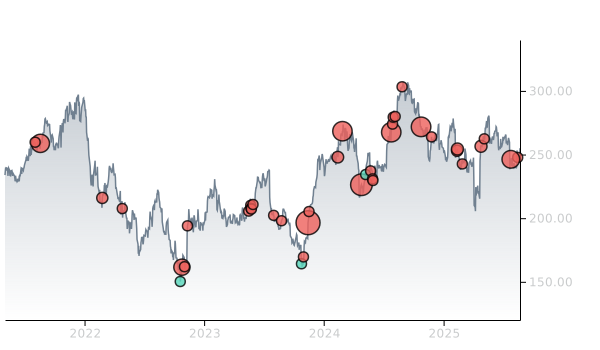
$EFX insiders have traded $EFX stock on the open market 32 times in the past 6 months. Of those trades, 1 have been purchases and 31 have been sales.
Here’s a breakdown of recent trading of $EFX stock by insiders over the last 6 months:
- MARK W BEGOR (CEO) has made 0 purchases and 25 sales selling 87,136 shares for an estimated $19,033,631.
- JAMIL FARSHCHI (EVP, Chief Technology Officer) has made 0 purchases and 3 sales selling 12,305 shares for an estimated $2,626,595.
- JOHN W JR GAMBLE (EVP, CFO & COO) has made 0 purchases and 2 sales selling 7,000 shares for an estimated $1,401,665.
- CHAD M BORTON (EVP, Pres Workforce Solutions) sold 2,535 shares for an estimated $485,452
- CECILIA MAO (EVP, Chief Product Officer) purchased 2,400 shares for an estimated $464,928
To track insider transactions, check out Quiver Quantitative's insider trading dashboard.
$EFX Revenue
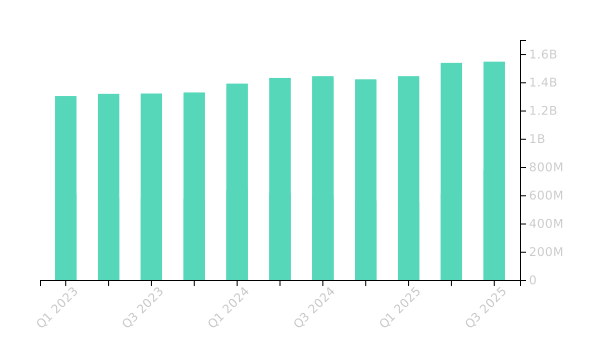
$EFX had revenues of $1.6B in Q4 2025. This is an increase of 9.24% from the same period in the prior year.
You can track EFX financials on Quiver Quantitative's EFX stock page.
$EFX Hedge Fund Activity
We have seen 397 institutional investors add shares of $EFX stock to their portfolio, and 486 decrease their positions in their most recent quarter.
Here are some of the largest recent moves:
- CAPITAL INTERNATIONAL INVESTORS removed 3,995,916 shares (-38.3%) from their portfolio in Q4 2025, for an estimated $867,033,853
- UBS AM, A DISTINCT BUSINESS UNIT OF UBS ASSET MANAGEMENT AMERICAS LLC removed 3,145,659 shares (-74.6%) from their portfolio in Q4 2025, for an estimated $682,545,089
- PRICE T ROWE ASSOCIATES INC /MD/ removed 1,741,584 shares (-29.2%) from their portfolio in Q4 2025, for an estimated $377,888,896
- HARRIS ASSOCIATES L P added 1,723,439 shares (+29.5%) to their portfolio in Q4 2025, for an estimated $373,951,794
- PARNASSUS INVESTMENTS, LLC removed 1,654,544 shares (-94.4%) from their portfolio in Q4 2025, for an estimated $359,002,957
- FMR LLC removed 1,579,807 shares (-87.0%) from their portfolio in Q4 2025, for an estimated $342,786,522
- GENERATION INVESTMENT MANAGEMENT LLP removed 1,164,793 shares (-42.6%) from their portfolio in Q4 2025, for an estimated $252,736,785
To track hedge funds' stock portfolios, check out Quiver Quantitative's institutional holdings dashboard.
$EFX Analyst Ratings
Wall Street analysts have issued reports on $EFX in the last several months. We have seen 5 firms issue buy ratings on the stock, and 0 firms issue sell ratings.
Here are some recent analyst ratings:
- RBC Capital issued a "Outperform" rating on 11/07/2025
- Stifel issued a "Buy" rating on 10/22/2025
- Needham issued a "Buy" rating on 10/21/2025
- Wells Fargo issued a "Overweight" rating on 10/15/2025
- UBS issued a "Buy" rating on 09/15/2025
To track analyst ratings and price targets for $EFX, check out Quiver Quantitative's $EFX forecast page.
$EFX Price Targets
Multiple analysts have issued price targets for $EFX recently. We have seen 13 analysts offer price targets for $EFX in the last 6 months, with a median target of $235.0.
Here are some recent targets:
- George Tong from Goldman Sachs set a target price of $208.0 on 02/09/2026
- Ashish Sabadra from RBC Capital set a target price of $222.0 on 02/05/2026
- Andrew Steinerman from JP Morgan set a target price of $230.0 on 02/05/2026
- Shlomo Rosenbaum from Stifel set a target price of $235.0 on 02/05/2026
- Jason Haas from Wells Fargo set a target price of $240.0 on 02/05/2026
- Toni Kaplan from Morgan Stanley set a target price of $244.0 on 02/05/2026
- Kyle Peterson from Needham set a target price of $265.0 on 02/05/2026
Full Release
Equifax Canada Q4 data shows widening divide across sectors and regions
Equifax Canada Market Pulse — Q4 2025 Quarterly Business Credit Trends Release
TORONTO, March 10, 2026 (GLOBE NEWSWIRE) -- New Equifax Canada data shows financial trade delinquencies rose 9.02 per cent year-over-year in Q4 2025 to 3.52 per cent nationally, even as industrial trade delinquencies fell sharply by 25.52 per cent to 4.65 per cent. At the same time, the Canadian Small Business Health Index declined 2.4 per cent year-over-year, signalling weakening resilience as debt loads climb and credit stress becomes more concentrated.
The data points to an uneven environment: many businesses are keeping up with their payments, but a growing number are falling behind on bank-related obligations, such as credit cards and lines of credit.
Financial trades track missed payments on bank loans, business credit cards and lines of credit. Industrial trades measure how consistently businesses pay suppliers and trade partners.
“This appears to be more concentrated pressure,” said Jeff Brown, Head of Commercial Solutions at Equifax Canada. “We’re seeing stabilization in day-to-day supplier payments, but leverage built up over the past two years is weighing on service and rate-sensitive sectors. When stress narrows into specific industries and regions, it can tighten lending conditions and increase the risk of localized business setbacks.”
Ontario Records Highest Financial Credit Stress
Ontario recorded the highest financial trade delinquency rate in the country at 3.88 per cent, up 12.90 per cent year-over-year. Credit pressure was most visible in Real Estate, Rental and Leasing, where delinquencies jumped 24.5 per cent, and in Finance and Insurance, which rose 21.3 per cent.
Prince Edward Island experienced the fastest acceleration nationally, with financial trade delinquencies climbing 32.78 per cent year-over-year.
Quebec stood out as the only province to post a year-over-year decline in financial trade delinquencies, down 1.29 per cent, supported by stronger employment growth and the lowest provincial unemployment rate in the country.
Debt Loads Climb as Businesses Restructure Borrowing
Average business debt rose 16.9 per cent year-over-year to $30,035. Newly established firms under 12 months old drove much of the increase, with balances surging 64 per cent. Despite rising debt levels, the number of businesses missing a payment declined 11.09 per cent year-over-year to 282,257 in Q4 2025.
Credit mix trends suggest restructuring with installment loan balances increasing 21.9 per cent year-over-year to $132,101, while credit card balances declined 5.0 per cent and lines of credit fell 14.7 per cent. Businesses appear to be locking into structured borrowing and pulling back from revolving credit exposure.
Manufacturing Health Improves as Service Sectors Strain
Industrial trades improved nationwide, with manufacturing leading the shift. Manufacturing delinquencies dropped 32.2 per cent year-over-year, and the sector’s health index rose 0.7 per cent annually and 6.1 per cent quarter-over-quarter.
In contrast, service-heavy and interest-sensitive industries continue to experience higher borrowing costs and softer consumer demand.
The Canadian Small Business Health Index , which measures the resilience and outlook of small and medium-sized businesses, showed a drop in business sentiment of 2.4 per cent year-over-year.
“The data indicates that the business climate is no longer rising or falling together, but rather separating - with some businesses improving their cash flow and leverage, while others are showing that they are more exposed to rate sensitivity and consumer softness. Whether thriving or dealing with challenges, businesses across the country are demonstrating their strength as business owners,” concluded Brown.
About Equifax
At Equifax (NYSE: EFX), we believe knowledge drives progress. As a global data, analytics, and technology company, we play an essential role in the global economy by helping financial institutions, companies, employers, and government agencies make critical decisions with greater confidence. Our unique blend of differentiated data, analytics, and cloud technology drives insights to power decisions to move people forward. Headquartered in Atlanta and supported by nearly 15,000 employees worldwide, Equifax operates or has investments in 24 countries in North America, Central and South America, Europe, and the Asia Pacific region. For more information, visit
Equifax.ca
.
Contact:
Andrew Findlater
SELECT Public Relations
[email protected]
(647) 444-1197
Angie Andich
Equifax Canada Media Relations
[email protected]