


New data show z-rostudirsen improves heart and lung function in DMD patients after 24 months of treatment.
Quiver AI Summary
Dyne Therapeutics, Inc. announced positive results from the Phase 1/2 DELIVER clinical trial of zeleciment rostudirsen (z-rostudirsen) for Duchenne muscular dystrophy (DMD) involving exon 51 skipping. New analyses showed significant improvements in heart and lung function after 24 months of treatment, which contrasts with expected declines in the natural history of DMD. The data indicated enhancement in lung function and cardiac performance markers, suggesting the effectiveness of the FORCE platform in delivering therapeutics to various muscles. The trial included safety assessments, which indicated a favorable profile for z-rostudirsen, with most adverse events being mild to moderate. These findings highlight the potential of z-rostudirsen to aid individuals with DMD in terms of functional outcomes. The results were presented at the 2026 Muscular Dystrophy Association conference.
Potential Positives
- New analyses from the DELIVER trial show significant improvements in heart and lung function in DMD patients after 24 months of treatment with z-rostudirsen, indicating potential long-term benefits beyond muscle function.
- The data supports the efficacy of z-rostudirsen as a treatment for DMD, facilitating its potential submission for U.S. Accelerated Approval.
- Z-rostudirsen has received multiple designations from the FDA and EMA, highlighting its potential as an important therapeutic option for individuals with DMD amenable to exon 51 skipping.
Potential Negatives
- The majority of participants at the 24-month timepoint initiated treatment at lower doses (0.7–2.8 mg/kg) than the registrational dose (20 mg/kg), raising questions about the long-term efficacy of the treatment when administered at the intended dose.
- Forward-looking statements in the release highlight significant risks and uncertainties, indicating that actual results may differ materially from the expectations detailed in the press release.
- Some treatment-emergent adverse events (TEAEs) were reported, such as fever and headache, which could raise concerns regarding the tolerability of the treatment.
FAQ
What is z-rostudirsen and its purpose?
Z-rostudirsen is an investigational therapeutic for Duchenne muscular dystrophy (DMD) targeting muscle and CNS improvement.
What were the key results from the DELIVER trial?
The DELIVER trial showed sustained improvement in heart and lung function in DMD patients over 24 months.
How does z-rostudirsen improve cardiopulmonary function?
Z-rostudirsen potentially enhances cardiopulmonary function through its unique FORCE platform, delivering therapeutics to critical muscles.
What kind of safety profile does z-rostudirsen have?
The treatment demonstrated a favorable safety profile, with most adverse events being mild or moderate.
Where can I find more information about the DELIVER trial?
Additional information about the DELIVER trial can be found on clinicaltrials.gov and euclinicaltrials.eu.
Disclaimer: This is an AI-generated summary of a press release distributed by GlobeNewswire. The model used to summarize this release may make mistakes. See the full release here.
$DYN Insider Trading Activity
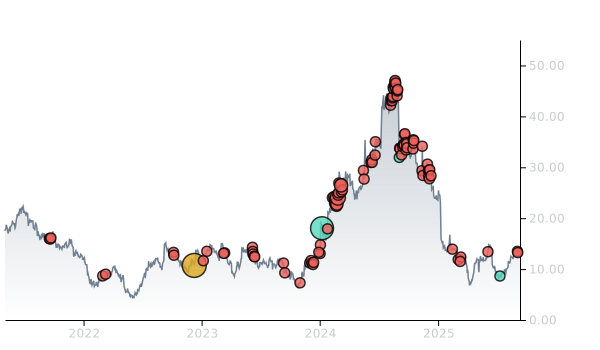
$DYN insiders have traded $DYN stock on the open market 6 times in the past 6 months. Of those trades, 0 have been purchases and 6 have been sales.
Here’s a breakdown of recent trading of $DYN stock by insiders over the last 6 months:
- JOHN COX (CEO & President) has made 0 purchases and 2 sales selling 5,394 shares for an estimated $95,863.
- DOUGLAS KERR (Chief Medical Officer) has made 0 purchases and 2 sales selling 1,784 shares for an estimated $31,703.
- JOHANNA FRIEDL-NADERER (Chief Commercial Officer) has made 0 purchases and 2 sales selling 292 shares for an estimated $5,188.
To track insider transactions, check out Quiver Quantitative's insider trading dashboard.
$DYN Hedge Fund Activity
We have seen 146 institutional investors add shares of $DYN stock to their portfolio, and 105 decrease their positions in their most recent quarter.
Here are some of the largest recent moves:
- RA CAPITAL MANAGEMENT, L.P. removed 9,714,392 shares (-100.0%) from their portfolio in Q3 2025, for an estimated $122,887,058
- ORBIS ALLAN GRAY LTD added 4,801,928 shares (+inf%) to their portfolio in Q4 2025, for an estimated $93,925,711
- PERCEPTIVE ADVISORS LLC added 2,938,500 shares (+543.7%) to their portfolio in Q4 2025, for an estimated $57,477,059
- VESTAL POINT CAPITAL, LP removed 2,655,000 shares (-95.7%) from their portfolio in Q4 2025, for an estimated $51,931,800
- MARSHALL WACE, LLP removed 2,336,398 shares (-77.5%) from their portfolio in Q4 2025, for an estimated $45,699,944
- CITADEL ADVISORS LLC removed 2,241,811 shares (-65.7%) from their portfolio in Q4 2025, for an estimated $43,849,823
- PARADIGM BIOCAPITAL ADVISORS LP removed 1,898,950 shares (-100.0%) from their portfolio in Q4 2025, for an estimated $37,143,462
To track hedge funds' stock portfolios, check out Quiver Quantitative's institutional holdings dashboard.
$DYN Analyst Ratings
Wall Street analysts have issued reports on $DYN in the last several months. We have seen 4 firms issue buy ratings on the stock, and 0 firms issue sell ratings.
Here are some recent analyst ratings:
- Stifel issued a "Buy" rating on 12/11/2025
- Oppenheimer issued a "Outperform" rating on 12/10/2025
- Chardan Capital issued a "Buy" rating on 12/09/2025
- HC Wainwright & Co. issued a "Buy" rating on 11/06/2025
To track analyst ratings and price targets for $DYN, check out Quiver Quantitative's $DYN forecast page.
$DYN Price Targets
Multiple analysts have issued price targets for $DYN recently. We have seen 8 analysts offer price targets for $DYN in the last 6 months, with a median target of $38.5.
Here are some recent targets:
- Ananda Ghosh from HC Wainwright & Co. set a target price of $50.0 on 03/03/2026
- Keay Nakae from Chardan Capital set a target price of $38.0 on 03/03/2026
- Michael Ulz from Morgan Stanley set a target price of $47.0 on 03/03/2026
- Tessa Romero from JP Morgan set a target price of $16.0 on 01/20/2026
- Gavin Clark-Gartner from Evercore ISI Group set a target price of $36.0 on 12/15/2025
- Paul Matteis from Stifel set a target price of $39.0 on 12/11/2025
- Andreas Argyrides from Oppenheimer set a target price of $40.0 on 12/10/2025
Full Release
- New analyses out to 24-months showed improvement in heart and lung function compared to expected declines in DMD natural history -
- Data expand on previously reported results demonstrating that z-rostudirsen treatment led to sustained functional improvement across multiple clinical measures -
WALTHAM, Mass., March 08, 2026 (GLOBE NEWSWIRE) -- Dyne Therapeutics, Inc . (Nasdaq: DYN), a clinical-stage company focused on delivering functional improvement for people living with genetically driven neuromuscular diseases, today announced additional positive data from the ongoing Phase 1/2 DELIVER clinical trial of zeleciment rostudirsen (z-rostudirsen, also known as DYNE-251), in individuals with Duchenne muscular dystrophy (DMD) amenable to exon 51 skipping. These data are being presented in a late-breaking poster presentation at the 2026 Muscular Dystrophy Association (MDA) Clinical & Scientific Conference being held March 8-11, 2026, in Orlando, FL, which is available in the Scientific Publications & Presentations section of Dyne’s website along with all of Dyne’s other posters being presented at the conference.
“This week we are presenting additional analyses of 24-month data from the DELIVER trial showing the breadth of potential benefits z-rostudirsen may bring to individuals with exon 51 skip amenable DMD beyond the previously reported unprecedented improvements in muscle function,” said Doug Kerr, M.D., Ph.D., chief medical officer of Dyne. “Cardiopulmonary issues are a key area of concern in DMD, so we are particularly encouraged by new analyses showing improvement in both heart and lung function out to 24 months. We attribute these results to the differentiated capabilities of our FORCE platform to deliver therapeutics to a broad range of muscles, including the heart, trunk and diaphragm, as well as the CNS.”
Dyne announced the results of new analyses of cardiac and pulmonary function amongst all DELIVER participants who were randomized to z-rostudirsen treatment at baseline (any dose 1 ) and for whom cardiac magnetic resonance imaging and/or pulmonary function data were available.
- Improvement from baseline in lung function, as measured by Forced Vital Capacity Percent Predicted (FVC%p), was observed through 24 months, as compared to the expected decline estimated in published natural history data 2 - 4 .
- Improvement from baseline was observed through 24 months in circumferential strain, an early signal of cardiac performance, as compared to the expected worsening estimated in published natural history data 5 , 6 .
- Improvement from baseline in left ventricular ejection fraction, a measure of how well the heart is pumping, was observed at 24 months, in contrast with the expected decline estimated in published natural history data 5 , 6 .
-
In previously reported safety and tolerability data from 86 total participants enrolled in the DELIVER trial and followed for up to 36 months, z-rostudirsen demonstrated a favorable safety profile
7
, and most related treatment emergent adverse events (TEAEs) were mild or moderate. The most commonly reported related TEAEs were pyrexia (fever) and headache. No related serious TEAEs were observed in the REC.
These data will be presented in a poster titled “Zeleciment rostudirsen led to trends in long-term improvement in clinical outcomes including cardiopulmonary function: Additional data from DELIVER” (poster # 476 LBT).
About the DELIVER Trial
DELIVER is a global, randomized, placebo-controlled, double-blind, Phase 1/2 clinical trial that evaluated the safety, tolerability and efficacy (as measured by both biomarker and functional improvement) of zeleciment rostudirsen (z-rostudirsen, also known as DYNE-251) in individuals with Duchenne muscular dystrophy (DMD) who have mutations in the DMD gene that are amenable to exon 51 skipping. The multiple ascending dose (MAD) portion of the study resulted in the selection of a registrational dose and regimen of 20 mg/kg of z-rostudirsen administered every four weeks. The placebo-controlled portion of the registrational expansion cohort (REC) to support a potential regulatory submission for U.S. Accelerated Approval has been completed. The primary endpoint for this cohort was the change from baseline in dystrophin protein levels as measured by Western blot at 6 months. Participants from the MAD and REC portions had the option to enroll in the open-label extension and long-term extension portions of the study. For more information on the DELIVER trial, visit
clinicaltrials.gov
and
euclinicaltrials.eu
.
About zeleciment rostudirsen (z-rostudirsen, also known as DYNE-251)
Z-rostudirsen is an investigational therapeutic being evaluated in the Phase 1/2 global DELIVER clinical trial for individuals with DMD who have mutations in the DMD gene that are amenable to exon 51 skipping. Z-rostudirsen consists of a phosphorodiamidate morpholino oligomer (PMO) conjugated to an antigen-binding fragment (Fab) that binds to the transferrin receptor 1 (TfR1). It is designed to enable the production of near full-length dystrophin in muscle and the central nervous system (CNS) to provide functional improvement. Z-rostudirsen has received Breakthrough Therapy, Fast Track and Rare Pediatric Disease designations from the U.S. Food and Drug Administration (FDA), as well as Orphan Drug designation from the FDA and European Medicines Agency (EMA) and the Ministry of Health, Labour and Welfare (MHLW) in Japan for the treatment of individuals with DMD amenable to exon 51 skipping.
In addition to z-rostudirsen, Dyne is building a DMD franchise and has preclinical programs targeting other exons, including DYNE-253, DYNE-245, DYNE-244 and DYNE-255.
About Duchenne Muscular Dystrophy (DMD)
Duchenne muscular dystrophy (DMD) is a rare X-linked progressive neuromuscular disorder caused by mutations in the DMD gene. These mutations result in a complete or near-complete absence of dystrophin, a protein critical for maintaining muscle structure and function. DMD is the most common form of childhood-onset muscular dystrophy, affecting approximately 12,000 individuals in the U.S. and 16,000 in the EU. Symptoms typically emerge between ages 3 and 5, beginning with muscle weakness in the upper arms, thighs and pelvic region, and progressively impacting the lower limbs, forearms, neck and trunk. In addition to physical decline, individuals may experience cognitive impairment and neuropsychiatric challenges such as intellectual disabilities, learning difficulties and behavioral disorders. Despite existing therapies, there remains a significant unmet need for new treatment options that deliver functional improvement.
About Dyne Therapeutics
Dyne Therapeutics is focused on delivering functional improvement for people living with genetically driven neuromuscular diseases. We are developing therapeutics that target muscle and the central nervous system (CNS) to address the root cause of disease. The company is advancing clinical programs for Duchenne muscular dystrophy (DMD) and myotonic dystrophy type 1 (DM1) as well as preclinical programs for facioscapulohumeral muscular dystrophy (FSHD), Pompe disease and multiple DMD mutations. At Dyne, we are on a mission to deliver functional improvement for individuals, families and communities. Learn more at
https://www.dyne-tx.com/
, and follow us on
X
,
LinkedIn
and
Facebook
.
Forward-Looking Statements
This press release contains forward-looking statements that involve substantial risks and uncertainties. All statements, other than statements of historical facts, contained in this press release, including statements regarding Dyne’s strategy, future operations, prospects and plans, objectives of management, the potential of the FORCE platform, the clinical potential of zeleciment rostudirsen (z-rostudirsen, also known as DYNE-251) and its potential cardiopulmonary effects, and expectations regarding the availability of accelerated approval pathways for z-rostudirsen, constitute forward-looking statements within the meaning of The Private Securities Litigation Reform Act of 1995. The words “anticipate,” “believe,” “continue,” “could,” “estimate,” “expect,” “intend,” “may,” “might,” “objective,” “ongoing,” “plan,” “predict,” “project,” “potential,” “should,” “will” or “would,” or the negative of these terms, or other comparable terminology are intended to identify forward-looking statements, although not all forward-looking statements contain these identifying words. Dyne may not actually achieve the plans, intentions or expectations disclosed in these forward-looking statements, and you should not place undue reliance on these forward-looking statements. Actual results or events could differ materially from the plans, intentions and expectations disclosed in these forward-looking statements as a result of various important factors, including: uncertainties inherent in the identification and development of product candidates, including the initiation and completion of preclinical studies and clinical trials; uncertainties as to the availability and timing of results from preclinical studies and clinical trials; whether results from preclinical studies and initial data from clinical trials will be predictive of the final results of the clinical trials or future trials; uncertainties as to the FDA’s and other regulatory authorities’ interpretation of the data from Dyne's clinical trials and the regulatory approval process; whether Dyne’s cash resources will be sufficient to fund its foreseeable and unforeseeable operating expenses and capital expenditure requirements; as well as the risks and uncertainties identified in Dyne’s filings with the Securities and Exchange Commission (SEC), including the Company’s most recent Form 10-K and in subsequent filings Dyne may make with the SEC. In addition, the forward-looking statements included in this press release represent Dyne’s views as of the date of this press release. Dyne anticipates that subsequent events and developments will cause its views to change. However, while Dyne may elect to update these forward-looking statements at some point in the future, it specifically disclaims any obligation to do so. These forward-looking statements should not be relied upon as representing Dyne’s views as of any date subsequent to the date of this press release.
- The majority of participants at the 24M timepoint initiated treatment at the 0.7–2.8 mg/kg Q4W dose levels. Because most participants accrued substantial time on doses lower than the registrational dose of 20 mg/kg z-rostudirsen Q4W, the observed long-term efficacy potentially does not reflect the effect of continuously maintaining 20 mg/kg Q4W.
- Meier T, et al. Neuromuscul Disord. 2017;27(4):307–314
- Mayer OH, et al. Pediatr Pulmonol. 2015;50(5):487–494
- McDonald CM, et al. Neuromuscul Disord. 2018;28(11):897–909;
- Batra A, et al. BMC Cardiovasc Disord. 2022;22(1):260;
- Hagenbuch SC, et al. Am J Cardiol. 2010;105(10):1451–1455;
-
Z-rostudirsen (DYNE-251) safety data as of August 19, 2025.
Contacts:
Investors
Mia Tobias
[email protected]
781-317-0353
Media
Stacy Nartker
[email protected]
781-317-1938