



Colliers' report outlines five megatrends reshaping corporate real estate, highlighting strategies for resilience amid global changes.
Quiver AI Summary
A new report from Colliers Global Occupier Services, titled "Building Resilience: 5 Megatrends Redefining Corporate Real Estate," identifies five transformative forces that are reshaping corporate location strategies: the integration of AI in the workforce, demographic shifts with aging populations, energy scarcity, increasing climate risks, and changes in global trade dynamics. The report emphasizes the need for businesses to reassess their approaches to planning and operating workplaces in response to these challenges. It introduces a Resilience Radar tool to help organizations evaluate their preparedness against these megatrends. Key recommendations include adopting flexible leasing, expanding remote work options, and re-evaluating supply chains to enhance long-term resilience and competitiveness. The findings are intended to encourage proactive strategies among businesses to navigate the evolving real estate landscape.
Potential Positives
- The report provides a comprehensive analysis of significant megatrends affecting the corporate real estate landscape, positioning Colliers as a thought leader in the industry.
- Colliers identifies clear opportunities for proactive organizations, suggesting strategies that can lead to long-term competitive advantages in real estate decisions.
- The introduction of the Resilience Radar tool adds value to clients by visually illustrating the impact of megatrends and the preparedness of organizations to respond, enhancing Colliers' service offerings.
- The report serves as a call to action for businesses to adopt innovative practices and technologies, potentially driving demand for Colliers' consultancy and advisory services.
Potential Negatives
- The report indicates that many organizations still struggle with constraints around energy and talent, suggesting that Colliers' clients may not be fully prepared for the challenges ahead.
- The mention of needing to reassess planning and investment strategies underscores potential shortcomings in current operational approaches among businesses, reflecting a level of crisis management.
- The call to action implies urgency and a risk of inaction, which may indicate that companies are not adequately adapting to these megatrends, potentially jeopardizing their competitiveness.
FAQ
What are the five megatrends affecting corporate real estate?
The five megatrends are AI-enabled workforces, seismic demographic shifts, energy scarcity and security, climate risks, and shifting global order.
How does AI impact workforce and location decisions?
AI integration transforms workforce composition, decision-making, and space requirements, influencing how companies choose investment locations.
What is the Resilience Radar introduced in the report?
The Resilience Radar is a visual tool illustrating each megatrend's impact and companies' preparedness to respond to these changes.
How can companies strengthen resilience according to the report?
Companies can strengthen resilience by adopting flexible leasing, expanding remote workforces, investing in nature-based solutions, and reassessing supply chains.
Where can I find more information about the report?
The full findings and the interactive Resilience Radar are available on Colliers’ Global Megatrends microsite.
Disclaimer: This is an AI-generated summary of a press release distributed by GlobeNewswire. The model used to summarize this release may make mistakes. See the full release here.
$CIGI Revenue
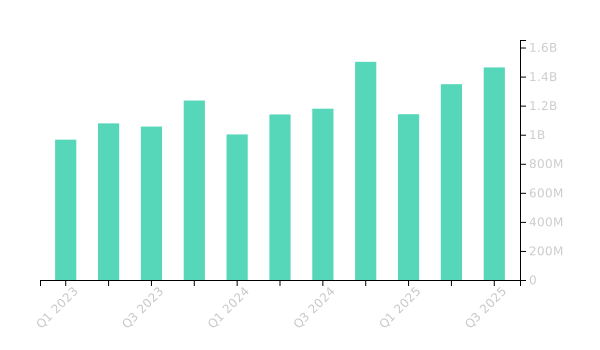
$CIGI had revenues of $1.3B in Q1 2026. This is an increase of 15.1% from the same period in the prior year.
You can track CIGI financials on Quiver Quantitative's CIGI stock page.
You can access data on CIGI stock through the Quiver Quantitative API.
$CIGI Hedge Fund Activity
We have seen 119 institutional investors add shares of $CIGI stock to their portfolio, and 103 decrease their positions in their most recent quarter.
Here are some of the largest recent moves:
- DURABLE CAPITAL PARTNERS LP removed 2,540,921 shares (-75.4%) from their portfolio in Q1 2026, for an estimated $271,599,045
- SPRUCE HOUSE INVESTMENT MANAGEMENT LLC added 1,209,867 shares (+93.0%) to their portfolio in Q1 2026, for an estimated $129,322,683
- CIBC ASSET MANAGEMENT INC added 953,874 shares (+682.0%) to their portfolio in Q1 2026, for an estimated $101,959,591
- 1832 ASSET MANAGEMENT L.P. added 821,736 shares (+34.2%) to their portfolio in Q1 2026, for an estimated $87,835,361
- BRITISH COLUMBIA INVESTMENT MANAGEMENT CORP removed 485,538 shares (-92.8%) from their portfolio in Q1 2026, for an estimated $51,899,156
- BEUTEL, GOODMAN & CO LTD. added 430,817 shares (+26.9%) to their portfolio in Q1 2026, for an estimated $46,050,029
- PICTON MAHONEY ASSET MANAGEMENT removed 375,697 shares (-100.0%) from their portfolio in Q1 2026, for an estimated $40,158,252
To track hedge funds' stock portfolios, check out Quiver Quantitative's institutional holdings dashboard. You can access data on hedge funds moves and 13F filings through the Quiver Quantitative API 13F endpoint.
Full Release
TORONTO, May 19, 2026 (GLOBE NEWSWIRE) -- Five powerful forces - from AI driven workforce transformation to intensifying energy constraints – are set to redefine how companies choose, build, and operate locations worldwide, according to a new report from Colliers Global Occupier Services. Building Resilience: 5 Megatrends Redefining Corporate Real Estate uncovers rising pressure on established global business hubs, and presents strategies organizations can use to strengthen resilience and long-term competitiveness amid accelerating change.
The report is the first in-depth study of the sweeping technological, demographic and economic shifts poised to reshape global real estate in the decades ahead. Drawing on analysis from Colliers’ industry-leading research teams and insights from Colliers leaders across regions, the Outlook evaluates the readiness of companies to respond to these forces and provides strategic pathways to future-proof workplaces and portfolios.
The report identifies five distinct yet intertwined megatrends impacting real estate decisions:
- AI-enabled workforces: The rapid integration of automation, analytics and AI into business functions is transforming workforce composition, decision-making and space requirements.
- Seismic demographic shifts: Aging populations and skill shortages are accelerating the need for new workforce strategies and geographic talent planning.
- Energy scarcity and security: Power-intensive technologies and infrastructure limitations are intensifying competition for reliable, affordable energy, making energy access a critical location factor.
- Climate risks: More frequent extreme weather events and rising physical climate risks are necessitating investments in resiliency and reshaping the long-term viability of major hubs.
-
Shifting global order:
The realignment of long-established trade patterns and economic corridors are redistributing growth, prompting companies to re-evaluate location strategies and supply chain dependencies.
“These megatrends will require businesses to fundamentally reassess the ways they plan, invest in and operationalise locations and workplaces,” said Andrew Hallissey, Chief Executive Officer, Global Occupier Services, Colliers. “As economies realign and climate and energy pose challenges to infrastructure, we believe it’s important to acknowledge the extent of the changes ahead and present a realistic picture of what the future of real estate will look like.”
“We’ve already seen how factors like access to the infrastructure and talent that power AI are changing what our clients look for when choosing locations to invest and grow for the long-term,” said Jodie Porier, President, Occupier Services, Americas, Colliers. “These demands will only accelerate as these forces are more firmly embedded in the economy, and should be integrated into planning and decision-making as we design the next generation of workplaces and economic hubs.”
The report also introduces a Resilience Radar, a visual tool illustrating the potential impact of each megatrend and how prepared companies are to respond. The Radar reveals that many organizations continue to grapple with constraints around energy and talent, while also adapting to emerging climate, geopolitical, and technology-driven pressures.
Despite these challenges, the research highlights clear opportunities for proactive organizations. Strategies such as flexible leasing structures, expanding remote workforces, investing in nature-based solutions and re-evaluating supply chain routes can help real estate owners and occupiers strengthen resilience and unlock long-term competitive advantages.
“We hope this research serves as a call to action, encouraging both businesses and providers of real estate and infrastructure to adopt policies, practices and technologies that will boost their resilience over the long term,” said Mike Davis, Managing Director, Asia Pacific, Occupier Services, Colliers. “The changes we’re already seeing play out on the ground mean not responding is not an option.”
The full findings, including the interactive Resilience Radar, are available on Colliers’ Global Megatrends microsite .
For further details or to arrange interviews with the Colliers experts behind the report, please contact:
Media Contact
Andrea Cheung
Senior Manager, Global Integrated Communications
[email protected]
(416) 324-6402
About Colliers
Colliers is a global diversified professional services and investment management company operating through three industry-leading businesses: Commercial Real Estate, Engineering, and Investment Management. With greater than a 30-year track record of consistent growth and strong recurring cash flows, we scale complementary, high-value businesses that provide essential services across the full asset lifecycle. Our unique partnership philosophy empowers exceptional leaders, preserves our entrepreneurial culture, and ensures meaningful inside ownership — driving strong alignment and sustained value creation for our shareholders. With $5.7 billion in annual revenues, 24,000 professionals, and $109 billion in assets under management, Colliers is committed to accelerating the success of our clients, investors, and people worldwide. Learn more at corporate.colliers.com.
A photo accompanying this announcement is available at https://www.globenewswire.com/NewsRoom/AttachmentNg/d49c2bd1-b495-4fde-ac81-9a64c6940c5f