

Over the last decade, Palantir has become entrenched in the halls and checkbooks of Washington DC. Securing billions in federal contracts for its data analytics and surveillance software, the company’s stock prices have more than tripled in the last two years, with over 50% of its revenue stemming from the U.S. government.
But Palantir isn’t the only one benefiting from its connections to the federal government. Congress members who purchased stock in Palantir even just a year ago are now seeing profits skyrocket as stocks continue to climb.
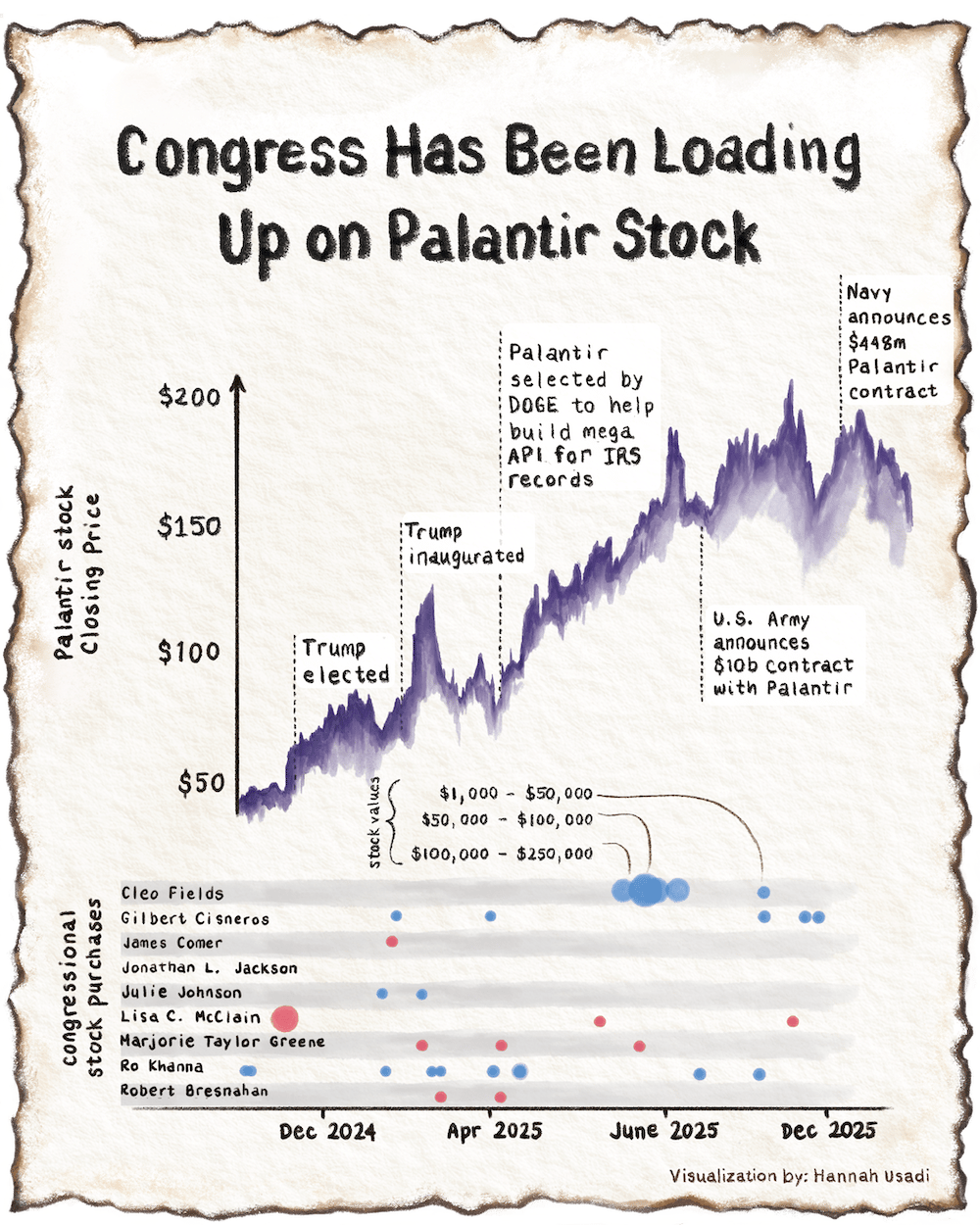
Some of these trades raise questions about potential conflicts of interest, with many of these congresspeople in committees that have direct authority over defense contracts.
Gilbert Cisneros (D-CA), who serves on the Armed Services Committee, filed five trades in Palantir over one year. Simultaneously, the DoD — whose budget is overseen by Congressional Armed Services Committees — approved multiple multi-million dollar defense contracts with Palantir. Rep. Jackson and Rep. Khanna also made purchases while on the Armed Services Committee (however, it’s worth noting that Khanna’s portfolio is run by an independent trust, and he has been one of the leading proponents of a stock trading ban).

With the midterm elections approaching, Palantir’s influence on Congress is also seen in PAC donations and government lobbying, as they spent over $6 million in congressional lobbying and over $41,500 in corporate PAC donations in 2025 (this number is expected to ramp up in the lead-up to the 2026 midterms).
Some of the PAC donations were directed to Sen. Eric Schmitt (R-MO) and Rep. Rob Wittman (R-VA), who both sit on congressional Armed Services Committees. In fact, Wittman is currently the Vice Chair of the House Armed Services Committee.
Palantir also donated to Markwayne Mullin’s campaign, who was recently named the new DHS secretary. In Feb. 2026, the DHS awarded Palantir a $1 billion contract to provide AI tools for immigration enforcement and border control.
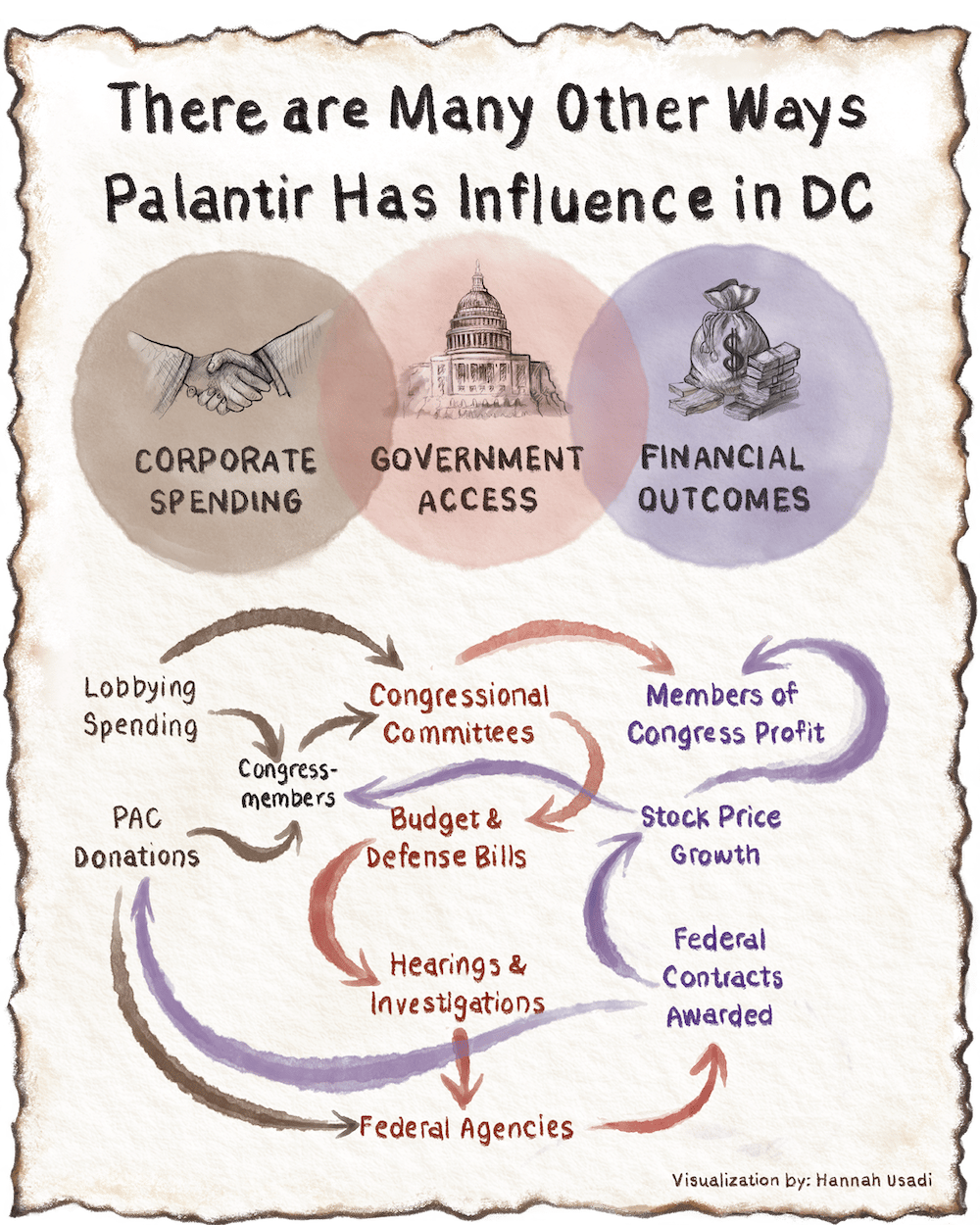
Palantir’s annual revenue has almost doubled since 2024. In 2025, the company received over $140 million in new public contracts tracked by Quiver, while in 2024, Palantir received just under $80 million. So far in 2026, Palantir has already received over $20 million from agencies ranging from NASA to DHS to the Department of Agriculture.
And their stock prices reflect this — just over a year ago, their stocks sat around $80, since then they have peaked at nearly $200 and continue to sit between $150 and $200.
Palantir sits right at the crossroads of the Trump administration’s priorities, including national security, military funding and expansion, and technological advancements. With Trump as an ally, the company has secured its place in American politics.
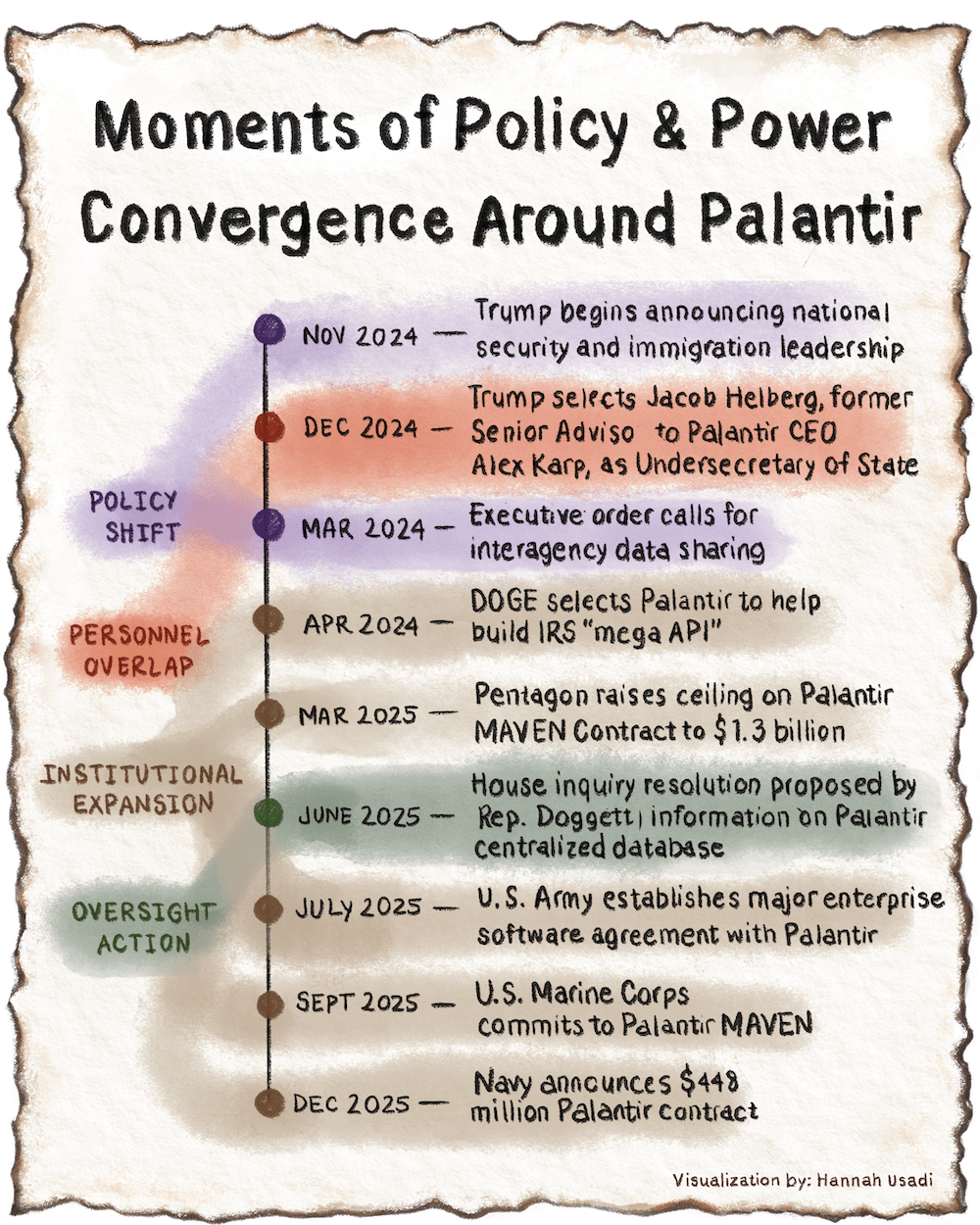
Just this week, Trump expanded the 2027 defense budget by 44%, increasing the total amount spent to $1.5 trillion. But as conflicts of interest between defense contractors and government officials run rampant, voters may certainly question whether this funding is being allocated with their best interests in mind.
About the Authors
Illustrations and Data Visualizations by Hannah Usadi, a freelance data journalist with a focus on visual storytelling. You can find more of her work at hannahusadi.com or on Instagram @comicsbyhannahusadi
-
Writing by Margaret Shreiner, a data journalism intern at Quiver Quantitative. Margaret is currently completing a Master’s in Applied Data Science at the University of Michigan.