


A new report details economic risks and challenges facing the defense industry amid geopolitical instability and rising procurement demands.
Quiver AI Summary
A recent report by Oxford Analytica and Willis highlights the significant challenges faced by defense contractors in today's unpredictable geopolitical landscape. Entitled "Managing the new economic risks in the defense sector," the report reveals a defense industry experiencing high demand but struggling with production and international collaboration. It outlines five key economic risks: balancing scale versus sovereignty, tariff wars impacting supply chains, dependency on Chinese materials, unfulfilled political promises for defense budgets, and difficulties in reindustrializing. Additionally, it raises concerns about social backlash against defense spending and potential fiscal crises due to rising government debt. With a shift from previous security concerns, the report notes that the resurgence of state-sponsored violence has drastically changed the defense procurement environment, affecting operations and planning for industry players.
Potential Positives
- The report highlights a significant increase in defense procurement demand, suggesting strong market opportunities for defense contractors.
- It underscores the resilience of defense procurement in Europe regardless of the ongoing Ukraine conflict, indicating a stable market outlook.
- The report's insights on the changing global defense landscape may position WTW as a thought leader in risk analytics within the defense sector.
Potential Negatives
- The press release highlights critical risks facing the defense sector, including tariff wars and dependence on Chinese materials, which could undermine long-term growth and operational stability for companies like WTW.
- There is a significant mention of potential social backlash against rising defense budgets, which could lead to political instability and challenge the sustainability of defense procurement contracts.
- The report underscores the challenges of reindustrialization in the Western defense sector, indicating possible operational difficulties that could affect future production capabilities for WTW and its clients.
FAQ
What are the main findings of the new report on the defense industry?
The report identifies five economic risks for the defense sector, including tariff wars and reliance on Chinese materials.
How does the Ukraine conflict affect defense procurement in Europe?
The report suggests that defense procurement in Europe will remain strong regardless of the Ukraine conflict's outcome.
What are the emerging threats facing the defense sector?
Emerging threats include social backlash against defense spending and potential fiscal crises affecting government budgets.
Who conducted the research for the defense industry report?
The report was produced by Oxford Analytica and Willis, a WTW business, through interviews with senior defense executives.
Where can the full report on defense sector risks be accessed?
The full report titled "Managing the new economic risks in the defense sector" can be downloaded from WTW's website.
Disclaimer: This is an AI-generated summary of a press release distributed by GlobeNewswire. The model used to summarize this release may make mistakes. See the full release here.
$WTW Revenue
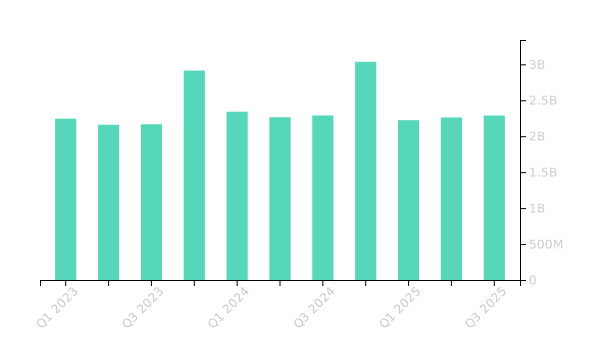
$WTW had revenues of $2.3B in Q3 2025. This is a decrease of -0.04% from the same period in the prior year.
You can track WTW financials on Quiver Quantitative's WTW stock page.
$WTW Congressional Stock Trading
Members of Congress have traded $WTW stock 1 times in the past 6 months. Of those trades, 0 have been purchases and 1 have been sales.
Here’s a breakdown of recent trading of $WTW stock by members of Congress over the last 6 months:
- REPRESENTATIVE VAL T. HOYLE sold up to $15,000 on 09/23.
To track congressional stock trading, check out Quiver Quantitative's congressional trading dashboard.
$WTW Hedge Fund Activity
We have seen 326 institutional investors add shares of $WTW stock to their portfolio, and 352 decrease their positions in their most recent quarter.
Here are some of the largest recent moves:
- DODGE & COX added 2,353,768 shares (+184.1%) to their portfolio in Q3 2025, for an estimated $813,109,155
- UBS AM, A DISTINCT BUSINESS UNIT OF UBS ASSET MANAGEMENT AMERICAS LLC removed 1,088,942 shares (-100.0%) from their portfolio in Q3 2025, for an estimated $376,175,013
- T. ROWE PRICE INVESTMENT MANAGEMENT, INC. added 966,357 shares (+51.5%) to their portfolio in Q3 2025, for an estimated $333,828,025
- SOUNDWATCH CAPITAL LLC removed 890,015 shares (-100.0%) from their portfolio in Q3 2025, for an estimated $307,455,681
- HARRIS ASSOCIATES L P added 508,350 shares (+13.4%) to their portfolio in Q3 2025, for an estimated $175,609,507
- BLACKROCK, INC. removed 453,731 shares (-4.7%) from their portfolio in Q3 2025, for an estimated $156,741,373
- PRANA CAPITAL MANAGEMENT, LP removed 327,485 shares (-100.0%) from their portfolio in Q3 2025, for an estimated $113,129,693
To track hedge funds' stock portfolios, check out Quiver Quantitative's institutional holdings dashboard.
$WTW Analyst Ratings
Wall Street analysts have issued reports on $WTW in the last several months. We have seen 6 firms issue buy ratings on the stock, and 1 firms issue sell ratings.
Here are some recent analyst ratings:
- Barclays issued a "Underweight" rating on 01/08/2026
- Keefe, Bruyette & Woods issued a "Outperform" rating on 01/06/2026
- TD Cowen issued a "Buy" rating on 11/10/2025
- Piper Sandler issued a "Overweight" rating on 10/31/2025
- Wells Fargo issued a "Overweight" rating on 10/08/2025
- Evercore ISI Group issued a "Outperform" rating on 10/01/2025
- Raymond James issued a "Strong Buy" rating on 09/22/2025
To track analyst ratings and price targets for $WTW, check out Quiver Quantitative's $WTW forecast page.
$WTW Price Targets
Multiple analysts have issued price targets for $WTW recently. We have seen 12 analysts offer price targets for $WTW in the last 6 months, with a median target of $374.5.
Here are some recent targets:
- Ryan Tunis from Cantor Fitzgerald set a target price of $345.0 on 01/14/2026
- Elyse Greenspan from Wells Fargo set a target price of $366.0 on 01/13/2026
- Alex Scott from Barclays set a target price of $318.0 on 01/08/2026
- David Motemaden from Evercore ISI Group set a target price of $383.0 on 01/07/2026
- Meyer Shields from Keefe, Bruyette & Woods set a target price of $388.0 on 01/06/2026
- Yaron Kinar from Mizuho set a target price of $386.0 on 12/16/2025
- Andrew Kligerman from TD Cowen set a target price of $391.0 on 11/10/2025
Full Release
LONDON, Jan. 21, 2026 (GLOBE NEWSWIRE) -- In an unstable geopolitical environment, defense contractors face new challenges. A new report from Oxford Analytica and Willis, a WTW business (NASDAQ: WTW), examines these risks through in‑depth interviews with senior executives across the defense industry.
The report, titled “Managing the new economic risks in the defense sector”, indicates a defense industry with skyrocketing demand but lagging production and insufficient collaboration between countries. The report also includes scenarios for the Ukraine conflict and suggests that defense procurement in Europe will remain robust whether the war in Ukraine persists or a lasting ceasefire is achieved.
The report identifies five economic risks confronting the defense sector today:
- Losing at the scale/sovereignty trade-off, as nations struggle between pooling defense resources for efficiency and preserving national control
- Tariff wars, with escalating trade barriers disrupting supply chains and raising costs
- China dependence, given the sector’s reliance on Chinese materials and components such as rare earths and electronics
- Phantom spending, where political pledges to increase defense budgets may not translate into actual future investment
-
Failure to reindustrialise, as Western nations rediscover the need for industrial capacity but face difficulties rebuilding it
Beyond these current concerns, expert interviewees flagged two emerging threats tied to fiscal pressures: social backlash against defense spending and looming fiscal crises. With debt‑to‑GDP ratios exceeding 100% across much of Europe, North America, and Japan, governments risk “soft defaults” through inflation or financial repression. Rising defense budgets could create political grievance if they lead to higher taxes or cuts in social programs, especially amid uncertain economic growth. These pressures may undermine long‑term defense commitments and create political instability.
Sam Wilkin, Director of political risk analytics at Willis, said: “In the late 1990s and early 2000s, terrorist threats dominated the national security agenda. In retrospect, that concern was born in an era of extraordinary geopolitical stability, when conflicts involving states had dwindled to historic lows.”
“Today, that stability has vanished. Non‑state actors remain disruptive, but the last few years have been shaped by the return of state‑sponsored violence. These threats occur on a much larger scale and therefore have driven a surge in defense procurement and a reshaping of global defense supply chains. For companies active in the sector, this shift in the risk landscape has strong implications for operations and future planning.”
The full report can be downloaded here .
About WTW
At WTW (NASDAQ: WTW), we provide data-driven, insight-led solutions in the areas of people, risk and capital. Leveraging the global view and local expertise of our colleagues serving 140 countries and markets, we help organizations sharpen their strategy, enhance organizational resilience, motivate their workforce and maximize performance.
Working shoulder to shoulder with our clients, we uncover opportunities for sustainable success - and provide perspective that moves you.
Learn more at wtwco.com .
Media contacts
Jo Barrett
[email protected]
/ +44 7940703911
Lauren David
[email protected]
/ +44 7385947619