


In 2025, natural catastrophes caused over $100 billion in insured losses, emphasizing increasing climate risk despite no US hurricanes.
Quiver AI Summary
In 2025, natural catastrophes resulted in over $100 billion in insured losses for the sixth consecutive year, although this marked a $40 billion decrease from the previous year. The absence of U.S. hurricanes does not diminish the ongoing threat of natural catastrophes, as the report from Willis highlights the critical role of wildfires and the need for updated risk modeling that factors in current conditions and asset characteristics. It also emphasizes that increased rainfall and flooding risks extend beyond traditional zones, necessitating broader considerations in insurance coverage. Furthermore, with climate change altering hurricane behavior and risk dynamics, experts urge insurers to adopt proactive strategies for risk management and foster resilience to mitigate future losses.
Potential Positives
- Willis (a WTW business) published a significant report detailing trends and risks associated with natural catastrophes, indicating their expertise and thought leadership in the field of risk management.
- The report highlights the decrease in insured losses from natural catastrophes in 2025 compared to 2024, suggesting potential stabilization in the insurance market despite ongoing risks.
- Expert insights provided in the report emphasize the necessity for insurance companies to adapt their risk models and strategies, positioning WTW as a vital resource for their clients in mitigating future risks.
Potential Negatives
- Insured losses from natural catastrophes still exceeded $100 billion in 2025, indicating a persistently high risk for the insurance industry despite a decrease from the previous year.
- The report highlights systemic vulnerabilities and overlooked warning signs that compounded the impact of natural catastrophes, suggesting potential deficiencies in risk management strategies within the company.
- The mention of a burgeoning affordability crisis in many insurance markets raises concerns about the company's future profitability and customer retention.
FAQ
What was the total insured loss from natural catastrophes in 2025?
In 2025, natural catastrophes caused over $100 billion in insured losses, marking the sixth consecutive year above that threshold.
How have wildfires impacted insurance portfolios?
Wildfires are a core contributor to insurance portfolio volatility, requiring updated models that reflect present-day conditions and detailed asset characteristics.
Why is flood risk increasing outside defined zones?
Flood risk is escalating due to more intense rainfall and climate change, causing severe flooding even in areas usually considered low risk.
How is climate change affecting hurricane patterns?
Warming in the North Atlantic is leading to more intense hurricanes and extended hurricane seasons, impacting regions like the Caribbean significantly.
What should risk managers focus on in light of these trends?
Risk managers should broaden their approach to high water risks and adjust insurance coverage based on the evolving climate and catastrophic peril landscape.
Disclaimer: This is an AI-generated summary of a press release distributed by GlobeNewswire. The model used to summarize this release may make mistakes. See the full release here.
$WTW Revenue
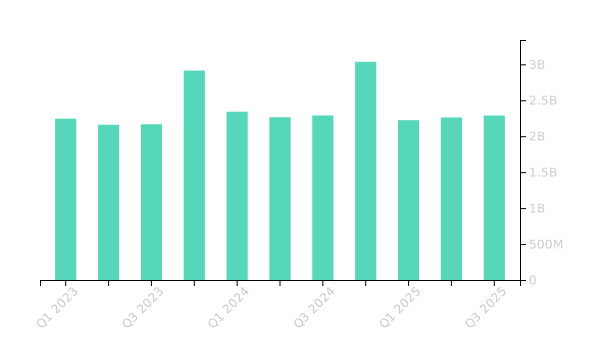
$WTW had revenues of $2.3B in Q3 2025. This is a decrease of -0.04% from the same period in the prior year.
You can track WTW financials on Quiver Quantitative's WTW stock page.
$WTW Congressional Stock Trading
Members of Congress have traded $WTW stock 1 times in the past 6 months. Of those trades, 0 have been purchases and 1 have been sales.
Here’s a breakdown of recent trading of $WTW stock by members of Congress over the last 6 months:
- REPRESENTATIVE VAL T. HOYLE sold up to $15,000 on 09/23.
To track congressional stock trading, check out Quiver Quantitative's congressional trading dashboard.
$WTW Hedge Fund Activity
We have seen 320 institutional investors add shares of $WTW stock to their portfolio, and 367 decrease their positions in their most recent quarter.
Here are some of the largest recent moves:
- DODGE & COX added 2,353,768 shares (+184.1%) to their portfolio in Q3 2025, for an estimated $813,109,155
- UBS AM, A DISTINCT BUSINESS UNIT OF UBS ASSET MANAGEMENT AMERICAS LLC removed 1,088,942 shares (-100.0%) from their portfolio in Q3 2025, for an estimated $376,175,013
- T. ROWE PRICE INVESTMENT MANAGEMENT, INC. added 966,357 shares (+51.5%) to their portfolio in Q3 2025, for an estimated $333,828,025
- SOUNDWATCH CAPITAL LLC removed 890,015 shares (-100.0%) from their portfolio in Q3 2025, for an estimated $307,455,681
- HARRIS ASSOCIATES L P added 508,350 shares (+13.4%) to their portfolio in Q3 2025, for an estimated $175,609,507
- BLACKROCK, INC. removed 453,731 shares (-4.7%) from their portfolio in Q3 2025, for an estimated $156,741,373
- PRANA CAPITAL MANAGEMENT, LP removed 327,485 shares (-100.0%) from their portfolio in Q3 2025, for an estimated $113,129,693
To track hedge funds' stock portfolios, check out Quiver Quantitative's institutional holdings dashboard.
$WTW Analyst Ratings
Wall Street analysts have issued reports on $WTW in the last several months. We have seen 6 firms issue buy ratings on the stock, and 1 firms issue sell ratings.
Here are some recent analyst ratings:
- Barclays issued a "Underweight" rating on 01/08/2026
- Keefe, Bruyette & Woods issued a "Outperform" rating on 01/06/2026
- TD Cowen issued a "Buy" rating on 11/10/2025
- Piper Sandler issued a "Overweight" rating on 10/31/2025
- Wells Fargo issued a "Overweight" rating on 10/08/2025
- Evercore ISI Group issued a "Outperform" rating on 10/01/2025
- Raymond James issued a "Strong Buy" rating on 09/22/2025
To track analyst ratings and price targets for $WTW, check out Quiver Quantitative's $WTW forecast page.
$WTW Price Targets
Multiple analysts have issued price targets for $WTW recently. We have seen 12 analysts offer price targets for $WTW in the last 6 months, with a median target of $374.5.
Here are some recent targets:
- Ryan Tunis from Cantor Fitzgerald set a target price of $345.0 on 01/14/2026
- Elyse Greenspan from Wells Fargo set a target price of $366.0 on 01/13/2026
- Alex Scott from Barclays set a target price of $318.0 on 01/08/2026
- David Motemaden from Evercore ISI Group set a target price of $383.0 on 01/07/2026
- Meyer Shields from Keefe, Bruyette & Woods set a target price of $388.0 on 01/06/2026
- Yaron Kinar from Mizuho set a target price of $386.0 on 12/16/2025
- Andrew Kligerman from TD Cowen set a target price of $391.0 on 11/10/2025
Full Release
LONDON, Jan. 29, 2026 (GLOBE NEWSWIRE) -- Natural catastrophes caused more than US$100 billion in insured losses in 2025, the sixth consecutive year above that threshold, yet a decrease of $40 billion when compared with 2024. The level of losses recorded, without a single hurricane making landfall in the United States, highlights the continued severity and persistence of natural catastrophe risk.
The latest edition of the Natural Catastrophe Review published today by Willis, a WTW business (NASDAQ: WTW), with contributions from Willis Re, delves into the underlying trends, structural pressures, warning signs and systemic vulnerabilities behind climate risk.
Key takeaways include:
-
Wildfire must be considered a core contributor to the volatility of insurance portfolios
:
pricing cannot rely exclusively on historical losses. Wildfire
models must be adjusted to present-day conditions, use detailed asset level characteristics to supplement exposure data and apply realistic estimates for replacement costs. Prolonged drought enhanced by global warming and the continuing encroachment of communities into the wildland-urban interface has long been predicted to make catastrophic fires much more likely, but 2025 proved how severe claims can get.-
Case study: Eaton and Palisades Fires, United States
-
Case study: Eaton and Palisades Fires, United States
-
Risk modelling has to consider compound perils:
cumulative damage brought on by multiple perils in quick succession (such as earthquakes on rain saturated soil, or typhoons following seismic events) can often lead to delayed claims payments and disagreements with policy holders. Disaster risk financing products can be tailored to reduce the economic impact of a sequence of catastrophic events when they happen.
- Case study: Super Typhoon Ragasa, Philippines
-
Warming North Atlantic is changing hurricane behaviour:
2025 was the first year in a decade where no hurricanes made landfall in the US, but other places were not so fortunate. The review analyses why the Caribbean may see more Category 5 storms and for a longer season. It was previously uncommon for major hurricanes to form in October, but as the North Atlantic has warmed, the environmental conditions that are favourable to hurricane formation are lasting later in the year. That same warming also allows storms to become much stronger very quickly.
- Case study: Hurricane Melissa, Jamaica
-
Flood risk is no longer confined to formally defined zones, and more intense rainfall than ever before is expected to accompany tropical storms:
as the world continues to warm, both ends of the hydrological spectrum (flood and drought) are expected to become more intense. The second half of 2025 featured extreme or record-setting rainfall in many locations, leading to numerous cases of severe flooding in places not typically considered to be high risk. Pluvial flooding, which occurs when intense rainfall overwhelms surface drainage and causes high water in places far removed from rivers, lakes or coasts, has become a risk to watch. Risk managers ought to think broadly about their exposure to all types of high water and adjust their insurance coverage accordingly.
-
Case study: Cyclone Senyar, Cyclone Ditwah and Typhoon Koto, Southeast Asia
-
Case study: Cyclone Senyar, Cyclone Ditwah and Typhoon Koto, Southeast Asia
Cameron Rye, Director of Natural Catastrophe Analytics at Willis Re said: “Good luck is no substitute for sound strategy. Even if 2025 can be described as a moderate loss year, catastrophe risk remains high, and physical risks continue to increase as the world warms. Insurers should act now to protect their portfolios against unsustainable accumulations of risk and prepare for a reversal of fortune. The path forward given these trends isn’t to walk away from risk, but instead to encourage investment in resilience and mitigation. Risk managers and sustainability teams can protect business value by working together, supported by advances in modelling, pricing and risk awareness.”
Scott St. George, Head of Weather and Climate research at the Willis Research Network, said: “Even without any hurricanes making landfall in the United States, in 2025 insured losses from natural catastrophes were still over $100 billion worldwide. That tells us the risk floor for catastrophic perils is higher than ever. Beyond the immediate headlines, our team of experts digs into the structural pressures, overlooked warning signs, and systemic vulnerabilities that multiplied the impact of natural catastrophes in 2025. Our perspectives on the evolving risk landscape provide advice to insurers seeking to update their view of these risks, including the burgeoning affordability crisis in many markets.”
The full report can be downloaded
here
.
About WTW
At WTW (NASDAQ: WTW), we provide data-driven, insight-led solutions in the areas of people, risk and capital. Leveraging the global view and local expertise of our colleagues serving 140 countries and markets, we help organizations sharpen their strategy, enhance organizational resilience, motivate their workforce and maximize performance.
Working shoulder to shoulder with our clients, we uncover opportunities for sustainable success - and provide perspective that moves you.
Learn more at wtwco.com .
Media contacts
Jo Barrett
[email protected]
/ +44 7940703911
Lauren David
[email protected]
/ +44 7385947619