


Whitestone REIT amends $750 million credit facility, extending maturities and reducing interest rates to enhance financial flexibility.
Quiver AI Summary
Whitestone REIT has announced the amendment, expansion, and extension of its $750 million credit facility through its operating partnership, which includes a $375 million revolver and a $375 million term loan. The revolver now matures in September 2029 with options to extend, while the term loan matures in January 2031. The initial interest rate is set at SOFR plus 1.40% for the revolver and SOFR plus 1.35% for the term loan, with interest rate swaps locking in the term loan's rate between 3.36% and 3.42%. This new facility increases the company’s borrowing capacity, reduces variable debt down to approximately 12%, and strengthens its financial position, helping it to target a 5-7% Core FFO per share growth from 2026 to 2028. CEO Dave Holeman expressed satisfaction with the updated terms, highlighting improvements in leverage metrics and the addition of new banking partners.
Potential Positives
- Amendment and expansion of the credit facility by $215 million, demonstrating increased financial strength and flexibility for Whitestone REIT.
- Locking in lower interest rates for the term loan, which can contribute to reduced borrowing costs and improved profitability.
- Extension of maturity dates, enhancing financial stability by avoiding imminent debt obligations and allowing for long-term planning.
- Reduction of variable debt to approximately 12%, which can decrease financial risk and enhance investor confidence.
Potential Negatives
- The press release indicates an amendment to the credit facility, which may imply the need for restructuring due to previously unfavorable conditions that necessitated changes in financial arrangements.
- The renewal of the credit facility and the locking of interest rates suggest exposure to rising rates in the future if market conditions change, potentially affecting profitability.
- The forward-looking statements highlight risks and uncertainties that could materially affect the company’s performance, including economic conditions, legislative changes, and operational challenges, which may undermine investor confidence.
FAQ
What is the recent credit facility announcement by Whitestone REIT?
Whitestone REIT announced an amendment and extension of its $750 million credit facility, enhancing financial flexibility and lowering interest rates.
How will the amended credit facility impact Whitestone REIT?
The facility improves Whitestone’s leverage, extends maturities, and locks lower interest rates, supporting its Core FFO growth targets through 2028.
What are the details of the new credit facility maturity dates?
The revolver matures in September 2029, while the term loan is scheduled to mature in January 2031.
Who are the co-lead arrangers for Whitestone’s credit facility?
The co-lead arrangers include BMO Capital Markets, BofA Securities, Capital One, Citizens Bank, KeyBanc, Truist Securities, and U.S. Bank.
How does Whitestone REIT plan to utilize its increased borrowing capacity?
Whitestone plans to use the additional borrowing capacity to strengthen operations, support acquisitions, and ensure sustained growth.
Disclaimer: This is an AI-generated summary of a press release distributed by GlobeNewswire. The model used to summarize this release may make mistakes. See the full release here.
$WSR Insider Trading Activity
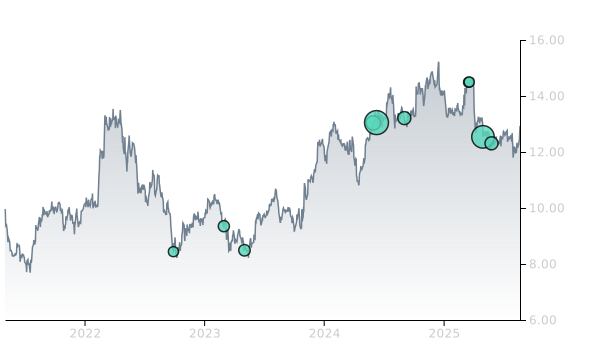
$WSR insiders have traded $WSR stock on the open market 4 times in the past 6 months. Of those trades, 4 have been purchases and 0 have been sales.
Here’s a breakdown of recent trading of $WSR stock by insiders over the last 6 months:
- DONALD A MILLER has made 4 purchases buying 20,000 shares for an estimated $253,800 and 0 sales.
To track insider transactions, check out Quiver Quantitative's insider trading dashboard.
$WSR Hedge Fund Activity
We have seen 97 institutional investors add shares of $WSR stock to their portfolio, and 117 decrease their positions in their most recent quarter.
Here are some of the largest recent moves:
- CSM ADVISORS, LLC added 581,167 shares (+inf%) to their portfolio in Q2 2025, for an estimated $7,252,964
- BLACKROCK, INC. removed 518,632 shares (-6.3%) from their portfolio in Q2 2025, for an estimated $6,472,527
- BALYASNY ASSET MANAGEMENT L.P. added 417,508 shares (+834.3%) to their portfolio in Q2 2025, for an estimated $5,210,499
- EMMETT INVESTMENT MANAGEMENT, LP added 343,687 shares (+42.9%) to their portfolio in Q2 2025, for an estimated $4,289,213
- SCHONFELD STRATEGIC ADVISORS LLC removed 324,739 shares (-100.0%) from their portfolio in Q1 2025, for an estimated $4,731,447
- HILLSDALE INVESTMENT MANAGEMENT INC. removed 303,100 shares (-100.0%) from their portfolio in Q2 2025, for an estimated $3,782,688
- FIRST EAGLE INVESTMENT MANAGEMENT, LLC removed 287,500 shares (-26.2%) from their portfolio in Q2 2025, for an estimated $3,588,000
To track hedge funds' stock portfolios, check out Quiver Quantitative's institutional holdings dashboard.
$WSR Analyst Ratings
Wall Street analysts have issued reports on $WSR in the last several months. We have seen 2 firms issue buy ratings on the stock, and 0 firms issue sell ratings.
Here are some recent analyst ratings:
- JMP Securities issued a "Market Outperform" rating on 06/18/2025
- Truist Securities issued a "Buy" rating on 05/12/2025
To track analyst ratings and price targets for $WSR, check out Quiver Quantitative's $WSR forecast page.
$WSR Price Targets
Multiple analysts have issued price targets for $WSR recently. We have seen 2 analysts offer price targets for $WSR in the last 6 months, with a median target of $15.0.
Here are some recent targets:
- Mitch Germain from JMP Securities set a target price of $16.0 on 06/18/2025
- Anthony Hau from Truist Securities set a target price of $14.0 on 05/12/2025
Full Release
HOUSTON, Sept. 22, 2025 (GLOBE NEWSWIRE) -- Whitestone REIT (NYSE: WSR) (“Whitestone” or the “Company”) today announced that through its operating partnership, Whitestone REIT Operating Partnership, L.P. (the “Operating Partnership”), it has amended, expanded and extended its $750 million credit facility, comprised of a $375 million revolver and $375 million term loan. The revolver is scheduled to mature in September 2029 with two six-month options to extend the maturity date and the term loan is scheduled to mature in January 2031.
The revolver has an initial interest rate of SOFR plus 1.40% ( 1) and the term loan has an initial interest rate of SOFR plus 1.35%. In addition, the Company entered into interest rate swaps to fix the interest rates on the $375 million term loan, locking in a rate between 3.36% and 3.42% (plus 1.35%) until maturity.
The renewal of the credit facility accomplishes several key objectives:
- Locks down a key earnings variable, strengthening Whitestone’s ability to hit their 5 – 7% Core FFO per share growth target in 2026, 2027 and 2028
- Extends Whitestone’s weighted average maturity date out to 2030 with no maturities due in 2026
- Reduces Whitestone’s current variable debt to approximately 12%
- Provides additional borrowing capacity
-
Expands the company’s bank group
“We are very pleased with the new facility, which includes a $215 million increase in size, lower interest rates, extended maturities and the addition of 3 strong new banks. Among the positive changes from the previous agreement was a lowering of the interest rate and an improvement in the capitalization rate used for valuation from 7% to 6.75%. These, and other improvements reflect the continued strengthening of our operations and financial position, and will provide additional liquidity and financial flexibility,” said Dave Holeman, Whitestone’s CEO. “Since our last extension in 2022, we have improved our leverage metrics by driving EBITDAre up, delivering top quartile Same Store Net Operating Income Growth and focusing on disciplined, effective capital spending. This agreement builds on the progress we’ve made over the last 3 years and lays the groundwork for additional consistent growth.”
The co-lead arrangers and joint-book runners for the facility were BMO Capital Markets Corp., BofA Securities, Inc., Capital One, National Association, Citizens Bank, N.A, KeyBanc Capital Markets Inc., Truist Securities, Inc., and U.S. Bank National Association.
(1) Based on the Company’s current leverage ratio as defined in the facility. Please see today’s 8 - K for more detail.
About Whitestone REIT
Whitestone REIT (NYSE: WSR) is a community-centered real estate investment trust (REIT) that acquires, owns, operates, and develops open-air, retail centers located in some of the fastest growing markets in the country: Phoenix, Austin, Dallas-Fort Worth, Houston and San Antonio.
Our centers are convenience focused: merchandised with a mix of service-oriented tenants providing food (restaurants and grocers), self-care (health and fitness), services (financial and logistics), education and entertainment to the surrounding communities. The Company believes its strong community connections and deep tenant relationships are key to the success of its current centers and its acquisition strategy. For additional information, please visit the Company's investor relations website.
Forward-Looking Statements
This Report contains forward-looking statements within the meaning of the federal securities laws, including discussion and analysis of our financial condition, pending acquisitions and the impact of such acquisitions on our financial condition and results of operations, anticipated capital expenditures required to complete projects, amounts of anticipated cash distributions to our shareholders in the future and other matters. These forward-looking statements are not historical facts but are the intent, belief or current expectations of our management based on its knowledge and understanding of our business and industry. Forward-looking statements are typically identified by the use of terms such as “may,” “will,” “should,” “potential,” “predicts,” “anticipates,” “expects,” “intends,” “plans,” “believes,” “seeks,” “estimates” or the negative of such terms and variations of these words and similar expressions, although not all forward-looking statements include these words. These statements are not guarantees of future performance and are subject to risks, uncertainties and other factors, some of which are beyond our control, are difficult to predict and could cause actual results to differ materially from those expressed or forecasted in the forward-looking statements.
Factors that could cause actual results to differ materially from any forward-looking statements made in this Report include: the imposition of federal income taxes if we fail to qualify as a real estate investment trust (“REIT”) in any taxable year or forego an opportunity to ensure REIT status; uncertainties related to the national economy, the real estate industry in general and in our specific markets; legislative or regulatory changes, including changes to laws governing REITs; adverse economic or real estate developments or conditions in Texas or Arizona, Houston and Phoenix in particular, including the potential impact of COVID-19 on our tenants’ ability to pay their rent, which could result in bad debt allowances or straight-line rent reserve adjustments; inflation and increases in interest rates, operating costs or general and administrative expenses; availability and terms of capital and financing, both to fund our operations and to refinance our indebtedness as it matures; decreases in rental rates or increases in vacancy rates; litigation risks; lease-up risks, including leasing risks arising from exclusivity and consent provisions in leases with significant tenants; our inability to renew tenant leases or obtain new tenant leases upon the expiration of existing leases; our inability to generate sufficient cash flows due to market conditions, competition, uninsured losses, changes in tax or other applicable laws; geopolitical conflicts, such as the ongoing conflict between Russia and Ukraine; the need to fund tenant improvements or other capital expenditures out of operating cash flow; and the risk that we are unable to raise capital for working capital, acquisitions or other uses on attractive terms or at all and other factors detailed in the Company's most recent Annual Report on Form 10-K, Quarterly Reports on Form 10-Q and other documents the Company files with the Securities and Exchange Commission from time to time.
Non-GAAP Financial Measures
This release contains supplemental financial measures that are not calculated pursuant to U.S. generally accepted accounting principles (“GAAP”) including EBITDAre, FFO, Core FFO, NOI and Same Store NOI. Following are explanations and reconciliations of these metrics to their most comparable GAAP metric.
EBITDAre: The National Association of Real Estate Investment Trusts (“NAREIT”) defines EBITDAre as net income computed in accordance with GAAP, plus interest expense, income tax expense, depreciation and amortization and impairment write-downs of depreciable property and of investments in unconsolidated affiliates caused by a decrease in value of depreciable property in the affiliate, plus or minus losses and gains on the disposition of depreciable property, including losses/gains on change in control and adjustments to reflect the entity’s share of EBITDAre of the unconsolidated affiliates and consolidated affiliates with non-controlling interests. We calculate EBITDAre in a manner consistent with the NAREIT definition. Management believes that EBITDAre represents a supplemental non-GAAP performance measure that provides investors with a relevant basis for comparing REITs. There can be no assurance the EBITDAre as presented by the Company is comparable to similarly titled measures of other REITs. EBITDAre should not be considered as an alternative to net income or other measurements under GAAP as indicators of operating performance or to cash flows from operating, investing or financing activities as measures of liquidity. EBITDAre does not reflect working capital changes, cash expenditures for capital improvements or principal payments on indebtedness.
FFO: Funds From Operations: NAREIT defines FFO as net income (loss) (calculated in accordance with GAAP), excluding depreciation and amortization related to real estate, gains or losses from the sale of certain real estate assets, gains and losses from change in control, and impairment write-downs of certain real estate assets and investments in entities when the impairment is directly attributable to decreases in the value of depreciable real estate held by the entity. We calculate FFO in a manner consistent with the NAREIT definition and also include adjustments for our unconsolidated real estate partnership.
Core Funds from Operations (“Core FFO”) is a non-GAAP measure. From time to time, we report or provide guidance with respect to “Core FFO” which removes the impact of certain non-recurring and non-operating transactions or other items we do not consider to be representative of our core operating results including, without limitation, default interest on debt of real estate partnership, extinguishment of debt cost, gains or losses associated with litigation involving the Company that is not in the normal course of business, and proxy contest costs.
Management uses FFO and Core FFO as a supplemental measure to conduct and evaluate our business because there are certain limitations associated with using GAAP net income alone as the primary measure of our operating performance. Historical cost accounting for real estate assets in accordance with GAAP implicitly assumes that the value of real estate assets diminishes predictably over time. Because real estate values instead have historically risen or fallen with market conditions, management believes that the presentation of operating results for real estate companies that use historical cost accounting is insufficient by itself. In addition, securities analysts, investors and other interested parties use FFO as the primary metric for comparing the relative performance of equity REITs. FFO and Core FFO should not be considered as alternatives to net income or other measurements under GAAP, as an indicator of our operating performance or to cash flows from operating, investing or financing activities as a measure of liquidity. FFO and Core FFO do not reflect working capital changes, cash expenditures for capital improvements or principal payments on indebtedness. Although our calculation of FFO is consistent with that of NAREIT, there can be no assurance that FFO and Core FFO presented by us is comparable to similarly titled measures of other REITs.
NOI: Net Operating Income: Management believes that NOI is a useful measure of our property operating performance. We define NOI as operating revenues (rental and other revenues) less property and related expenses (property operation and maintenance and real estate taxes). Other REITs may use different methodologies for calculating NOI and, accordingly, our NOI may not be comparable to other REITs. Because NOI excludes general and administrative expenses, depreciation and amortization, deficit in earnings of real estate partnership, interest expense, interest, dividend and other investment income, provision for income taxes, gain on sale of properties, loss on disposal of assets, and includes NOI of real estate partnership (pro rata) and net income attributable to noncontrolling interest, it provides a performance measure that, when compared year-over-year, reflects the revenues and expenses directly associated with owning and operating commercial real estate properties and the impact to operations from trends in occupancy rates, rental rates and operating costs, providing perspective not immediately apparent from net income. We use NOI to evaluate our operating performance since NOI allows us to evaluate the impact that factors such as occupancy levels, lease structure, lease rates and tenant base have on our results, margins and returns. In addition, management believes that NOI provides useful information to the investment community about our property and operating performance when compared to other REITs since NOI is generally recognized as a standard measure of property performance in the real estate industry. However, NOI should not be viewed as a measure of our overall financial performance since it does not reflect the level of capital expenditure and leasing costs necessary to maintain the operating performance of our properties, including general and administrative expenses, depreciation and amortization, equity or deficit in earnings of real estate partnership, interest expense, interest, dividend and other investment income, provision for income taxes, gain on sale of properties, and gain or loss on sale or disposition of assets.
Same Store NOI: Management believes that Same Store NOI is a useful measure of the Company’s property operating performance because it includes only the properties that have been owned for the entire period being compared, and that it is frequently used by the investment community. Same Store NOI assists in eliminating differences in NOI due to the acquisition or disposition of properties during the period being presented, providing a more consistent measure of the Company’s performance. The Company defines Same Store NOI as operating revenues (rental and other revenues, excluding straight-line rent adjustments, amortization of above/below market rents, and lease termination fees) less property and related expenses (property operation and maintenance and real estate taxes), Non-Same Store NOI, and NOI of our investment in Pillarstone OP (pro rata). We define “Non-Same Stores” as properties that have been acquired since the beginning of the period being compared and properties that have been sold, but not classified as discontinued operations. Other REITs may use different methodologies for calculating Same Store NOI, and accordingly, the Company's Same Store NOI may not be comparable to that of other REITs.
Investor and Media Contact:
David Mordy
Director of Investor Relations
Whitestone REIT
(713) 435-2219
[email protected]