


A survey reveals significant pay disparities for AI roles across countries, with the US leading in compensation.
Quiver AI Summary
A recent report from WTW reveals significant disparities in pay for artificial intelligence (AI) and digital talent across various countries, with the United States leading by a considerable margin. For mid-level Machine Learning roles, median total compensation in the US exceeds $170,000, notably higher than Germany's $122,000 and the UK's nearly $100,000. While average pay for these roles increased globally, Canada fell behind the UK in rankings, experiencing pay declines. WTW highlights that AI roles command higher salaries than other digital disciplines like cybersecurity and cloud computing due to a lack of specialized skills. Organizations are increasingly utilizing short and long-term incentives to attract and retain talent, and nearly half are offering tailored reward programs, including flexible working conditions and development opportunities, as they adapt to the rapidly changing digital landscape.
Potential Positives
- The latest salary survey indicates a significant growth in total compensation for AI and digital talent globally, showing an average increase of 6% in total compensation and highlighting a strengthening job market.
- The report emphasizes the growing strategic importance of AI roles compared to other digital disciplines, which could lead to increased demand and investment in these areas.
- Employers are adapting their reward strategies, incorporating long-term incentives to retain talent, reflecting a proactive approach to talent management in a competitive market.
- The survey reveals geographic variations in demand and supply for AI talent, providing valuable insights for businesses to tailor their recruitment and compensation strategies effectively.
Potential Negatives
- Canada recorded declines in median pay for AI roles, indicating a cooling labor market for digital talent in a mature economy.
- Machine learning and AI engineers rank lower in terms of current demand compared to software engineers, suggesting potential challenges in attracting talent.
- The press release emphasizes that employers must offer competitive and varied incentive packages, indicating that reliance solely on base pay may not be sufficient to retain talent.
FAQ
What are the salary trends for AI talent globally?
Salary for AI talent varies, with the US leading at over $170,000, while Germany and the UK follow at $122,000 and $100,000 respectively.
Which countries have seen the highest growth in AI salaries?
Mexico leads with a 19% increase in salaries and 29% in total compensation, while Brazil also experienced significant growth.
Are AI roles better compensated than cybersecurity and cloud roles?
Yes, AI roles generally command higher pay than cybersecurity and cloud computing positions due to the scarcity of advanced AI skills.
How are employers adjusting their pay structures for digital talent?
Employers are increasingly using differentiated reward programs, including flexible working and long-term incentives, to attract and retain digital talent.
What factors influence the demand for AI talent in different countries?
Demand for AI talent varies by country based on local supply, market maturity, and the specific skills required in each region.
Disclaimer: This is an AI-generated summary of a press release distributed by GlobeNewswire. The model used to summarize this release may make mistakes. See the full release here.
$WTW Insider Trading Activity
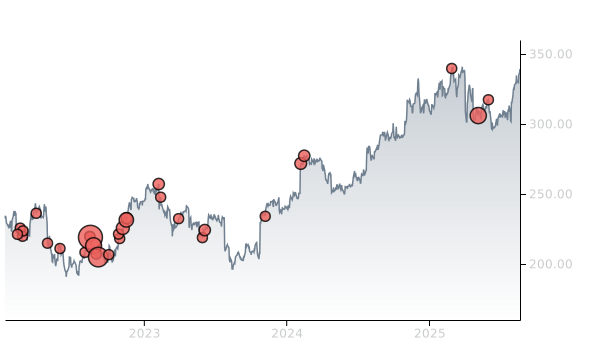
$WTW insiders have traded $WTW stock on the open market 1 times in the past 6 months. Of those trades, 0 have been purchases and 1 have been sales.
Here’s a breakdown of recent trading of $WTW stock by insiders over the last 6 months:
- MATTHEW FURMAN (General Counsel) sold 3,000 shares for an estimated $912,008
To track insider transactions, check out Quiver Quantitative's insider trading dashboard. You can access data on insider stock transactions through the Quiver Quantitative API.
$WTW Revenue
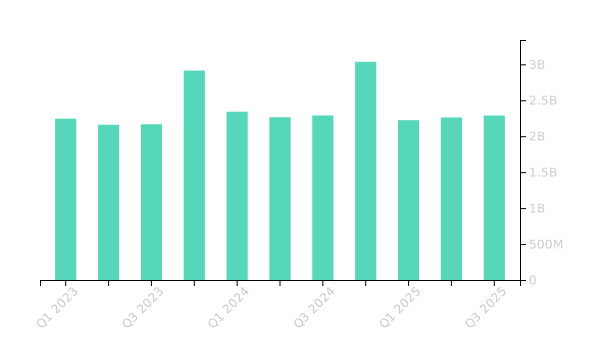
$WTW had revenues of $2.4B in Q1 2026. This is an increase of 8.5% from the same period in the prior year.
You can track WTW financials on Quiver Quantitative's WTW stock page.
$WTW Hedge Fund Activity
We have seen 304 institutional investors add shares of $WTW stock to their portfolio, and 395 decrease their positions in their most recent quarter.
Here are some of the largest recent moves:
- DODGE & COX added 3,293,334 shares (+90.7%) to their portfolio in Q4 2025, for an estimated $1,082,189,552
- HARRIS ASSOCIATES L P added 1,318,482 shares (+30.7%) to their portfolio in Q4 2025, for an estimated $433,253,185
- FMR LLC removed 1,119,109 shares (-33.6%) from their portfolio in Q4 2025, for an estimated $367,739,217
- UBS AM, A DISTINCT BUSINESS UNIT OF UBS ASSET MANAGEMENT AMERICAS LLC added 866,006 shares (+inf%) to their portfolio in Q4 2025, for an estimated $284,569,571
- BANK OF MONTREAL /CAN/ added 817,301 shares (+657.3%) to their portfolio in Q4 2025, for an estimated $268,565,108
- BLACKROCK, INC. removed 794,851 shares (-8.6%) from their portfolio in Q4 2025, for an estimated $261,188,038
- T. ROWE PRICE INVESTMENT MANAGEMENT, INC. removed 476,225 shares (-16.8%) from their portfolio in Q4 2025, for an estimated $156,487,535
To track hedge funds' stock portfolios, check out Quiver Quantitative's institutional holdings dashboard. You can access data on hedge funds moves and 13F filings through the Quiver Quantitative API.
$WTW Analyst Ratings
Wall Street analysts have issued reports on $WTW in the last several months. We have seen 3 firms issue buy ratings on the stock, and 1 firms issue sell ratings.
Here are some recent analyst ratings:
- BMO Capital issued a "Outperform" rating on 05/01/2026
- Barclays issued a "Underweight" rating on 01/08/2026
- Keefe, Bruyette & Woods issued a "Outperform" rating on 01/06/2026
- TD Cowen issued a "Buy" rating on 11/10/2025
To track analyst ratings and price targets for $WTW, check out Quiver Quantitative's $WTW forecast page.
$WTW Price Targets
Multiple analysts have issued price targets for $WTW recently. We have seen 14 analysts offer price targets for $WTW in the last 6 months, with a median target of $349.0.
Here are some recent targets:
- Yaron Kinar from Mizuho set a target price of $338.0 on 05/05/2026
- Brian Meredith from UBS set a target price of $400.0 on 05/04/2026
- Michael Zaremski from BMO Capital set a target price of $300.0 on 05/01/2026
- David Motemaden from Evercore ISI Group set a target price of $360.0 on 05/01/2026
- Paul Newsome from Piper Sandler set a target price of $283.0 on 05/01/2026
- Matthew Heimermann from Citigroup set a target price of $300.0 on 05/01/2026
- Joshua Shanker from B of A Securities set a target price of $347.0 on 04/14/2026
Full Release
NEW YORK, May 06, 2026 (GLOBE NEWSWIRE) -- Pay for artificial intelligence (AI) and digital talent continues to diverge sharply by country, with the United States extending its lead while Germany and the UK strengthen their positions in Europe, according to new findings from WTW’s (NASDAQ:WTW) latest Artificial Intelligence and Digital Talent Salary Survey Reports .
Median pay for Machine Learning roles (mid-level, technical expert) is highest in the US by a wide margin. At the median, total compensation for these roles (including: salary; allowances; short and long-term incentives) exceeds $170,000 in the US, compared to around $122,000 in Germany and just under $100,000 in the UK. Canada has fallen behind the UK this year, into fourth place for AI pay.
Across all countries studied* median pay for Machine Learning roles increased on average by 2% for salaries and 6% in total compensation, but Brazil and Mexico posted double-digit growth, with Mexico seeing a 19% rise in salaries and a 29% jump in total compensation. By contrast, Canada recorded declines in median pay for these roles, highlighting cooling pressure in some mature markets.
“AI pay is no longer just about where salaries are highest, but where momentum is building fastest and how employers are aligning pay and incentives to keep pace,” said Lesli Jennings, North America Leader for Work, Rewards, and Careers, WTW. “Employers that rely on last year’s assumptions risk falling behind, particularly as short and long-term incentives play a bigger role in fast-growing markets.”
AI still pays more than cyber and cloud
Across countries, AI Applications and Machine Learning roles continue to command higher pay than other high-demand digital disciplines such as cybersecurity and cloud computing engineering. WTW’s analysis attributes this gap to the scarcity of advanced AI skills, including algorithm design, neural networks and data modeling, alongside AI’s growing strategic importance across sectors.
Despite this, cloud computing pay is rising quickly. Median salaries for cloud engineering increased by an average of 9% across the ten countries, with total compensation up 12%. China and India saw particularly strong growth, reflecting rapid investment in cloud infrastructure across the Asia-Pacific region.
“Organizations are increasingly using short and long-term incentives to compete for scarce skills,” Jennings said. “In AI roles especially, stronger growth in total pay rather than base salary alone suggests that long-term incentives are becoming a more important retention lever. For example, we’re seeing some employers using Restricted Stock Units with regular vesting periods in order to make pay packages more attractive and ‘sticky’ in terms of retaining talent for longer.”
Hot roles vary by country
Despite the attention AI attracts, the survey reports find that the most in-demand digital roles globally remain software-led. Software engineers top the worldwide demand rankings, followed by application developers and data scientists. Machine learning and AI engineers rank lower in terms of current demand, although WTW expects their strategic importance to grow as adoption deepens and infrastructure readiness catches up.
Geographically, supply and demand for AI talent is highly concentrated. The US, India and Germany lead demand for both AI engineers and machine learning engineers. Supply is strongest in India, followed by the US, with Canada and Germany also featuring prominently.
“These patterns underline why a single global pay strategy rarely works,” Jennings said. “What is considered a hot role – and how organizations need to reward and develop those roles, depends heavily on local supply, maturity of adoption and the mix of incentives on offer.”
Employers rethink the full reward package
The survey reports also show that base pay alone is no longer enough. Nearly half of organizations now offer differentiated reward programs for digital talent. Enhanced base pay remains the most common tool, but flexible working, learning and development, retention bonuses and long-term incentives are increasingly used to attract and keep scarce skills. Organizations also are looking at their skills strategies – alongside pay – to support the attraction, development and retention of digital and AI talent.
As AI roles evolve and new positions emerge, WTW notes that employers are reassessing job design and career paths alongside pay, reflecting the fast-changing nature of the digital labor market.
Notes to editors
*The ten countries analyzed were: Brazil, Canada, China, France, Germany, India, Mexico, Spain, UK and US.
About WTW
At WTW (NASDAQ: WTW), we provide data-driven, insight-led solutions in the areas of people, risk and capital. Leveraging the global view and local expertise of our colleagues serving 140 countries and markets, we help organizations sharpen their strategy, enhance organizational resilience, motivate their workforce and maximize performance.
Working shoulder to shoulder with our clients, we uncover opportunities for sustainable success—and provide perspective that moves you. Learn more at wtwco.com.
Media contacts:
Ileana Feoli
+1 212 309 5504
[email protected]