


Viasat announced its entry into Boeing's evaluation process for the next-gen AERA antenna, enhancing connectivity for commercial airlines.
Quiver AI Summary
Viasat, Inc. has announced its entry into Boeing's technical evaluation process for the Viasat AERA, a next-generation electronically steered antenna terminal, at the Aircraft Interior Expo in Carlsbad, California. The AERA will be integrated into Boeing's commercial airplane programs using the Aerodynamic Shroud antenna fairing, becoming a selectable linefit option for airlines to enhance their connectivity offerings. Viasat AERA is designed to provide innovative multi-orbit connectivity, improving reliability and reducing operational complexity for airlines, while also enhancing the passenger Wi-Fi experience. Viasat aims to launch the AERA terminal in early 2028, featuring capabilities that evolve with software updates, ensuring long-term adaptability for airlines. The press release also highlights Viasat's commitment to developing global communications networks that connect people reliably and affordably.
Potential Positives
- Viasat has entered Boeing’s technical evaluation process for its next-generation AERA terminal, indicating strong collaboration with a major aerospace player.
- The AERA terminal will be a selectable linefit option, allowing airlines to seamlessly integrate new connectivity solutions into their aircraft, enhancing operational flexibility.
- Viasat AERA promises innovative technology that provides true multi-orbit flexibility and high reliability, potentially improving the passenger Wi-Fi experience significantly.
- The lightweight and low-profile design of the AERA terminal aims to reduce maintenance demands and operational costs for airlines, supporting long-term sustainability.
Potential Negatives
- The press release includes forward-looking statements that indicate potential challenges, such as risks associated with satellite performance and manufacturing delays, which could lead to significant operational setbacks.
- The mention of needing to assess and qualify Viasat AERA within Boeing's technical evaluation process may imply that certification is not guaranteed, potentially delaying market entry.
- The company's reliance on external factors like satellite capacity and relationships with key suppliers introduces uncertainty, which could adversely affect their strategic plans and investor confidence.
FAQ
What is Viasat AERA?
Viasat AERA is a next-generation electronically steered antenna terminal designed for enhanced connectivity in commercial airplanes.
When will Viasat AERA be available?
Viasat AERA is expected to enter the market in early 2028, following its certification process.
How does Viasat AERA improve connectivity?
It provides simultaneous multibeam technology for true multi-orbit flexibility, ensuring consistent Wi-Fi performance across various environments.
What are the benefits for airlines upgrading to Viasat AERA?
Airlines can reduce weight, minimize drag, and enhance operational efficiencies while providing next-generation connectivity without structural changes.
Is Viasat AERA compatible with existing aircraft?
The hardware is designed for easy integration, requiring no structural changes or extensive downtime for existing aircraft customers.
Disclaimer: This is an AI-generated summary of a press release distributed by GlobeNewswire. The model used to summarize this release may make mistakes. See the full release here.
$VSAT Insider Trading Activity

$VSAT insiders have traded $VSAT stock on the open market 20 times in the past 6 months. Of those trades, 0 have been purchases and 20 have been sales.
Here’s a breakdown of recent trading of $VSAT stock by insiders over the last 6 months:
- MARK D DANKBERG (Chairman and CEO) has made 0 purchases and 4 sales selling 300,000 shares for an estimated $11,052,173.
- SHAWN LYNN DUFFY (SVP, Chief Accounting Officer) has made 0 purchases and 2 sales selling 51,480 shares for an estimated $1,873,022.
- CRAIG ANDREW MILLER (SVP, Pres Viasat Government) has made 0 purchases and 3 sales selling 40,645 shares for an estimated $1,856,317.
- ROBERT JAMES BLAIR (SVP, General Counsel) has made 0 purchases and 3 sales selling 32,680 shares for an estimated $1,511,456.
- GARRETT L. CHASE (SVP, Chief Financial Officer) has made 0 purchases and 4 sales selling 25,000 shares for an estimated $872,636.
- BENJAMIN EDWARD PALMER (SVP, Pres Commercial) has made 0 purchases and 3 sales selling 7,580 shares for an estimated $325,668.
- CAMELLIA E FITZGERALD (Chief Accounting Officer) sold 2,810 shares for an estimated $134,880
To track insider transactions, check out Quiver Quantitative's insider trading dashboard.
$VSAT Revenue
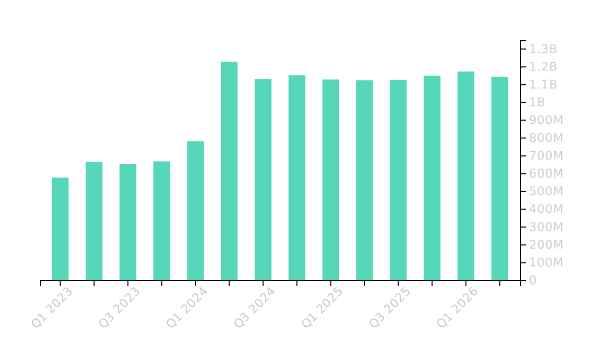
$VSAT had revenues of $1.2B in Q3 2026. This is an increase of 2.96% from the same period in the prior year.
You can track VSAT financials on Quiver Quantitative's VSAT stock page.
$VSAT Congressional Stock Trading
Members of Congress have traded $VSAT stock 1 times in the past 6 months. Of those trades, 1 have been purchases and 0 have been sales.
Here’s a breakdown of recent trading of $VSAT stock by members of Congress over the last 6 months:
- REPRESENTATIVE JONATHAN L. JACKSON purchased up to $100,000 on 01/22.
To track congressional stock trading, check out Quiver Quantitative's congressional trading dashboard.
$VSAT Hedge Fund Activity
We have seen 187 institutional investors add shares of $VSAT stock to their portfolio, and 139 decrease their positions in their most recent quarter.
Here are some of the largest recent moves:
- CANADA PENSION PLAN INVESTMENT BOARD removed 4,789,434 shares (-99.9%) from their portfolio in Q4 2025, for an estimated $165,043,895
- PRICE T ROWE ASSOCIATES INC /MD/ added 3,112,670 shares (+2821.7%) to their portfolio in Q4 2025, for an estimated $107,262,608
- MORGAN STANLEY removed 1,303,929 shares (-46.9%) from their portfolio in Q4 2025, for an estimated $44,933,393
- JANE STREET GROUP, LLC added 1,261,895 shares (+3459.0%) to their portfolio in Q4 2025, for an estimated $43,484,901
- ROYAL BANK OF CANADA removed 996,771 shares (-89.8%) from their portfolio in Q4 2025, for an estimated $34,348,728
- AMERICAN CENTURY COMPANIES INC added 917,644 shares (+24.7%) to their portfolio in Q4 2025, for an estimated $31,622,012
- UBS AM, A DISTINCT BUSINESS UNIT OF UBS ASSET MANAGEMENT AMERICAS LLC removed 772,026 shares (-74.7%) from their portfolio in Q4 2025, for an estimated $26,604,015
To track hedge funds' stock portfolios, check out Quiver Quantitative's institutional holdings dashboard.
$VSAT Price Targets
Multiple analysts have issued price targets for $VSAT recently. We have seen 4 analysts offer price targets for $VSAT in the last 6 months, with a median target of $49.5.
Here are some recent targets:
- Mathieu Robilliard from Barclays set a target price of $49.0 on 04/08/2026
- Ryan Koontz from Needham set a target price of $58.0 on 03/27/2026
- Edison Yu from Deutsche Bank set a target price of $48.0 on 02/09/2026
- Philip Cusick from JP Morgan set a target price of $50.0 on 11/11/2025
Full Release
CARLSBAD, Calif., April 14, 2026 (GLOBE NEWSWIRE) -- Viasat, Inc. (NASDAQ: VSAT), a global leader in satellite communications, today during the Aircraft Interior Expo (AIX), announced it has entered Boeing’s technical evaluation process to assess and qualify Viasat AERA, the company’s next-generation electronically steered antenna (ESA) terminal, across all current Boeing commercial airplane programs. Viasat AERA is designed for installation using the Boeing Aerodynamic Shroud antenna fairing, reinforcing its alignment with Boeing’s future-forward connectivity architecture.
Following certification of the system, Viasat AERA will be a selectable linefit option, enabling airlines to incorporate Viasat’s next generation, innovative hardware -- which is part of its widely adopted Viasat AMARA solution -- directly into their aircraft configuration and future fleet planning.
“This agreement continues our long tradition of working to bring powerful connectivity solutions to the market and is an important milestone in bringing Viasat AERA to airlines around the world,” said Brian Simone, Vice President of Aviation Products, Viasat. “Being linefit offerable will allow us to deliver a next-generation connectivity solution that enhances the passenger experience through simultaneous multi-orbit flexibility, and smart, adaptive traffic routing, while reducing operational complexity for airlines.”
Viasat
AERA:
Designed
to
Deliver
the
Connected
Journey
of
the
Future
Also at AIX, Viasat demonstrated progress on readiness for its planned entry of the Viasat AERA terminal into the market in early 2028, outlining innovative technologies and capabilities that will enable both airline and passenger benefits, including:
- Viasat AERA’s simultaneous multibeam technology is designed to unlock true multi-orbit flexibility in a way that has never been done commercially before. The terminal will leverage multiple satellite networks at the same time, helping ensure a very consistent connection across a wider range of geographies, airport environments, and flight conditions. For airlines, this means greater reliability and resiliency. For passengers, it means a smooth, snappy, and predictable Wi-Fi experience from gate-to-gate.
- Viasat AERA will be a lightweight, low-profile ESA solution built to deliver high performance with minimal maintenance demands. Its solid-state design and built-in redundancies will support long service life, mitigate service outages, and help reduce aircraft downtime, benefits that lower costs and help keep fleets reliably online.
-
Additionally, like the broader Viasat AMARA solution it supports, the Viasat AERA terminal is built to evolve. Its capabilities will be enhanced through software updates that support new features, performance improvements, and emerging satellite networks. This gives commercial airlines around the globe a long- term, path-forward solution that can grow alongside their connectivity strategy.
-
For existing Viasat customers that upgrade to Viasat AERA, the hardware is engineered to simplify the process, requiring no structural aircraft changes and minimizing aircraft downtime. The transition will reduce weight, cut drag and enable airlines to capture operational efficiencies while delivering next-generation connectivity.
About
Viasat
Viasat is a global communications company that believes everyone and everything in the world can be connected. With offices in 24 countries around the world, our mission shapes how consumers, businesses, governments and militaries around the world communicate and connect. Viasat is developing the ultimate global communications network to power high-quality, reliable, secure, affordable, fast connections to positively impact people’s lives anywhere they are—on the ground, in the air or at sea, while building a sustainable future in space. In May 2023, Viasat completed its acquisition of Inmarsat, combining the teams, technologies and resources of the two companies to create a new global communications partner. Learn more at
www.viasat.com
,
the
Viasat News Room
or follow us on
LinkedIn
,
X
,
Instagram
,
Facebook
,
Bluesky
,
Threads
, and
YouTube
.
Copyright © 2026 Viasat, Inc. All rights reserved. Viasat, the Viasat logo and the Viasat Signal are registered trademarks in the U.S. and in other countries of Viasat, Inc. All other product or company names mentioned are used for identification purposes only and may be trademarks of their respective owners.
Viasat,
Inc.
Contacts:
Scott Goryl, External Communications, Corporate & Aviation,
[email protected]
Lisa Curran/Peter Lopez, Investor Relations,
[email protected]
Forward-Looking
Statements
This press release contains forward-looking statements that are subject to the safe harbors created under the Securities Act of 1933 and the Securities Exchange Act of 1934. Forward-looking statements include, among others, statements related to the availability, features, performance and benefits of Viasat’s AMARA and AERA solutions. Readers are cautioned that actual results could differ materially and adversely from those expressed in any forward-looking statements. Factors that could cause actual results to differ include: our ability to successfully implement our business plan for our broadband services on our anticipated timeline or at all; risks associated with the construction, launch and operation of satellite, including the effect of any anomaly, operational failure or degradation in satellite performance; the availability of capacity on partner satellites; contractual problems; product defects; manufacturing issues or delays; regulatory issues; changes in relationships with, or the financial condition of, key suppliers; technologies not being developed according to anticipated schedules, or that do not perform according to expectations; and other factors affecting the aviation sector generally. In addition, please refer to the risk factors contained in Viasat's SEC filings available at
www.sec.gov,
including Viasat's most recent Annual Report on Form 10-K and Quarterly Reports on Form 10-Q. Readers are cautioned not to place undue reliance on any forward- looking statements, which speak only as of the date on which they are made. Viasat undertakes no obligation to update or revise any forward-looking statements for any reason.