


One-third of consumers consider altering insurance claims digitally, with rising sophistication in fraud detected by insurers.
Quiver AI Summary
A recent Verisk study reveals that a significant number of consumers, particularly 55% of Generation Z, are open to digitally altering images or documents related to insurance claims to strengthen their cases. Insurers are increasingly facing sophisticated media manipulation, with 98% acknowledging that AI-powered editing tools are contributing to a rise in digital fraud. While many insurers are investing in technology and tools for fraud detection, their confidence in identifying advanced forms of manipulation, such as deepfakes, remains low. The study highlights a generational divide in ethical perspectives on digital edits, with younger consumers more likely to justify alterations. As the prevalence of AI-driven fraud grows, concerns are rising about its broader impact on insurance premiums and claims processing, prompting calls for improved collaboration and technological integration within the industry to maintain trust and protect policyholders.
Potential Positives
- Verisk conducted a comprehensive study on insurance fraud that highlights the growing impact of AI-driven digital manipulation on the insurance claims process, positioning the company as a thought leader in addressing these emerging challenges.
- The study reveals significant data about consumer attitudes towards insurance fraud, providing valuable insights that can inform insurers' strategies to combat fraud and enhance operational practices.
- Verisk emphasizes the necessity for stronger collaboration and technology integration among insurers, which aligns with its mission to improve operational efficiency and trust in the insurance ecosystem.
- The findings underscore the increasing demand for advanced detection tools and a proactive approach to managing fraud risk, reinforcing Verisk's role as a critical partner in the insurance industry's evolution.
Potential Negatives
- Growing concern over digital media fraud may damage consumer trust in the insurance process, as a significant portion of consumers indicates a willingness to manipulate claim information.
- Insurers themselves express low confidence in their ability to detect manipulated claims effectively, undermining the integrity of the claims process.
- The anticipated increase in premiums due to rising digital fraud could lead to widespread dissatisfaction among policyholders, affecting the company's reputation and customer retention.
FAQ
What percentage of consumers consider altering insurance claim images?
One in three consumers, or 36%, would consider digitally altering an insurance claim image or document.
How has insurance fraud been affected by AI tools?
Nearly all insurers (98%) agree that AI-powered editing tools are driving an increase in digital insurance fraud.
What generational differences exist in attitudes toward digital editing?
55% of Generation Z and 49% of Millennials would consider altering claims, compared to just 12% of Baby Boomers.
How confident are insurers in detecting manipulated claims?
While 58% of insurers are confident in detecting real edits, only 32% feel confident identifying deepfakes.
What potential impacts do consumers expect from increased insurance fraud?
69% of consumers believe fraudulent claims will lead to higher premiums for all policyholders over time.
Disclaimer: This is an AI-generated summary of a press release distributed by GlobeNewswire. The model used to summarize this release may make mistakes. See the full release here.
$VRSK Insider Trading Activity
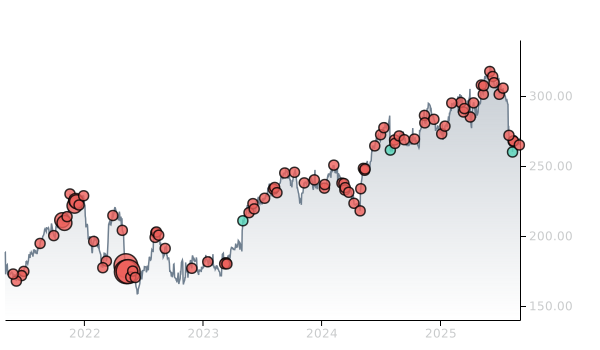
$VRSK insiders have traded $VRSK stock on the open market 11 times in the past 6 months. Of those trades, 5 have been purchases and 6 have been sales.
Here’s a breakdown of recent trading of $VRSK stock by insiders over the last 6 months:
- LEE SHAVEL (Chief Executive Officer) has made 0 purchases and 2 sales selling 2,200 shares for an estimated $480,766.
- ELIZABETH MANN (Chief Financial Officer) has made 0 purchases and 4 sales selling 1,200 shares for an estimated $280,044.
- GREGORY HENDRICK has made 2 purchases buying 1,000 shares for an estimated $198,150 and 0 sales.
- KIMBERLY S STEVENSON purchased 1,000 shares for an estimated $179,200
- JEFFREY J DAILEY purchased 500 shares for an estimated $108,515
- SABRA R. PURTILL purchased 450 shares for an estimated $98,077
To track insider transactions, check out Quiver Quantitative's insider trading dashboard.
$VRSK Revenue
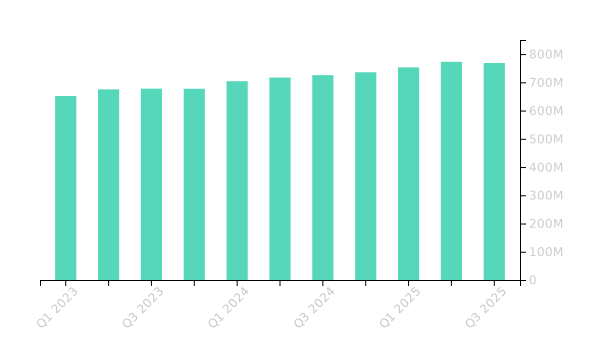
$VRSK had revenues of $778.8M in Q4 2025. This is an increase of 5.87% from the same period in the prior year.
You can track VRSK financials on Quiver Quantitative's VRSK stock page.
$VRSK Congressional Stock Trading
Members of Congress have traded $VRSK stock 7 times in the past 6 months. Of those trades, 2 have been purchases and 5 have been sales.
Here’s a breakdown of recent trading of $VRSK stock by members of Congress over the last 6 months:
- REPRESENTATIVE GILBERT RAY CISNEROS, JR. has traded it 4 times. They made 2 purchases worth up to $30,000 on 02/10, 11/18 and 2 sales worth up to $30,000 on 01/09, 12/19.
- REPRESENTATIVE RICK LARSEN sold up to $15,000 on 01/07.
- REPRESENTATIVE JULIE JOHNSON sold up to $15,000 on 11/03.
- REPRESENTATIVE VAL T. HOYLE sold up to $15,000 on 09/23.
To track congressional stock trading, check out Quiver Quantitative's congressional trading dashboard.
$VRSK Hedge Fund Activity
We have seen 486 institutional investors add shares of $VRSK stock to their portfolio, and 579 decrease their positions in their most recent quarter.
Here are some of the largest recent moves:
- UBS AM, A DISTINCT BUSINESS UNIT OF UBS ASSET MANAGEMENT AMERICAS LLC removed 3,979,155 shares (-74.3%) from their portfolio in Q4 2025, for an estimated $890,097,181
- CAPITAL INTERNATIONAL INVESTORS added 3,013,400 shares (+1200.9%) to their portfolio in Q4 2025, for an estimated $674,067,446
- FMR LLC removed 1,738,173 shares (-40.1%) from their portfolio in Q4 2025, for an estimated $388,811,918
- D. E. SHAW & CO., INC. added 1,157,181 shares (+60.2%) to their portfolio in Q4 2025, for an estimated $258,849,817
- MASSACHUSETTS FINANCIAL SERVICES CO /MA/ removed 665,802 shares (-25.9%) from their portfolio in Q4 2025, for an estimated $148,933,249
- MACKENZIE FINANCIAL CORP removed 615,341 shares (-86.5%) from their portfolio in Q4 2025, for an estimated $137,645,628
- MILLENNIUM MANAGEMENT LLC removed 559,893 shares (-88.0%) from their portfolio in Q4 2025, for an estimated $125,242,465
To track hedge funds' stock portfolios, check out Quiver Quantitative's institutional holdings dashboard.
$VRSK Analyst Ratings
Wall Street analysts have issued reports on $VRSK in the last several months. We have seen 5 firms issue buy ratings on the stock, and 1 firms issue sell ratings.
Here are some recent analyst ratings:
- Barclays issued a "Overweight" rating on 10/30/2025
- RBC Capital issued a "Outperform" rating on 10/30/2025
- Wells Fargo issued a "Overweight" rating on 10/30/2025
- JP Morgan issued a "Overweight" rating on 10/30/2025
- Rothschild & Co issued a "Sell" rating on 10/16/2025
- Seaport Global issued a "Buy" rating on 10/01/2025
To track analyst ratings and price targets for $VRSK, check out Quiver Quantitative's $VRSK forecast page.
$VRSK Price Targets
Multiple analysts have issued price targets for $VRSK recently. We have seen 10 analysts offer price targets for $VRSK in the last 6 months, with a median target of $235.0.
Here are some recent targets:
- C. Gregory Peters from Raymond James set a target price of $260.0 on 03/02/2026
- Jason Haas from Wells Fargo set a target price of $240.0 on 03/02/2026
- Andrew Steinerman from JP Morgan set a target price of $220.0 on 02/19/2026
- Ashish Sabadra from RBC Capital set a target price of $230.0 on 02/19/2026
- Andre Benjamin from Goldman Sachs set a target price of $206.0 on 02/19/2026
- David Motemaden from Evercore ISI Group set a target price of $216.0 on 02/19/2026
- Toni Kaplan from Morgan Stanley set a target price of $270.0 on 12/17/2025
Full Release
- One in three consumers would consider digitally altering an insurance claim image or document to strengthen their case – and that number rises to 55 percent of Generation Z.
- Three out of four insurers (76 percent) say manipulated media submissions have grown more sophisticated – even as confidence lags in detecting deepfakes at scale.
-
New
Verisk State of Insurance Fraud
study points to a need for stronger collaboration, more connected systems and technology to help protect policyholders and preserve trust.
JERSEY CITY, N.J., March 17, 2026 (GLOBE NEWSWIRE) -- From adjusting the lighting in a photo to repairing a blurry image, AI‑powered image editing tools have become part of everyday life – and increasingly, part of the insurance claims process. New data from the Verisk State of Insurance Fraud study reveals that more than one third of consumers (36 percent) would consider digitally altering a claim image or document, even if it would break insurer rules . At the same time, insurers report a sharp rise in manipulated media, with nearly all (98 percent) agreeing that AI‑powered editing tools are fueling an increase in digital insurance fraud.
Verisk (Nasdaq: VRSK), a leading global data analytics and technology provider to the insurance industry, commissioned the Verisk State of Insurance Fraud study to provide insights into how artificial intelligence is reshaping risk and consequences for all participants in the insurance ecosystem, from insurers to policyholders.
“AI editing tools are changing how people interact with digital content, and insurance is feeling that shift in real time,” said Shane Riedman, president of Anti‑Fraud Analytics at Verisk. “Our concern is that many consumers don’t see small edits as crossing a line, but when those changes make their way into claims, they can materially affect outcomes. As manipulated media becomes more common, many insurers face growing pressure to establish clearer boundaries, improve visibility, and prevent fraud – while preserving a fair and efficient claims experience for policyholders.”
Anyone Can Do It: AI Tools Make Digital Insurance Fraud More Accessible
AI‑powered editing tools are no longer niche or technical – they’re often widely used, easy to access and increasingly realistic. Nearly half (44 percent) of consumers who have used AI editing tools to modify a photo, video or document describe the results of their edits as “very realistic,” underscoring how convincingly altered content can now resemble the real thing.
As use becomes more commonplace, personal exposure to AI‑driven manipulation is also growing.
- Four in 10 consumers (41 percent) say they know someone who has used AI editing tools to alter or create a photo, video, or document for financial gain – including in insurance claims, product returns or online sales.
- This figure jumps to 64 percent for Gen Z and 54 percent for millennial respondents.
-
When it comes to insurance specifically, 62 percent of consumers believe people use AI tools to manipulate claim documents often or very often.
Insurers are seeing the same trend play out in real time: 98 percent agree that AI‑powered editing tools are driving a rise in digital media fraud, 99 percent say they have encountered manipulated or AI‑altered documentation, and 76 percent of insurers report that AI-altered claims submissions have become more sophisticated in the past year .
As AI‑powered editing becomes more accessible and more convincing, the Verisk State of Insurance Fraud study shows that many insurers are facing a growing volume of manipulated media that blurs the line between everyday digital behavior and fraud – raising the stakes for claims operations, detection capabilities and trust across the insurance ecosystem.
The Ethics Gap: A Generational Divide
While most Americans say they draw a clear ethical line in principle, real‑world behavior tells a more complicated story: more than one third (36 percent) say they would still be at least somewhat likely to consider digitally altering a claim to strengthen their case – even if doing so would break insurer rules .
This gap is most pronounced among younger generations:
- Half of Generation Z and Millennials (55 and 49 percent, respectively) say they would consider making a digital edit to strengthen a claim.
- Only 28 percent of Generation X respondents, and just 12 percent of Baby Boomers would consider doing so.
These generational differences suggest that younger consumers may be more comfortable navigating gray areas around digital edits, especially as AI tools become more embedded in everyday technology use.
When it comes to specific edits: just over half of consumers (52 percent) say adjusting brightness or contrast to make damage easier to see is acceptable, and 49 percent are comfortable cropping out unrelated background elements. More concerning, a meaningful minority of consumers say it is acceptable to fabricate or misrepresent claim evidence – including exaggerating damage (15 percent) or even creating images of damage that never occurred (13 percent) . Taken together, the data points to a growing ethics gap in which increasingly powerful digital tools are normalizing behavior that can materially affect claim outcomes – creating new challenges for insurers charged with maintaining fairness, consistency, and trust.
Insurers Work to Keep Pace as Digital Fraud Grows More Sophisticated
As manipulated media becomes more common and more sophisticated, two-thirds of insurers (66 percent) believe digital media fraud goes undetected often or very often across the industry . Against that backdrop, many insurers are investing heavily to strengthen their defenses – combining AI tools, training and human review to identify suspicious claims.
- Nearly two‑thirds of insurers (65 percent) say they use automated, AI‑based detection tools provided by third parties or vendors.
- Half of insurers (50 percent) report using internally developed AI tools.
Yet confidence in these defenses has not kept pace with the evolving threat. While 58 percent of insurers say they are very confident in their ability to detect edits made to real photos or videos, that confidence drops sharply when it comes to more advanced forms of manipulation. Fewer than half of insurers (43 percent) feel very confident in their organization’s ability to assess the authenticity of digital media at scale, and just 32 percent of insurers say they are very confident they could identify a deepfake .
“Insurers aren’t standing still, but the threat is evolving faster than many systems were built to handle,” Riedman said. “Detection tools that aren’t fully integrated into claims workflows can create blind spots. As deepfakes and other AI‑driven manipulation become more common, the carriers will need more connected systems and shared intelligence to keep pace.”
How Digital Fraud is Redefining Insurance Economics, for Insurers and Policyholders
As AI‑driven digital manipulation becomes more widespread, both consumers and insurers expect its impact to extend far beyond individual claims. Nearly seven in 10 consumers (69 percent) believe fraudulent insurance claims will increase premiums for all policyholders over time , not just those involved in claims . When asked about their top concerns related to AI‑driven insurance fraud, consumers most often point to broader system‑wide effects – including the potential for higher premiums (42 percent) and the risk that legitimate claims could be delayed or denied if altered documents are mistakenly flagged as suspicious (36 percent).
These concerns mirror how many insurers themselves view the road ahead. Looking three to five years out, nearly half of insurers (48 percent) expect increased adoption of technology solutions to offset rising digital media fraud , alongside greater regulatory consistency across the industry. Many also anticipate tighter documentation or proof‑of‑loss requirements for claimants (45 percent), greater operational strain on claims teams (36 percent), longer claim cycle times (35 percent), and higher premiums for consumers (35 percent). Together, these expectations point to a future in which AI‑driven digital fraud reshapes not just fraud prevention, but the cost, complexity, and expectations surrounding insurance claims more broadly.
“This isn’t a problem any one insurer can solve in isolation,” Verisk’s Riedman said. “As digital manipulation techniques evolve and deepfakes become more prevalent, many insurers are under pressure to close structural and operational gaps and move toward more connected systems. Doing that effectively will require shared intelligence and better integration – not only to keep pace with increasingly sophisticated fraud, but to help ensure legitimate claims continue to be paid quickly and fairly, and trust in the claims process is preserved.”
About the Verisk State of Insurance Fraud study
The Verisk State of Insurance Fraud study is based on two national surveys – one of 1,000 U.S. consumers and another of 300 insurance claims professionals. The survey was designed to examine how the rapid adoption of AI editing tools is reshaping consumer behavior, fraud risk and insurer readiness.
For more information, click here .
###
About Verisk
Verisk (Nasdaq: VRSK) is a leading strategic data analytics and technology partner to the global insurance industry. It empowers clients to strengthen operating efficiency, improve underwriting and claims outcomes, combat fraud and make informed decisions about global risks, including climate change, catastrophic events, sustainability and political issues. Through advanced data analytics, software, scientific research and deep industry knowledge, Verisk helps build global resilience for individuals, communities and businesses. With teams across more than 20 countries, Verisk consistently earns certification by
Great Place to Work
. For more, visit
Verisk.com
and the
Verisk Newsroom
.