


TransUnion projects moderate growth in mortgage and unsecured personal loan originations for 2026, with varied performance across other credit products.
Quiver AI Summary
TransUnion's 2026 credit originations forecast indicates ongoing growth in mortgage and unsecured personal loan originations, driven by consumer demand despite a mixed performance in other credit products. The company's Q4 2025 Credit Industry Insights Report shows that mortgage originations are rebounding from low levels, with both purchase and refinance segments expected to see continued growth. Unsecured personal loans are projected to have their third consecutive year of growth. However, credit card and auto loan originations are expected to exhibit more moderate increases or declines. Overall, the lending landscape is normalizing, with lenders adopting a cautious approach to growth, while consumer credit demand remains robust, particularly if interest rates decrease further. Delinquencies have slightly increased, but new lending strategies are yielding better performance for recent loans, especially in the subprime segment.
Potential Positives
- TransUnion projects continued growth in mortgage originations and unsecured personal loans, highlighting strong consumer demand for credit in 2026.
- The forecast indicates a positive trend in the housing market and consumer lending, with mortgage purchase and refinance originations rebounding from low levels.
- Unsecured personal loan originations are expected to achieve a third consecutive year of growth, marking a significant trend in consumer credit behavior.
- The report reflects growing confidence in the economy, as evidenced by anticipated moderate growth across multiple credit categories despite a mixed performance overall.
Potential Negatives
- Forecasted demand for certain credit products shows mixed performance, indicating potential instability or challenges in those categories.
- The increase in consumer-level delinquencies, particularly in the unsecured personal loan segment, may signal growing financial strain among borrowers.
- The revision of earlier projections for growth in credit products suggests a lack of confidence in optimistic forecasts, which can impact investor sentiments.
FAQ
What is TransUnion's 2026 credit originations forecast?
TransUnion forecasts continued momentum in mortgage and unsecured personal loan originations for 2026, with modest growth projected across these sectors.
How much are mortgage originations expected to grow in 2026?
Mortgage originations are expected to grow by 4.0% for purchases and 4.2% for refinances in 2026.
What trends are expected for unsecured personal loans?
Unsecured personal loans are projected to see an 11.2% growth in originations in 2026, marking a strong demand trend.
How are auto loan originations expected to change in 2026?
Auto loan originations are expected to decrease by 1.5% in 2026, following gains driven by early purchases in 2025.
What insights does TransUnion provide about credit card performance?
TransUnion anticipates a 2.0% increase in credit card originations for 2026, following a period of significant growth in 2025.
Disclaimer: This is an AI-generated summary of a press release distributed by GlobeNewswire. The model used to summarize this release may make mistakes. See the full release here.
$TRU Insider Trading Activity
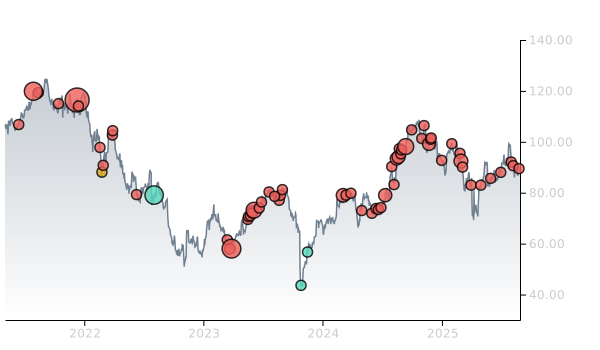
$TRU insiders have traded $TRU stock on the open market 12 times in the past 6 months. Of those trades, 0 have been purchases and 12 have been sales.
Here’s a breakdown of recent trading of $TRU stock by insiders over the last 6 months:
- HEATHER J RUSSELL (EVP, Chief Legal Officer) sold 5,337 shares for an estimated $480,383
- STEVEN M CHAOUKI (President, US Markets) has made 0 purchases and 5 sales selling 5,000 shares for an estimated $419,530.
- TIFFANI CHAMBERS (EVP, Chief Operations Officer) sold 4,318 shares for an estimated $371,348
- TODD C. SKINNER (President, International) has made 0 purchases and 3 sales selling 1,500 shares for an estimated $122,785.
- JENNIFER A. WILLIAMS (SVP, Chief Accounting Officer) has made 0 purchases and 2 sales selling 1,000 shares for an estimated $88,646.
To track insider transactions, check out Quiver Quantitative's insider trading dashboard.
$TRU Revenue
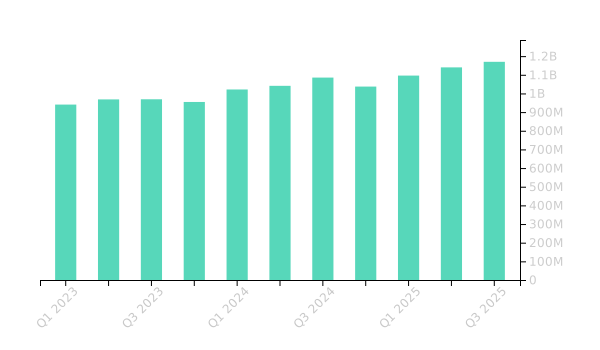
$TRU had revenues of $1.2B in Q4 2025. This is an increase of 12.98% from the same period in the prior year.
You can track TRU financials on Quiver Quantitative's TRU stock page.
$TRU Hedge Fund Activity
We have seen 288 institutional investors add shares of $TRU stock to their portfolio, and 351 decrease their positions in their most recent quarter.
Here are some of the largest recent moves:
- DODGE & COX added 9,842,006 shares (+inf%) to their portfolio in Q4 2025, for an estimated $843,952,014
- INDEPENDENT FRANCHISE PARTNERS LLP added 4,561,619 shares (+99.7%) to their portfolio in Q4 2025, for an estimated $391,158,829
- FARALLON CAPITAL MANAGEMENT LLC removed 4,057,075 shares (-85.7%) from their portfolio in Q4 2025, for an estimated $347,894,181
- UBS AM, A DISTINCT BUSINESS UNIT OF UBS ASSET MANAGEMENT AMERICAS LLC removed 3,759,939 shares (-76.3%) from their portfolio in Q4 2025, for an estimated $322,414,769
- APG ASSET MANAGEMENT N.V. removed 3,389,850 shares (-96.7%) from their portfolio in Q4 2025, for an estimated $290,679,637
- VICTORY CAPITAL MANAGEMENT INC removed 3,188,762 shares (-97.6%) from their portfolio in Q4 2025, for an estimated $273,436,341
- FMR LLC added 2,792,325 shares (+166.4%) to their portfolio in Q4 2025, for an estimated $239,441,868
To track hedge funds' stock portfolios, check out Quiver Quantitative's institutional holdings dashboard.
$TRU Analyst Ratings
Wall Street analysts have issued reports on $TRU in the last several months. We have seen 3 firms issue buy ratings on the stock, and 0 firms issue sell ratings.
Here are some recent analyst ratings:
- Needham issued a "Buy" rating on 02/13/2026
- JP Morgan issued a "Overweight" rating on 10/24/2025
- BMO Capital issued a "Outperform" rating on 10/24/2025
To track analyst ratings and price targets for $TRU, check out Quiver Quantitative's $TRU forecast page.
$TRU Price Targets
Multiple analysts have issued price targets for $TRU recently. We have seen 9 analysts offer price targets for $TRU in the last 6 months, with a median target of $93.0.
Here are some recent targets:
- Toni Kaplan from Goldman Sachs set a target price of $80.0 on 02/17/2026
- Manav Patnaik from Barclays set a target price of $80.0 on 02/13/2026
- Kyle Peterson from Needham set a target price of $95.0 on 02/13/2026
- Jason Haas from Wells Fargo set a target price of $90.0 on 02/13/2026
- Shlomo Rosenbaum from Stifel set a target price of $88.0 on 02/13/2026
- Toni Kaplan from Morgan Stanley set a target price of $120.0 on 12/17/2025
- Andrew Steinerman from JP Morgan set a target price of $107.0 on 10/24/2025
Full Release
CHICAGO, Feb. 19, 2026 (GLOBE NEWSWIRE) -- TransUnion (NYSE: TRU) released its 2026 credit originations forecast, highlighting continued momentum in originations for mortgages as well as for unsecured personal loans. These growth trends come as forecasted demand for other credit products shows mixed performance. TransUnion released the originations forecast alongside its Q4 2025 Credit Industry Insights Report (CIIR), which pointed to continued expansion in consumer lending at the end of 2025.
The 2026 originations forecast points to mortgage and unsecured personal loans as the primary drivers of projected expansion. Mortgage originations, both purchase and refinance, are set to extend the rebound of the past two years from near-record low levels, and unsecured personal loans are on pace for a third consecutive year of annual growth. These shifts illustrate continued consumer demand for credit in 2026 across most products, though at slower levels of growth than in 2025 as the broader credit landscape continues to normalize.
Mortgage and Unsecured Personal Loans are Expected to See Moderate Growth in 2026
| Annual Originations (annual growth) | 2026** | 2025** | 2024 | 2023 | 2022 | |
| Auto | -1.5 % | 4.9% | 2.4% | -6.1% | -10.9% | |
| Credit Card | 2.0 % | 9.0% | -5.1% | -4.3% | 10.4% | |
| Mortgage | Purchase | 4.0 % | 2.3% | 4.6% | -24.7% | -30.2% |
| Refinance | 4.2 % | 28.1% | 50.6% | -68.6% | -75.1% | |
| Unsecured Personal Loans | 11.2 %* | 20.8%* | 13.9% | -11.4% | 18.4% | |
**Forecasted
*An earlier version of the news release referenced initial projections of 5.7% and 20.2%, which have since been updated.
Source: TransUnion U.S. Consumer Credit Database, Mortgage Bankers Association (MBA) Forecast
Credit cards are also expected to see a modest increase in originations for 2026; however, it’s worth noting that this expansion comes on the heels of near-record growth in 2025. Auto loan originations are expected to edge lower, following 2025 gains that were driven largely by consumers who accelerated purchases in advance of anticipated tariffs and the end of the EV tax credit.
“We expect lending activity to remain measured across most categories as lenders take a disciplined approach to profitable growth, using more data and services to better manage risk and fraud,” said Jason Laky, executive vice president and head of financial services at TransUnion. “At the same time, consumer demand for credit remains strong across risk tiers and will likely strengthen further if interest rates fall more than expected in the coming quarters.”
TransUnion’s Q4 2025 Credit Industry Insights Report saw originations gains as delinquencies edged up
Early signs of this forecasted originations growth can be seen when looking back to late 2025, where year-over-year (YoY) increases emerged across credit cards, unsecured personal loans and auto. At the same time, more consumers continued to drift away from the mid-level risk tiers and toward the highest and lowest risk tiers, reshaping portfolio dynamics for lenders. After remaining unchanged for the past several years, the median VantageScore ® posted a YoY decline in Q4 2025, down 2 points to 711, signaling a subtle, but meaningful change in overall consumer credit health.
“After several years marked by credit behaviors influenced by stubbornly high inflation and elevated interest rates, we may be seeing signs of a return to more traditional growth,” said Michele Raneri, vice president and head of U.S. research and consulting at TransUnion. “As these more typical patterns return, it’s more important than ever for lenders to leverage advanced tools, including trended data, to more accurately assess evolving risk profiles.”
To learn more about the latest consumer credit trends, register for the Q4 2025 Quarterly Credit Industry Insights Report webinar . Read on for more specific insights about credit cards, personal loans, auto loans and mortgages.
Bankcard originations surge as balances hold steady
Q4 2025 CIIR Credit Card Summary
-
Bankcard originations rose 11.7% year-over-year in Q3 2025, marking the fourth consecutive quarterly increase and the strongest annual growth in three years.
Growth was primarily driven by both the subprime and super prime segments.
-
Total balances grew 4.2% year-over-year in Q4 2025 to $1.15 trillion, with the pace of growth holding steady for the fourth consecutive quarter.
Total new credit lines rose 9.2% year-over-year as issuers continued shifting toward more below-prime accounts with lower initial credit limits to help manage risk.
-
Consumer-level delinquencies ticked up after four consecutive quarters of year-over-year improvement, though overall levels remain consistent with those seen in 2023.
The 90+ days past due (DPD) delinquency rate on a consumer basis rose 2 basis points to 2.58%, remaining relatively flat over the last 3 years.
Instant Analysis
“Origination volume is expected to remain flat or experience slight seasonal declines next quarter, with a growing share shifting toward below-prime consumers. The continued expansion of the bankcard market reflects strengthened originations across all risk tiers, reflecting a measured commitment to maintaining credit access for consumers throughout the risk spectrum. We anticipate that balances will hold their current pace of growth in the near term.”
- Paul Siegfried, senior vice president, credit card business leader at TransUnion
Q4 2025 Credit Card Trends
| Credit Card Lending Metric (Bankcard) | Q4 2025 | Q4 2024 | Q4 2023 | Q4 2022 |
| Number of Credit Cards (Bankcards) | 581.0 million | 561.5 million | 542.6 million | 518.4 million |
| Borrower-Level Delinquency Rate (90+ DPD) | 2.58 % | 2.56% | 2.59% | 2.26% |
| Total Credit Card Balances | $1.15 Trillion | $1.11 Trillion | $1.05 Trillion | $931 billion |
| Average Debt Per Borrower | $ 6,715 | $6,580 | $6,360 | $5,805 |
| Number of Consumers Carrying a Balance | 176.4 million | 173.1 million | 169.9 million | 166.0 million |
| Prior Quarter Originations* | 21.3 million | 19.1 million | 20.1 million | 21.6 million |
| Average New Account Credit Lines* | $ 5,587 | $5,702 | $5,673 | $5,226 |
Source: TransUnion U.S. Consumer Credit Database
*Note: Originations are viewed one quarter in arrears to account for reporting lag.
For more credit card industry information,
click here
for episodes of
Extra Credit: A Card and Banking Podcast by TransUnion
.
Click here
for a credit card industry infographic.
Unsecured personal loan demand sets a new high as lenders navigate shifting risk
Q4 2025 CIIR Unsecured Personal Loan Summary
-
Unsecured personal loan originations reached a record 7.2M in Q3 2025, the second consecutive quarter of new highs.
Subprime drove growth with a 32.5% YoY increase in originations, while near prime and super prime segments each rose 21.5%. FinTech lenders held a 42% share of originations, up from roughly one‑third a year earlier.
-
Total unsecured personal loan balances climbed to a record $276B in Q4 2025, held across 26.4M consumers carrying a balance.
Subprime borrowers again led expansion with a 17% YoY increase. Despite record totals, average balances per consumer and per account remained flat YoY.
-
The consumer-level 60+ days past due delinquency rate rose to 3.99% in Q4 2025 from 3.57% a year earlier, the largest YoY increase since early 2023 and consistent with late-2022/2023 levels.
Delinquency rose across all risk tiers, with subprime showing the sharpest increase at about half a percentage point. Even so, vintage data indicate new accounts originated in Q1 and Q2 2025 are going delinquent at a lower rate than in prior years, particularly within subprime.
Instant Analysis
“More Americans are turning to unsecured personal loans, and lenders are meeting that demand with stronger risk management. FinTechs remain the most active issuers, and even at elevated growth levels, especially among non‑prime borrowers, performance reflects disciplined underwriting and recalibrated risk strategies. Although account‑ and consumer‑level delinquency increased year over year, balance‑level performance held steady. Recent vintages also show newer subprime loans outperforming older cohorts, while super‑prime performance has deteriorated slightly.”
- Josh Turnbull, senior vice president, consumer lending business leader at TransUnion
Q4 2025 Unsecured Personal Loan Trends
| Personal Loan Metric | Q4 2025 | Q4 2024 | Q4 2023 | Q4 2022 |
| Total Balances | $276 billion | $251 billion | $245 billion | $222 billion |
| Number of Unsecured Personal Loans | 32.7 million | 29.6 million | 28.1 million | 27.0 million |
| Number of Consumers with Unsecured Personal Loans | 26.4 million | 24.5 million | 23.5 million | 22.5 million |
| Borrower-Level Delinquency Rate (60+ DPD) | 3.99 % | 3.57% | 3.90% | 4.14% |
| Average Debt Per Borrower | $ 11,699 | $11,607 | $11,773 | $11,116 |
| Average Account Balance | $ 8,421 | $8,496 | $8,704 | $8,195 |
| Prior Quarter Originations* | 7.2 million | 5.8 million | 5.0 million | 5.6 million |
Source: TransUnion U.S. Consumer Credit Database
*Note: Originations are viewed one quarter in arrears to account for reporting lag.
Click here
for additional unsecured personal loan industry metrics.
Click here
for an unsecured personal loan industry infographic.
Mortgage and home equity originations see gains as delinquencies edge up
Q4 2025 CIIR Mortgage Loan Summary
-
Mortgage originations rose 6.5% YoY in Q3 2025 to 1.34M, supported by increased purchase demand and stronger refinance activity.
Purchase mortgage volume grew 4.2% YoY and made up roughly 80% of all originations, slightly below last year’s 82.1%. Rate‑and‑term refinances jumped 25.7% YoY, marking their eighth straight quarter of growth.
-
Home
‑
equity originations increased 14.3% YoY in Q3 2025 to 714K, the sixth consecutive quarter of expansion.
HELOCs rose 15.8% YoY to 352K, also the sixth straight quarterly gain, with Gen X and Baby Boomers representing the largest borrower segments at 38% and 30%. HELOAN volume climbed 12.9% YoY, with growth rates led by strong Gen Z activity, which surged 29% YoY.
-
Consumer
‑
level 60+ days past due mortgage delinquencies edged up to 1.51% in Q4 2025, marking the 15th consecutive quarter of YoY increases.
FHA loans continued to account for the largest share of these delinquencies, while VA loans again posted the fastest YoY growth.
Instant Analysis
“As we move through 2026, easing 30‑year mortgage rates should improve affordability for both buyers and refinancers. Homeowners are also tapping accumulated equity, with home‑equity originations posting a sixth straight quarter of growth. We’re seeing further signs of normalization as inventory reaches its most balanced levels in nearly a decade. We’re encouraged by the momentum created by falling rates, increased supply and strong equity positions. Overall, the outlook remains positive as long as stakeholders stay focused and responsive.”
- Satyan Merchant, senior vice president, automotive and mortgage business leader at TransUnion
Q4 2025 Mortgage Trends
| Mortgage Lending Metric | Q4 2025 | Q4 2024 | Q4 2023 | Q4 2022 |
| Number of Mortgage Loans | 54.6 million | 53.8 million | 52.9 million | 52.6 million |
| Consumer-Level Delinquency Rate (60+ DPD) | 1.51 % | 1.31% | 1.03% | 0.89% |
| Prior Quarter Originations* | 1.3 million | 1.3 million | 1.2 million | 1.5 million |
| Average Loan Amounts of New Mortgage Loans* | 368,729 | 350,250 | 337,977 | 334,339 |
| Average Balance per Consumer | $ 269,562 | $261,631 | $258,167 | $252,212 |
| Total Balances of All Mortgage Loans | $12.8 trillion | $12.3 trillion | $12.0 trillion | $11.7 trillion |
Source: TransUnion U.S. Consumer Credit Database
* O
riginations are viewed one quarter in arrears to account for reporting lag.
Click here
for additional mortgage industry metrics.
Click here
for a mortgage industry infographic.
Auto lending ticks up as borrowers take on higher payments and larger loans
Q4 2025 CIIR Auto Loan Summary
-
Auto loan originations rose 6.2% YoY to 6.7 million in Q3 2025.
Despite ongoing affordability challenges and tariff concerns impacting consumer vehicle demand, every risk tier posted YoY gains. Subprime (+13.8%) and super prime (+8.8%) led growth, while prime (+1.0%) saw a more modest increase.
-
Average monthly payments continued to climb.
New vehicle payments rose 3.4% YoY to $782, while used vehicle payments increased 3.1% YoY to $538. Amounts financed also grew. New‑car financing rose 4.9% YoY to $44,495, and used‑car financing increased 4.3% YoY to $27,278.
-
Accounts 60+ days past due reached 1.50% in Q4 2025, up three basis points YoY.
While delinquency continued to rise, increases were driven more by used vehicles, with delinquencies up 10 bps YoY compared to a 4 bps increase for new vehicles—signaling a slower pace of overall deterioration.
Instant Analysis
“Rising vehicle prices continue to push loan sizes and monthly payments higher, shifting a greater share of new loan originations to super prime consumers, who are better positioned to absorb these increases. These trends underscore persistent affordability pressures that make it harder for many consumers to manage the total cost of ownership. While tariffs add to these challenges, broader pricing dynamics suggest affordability constraints are likely to persist if current patterns continue.”
- Satyan Merchant, senior vice president, automotive and mortgage business leader at TransUnion
Q4 2025 Auto Loan Trends
| Auto Lending Metric | Q4 2025 | Q4 2024 | Q4 2023 | Q4 2022 |
|
Total Auto Loan Accounts
|
79.6 million | 80.4 million | 80.4 million | 80.2 million |
| Prior Quarter Originations 1 | 6.7 million | 6.4 million | 6.3 million | 6.5 million |
| Average Monthly Payment NEW 2 | $ 782 | $756 | $751 | $729 |
| Average Monthly Payment USED 2 | $ 538 | $522 | $530 | $526 |
| Average Balance per Consumer | $ 24,822 | $24,373 | $23,945 | $22,998 |
| Average Amount Financed on New Auto Loans 2 | $ 44,495 | $42,402 | $41,041 | $41,923 |
| Average Amount Financed on Used Auto Loans 2 | $ 27,278 | $26,162 | $26,378 | $27,455 |
| Account-Level Delinquency Rate (60+ DPD) | 1.50 % | 1.47% | 1.42% | 1.26% |
Source: TransUnion U.S. Consumer Credit Database
1
Note: Originations are viewed one quarter in arrears to account for reporting lag.
2
Data from S&P Global
MobilityAutoCreditInsight
, Q4 2025 data only for months of October & November.
Click here
for additional auto industry metrics.
For more information about the report, please register for the Q4 2025 Credit Industry Insight Report webinar .
About TransUnion (NYSE: TRU)
TransUnion is a global information and insights company with over 13,000 associates operating in more than 30 countries. We make trust possible by ensuring each person is reliably represented in the marketplace. We do this with a Tru™ picture of each person: an actionable view of consumers, stewarded with care. Through our acquisitions and technology investments we have developed innovative solutions that extend beyond our strong foundation in core credit into areas such as marketing, fraud, risk and advanced analytics. As a result, consumers and businesses can transact with confidence and achieve great things. We call this Information for Good® — and it leads to economic opportunity, great experiences and personal empowerment for millions of people around the world.
http://www.transunion.com/business
| Contact | Dave Blumberg |
| TransUnion | |
| [email protected] | |
| Telephone | 312-972-6646 |