


New data reveals significant diagnostic gaps and burdens of tardive dyskinesia in individuals with mood disorders, especially young adults.
Quiver AI Summary
New data from the IMPACT-TD Registry reveals that tardive dyskinesia (TD) significantly burdens individuals, particularly those with mood disorders, across all ages. The analysis found that 85% of young adults aged 18-29 with mood disorders experienced moderate to severe impacts from TD, yet only 23% received a formal diagnosis. This highlights a critical diagnostic gap. The study, which is the largest of its kind, measured the multidimensional impacts of TD and found a notable delay in diagnosis, with patients waiting over 3.5 years after symptoms appeared. Teva Pharmaceuticals emphasizes its commitment to bridging these gaps in diagnosis and improving patient outcomes, recognizing the profound effects TD has on daily living and mental health.
Potential Positives
- Teva Pharmaceuticals highlights a significant gap in diagnosing tardive dyskinesia (TD) in young adults with mood disorders, showcasing the company's commitment to addressing this critical healthcare issue.
- The new data presented at a prominent medical conference emphasizes the company's dedication to advancing research and improving patient outcomes in a condition that affects a substantial portion of those on mental health treatments.
- Teva's involvement in the largest TD study to date, the IMPACT-TD Registry, reinforces its position as a leader in the field of neuropsychiatry and indicates a strong focus on patient-centric research.
Potential Negatives
- The low rate of formal diagnosis of tardive dyskinesia (TD) among young adults (23%) suggests a significant failure in the healthcare system that may reflect poorly on Teva's efforts, as they are involved in addressing this condition.
- The average delay of more than 3.5 years for patients to be diagnosed after recognizing their symptoms indicates an ineffective diagnostic process, which could undermine confidence in the company's commitment to improving patient outcomes.
- The high levels of moderate to severe impact on patients, especially in younger demographics, highlight a pressing medical need that may not be effectively addressed by Teva's current treatment options or strategies.
FAQ
What is the IMPACT-TD Registry?
The IMPACT-TD Registry is a comprehensive study examining the progression and impact of tardive dyskinesia in diverse populations.
How many young adults with mood disorders experience severe TD impact?
According to the study, 85% of young adults aged 18-29 with mood disorders face moderate to severe impact from TD.
What percentage of young adults received a formal TD diagnosis?
Only 23% of young adults aged 18-29 in the study received a formal diagnosis of tardive dyskinesia.
How long do patients typically wait for a TD diagnosis?
Patients often wait over 3.5 years for a formal diagnosis after their involuntary movements are recognized.
What commitments has Teva Pharmaceuticals made regarding TD?
Teva is dedicated to advancing research, identifying diagnostic gaps, and improving outcomes for patients living with tardive dyskinesia.
Disclaimer: This is an AI-generated summary of a press release distributed by GlobeNewswire. The model used to summarize this release may make mistakes. See the full release here.
$TEVA Insider Trading Activity
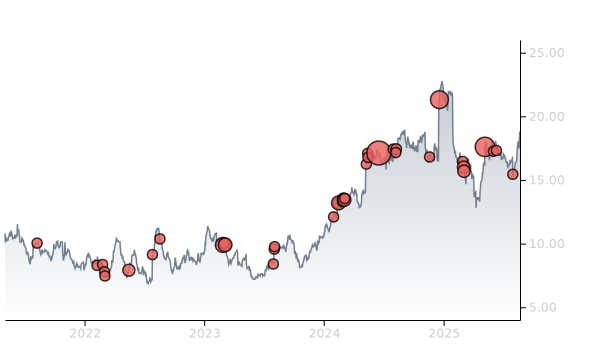
$TEVA insiders have traded $TEVA stock on the open market 29 times in the past 6 months. Of those trades, 0 have been purchases and 29 have been sales.
Here’s a breakdown of recent trading of $TEVA stock by insiders over the last 6 months:
- RICHARD D FRANCIS (President and CEO) has made 0 purchases and 4 sales selling 486,353 shares for an estimated $15,726,934.
- ELIYAHU SHARON KALIF (EVP, Chief Financial Officer) sold 345,810 shares for an estimated $11,634,708
- RICHARD DANIELL (EVP, Europe Commercial) has made 0 purchases and 7 sales selling 353,093 shares for an estimated $11,016,289.
- MARK SABAG (See "Remarks") has made 0 purchases and 3 sales selling 278,994 shares for an estimated $8,102,570.
- ROBERTO MIGNONE has made 0 purchases and 2 sales selling 127,400 shares for an estimated $3,642,150.
- ERIC A HUGHES (See "Remarks") has made 0 purchases and 4 sales selling 101,572 shares for an estimated $3,281,447.
- CHRISTINE FOX (EVP, U.S. Commercial) has made 0 purchases and 3 sales selling 45,251 shares for an estimated $1,245,825.
- MATTHEW SHIELDS (EVP, Global Operations) sold 17,295 shares for an estimated $547,704
- PLACID JOVER (See "Remarks") sold 14,150 shares for an estimated $448,107
- AMIR WEISS (Chief Accounting Officer) sold 12,300 shares for an estimated $371,504
- BRIAN SAVAGE (Interim Chief Legal Officer) has made 0 purchases and 2 sales selling 2,401 shares for an estimated $76,916.
To track insider transactions, check out Quiver Quantitative's insider trading dashboard. You can access data on insider stock transactions through the Quiver Quantitative API insider transaction endpoint.
$TEVA Hedge Fund Activity
We have seen 321 institutional investors add shares of $TEVA stock to their portfolio, and 290 decrease their positions in their most recent quarter.
Here are some of the largest recent moves:
- NORGES BANK added 33,318,265 shares (+1786.8%) to their portfolio in Q4 2025, for an estimated $1,039,863,050
- WCM INVESTMENT MANAGEMENT, LLC added 26,813,522 shares (+191.4%) to their portfolio in Q1 2026, for an estimated $807,623,282
- GLENVIEW CAPITAL MANAGEMENT, LLC removed 10,032,460 shares (-60.1%) from their portfolio in Q1 2026, for an estimated $302,177,695
- SLATE PATH CAPITAL LP removed 7,927,998 shares (-100.0%) from their portfolio in Q4 2025, for an estimated $247,432,817
- BLACKROCK, INC. added 6,833,776 shares (+11.7%) to their portfolio in Q1 2026, for an estimated $205,833,333
- CAPITAL WORLD INVESTORS added 6,472,554 shares (+274.1%) to their portfolio in Q1 2026, for an estimated $194,953,326
- RUBRIC CAPITAL MANAGEMENT LP removed 6,105,510 shares (-28.6%) from their portfolio in Q1 2026, for an estimated $183,897,961
To track hedge funds' stock portfolios, check out Quiver Quantitative's institutional holdings dashboard. You can access data on hedge funds moves and 13F filings through the Quiver Quantitative API 13F endpoint.
$TEVA Analyst Ratings
Wall Street analysts have issued reports on $TEVA in the last several months. We have seen 6 firms issue buy ratings on the stock, and 0 firms issue sell ratings.
Here are some recent analyst ratings:
- Truist Securities issued a "Buy" rating on 04/30/2026
- Barclays issued a "Overweight" rating on 01/30/2026
- Jefferies issued a "Buy" rating on 01/06/2026
- Piper Sandler issued a "Overweight" rating on 12/22/2025
- Goldman Sachs issued a "Buy" rating on 12/19/2025
- JP Morgan issued a "Overweight" rating on 12/16/2025
To track analyst ratings and price targets for $TEVA, check out Quiver Quantitative's $TEVA forecast page.
$TEVA Price Targets
Multiple analysts have issued price targets for $TEVA recently. We have seen 9 analysts offer price targets for $TEVA in the last 6 months, with a median target of $42.0.
Here are some recent targets:
- Glen Santangelo from Barclays set a target price of $40.0 on 05/06/2026
- David Amsellem from Piper Sandler set a target price of $42.0 on 04/30/2026
- Ashwani Verma from UBS set a target price of $42.0 on 04/30/2026
- Chris Schott from JP Morgan set a target price of $40.0 on 04/30/2026
- Les Sulewski from Truist Securities set a target price of $45.0 on 04/30/2026
- Jason Gerberry from B of A Securities set a target price of $42.0 on 04/09/2026
- Matt Dellatorre from Goldman Sachs set a target price of $45.0 on 02/09/2026
Full Release
- New analysis from the IMPACT-TD Registry confirms tardive dyskinesia (TD) causes a significant burden for most individuals with concomitant mood disorders, impacting their lives regardless of age
- The data shows that 85% of young adults with mood disorders living with TD movements, ages 18-29 (n=13), experience moderate to severe TD impact, yet only 23% received a formal diagnosis of TD, revealing a gap in disease identification
-
Teva is dedicated to advancing research and initiatives that deepen clinical understanding, identify diagnostic gaps and improve outcomes for patients with TD
PARSIPPANY, N.J. and TEL AVIV, Israel, May 18, 2026 (GLOBE NEWSWIRE) -- Teva Pharmaceuticals, a U.S. affiliate of Teva Pharmaceutical Industries Ltd. (NYSE and TASE: TEVA), today announced new data from the ongoing, real-world IMPACT-TD Registry, highlighting a significant gap in diagnosing tardive dyskinesia (TD) in patients with underlying mood disorders. While the findings demonstrate that most patients across all age groups experience multidimensional impact from the condition, young adults (aged 18-29, n=13) had the lowest rate of formal diagnosis (23%) despite having one of the highest rates of personal impact (85%). The data were presented at the 2026 American Psychiatric Association Annual Meeting, taking place May 16 – 20, 2026 in San Francisco, California.
“The latest data from the IMPACT-TD Registry underscores the profound, multidimensional impact of tardive dyskinesia on individuals, extending far beyond any single demographic. Despite its widespread impact, we are still confronted with meaningful diagnostic gaps, leaving many patients undiagnosed and untreated,” said Verena Ramirez Campos, MD-MBA, Vice President U.S. Medical Affairs and Global Innovative Strategy at Teva. “We are committed to grasping the complete human experience of TD, and working to help close those gaps and bring forth innovations that make a meaningful difference in the day-to-day lives of people living with TD.”
The IMPACT-TD Registry, the largest TD study to date, is a 3-year, prospective, non-interventional, Phase 4 study examining how TD progresses over time and the impact it has on patients’ lives. 1-3 The study, which includes a broad representation of people affected by TD (age, sex, race/ethnicity, underlying conditions, movement severity and treatment status), evaluates 611 participants aged ≥18 years who, at enrollment, had either a score of ≥2 on at least one item of the Abnormal Involuntary Movement Scale (AIMS) and probable TD, or were receiving vesicular monoamine transporter 2 (VMAT2) inhibitor therapy for TD. The present analysis of the IMPACT-TD Registry evaluated 211 adults with TD who were not receiving VMAT2 inhibitor therapy at enrollment and had concomitant mood disorders, such as bipolar disorder (60%) or depression (54%), reflecting a diverse, real-world patient population. Multidimensional impact of TD was measured using the clinician-reported IMPACT-TD scale, while TD severity was assessed by AIMS.
The IMPACT-TD findings revealed:
- A majority of participants, regardless of age, reported a moderate to severe global impact from TD. This burden was particularly high for those aged 18-29 (85%) and 50-59 (87%, n=57), demonstrating that TD significantly affects daily life across the adult lifespan.
- The psychological impact of TD was most pronounced in adults aged <60. Over three-quarters (77%) of those aged 18-29 experienced moderate to severe psychological effects despite lower AIMS scores (6.4) on average compared to older adults aged 60-69 (8.4, n=56) and >69 (9.9, n=28).
- Despite the high impact, formal TD diagnosis rates were lowest among adults <40 years old. The rate was 23% for participants aged 18-29 and 35% for participants aged 30-39 (n=20), well below the peak of 57% seen in adults aged 40-49 (n=37) and 47% average in the 50+ age subgroups.
-
A significant delay in diagnosis was also identified, with patients waiting an average of more than 3.5 years to be formally diagnosed after their involuntary movements were first recognized.
“Beyond the visible symptoms, tardive dyskinesia impacts every aspect of daily living, from personal independence to social interaction and emotional wellbeing,” said Richard Jackson, MD, an Assistant Clinical Adjunct Professor in the University of Michigan School of Medicine’s Department of Psychiatry and IMPACT-TD principal investigator. “What remains a critical unknown is how this debilitating condition uniquely impacts those already struggling with mood disorders, especially at different ages. The IMPACT-TD study is designed to bridge this crucial knowledge gap, giving us the insights we urgently need to offer targeted, meaningful support to every TD patient, no matter their background.”
Teva is committed to assisting in addressing these significant diagnostic gaps, which could improve the lives of those living with tardive dyskinesia.
About Tardive Dyskinesia (TD)
Tardive dyskinesia (TD) is a highly debilitating, chronic movement disorder that affects one in four people who take certain mental health treatments and is characterized by uncontrollable, abnormal, and repetitive movements of the face, torso, and/or other body parts, which may be disruptive and negatively impact individuals.
4-6
About Teva
Teva Pharmaceutical Industries Ltd. (NYSE and TASE: TEVA) is transforming into a leading innovative biopharmaceutical company, enabled by a world-class generics business. For over 120 years, Teva’s commitment to bettering health has never wavered. From innovating in the fields of neuroscience and immunology to providing complex generic medicines, biosimilars and pharmacy brands worldwide, Teva is dedicated to addressing patients’ needs, now and in the future. At Teva, We Are All In For Better Health. To learn more about how, visit
www.tevapharm.com
.
Teva Cautionary Note Regarding Forward Looking Statements
This press release contains forward-looking statements within the meaning of the Private Securities Litigation Reform Act of 1995, which are based on management’s current beliefs and expectations and are subject to substantial risks and uncertainties, both known and unknown, that could cause our future results, performance or achievements to differ significantly from that expressed or implied by such forward-looking statements. You can identify these forward-looking statements by the use of words such as “should,” “expect,” “anticipate,” “estimate,” “target,” “may,” “project,” “intend,” “plan,” “believe” and other words and terms of similar meaning and expression in connection with any discussion of future operating or financial performance. Important factors that could cause or contribute to such differences include risks relating to: our ability to successfully continue to develop and commercialize products for the treatment of tardive dyskinesia and for the treatment of chorea associated with Huntington’s disease, and to improve the lives of those living with tardive dyskinesia; our ability to successfully compete in the marketplace, including our ability to develop and commercialize additional pharmaceutical products; our ability to successfully execute our Pivot to Growth strategy, including to expand our innovative and biosimilar medicines pipeline and profitably commercialize the innovative medicines and biosimilar portfolio, whether organically or through business development; and other factors discussed in our Quarterly Report on Form 10-Q for the first quarter of 2026 and in our Annual Report on Form 10-K for the year ended December 31, 2025, including in the section captioned “Risk Factors.” Forward-looking statements speak only as of the date on which they are made, and we assume no obligation to update or revise any forward-looking statements or other information contained herein, whether as a result of new information, future events or otherwise. You are cautioned not to put undue reliance on these forward-looking statements.
References:
- Finkbeiner S, Konings M, Henegar M, et al. Multidimensional impact of tardive dyskinesia: interim analysis of clinician-reported measures in the IMPACT-TD registry. Poster presented at: Annual Psych Congress Elevate; May 30-June 2, 2024; Las Vegas, NV.
- Data on file. Parsippany, NJ: Teva Neuroscience, Inc.
- American Psychiatric Association. Practice Guideline for the Treatment of Patients With Schizophrenia. 3rd ed. American Psychiatric Association; 2021.
- Warikoo N, Schwartz T, Citrome L. Tardive dyskinesia. In: Schwartz TL, Megna J, Topel ME, eds. Antipsychotic Drugs. Hauppauge, NY: Nova Science Publishers. 2013:235-258.
- Waln O, Jankovic J. An Update on Tardive Dyskinesia: From Phenomenology to Treatment. Tremor Other Hyperkinet Mov. 2013;3:1-11.
- Tardive dyskinesia. National Alliance on Mental Illness website. https://www.nami.org/Learn-More/Treatment/Mental-Health-Medications/Tardive-Dyskinesia. Accessed May 4, 2023.
|
Teva Media
Inquiries |
[email protected] |
|
Teva Investor
Relations Inquiries |
[email protected] |