


Preclinical data supports TSHA-102's efficacy for Rett syndrome, showing superior MeCP2 expression and functionality via scAAV9 delivery.
Quiver AI Summary
Taysha Gene Therapies, Inc. has announced new preclinical data demonstrating that its gene therapy candidate TSHA-102, which utilizes a self-complementary AAV9 (scAAV9) vector, achieves approximately 30-fold higher expression of the MeCP2 protein compared to the single-stranded AAV9 (ssAAV9) vector. This enhanced efficiency supports the drug's delivery to the central nervous system through lumbar intrathecal administration. Additionally, the miniaturized MeCP2 (miniMeCP2) protein in TSHA-102 exhibits functional similarities to the full-length MeCP2 protein. The data will be presented at the American Society of Gene and Cell Therapy Annual Meeting in May 2026, further validating the design of TSHA-102 and providing translational support for ongoing Phase 1/2 trials in patients with Rett syndrome, a severe neurodevelopmental disorder. The company will also share updates on long-term safety and efficacy data from the trials later this quarter.
Potential Positives
- In vitro data shows that self-complementary AAV9 (scAAV9) enables approximately 30-fold higher MeCP2 protein expression compared to single-stranded AAV9 (ssAAV9), indicating significant potential for more effective gene delivery to the CNS.
- The miniMeCP2 protein in TSHA-102 demonstrates functional comparability to full-length MeCP2, supporting the design of the therapy and providing confidence in its efficacy.
- Data validate the selection of scAAV9 and miniMeCP2 for the TSHA-102 construct and offer translational support for positive results seen in the early phases of clinical trials for Rett syndrome.
- TSHA-102 has received multiple regulatory designations, including Breakthrough Therapy and Fast Track, which may expedite its development and market access for patients with unmet medical needs.
Potential Negatives
- Data presented in the press release relies heavily on preclinical in vitro results, which may not fully translate to clinical efficacy in human patients during trials.
- The statement regarding the anticipated reporting of longer-term safety and efficacy data may raise concerns among investors about the timeline and potential delays in trial progress.
- The mention of risks and uncertainties associated with forward-looking statements suggests significant unknowns that could impact the company's performance and stock value.
FAQ
What is TSHA-102 and its purpose?
TSHA-102 is a gene therapy in clinical evaluation for Rett syndrome, designed to deliver a functional MECP2 to the CNS.
How does self-complementary AAV9 compare to single-stranded AAV9?
Self-complementary AAV9 enables approximately 30-fold higher MeCP2 protein expression than single-stranded AAV9 in neuronal cells.
What role does miniMeCP2 play in TSHA-102?
MiniMeCP2 is functionally comparable to full-length MeCP2, ensuring stable expression in neuronal cells within TSHA-102.
What clinical trials is TSHA-102 involved in?
TSHA-102 is being evaluated in the REVEAL Phase 1/2 clinical trials for patients with Rett syndrome.
Where will the new preclinical data be presented?
The preclinical data will be presented at the ASGCT Annual Meeting in Boston from May 11-15, 2026.
Disclaimer: This is an AI-generated summary of a press release distributed by GlobeNewswire. The model used to summarize this release may make mistakes. See the full release here.
$TSHA Insider Trading Activity
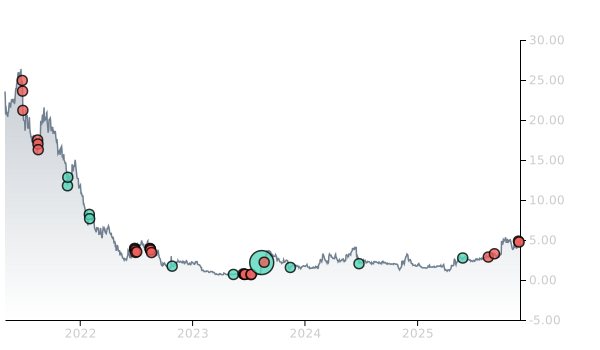
$TSHA insiders have traded $TSHA stock on the open market 11 times in the past 6 months. Of those trades, 0 have been purchases and 11 have been sales.
Here’s a breakdown of recent trading of $TSHA stock by insiders over the last 6 months:
- SUKUMAR NAGENDRAN (President and Head of R&D) has made 0 purchases and 6 sales selling 886,222 shares for an estimated $4,077,374.
- SEAN P. NOLAN (Chief Executive Officer) has made 0 purchases and 2 sales selling 178,101 shares for an estimated $840,196.
- KAMRAN ALAM (CHIEF FINANCIAL OFFICER) has made 0 purchases and 3 sales selling 104,472 shares for an estimated $492,522.
To track insider transactions, check out Quiver Quantitative's insider trading dashboard. You can access data on insider stock transactions through the Quiver Quantitative API.
$TSHA Hedge Fund Activity
We have seen 116 institutional investors add shares of $TSHA stock to their portfolio, and 72 decrease their positions in their most recent quarter.
Here are some of the largest recent moves:
- RTW INVESTMENTS, LP removed 8,623,287 shares (-34.5%) from their portfolio in Q4 2025, for an estimated $47,428,078
- VESTAL POINT CAPITAL, LP added 8,250,000 shares (+150.0%) to their portfolio in Q4 2025, for an estimated $45,375,000
- HEALTHCARE OF ONTARIO PENSION PLAN TRUST FUND added 3,722,000 shares (+inf%) to their portfolio in Q4 2025, for an estimated $20,471,000
- STATE STREET CORP added 3,553,619 shares (+49.1%) to their portfolio in Q4 2025, for an estimated $19,544,904
- POINT72 ASSET MANAGEMENT, L.P. removed 3,462,788 shares (-47.2%) from their portfolio in Q4 2025, for an estimated $19,045,334
- DEERFIELD MANAGEMENT COMPANY, L.P. removed 2,663,835 shares (-49.5%) from their portfolio in Q4 2025, for an estimated $14,651,092
- POLAR CAPITAL HOLDINGS PLC added 2,637,524 shares (+49.8%) to their portfolio in Q4 2025, for an estimated $14,506,382
To track hedge funds' stock portfolios, check out Quiver Quantitative's institutional holdings dashboard. You can access data on hedge funds moves and 13F filings through the Quiver Quantitative API.
$TSHA Analyst Ratings
Wall Street analysts have issued reports on $TSHA in the last several months. We have seen 2 firms issue buy ratings on the stock, and 0 firms issue sell ratings.
Here are some recent analyst ratings:
- Chardan Capital issued a "Buy" rating on 01/06/2026
- Citizens issued a "Market Outperform" rating on 11/05/2025
To track analyst ratings and price targets for $TSHA, check out Quiver Quantitative's $TSHA forecast page.
$TSHA Price Targets
Multiple analysts have issued price targets for $TSHA recently. We have seen 5 analysts offer price targets for $TSHA in the last 6 months, with a median target of $12.0.
Here are some recent targets:
- Whitney Ijem from Canaccord Genuity set a target price of $17.0 on 04/06/2026
- Geulah Livshits from Chardan Capital set a target price of $12.0 on 03/19/2026
- Gil Blum from Needham set a target price of $12.0 on 03/19/2026
- Yanan Zhu from Wells Fargo set a target price of $11.0 on 01/05/2026
- Silvan Tuerkcan from Citizens set a target price of $8.0 on 11/05/2025
Full Release
In vitro data demonstrated self-complementary AAV9 (scAAV9) enabled ~30-fold higher MeCP2 protein expression compared to single-stranded AAV9 (ssAAV9), supporting the ability to effectively deliver TSHA-102 to the CNS by lumbar IT administration
MiniMeCP2 is functionally comparable to full-length MeCP2 across molecular and biochemical functions, with both proteins exhibiting comparable, stable expression in neuronal cells
Data further validate the selection of scAAV9 and miniMeCP2 in the TSHA-102 construct and provide translational support for the Part A REVEAL Phase 1/2 clinical data in patients with Rett syndrome
DALLAS, April 27, 2026 (GLOBE NEWSWIRE) -- Taysha Gene Therapies, Inc. (Nasdaq: TSHA) (Taysha or the Company), a clinical-stage biotechnology company focused on advancing adeno-associated virus (AAV)-based gene therapies for severe monogenic diseases of the central nervous system (CNS), today announced that it will present new preclinical in vitro data from a head-to-head evaluation of TSHA-102 (scAAV9-mini MeCP2 ) compared to an analogous ssAAV9 construct with the full-length MECP2 in neuronal cell models. The data will be presented during a poster presentation at the upcoming American Society of Gene and Cell Therapy (ASGCT) Annual Meeting, taking place in Boston from May 11-15, 2026.
TSHA-102 is a scAAV9 gene therapy in clinical evaluation for Rett syndrome that encodes a functional, miniaturized MECP2 transgene, a key design feature that supports enhanced transduction efficiency and stability. Data to be presented are consistent with previously published vector comparisons demonstrating that scAAV9 drives significantly higher MeCP2 protein expression than ssAAV9, which support Taysha’s ability to effectively deliver TSHA-102 to the CNS using a minimally invasive lumbar intrathecal (IT) administration. In addition, the data show that the miniMeCP2 protein is functionally comparable to full-length MeCP2 protein across molecular and biochemical functions and exhibits comparable, stable expression in neuronal cells.
“These findings demonstrate that miniMeCP2 protein is functionally comparable to full-length MeCP2 and that the scAAV9 vector enables significantly higher protein expression, delivering up to 30-fold higher MeCP2 than a comparable ssAAV9 construct in neuronal cell models,” said Sukumar Nagendran, M.D., President and Head of Research & Development at Taysha. “The enhanced transduction efficiency and improved genomic stability of scAAV9 supports our ability to effectively deliver TSHA-102 to the CNS using a minimally invasive lumbar intrathecal administration. Importantly, the data provide direct mechanistic validation of TSHA-102’s differentiated construct design and offer translational support for the early, sustained and deepening functional gains demonstrated following treatment with TSHA-102 in Part A of our REVEAL Phase 1/2 trials. We look forward to reporting longer-term safety and efficacy data from our Part A of REVEAL Phase 1/2 trials later this quarter.”
Poster presentation details are as follows :
Title : Superior expression of self-complementary AAV and comparable functionality of mini and full-length MECP2 support the design of TSHA-102 gene therapy for Rett syndrome
Presenter : Ryan Chaparian, Principal Scientist, Bioanalytics, at Taysha Gene Therapies
Poster Session Date and Time : Thursday, May 14 from 5:00-6:30 PM ET
Session : Poster Reception
Poster Number : 3481
Additional details on the meeting can be found at the ASGCT Annual Meeting website .
About TSHA-102
TSHA-102 is a self-complementary intrathecally delivered AAV9 investigational gene transfer therapy in clinical evaluation for Rett syndrome. Designed as a one-time treatment, TSHA-102 aims to address the genetic root cause of the disease by delivering a functional form of
MECP2
to cells in the CNS. TSHA-102 utilizes a novel miRNA-Responsive Auto-Regulatory Element (miRARE) technology designed to mediate levels of
MECP2
in the CNS on a cell-by-cell basis without risk of overexpression. TSHA-102 has received Breakthrough Therapy, Regenerative Medicine Advanced Therapy, Fast Track and Orphan Drug and Rare Pediatric Disease designations from the FDA, Orphan Drug designation from the European Commission and Innovative Licensing and Access Pathway designation from the Medicines and Healthcare products Regulatory Agency.
About Rett Syndrome
Rett syndrome is a rare neurodevelopmental disorder caused by mutations in the X-linked
MECP2
gene encoding methyl CpG-binding protein 2 (MeCP2), which is essential for regulating neuronal and synaptic function in the brain. The disorder is characterized by loss of communication and hand function, slowing and/or regression of development, motor and respiratory impairment, seizures, intellectual disabilities and shortened life expectancy. Rett syndrome progression is divided into four key stages, beginning with early onset stagnation at 6 to 18 months of age followed by rapid regression, plateau and late motor deterioration. Rett syndrome primarily occurs in females and is one of the most common genetic causes of severe intellectual disability. Currently, there are no approved disease-modifying therapies that treat the genetic root cause of the disease. Rett syndrome caused by a pathogenic/likely pathogenic
MECP2
mutation is estimated to affect between 15,000 and 20,000 patients in the U.S., EU, and U.K.
About Taysha Gene Therapies
Taysha Gene Therapies (Nasdaq: TSHA) is a clinical-stage biotechnology company focused on advancing adeno-associated virus (AAV)-based gene therapies for severe monogenic diseases of the central nervous system. Its lead clinical program TSHA-102 is in development for Rett syndrome, a rare neurodevelopmental disorder with no approved disease-modifying therapies that address the genetic root cause of the disease. With a singular focus on developing transformative medicines, Taysha aims to address severe unmet medical needs and dramatically improve the lives of patients and their caregivers. The Company’s management team has proven experience in gene therapy development and commercialization. Taysha leverages this experience, its manufacturing process and a clinically and commercially proven AAV9 capsid in an effort to rapidly translate treatments from bench to bedside. For more information, please visit
www.tayshagtx.com
.
Forward-Looking Statements
This press release contains forward-looking statements within the meaning of the Private Securities Litigation Reform Act of 1995. Words such as “anticipates,” “believes,” “expects,” “intends,” “projects,” “plans,” and “future” or similar expressions are intended to identify forward-looking statements. Forward-looking statements include, but are not limited to, statements concerning the potential of TSHA-102 and Taysha’s other product candidates to positively impact quality of life and alter the course of disease in the patients Taysha seeks to treat, the expected timing of reporting longer-term safety and efficacy data from Part A of the REVEAL Phase 1/2 trials, and the ability of scAAV9 to effectively deliver TSHA-102 to the CNS using lumbar intrathecal administration. Forward-looking statements are based on management’s current expectations and are subject to various risks and uncertainties that could cause actual results to differ materially and adversely from those expressed or implied by such forward-looking statements. Accordingly, these forward-looking statements do not constitute guarantees of future performance, and you are cautioned not to place undue reliance on these forward-looking statements. Risks regarding Taysha’s business are described in detail in Taysha’s Securities and Exchange Commission (“SEC”) filings, including in our Annual Report on Form 10-K for the full-year ended December 31, 2025, which are available on the SEC’s website at
www.sec.gov
. Additional information will be made available in other filings that Taysha makes from time to time with the SEC. These forward-looking statements speak only as of the date hereof, and Taysha disclaims any obligation to update these statements except as may be required by law.
Company Contact:
Hayleigh Collins
Senior Director, Corporate Communications and Investor Relations
Taysha Gene Therapies, Inc.
[email protected]
Media Contact:
Carolyn Hawley
Inizio Evoke
[email protected]