


A survey reveals increased sleep health awareness but highlights a significant gap in actual sleep quality and healthcare engagement.
Quiver AI Summary
Resmed's sixth annual Global Sleep Survey indicates an increasing awareness of sleep health among 30,000 participants across 13 countries, revealing that 53% consider sleep the most vital behavior for a long, healthy life, surpassing diet and exercise. Despite this recognition, many struggle with sleep quality, as over half report only achieving quality sleep four nights a week or less. While 66% express a willingness to seek medical help for persistent sleep issues, a mere 23% actually do so. The survey also highlights significant barriers to sleep, particularly for women, with 48% struggling to fall asleep, and a noted impact on mental health due to insufficient sleep. Moreover, factors like heavy workloads and partner disruptions further complicate sleep management. Resmed emphasizes the need to bridge the gap between sleep awareness and action by enhancing education and access to support for sleep health.
Potential Positives
- The survey indicates a strong global recognition of sleep as a crucial component for long-term health, with 53% of respondents prioritizing it over diet and exercise, which aligns with Resmed's mission.
- There is a significant increase in the use of wearables for sleep tracking, rising from 16% to 53%, suggesting a growing market opportunity for Resmed's products related to sleep technology.
- The findings highlight a clear gap in accessing healthcare for sleep issues, suggesting potential demand for Resmed's innovative solutions that can bridge this gap.
- Resmed's commitment to improving sleep health is reinforced by its alignment with survey insights, emphasizing opportunities for education and accessing care in sleep health management.
Potential Negatives
- Despite increased awareness of the importance of sleep, a significant disconnect exists as only 23% of people seek medical help for persistent sleep issues, indicating potential shortcomings in the company's outreach or product effectiveness.
- The survey reveals a troubling trend where nearly half of women struggle with sleep, reflecting potential inadequacies in addressing women's specific health needs and highlighting a gap in targeted solutions from the company.
- While the use of wearable technology for sleep tracking has increased, the need for improved education and proactive healthcare discussions remains evident, suggesting that the company may not be fully capitalizing on the market for actionable sleep health interventions.
FAQ
What were the main findings of the 2026 Global Sleep Survey?
The survey revealed a growing awareness of sleep's importance, yet a significant gap remains in taking action to improve sleep health.
How many respondents prioritize sleep over diet and exercise?
53% of respondents ranked sleep as the most important behavior for long-term health, ahead of diet and exercise.
What percentage of people report getting quality sleep regularly?
Over half of the respondents indicated they get quality sleep only four nights a week or less.
Are people seeking medical help for sleep issues?
While 66% would seek medical advice for ongoing sleep problems, only 23% have actually done so.
How has wearable technology impacted sleep awareness?
Wearable use for sleep tracking has increased from 16% in 2025 to 53% in 2026, highlighting growing awareness.
Disclaimer: This is an AI-generated summary of a press release distributed by GlobeNewswire. The model used to summarize this release may make mistakes. See the full release here.
$RMD Insider Trading Activity
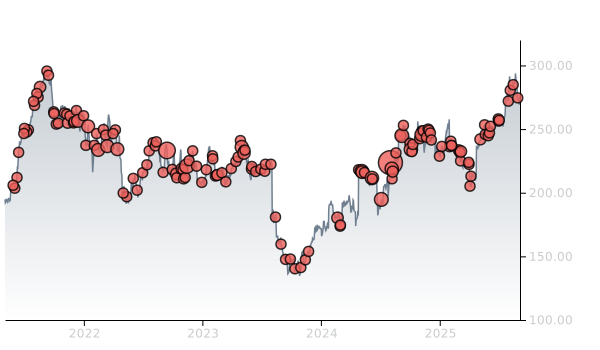
$RMD insiders have traded $RMD stock on the open market 21 times in the past 6 months. Of those trades, 0 have been purchases and 21 have been sales.
Here’s a breakdown of recent trading of $RMD stock by insiders over the last 6 months:
- MICHAEL J. FARRELL (Chairman and CEO) has made 0 purchases and 6 sales selling 39,002 shares for an estimated $10,354,992.
- BRETT SANDERCOCK (Chief Financial Officer) has made 0 purchases and 6 sales selling 12,000 shares for an estimated $3,120,950.
- PETER C FARRELL has made 0 purchases and 4 sales selling 8,000 shares for an estimated $2,007,320.
- WITTE JAN DE has made 0 purchases and 2 sales selling 2,542 shares for an estimated $645,896.
- MICHAEL J RIDER (Global General Counsel) has made 0 purchases and 3 sales selling 150 shares for an estimated $37,295.
To track insider transactions, check out Quiver Quantitative's insider trading dashboard.
$RMD Revenue
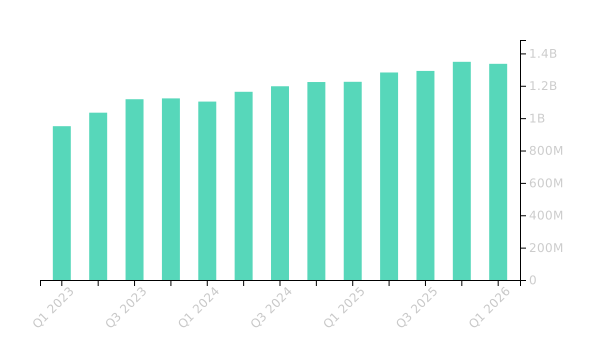
$RMD had revenues of $1.4B in Q2 2026. This is an increase of 10.98% from the same period in the prior year.
You can track RMD financials on Quiver Quantitative's RMD stock page.
$RMD Hedge Fund Activity
We have seen 408 institutional investors add shares of $RMD stock to their portfolio, and 502 decrease their positions in their most recent quarter.
Here are some of the largest recent moves:
- UBS AM, A DISTINCT BUSINESS UNIT OF UBS ASSET MANAGEMENT AMERICAS LLC removed 2,790,548 shares (-76.9%) from their portfolio in Q4 2025, for an estimated $672,159,296
- FIRST TRUST ADVISORS LP added 1,072,394 shares (+240.9%) to their portfolio in Q4 2025, for an estimated $258,307,542
- DEUTSCHE BANK AG\ added 787,949 shares (+126.0%) to their portfolio in Q4 2025, for an estimated $189,793,275
- MORGAN STANLEY added 578,559 shares (+25.0%) to their portfolio in Q4 2025, for an estimated $139,357,506
- SWEDBANK AB added 559,765 shares (+103.1%) to their portfolio in Q4 2025, for an estimated $134,830,595
- FMR LLC removed 464,493 shares (-52.8%) from their portfolio in Q4 2025, for an estimated $111,882,428
- ROYAL BANK OF CANADA removed 420,468 shares (-59.5%) from their portfolio in Q4 2025, for an estimated $101,278,127
To track hedge funds' stock portfolios, check out Quiver Quantitative's institutional holdings dashboard.
$RMD Analyst Ratings
Wall Street analysts have issued reports on $RMD in the last several months. We have seen 4 firms issue buy ratings on the stock, and 0 firms issue sell ratings.
Here are some recent analyst ratings:
- RBC Capital issued a "Outperform" rating on 10/31/2025
- Mizuho issued a "Outperform" rating on 10/31/2025
- Morgan Stanley issued a "Overweight" rating on 10/21/2025
- Citigroup issued a "Buy" rating on 09/18/2025
To track analyst ratings and price targets for $RMD, check out Quiver Quantitative's $RMD forecast page.
$RMD Price Targets
Multiple analysts have issued price targets for $RMD recently. We have seen 9 analysts offer price targets for $RMD in the last 6 months, with a median target of $299.0.
Here are some recent targets:
- Laura Sutcliffe from Citigroup set a target price of $345.0 on 02/02/2026
- Adam Maeder from Piper Sandler set a target price of $275.0 on 01/30/2026
- Nathan Treybeck from Wells Fargo set a target price of $270.0 on 01/30/2026
- Jonathan Block from Stifel set a target price of $265.0 on 01/30/2026
- Craig Wong-Pan from RBC Capital set a target price of $314.0 on 01/30/2026
- Joe Vruwink from Baird set a target price of $275.0 on 12/16/2025
- Brett Fishbin from Keybanc set a target price of $299.0 on 10/31/2025
Full Release
Insights from 30,000 people across 13 countries show global sleep health awareness is growing, yet an action gap remains
- 53% of people surveyed rank sleep as the most important behavior for a long, healthy life, ahead of diet and exercise.
- Over half of respondents get quality sleep on only four nights a week or less.
-
While 66% of people surveyed say they would seek medical help for ongoing sleep issues, just 23% actually do.
SAN DIEGO, March 03, 2026 (GLOBE NEWSWIRE) -- Resmed (NYSE: RMD, ASX: RMD), the leading health technology company focused on sleep, breathing and care delivered in the home, today unveiled the findings from its sixth annual Global Sleep Survey .
Drawing insights from 30,000 people across 13 countries, the survey reveals a widening gap between recognition of sleep’s importance and action to improve sleep health. While over half (53%) of respondents rank sleep as the most important contributor to long-term health compared to diet and exercise, many are not taking meaningful steps to improve their sleep quality.
Sleep is increasingly recognized as a key pillar of long-term health 1 , with 84% of respondents worldwide understanding that consistent, quality sleep can help extend a healthy lifespan. However, awareness has not translated into consistent results. The majority of respondents (53%) report getting a good night’s sleep only four nights a week or fewer, highlighting the persistent gap between knowing sleep is critical and being able to prioritize it as part of a healthy lifestyle.
As sleep awareness grows, so does the opportunity to turn intent into action.
-
Increased Wearable Use Raises Sleep Awareness Higher Than Ever:
Wearable use for sleep tracking has surged among respondents, increasing from 16% in 2025
2
to 53% in 2026. Smartwatches lead the way, with 58% of respondents globally using them to track their sleep. Among wearable users, 62% say they would seek medical advice if their device flagged a potential risk.
-
Following Through on Healthcare Provider Conversations Remains a Challenge:
While 66% of respondents say they would consult a healthcare provider for persistent sleep issues, only 23% have done so. Fewer than half (46%) of survey respondents say a healthcare provider has asked about sleep during a routine visit.
The findings suggest a clear opportunity to improve education, screening and diagnosis so more people can identify sleep issues earlier and access pathways to care.
How Daily Life Disrupts Sleep
The survey also highlights the everyday pressures shaping sleep patterns worldwide.
-
Closing the Sleep Gap for Women:
Nearly half of women surveyed (48%) struggle to fall asleep, up from 38% in 2025.
2
For 42% of women surveyed, stress and anxiety are key barriers to consistent, quality sleep compared with over one third (36%) of men surveyed. Family responsibilities widen the gender gap further, negatively affecting sleep for 39% of women versus 33% of men.
-
Recognizing Sleep as a Mental Health Essential:
Insufficient sleep is linked to higher risk of anxiety and depression across age groups.
3
This is reflected in our survey, which shows after a poor night’s sleep, more than a third of respondents report higher levels of irritability (36%) and stress (33%). Feelings of depression also increased for a quarter of respondents globally (25%).
-
Making Sleep a Workplace Priority:
More than half of respondents (58%) agree that heavy workloads negatively affect their sleep. 70% of respondents report taking a “snooze day” — calling in sick after a poor night’s sleep. At the same time, 59% say flexible working arrangements help them better manage their sleep.
-
Improving Sleep in Shared Spaces:
Sleeping together is associated with stronger intimacy, with 53% of respondents reporting a positive impact on their sex life compared to 23% of those who sleep apart. However, disruption is common: 39% of respondents say their partner interrupts their sleep at least weekly, and 80% experience some level of partner-related sleep disruption.
“People are increasingly recognizing sleep as a cornerstone to long-term health, which is encouraging,” said Dr. Carlos Nunez, Chief Medical Officer at Resmed. “But recognition alone is not enough. We need to help people move from awareness to action by addressing everyday barriers and improving access to screening, support and care.”
Are you getting enough sleep? Read the full 2026 Resmed Global Sleep Survey report to learn more about the trends impacting the way we sleep. To assess your sleep health, take our online sleep assessment.
Survey Methodology
Resmed commissioned an independent survey of 30,000 individuals across 13 markets: the United States (5,000), China (5,000), India (5,000), United Kingdom (2,000), Germany (2,000), France (2,000), Australia (1,500), Japan (1,500), Korea (1,500), Brazil (1,500), Poland (1,000), Singapore (1,000), and Mexico (1,000). The survey was developed in partnership with The Sleep Health Foundation (Australia) and The Sleep Charity (UK), leveraging their expertise to help identify and refine key focus areas. Samples within each country were representative of national gender and age distributions. The survey was fielded by Cint from 11 December 2025 to 14 January 2026.
About Resmed
Resmed (NYSE: RMD, ASX: RMD) creates life-changing health technologies that people love. We’re relentlessly committed to pioneering innovative technology to empower millions of people in 140 countries to live happier, healthier lives. Our AI-powered digital health solutions, cloud-connected devices and intelligent software make home healthcare more personalized, accessible and effective. Ultimately, Resmed envisions a world where every person can achieve their full potential through better sleep and breathing, with care delivered in their own home. Learn more about how we’re redefining sleep health at Resmed.com and follow @Resmed.
| For Media | For Investors |
|
Cassie-Anne Low
|
Salli Schwartz
|
| [email protected] | [email protected] |
_______________________________
1
Resmed Global Sleep Survey 2026. Available at: sleepsurvey.resmed.com (Accessed March 2026)
2
Resmed Global Sleep Survey 2025. Available at: sleepsurvey.resmed.com (Accessed February 2026)
3
Li Y, et al. Sleep Med Rev. 2019;42:69–89