


PacBio will support a UW Medicine study using HiFi sequencing to investigate Sudden Unexplained Death in Childhood.
Quiver AI Summary
PacBio announced a collaboration with UW Medicine and Seattle Children’s Hospital to investigate Sudden Unexplained Death in Childhood (SUDC) using their HiFi whole-genome sequencing technology. Led by researchers Danny Miller and Alexandra Keefe, the project aims to sequence the genomes of children and their parents, focusing on long-read sequencing to detect genetic variants linked to SUDC. Supported by the SUDC Foundation and PacBio, this initiative will join the HiFi Solves Global Consortium, which aims to enhance the understanding of genetic diseases through advanced sequencing techniques. The use of HiFi sequencing is expected to improve diagnostic outcomes by accurately identifying complex genetic variants. The partnership underscores a commitment to providing families with vital answers about SUDC.
Potential Positives
- PacBio's HiFi whole-genome sequencing has been chosen as the first-line approach in a significant research effort aimed at investigating Sudden Unexplained Death in Childhood (SUDC), highlighting the technology's importance in tackling complex genetic issues.
- The collaboration with prestigious institutions like UW Medicine and Seattle Children’s, along with backing from the SUDC Foundation, enhances PacBio’s reputation and visibility in the scientific community.
- Joining the HiFi Solves Global Consortium positions PacBio at the forefront of innovative genomic research, potentially leading to new discoveries and applications of its sequencing technologies.
Potential Negatives
- The press release emphasizes that PacBio products are for "Research Use Only" and not for use in diagnostic procedures, which may limit the marketability and perceived applicability of their technology in clinical settings.
- The mention of "challenges inherent in sequencing a large number of genomes" and potential "product performance and quality issues" could raise concerns regarding the reliability and scalability of their technology.
- The forward-looking statements include numerous uncertainties and potential risks, suggesting a lack of assurance in the anticipated benefits and outcomes of the research being conducted using their products.
FAQ
What is the purpose of the UW Medicine and Seattle Children's research?
The research aims to investigate Sudden Unexplained Death in Childhood (SUDC) using PacBio HiFi whole-genome sequencing.
How will PacBio's HiFi sequencing benefit the study?
HiFi sequencing provides accurate long-read data to increase diagnostic yield and resolve complex genetic variants related to SUDC.
What is the HiFi Solves Global Consortium?
The consortium is a collaboration of institutions studying the clinical applications of HiFi-based whole-genome sequencing for genetic research.
Who supports the research initiative on SUDC?
The project is backed by the SUDC Foundation and receives in-kind support from PacBio.
How will the research impact families affected by SUDC?
The research aims to provide actionable insights and improved diagnostic recommendations for families experiencing SUDC.
Disclaimer: This is an AI-generated summary of a press release distributed by GlobeNewswire. The model used to summarize this release may make mistakes. See the full release here.
$PACB Insider Trading Activity
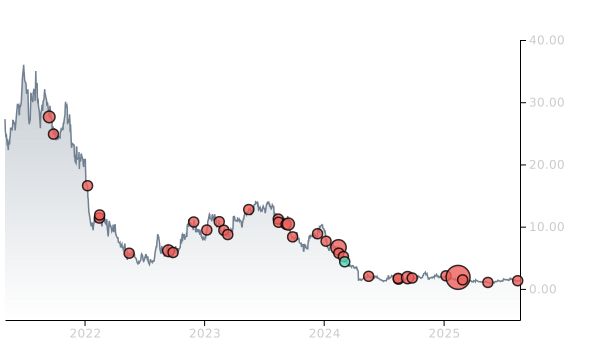
$PACB insiders have traded $PACB stock on the open market 1 times in the past 6 months. Of those trades, 0 have been purchases and 1 have been sales.
Here’s a breakdown of recent trading of $PACB stock by insiders over the last 6 months:
- OENE MARK VAN (See Remarks) sold 26,836 shares for an estimated $35,181
To track insider transactions, check out Quiver Quantitative's insider trading dashboard.
$PACB Revenue
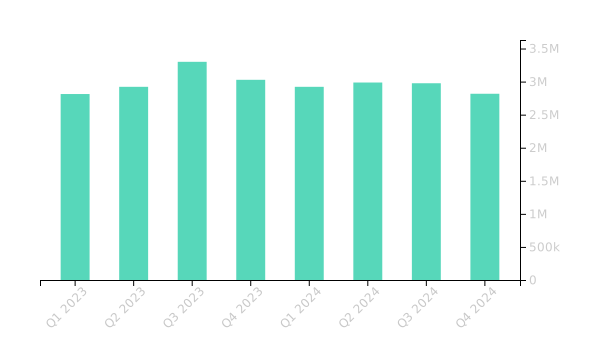
$PACB had revenues of $2.8M in Q4 2024. This is a decrease of -6.97% from the same period in the prior year.
You can track PACB financials on Quiver Quantitative's PACB stock page.
$PACB Hedge Fund Activity
We have seen 88 institutional investors add shares of $PACB stock to their portfolio, and 82 decrease their positions in their most recent quarter.
Here are some of the largest recent moves:
- MADRONE ADVISORS, LLC removed 11,786,127 shares (-70.3%) from their portfolio in Q3 2025, for an estimated $15,086,242
- ARK INVESTMENT MANAGEMENT LLC removed 5,374,060 shares (-14.8%) from their portfolio in Q3 2025, for an estimated $6,878,796
- MILLENNIUM MANAGEMENT LLC added 4,048,555 shares (+466.3%) to their portfolio in Q3 2025, for an estimated $5,182,150
- EDMOND DE ROTHSCHILD HOLDING S.A. removed 2,691,000 shares (-20.1%) from their portfolio in Q3 2025, for an estimated $3,444,480
- CITADEL ADVISORS LLC added 2,498,354 shares (+inf%) to their portfolio in Q3 2025, for an estimated $3,197,893
- POINT72 (DIFC) LTD added 1,811,137 shares (+73.7%) to their portfolio in Q3 2025, for an estimated $2,318,255
- NATIONAL BANK OF CANADA /FI/ removed 1,084,578 shares (-100.0%) from their portfolio in Q3 2025, for an estimated $1,388,259
To track hedge funds' stock portfolios, check out Quiver Quantitative's institutional holdings dashboard.
$PACB Analyst Ratings
Wall Street analysts have issued reports on $PACB in the last several months. We have seen 1 firms issue buy ratings on the stock, and 0 firms issue sell ratings.
Here are some recent analyst ratings:
- Stephens & Co. issued a "Overweight" rating on 11/10/2025
To track analyst ratings and price targets for $PACB, check out Quiver Quantitative's $PACB forecast page.
$PACB Price Targets
Multiple analysts have issued price targets for $PACB recently. We have seen 3 analysts offer price targets for $PACB in the last 6 months, with a median target of $2.0.
Here are some recent targets:
- Luke Sergott from Barclays set a target price of $2.0 on 12/15/2025
- David Westenberg from Piper Sandler set a target price of $2.0 on 11/11/2025
- Mason Carrico from Stephens & Co. set a target price of $2.0 on 11/10/2025
Full Release
MENLO PARK, Calif., Jan. 12, 2026 (GLOBE NEWSWIRE) -- PacBio (NASDAQ: PACB), developer of the world's most advanced sequencing technologies, today announced that a UW Medicine and Seattle Children’s research effort led by Danny Miller, MD, PhD, and Alexandra Keefe, MD, PhD, will employ PacBio HiFi whole-genome sequencing as the first-line approach to investigate Sudden Unexplained Death in Childhood (SUDC). Backed by the SUDC Foundation and with in-kind support from PacBio, the project will sequence each child and their parents, prioritizing long-read HiFi data for comprehensive variant detection. Additionally, the University of Washington team will join the HiFi Solves Global Consortium, which brings together institutions around the world to study the value HiFi-based human genome sequencing may have in clinical research applications and to further our understanding of genetic diseases.
Applying HiFi sequencing as a first-tier assay is designed to consolidate and simplify the laboratory workflow especially in the context of post-mortem tissue and newborn dried blood spots as challenging sample inputs. The researchers hope to increase diagnostic yield by resolving complex variants like structural variants and tandem repeats and by including parents to elucidate de novo and inherited contributors to risk.
“Selecting HiFi sequencing as our first-line whole-genome assay allows us to search for answers with the accuracy and breadth these families deserve,” said Danny Miller, MD, PhD, Assistant Professor of Pediatrics and of Laboratory Medicine & Pathology at the University of Washington School of Medicine, and physician-scientist at Seattle Children’s. “By starting with long reads and incorporating parental data we can better resolve difficult variants, phase them accurately, and offer appropriate recommendations to families relevant to SUDC.”
“We’re honored to support this essential SUDC research,” said David Miller, Global Vice President of Marketing at PacBio. “Making highly accurate long-read whole genomes the starting point can accelerate discovery and, ultimately, the path to better answers for families.”
“The SUDC Foundation is proud to fund research that prioritizes actionable answers for families,” said Tina Yun Lee, CEO, SUDC Foundation. “Adopting HiFi sequencing as a first-line tool reflects a commitment to scientific rigor and compassion, two values that guide our mission to understand, predict, and one day prevent SUDC.”
For background on the award and team, see the SUDC Foundation announcement and UW Medicine newsroom posts.
About PacBio
PacBio (NASDAQ: PACB) is a premier life science technology company that designs, develops, and manufactures advanced sequencing solutions to help scientists and clinical researchers resolve genetically complex problems. Our products and technologies, which include our HiFi long-read sequencing, address solutions across a broad set of research applications including human germline sequencing, plant and animal sciences, infectious disease and microbiology, oncology, and other emerging applications. For more information, please visit
www.pacb.com
and follow @PacBio.
PacBio products are provided for Research Use Only. Not for use in diagnostic procedures.
Forward-Looking Statements
This press release may contain “forward-looking statements” within the meaning of Section 21E of the Securities Exchange Act of 1934, as amended, and the U.S. Private Securities Litigation Reform Act of 1995. All statements other than statements of historical fact are forward-looking statements, including statements relating to: the uses, advantages, or quality or performance of, or benefits or expected benefits of using, PacBio products or technologies; certain researchers from UW Medicine and Seattle Children’s employing PacBio HiFi to investigate SUDC; the University of Washington joining the HiFi Solves Global Consortium; use of HiFi sequencing to consolidate and simplify laboratory workflow; increasing diagnostic yield; use of HiFi sequencing to increase sequencing accuracy and breadth; use of HiFi sequencing to resolve and phase difficult variants, and benefits related thereto; accelerating discovery; and other future events. You should not place undue reliance on forward-looking statements because they are subject to assumptions, risks, and uncertainties and could cause actual outcomes and results to differ materially from currently anticipated results, including, challenges inherent in sequencing a large number of genomes, the difficulty of generating discoveries in new areas of research; potential product performance and quality issues; third-party claims alleging infringement of patents and proprietary rights or seeking to invalidate PacBio's patents or proprietary rights, among others. Additional factors that could materially affect actual results can be found in PacBio's most recent filings with the Securities and Exchange Commission, including PacBio's most recent reports on Forms 8-K, 10-K, and 10-Q, and include those listed under the caption "Risk Factors." These forward-looking statements are based on current expectations and speak only as of the date hereof; except as required by law, PacBio disclaims any obligation to revise or update these forward-looking statements to reflect events or circumstances in the future, even if new information becomes available.
About SUDC
The SUDC Foundation is the only organization worldwide whose purpose is to raise awareness, fund research, and serve those affected by Sudden Unexplained Death in Childhood (SUDC). The SUDC Foundation provides all trauma informed services and supports at no cost to the people it serves. www.sudc.org.
About UW Miller Lab
The Miller Lab at the University of Washington focuses on advancing genomics in clinical diagnostics, particularly in the context of rare diseases. The lab is committed to developing tools and resources that democratize access to cutting-edge genomic technologies.
Contacts (University of Washington Miller Lab)
Danny Miller
[email protected]
Contacts (SUDC Foundation)
Tina Yun Lee
[email protected]
Media: [email protected]
Contacts (PacBio)
Investors:
[email protected]
Media:
[email protected]