


OPTAVIA emphasizes clinical validation and human coaching in weight loss, supported by extensive peer-reviewed research and trial outcomes.
Quiver AI Summary
The weight loss industry, valued at $16.3 billion in 2025, faces scrutiny as clinical validation of program outcomes is inconsistent. OPTAVIA emphasizes the importance of randomized controlled trials in establishing the efficacy of weight loss programs, asserting that these trials eliminate biases found in self-reported data. Their comprehensive metabolic health system is supported by over 100 peer-reviewed publications and more than 18 randomized trials, demonstrating significant outcomes such as the preservation of 98% of lean mass in participants following their Optimal Weight 5 & 1 Plan. Additionally, clients who engage with a coach reportedly lose significantly more weight than those without support, highlighting the role of personalized guidance. As the market for weight loss solutions expands, the press release underscores the necessity of peer-reviewed research to validate claims and shift focus from mere weight loss to improving overall metabolic health.
Potential Positives
- OPTAVIA's approach is validated by 18 randomized controlled trials and 100+ peer-reviewed publications, enhancing its credibility in the weight loss industry.
- Participants in the OPTAVIA Optimal Weight 5 & 1 Plan® retain 98% of lean mass after 16 weeks, which is significant for long-term metabolic health and weight management.
- Clients working with an OPTAVIA Coach lose up to 10 times more weight and 17 times more fat compared to those without coaching support, demonstrating the effectiveness of personalized guidance.
- Medifast's commitment to addressing metabolic dysfunction through scientifically backed methods positions it favorably within a competitive and growing $16.3 billion industry.
Potential Negatives
- Peer-reviewed clinical validation of outcomes is described as uneven across the weight loss industry, which could raise concerns about the credibility of the OPTAVIA program relative to others.
- While the press release highlights numerous studies, it does not provide information about any studies that may not have had positive outcomes, potentially leading to questions about transparency.
- The press release's emphasis on coaching suggests that the effectiveness of the program heavily relies on human intervention, which may imply that users without coaching support could have significantly poorer results, calling the program's accessibility into question.
FAQ
What makes a weight loss program clinically proven?
A clinically proven weight loss program publishes outcomes in peer-reviewed journals and uses randomized controlled trials with verified methodology.
How can I check the clinical research behind a weight loss program?
Look for published randomized controlled trial data in peer-reviewed journals, and check for body composition outcomes and scientific conference presentations.
What is metabolic health and its role in weight loss?
Metabolic health refers to the effectiveness of the body's metabolic processes. Poor metabolic health complicates weight management and other chronic health issues.
Why is body composition more important than total weight lost?
Body composition indicates how weight changes originate from fat versus lean mass, affecting metabolic health and weight management outcomes.
How does coaching impact weight loss success?
Clients using OPTAVIA with coaching lose up to 10 times more weight and 17 times more fat due to personalized guidance and accountability.
Disclaimer: This is an AI-generated summary of a press release distributed by GlobeNewswire. The model used to summarize this release may make mistakes. See the full release here.
$MED Insider Trading Activity
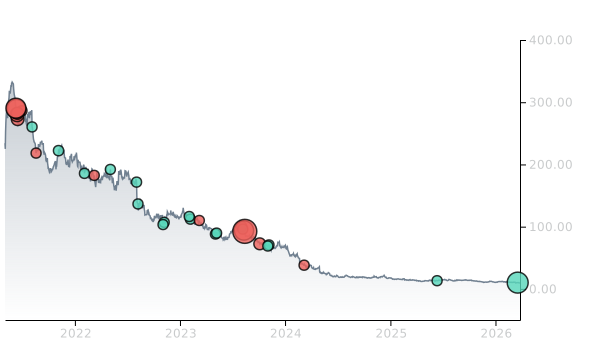
$MED insiders have traded $MED stock on the open market 1 times in the past 6 months. Of those trades, 1 have been purchases and 0 have been sales.
Here’s a breakdown of recent trading of $MED stock by insiders over the last 6 months:
- DANIEL R CHARD (Chairman & CEO) purchased 17,678 shares for an estimated $178,724
To track insider transactions, check out Quiver Quantitative's insider trading dashboard. You can access data on insider stock transactions through the Quiver Quantitative API insider transaction endpoint.
$MED Revenue
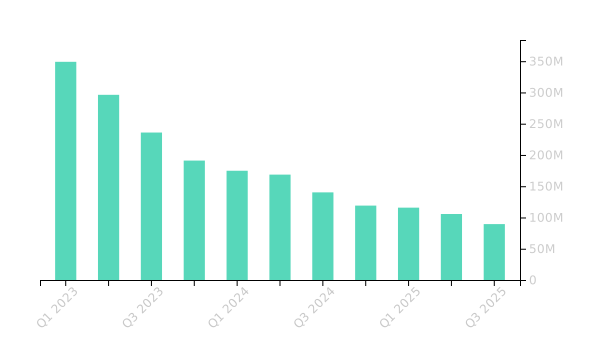
$MED had revenues of $76M in Q1 2026. This is a decrease of -34.29% from the same period in the prior year.
You can track MED financials on Quiver Quantitative's MED stock page.
You can access data on MED stock through the Quiver Quantitative API.
$MED Hedge Fund Activity
We have seen 53 institutional investors add shares of $MED stock to their portfolio, and 75 decrease their positions in their most recent quarter.
Here are some of the largest recent moves:
- STEAMBOAT CAPITAL PARTNERS, LLC added 431,176 shares (+156.0%) to their portfolio in Q1 2026, for an estimated $4,393,683
- BANK OF AMERICA CORP /DE/ removed 355,070 shares (-78.5%) from their portfolio in Q4 2025, for an estimated $3,792,147
- MORGAN STANLEY removed 253,681 shares (-43.1%) from their portfolio in Q4 2025, for an estimated $2,709,313
- AQR CAPITAL MANAGEMENT LLC removed 179,310 shares (-57.7%) from their portfolio in Q4 2025, for an estimated $1,915,030
- ACADIAN ASSET MANAGEMENT LLC removed 157,778 shares (-100.0%) from their portfolio in Q1 2026, for an estimated $1,607,757
- TWO SIGMA INVESTMENTS, LP removed 148,459 shares (-64.9%) from their portfolio in Q4 2025, for an estimated $1,585,542
- LIDO ADVISORS, LLC removed 147,668 shares (-44.7%) from their portfolio in Q1 2026, for an estimated $1,504,736
To track hedge funds' stock portfolios, check out Quiver Quantitative's institutional holdings dashboard. You can access data on hedge funds moves and 13F filings through the Quiver Quantitative API 13F endpoint.
Full Release
- The global weight loss industry was valued at $16.3 billion in 2025, yet peer-reviewed clinical validation of program outcomes remains uneven across the category
- Randomized controlled trials control for the lifestyle variables and selection bias that self-reported program data cannot account for, making them the standard for evaluating whether a weight loss program itself is driving outcomes
- Body composition is the breakdown of fat, lean mass, and bone. It shows what weight loss is actually made up of, a distinction that scale weight alone cannot capture
- A coach can address the specific barriers that may cause program adherence to stall, providing an additional support compared to digital trackers and tools
BALTIMORE, MD, May 15, 2026 (GLOBE NEWSWIRE) -- Client experiences and peer-reviewed research are two pillars of evidence that, at their best, reinforce each other. The former reflects what people live while the latter confirms why it works. OPTA VIA , a science-backed, coach-guided comprehensive metabolic health system, is built on both a community of clients who share what the program has done for them and a research portfolio spanning 100+ peer-reviewed presentations and publications that validates those outcomes at a clinical level.
"Randomized controlled trials are the standard in clinical research because they control for variables that self-reported data simply cannot. They tell you whether the program itself is driving the outcome, not lifestyle factors or selection bias," said Satya Jonnalagadda, PhD, MBA, RD, Vice President of Scientific & Clinical Affairs at OPTA VIA. "That's the level of rigor we've applied across our studies, and it's why the outcomes we report reflect what the science actually shows."
KEY FACTS
- OPTA VIA’s clinical approach is supported by 18 randomized controlled trials, 30+ scientific research studies and analyses, 40+ peer-reviewed scientific journal publications and 100+ peer-reviewed scientific presentations and publications
- A 16-week randomized controlled trial found that individuals on the OPTA VIA Optimal Weight 5 & 1 Plan® retained 98% of lean mass ( Arterburn LM, et al., 2019 ).
Promises Outlast Evidence
According to Future Market Insights , the global weight loss and management industry was valued at $16.3 billion in 2025, yet peer-reviewed validation of outcomes remains uneven across the category. Randomized controlled trials require independent external review of methodology, sample sizes, and statistical significance before findings are published, a layer of third-party scrutiny that adds clinical credibility to the real-world results programs report.
Submitting program outcomes to peer review means independent researchers assess whether the methodology and results hold up. For health professionals evaluating programs for their patients, and for consumers sorting through a saturated market, the presence or absence of a documented research trail can become a deciding factor.
Metabolic dysfunction sits at the center of this conversation. The Journal of the American College of Cardiology found poor metabolic health affects more than 90% of adults in the United States. Programs that address only scale weight without considering underlying metabolic processes are increasingly scrutinized by researchers and clinicians for leaving the harder problem untreated, according to the Journal of Obesity .
What the Data Shows After 16 Weeks
One outcome that peer-reviewed research examines is body composition, a measure that distinguishes between fat loss and lean mass loss in ways that scale weight alone cannot capture. A randomized controlled trial published in Obesity Science & Practice found that individuals on the OPTA VIA Optimal Weight 5 & 1 Plan® preserved 98% of lean mass at 16 weeks (Arterburn LM, et al., 2019).
The significance of that figure extends beyond aesthetics: lean mass, which includes muscle, organs, and connective tissue, plays a direct role in metabolic function, mobility, and long-term weight management. Research published in Current Developments in Nutrition found that weight loss interventions can reduce skeletal muscle mass, accounting for 20% to 50% of total weight lost. The authors note this loss is comparable to a decade of human aging, underscoring why lean mass preservation is a clinically relevant outcome, not a secondary metric.
The Coaching Variable, Measured
The same clinical research from Obesity Science & Practice has also isolated the contribution of human coaching as a measurable outcome driver with quantifiable impact. Clients who use the OPTA VIA Optimal Weight 5 & 1 Plan® and work with a coach lose up to 10 times more weight and 17 times more fat than those who attempt the program without coaching support (Arterburn LM, et al., 2019). That difference reflects what happens when personalized guidance, real-time accountability, and structured behavior change support are removed from an otherwise identical program.
"The data shows that accountability and real-time support change how people respond to a structured program and in their adherence patterns and metabolic outcomes," Jonnalagadda added. "A coach addresses the specific barriers that cause people to stall and provides human accountability, and that's a fundamentally different kind of intervention than a notification or a digital tracker."
As obesity medications, programs and solutions continue to flood the market, peer-reviewed evidence confirms whether success was real. It also helps to shift the focus away from cosmetic weight loss metrics toward building daily habits, support systems and practices that can help improve metabolic health outcomes over time.
FAQ
Q: What makes a weight loss program clinically proven?
A: A clinically proven weight loss program publishes its outcomes in peer-reviewed scientific journals, uses randomized controlled trials with independently verified methodology, and subjects its results to external scientific review. Programs that rely solely on testimonials or internal data lack the third-party validation that clinical research requires.
Q: How do I know if a weight loss program has genuine clinical research behind it?
A: Published randomized controlled trial data in peer-reviewed journals is a reliable indicator. Look for body composition outcomes reported alongside total weight lost and findings presented at independent scientific conferences. A Scientific Advisory Board of externally credentialed researchers further reinforces the program.
Q: What is metabolic health, and how does it relate to weight loss?
A: Metabolic health refers to how well the body's metabolic and biochemical processes function to support overall physiological health. Poor metabolic health can make weight management more difficult and compound other chronic health challenges.
Q: Why does body composition data matter more than total weight lost?
A: Scale weight reduction can happen on a structured weight loss program. What matters clinically is how much of that weight came from visceral fat versus lean mass, and what happened to metabolic markers once the program ended.
* OPTA VIA recommends that you contact your healthcare provider before starting and throughout your weight loss journey. Average weight loss on the Optimal Weight 5 & 1 Plan® is 12 pounds. Clients are in weight loss, on average, for 12 weeks.
* Arterburn LM, et al.
Randomized controlled trial assessing two commercial weight loss programs in adults with overweight or obesity.
Obesity Science & Practice. 2019.
https://onlinelibrary.wiley.com/doi/10.1002/osp4.312
.
In a clinical study, individuals on the
OPTA
VIA® 5 & 1 Plan® experienced a reduction of 14% visceral fat and 98% of lean mass was retained at 16 weeks
.
Those on the Optimal Weight 5&1 Plan® with support of an
OPTA
VIA® Coach successfully lost 10x more weight and 17x more fat than those who tried to lose weight on their own.
About Medifast
Medifast
(NYSE: MED) is the health and wellness company known for its science-backed, coach-guided lifestyle system. Designed to address the challenges of metabolic dysfunction, the company's holistic approach integrates personalized plans, scientifically developed products and a framework for sustainable habit creation — all supported by a dedicated network of independent coaches.
Driven to improve metabolic health through advanced science and comprehensive behavioral support, Medifast has introduced Metabolic Synchronization ® , a breakthrough science that reverses metabolic dysfunction through targeted metabolic reset. Research demonstrates that the company's comprehensive system activates strong and targeted fat burning to enhance metabolic health and body composition by reducing visceral fat, preserving lean mass and protecting muscle integrity.
Backed by more than 40 years of clinical heritage, Medifast continues to advance its mission of Lifelong Transformation, Making a Healthy Lifestyle Second Nature®. For more information, visit MedifastInc.com .