


FibroGen announces FDA Orphan Drug Designation for roxadustat in treating myelodysplastic syndromes, with Phase 3 protocol filing planned for Q4 2025.
Quiver AI Summary
FibroGen, Inc. announced that the FDA has granted Orphan Drug Designation for roxadustat, aimed at treating myelodysplastic syndromes (MDS), with a Phase 3 protocol filing expected in Q4 2025. CEO Thane Wettig emphasized the significant treatment gap for MDS patients, particularly those with high transfusion needs, highlighting roxadustat's potential benefits in transfusion independence and its oral administration compared to current treatments. Approximately 58,000 patients in the U.S. are diagnosed with lower-risk MDS, 85% of whom experience anemia and face various complications. Current treatments have limited effectiveness, and roxadustat's designation may facilitate expedited development and market exclusivity upon approval.
Potential Positives
- FibroGen's roxadustat received Orphan Drug Designation from the FDA for the treatment of myelodysplastic syndromes (MDS), highlighting its potential to address unmet medical needs in a rare disease population.
- The Orphan Drug Designation may provide FibroGen with financial incentives for clinical development, exemption from certain fees, and seven years of market exclusivity in the U.S. post-approval.
- Post-hoc analysis from the Phase 3 MATTERHORN trial indicates that roxadustat may offer significant benefits, such as improved transfusion independence in patients with high transfusion burden, setting it apart from current treatment options.
- The company is on track to file the Phase 3 protocol for roxadustat in MDS in the fourth quarter of 2025, indicating progress in its development timeline.
Potential Negatives
- The announcement indicates a significant delay, as the Phase 3 protocol is not expected to be filed until the fourth quarter of 2025.
- The company highlights a high unmet need for treatments in a market where current options have low response rates, implying the competitive challenges roxadustat faces without immediate availability.
- The release describes a reliance on post-hoc analysis data for claims of efficacy, which can be a red flag regarding the robustness of the trial results and perceived credibility in the market.
FAQ
What is the Orphan Drug Designation granted to roxadustat?
The FDA granted roxadustat Orphan Drug Designation for treating myelodysplastic syndromes (MDS), recognizing the significant treatment need.
When will FibroGen file the Phase 3 protocol?
FibroGen is on track to file the Phase 3 protocol in the fourth quarter of 2025.
What are myelodysplastic syndromes (MDS)?
MDS are disorders characterized by dysfunctional blood cells, resulting in chronic anemia and increased complications like cardiovascular issues.
How does roxadustat differ from current treatments?
Roxadustat offers an oral administration route and has shown improved transfusion independence compared to existing second-line treatments.
What patient population is targeted by roxadustat?
Roxadustat targets lower-risk myelodysplastic syndrome (LR-MDS) patients who often suffer from anemia and high transfusion dependency.
Disclaimer: This is an AI-generated summary of a press release distributed by GlobeNewswire. The model used to summarize this release may make mistakes. See the full release here.
$FGEN Insider Trading Activity
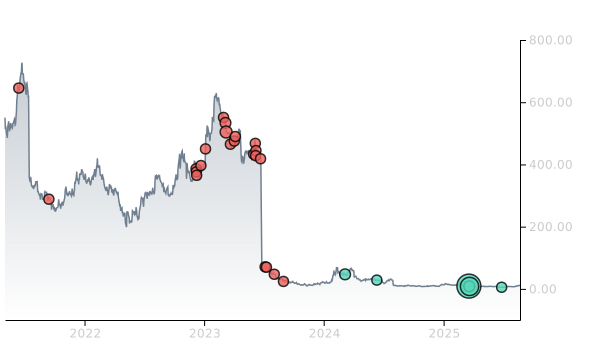
$FGEN insiders have traded $FGEN stock on the open market 3 times in the past 6 months. Of those trades, 3 have been purchases and 0 have been sales.
Here’s a breakdown of recent trading of $FGEN stock by insiders over the last 6 months:
- JAMES A SCHOENECK purchased 23,567 shares for an estimated $119,484
- THANE WETTIG (CEO) has made 2 purchases buying 3,700 shares for an estimated $33,749 and 0 sales.
To track insider transactions, check out Quiver Quantitative's insider trading dashboard.
$FGEN Hedge Fund Activity
We have seen 13 institutional investors add shares of $FGEN stock to their portfolio, and 32 decrease their positions in their most recent quarter.
Here are some of the largest recent moves:
- ARMISTICE CAPITAL, LLC added 42,000 shares (+12.5%) to their portfolio in Q3 2025, for an estimated $514,500
- PRIMECAP MANAGEMENT CO/CA/ removed 30,817 shares (-34.4%) from their portfolio in Q3 2025, for an estimated $377,508
- ACADIAN ASSET MANAGEMENT LLC removed 28,840 shares (-20.7%) from their portfolio in Q3 2025, for an estimated $353,290
- TWO SIGMA ADVISERS, LP removed 27,048 shares (-100.0%) from their portfolio in Q2 2025, for an estimated $143,354
- TWO SIGMA INVESTMENTS, LP added 26,107 shares (+185.0%) to their portfolio in Q3 2025, for an estimated $319,810
- CITADEL ADVISORS LLC added 23,517 shares (+inf%) to their portfolio in Q3 2025, for an estimated $288,083
- RENAISSANCE TECHNOLOGIES LLC added 18,100 shares (+161.9%) to their portfolio in Q3 2025, for an estimated $221,725
To track hedge funds' stock portfolios, check out Quiver Quantitative's institutional holdings dashboard.
$FGEN Analyst Ratings
Wall Street analysts have issued reports on $FGEN in the last several months. We have seen 1 firms issue buy ratings on the stock, and 0 firms issue sell ratings.
Here are some recent analyst ratings:
- HC Wainwright & Co. issued a "Buy" rating on 08/07/2025
To track analyst ratings and price targets for $FGEN, check out Quiver Quantitative's $FGEN forecast page.
Full Release
-
Company is on track to file the Phase 3 protocol in the fourth quarter of 2025
SAN FRANCISCO, Dec. 15, 2025 (GLOBE NEWSWIRE) -- FibroGen, Inc. (NASDAQ: FGEN) today announced that the Office of Orphan Products Development of the U.S. Food and Drug Administration (FDA) has granted roxadustat Orphan Drug Designation for the treatment of myelodysplastic syndromes (MDS).
“The Orphan Drug Designation granted to roxadustat for MDS underscores the significant treatment gap in this indication, and highlights patients’ need for additional convenient treatments that can provide durable response,” said Thane Wettig, Chief Executive Officer of FibroGen. “Roxadustat showed an improvement in transfusion-independence in a subset of patients with high transfusion burden in a post-hoc analysis from the Phase 3 MATTHERHORN trial, which along with its favorable tolerability profile and oral route of administration has the ability to set it apart from current second-line treatments. Our team is finalizing the Phase 3 protocol in this patient population for submission to the FDA in the fourth quarter of 2025.”
There are approximately 58,000 patients diagnosed with LR-MDS in the U.S. with 85% of them suffering from anemia. Anemia in patients with MDS is associated with increased risk of cardiovascular complications and the need for blood transfusions. Transfusion-dependent patients suffer higher rates of complications and decreased quality of life. Current first-line treatments lead to transfusion independence in less than 50% of patients and relief is often temporary with limited options for second line and beyond treatments. In a post-hoc analysis from the Phase 3 MATTERHORN trial, roxadustat demonstrated transfusion independence benefits compared to placebo in patients with high transfusion burden.
The FDA Orphan Drug Designation is granted to drugs intended for the treatment, diagnosis, or prevention of rare diseases that affect fewer than 200,000 people in the U.S. Benefits of the designation may include exemption from certain FDA fees, financial incentives for qualified clinical development, and seven years of market exclusivity in the U.S. following drug approval.
About Myelodysplastic Syndromes Anemia
Myelodysplastic syndromes (MDS) are a group of disorders characterized by dysfunctional progenitor blood cells and stem cells, resulting in chronic anemia in most patients. Annual incidence rates of MDS are estimated to be 4.9/100,000 adults in the U.S, of which 77% are considered lower-risk MDS. Approximately 80% of patients with MDS have anemia at the time of diagnosis, and around 60% of patients with MDS will experience severe anemia (hemoglobin <8 g/dL) at some point during the course of their disease. Anemia in patients with MDS is associated with increased risk of cardiovascular complications and the need for blood transfusion. Approximately 50% of patients with MDS require regular red blood cell transfusions. Transfusion-dependent MDS patients suffer higher rates of cardiac events, infections, and iron overload with the related complications. In addition, anemia frequently leads to significant fatigue, cognitive dysfunction, and decreased quality of life. Today, patients are routinely treated with erythropoiesis-stimulating agents (ESAs), luspatercept, imetelstat, or lenalidomide in lower-risk MDS with isolated del(5q), and hypomethylating agents (HMAs) in higher-risk disease. Only 35-40% of patients respond to current treatments and the durability of response is short. Moreover, these treatments are challenging to dose-calibrate and can only be administered via subcutaneous injection or through IV infusion. There remains a high unmet need for the treatment of anemia associated with MDS, and new strategies that provide durable response and the convenience of oral administration are highly desired in managing patients with MDS.
About Roxadustat
Roxadustat, an oral medication, is the first in a new class of medicines comprising HIF-PH inhibitors that promote erythropoiesis, or red blood cell production, through increased endogenous production of erythropoietin, improved iron absorption and mobilization, and downregulation of hepcidin.
Roxadustat is approved in Europe, Japan, and numerous other countries for the treatment of anemia of CKD in adult patients on dialysis (DD) and not on dialysis (NDD). FibroGen has the sole rights to roxadustat in the United States, Canada, Mexico, and in all markets not held by AstraZeneca or licensed to Astellas. Astellas and FibroGen are collaborating on the commercialization of roxadustat for the treatment of anemia in territories including Japan, Europe, Turkey, Russia, and the Commonwealth of Independent States, the Middle East, and South Africa.
About FibroGen
FibroGen, Inc. is a biopharmaceutical company focused on development of novel therapies at the frontiers of cancer biology and anemia. Roxadustat (爱瑞卓
®
, EVRENZO
TM
) is currently approved in Europe, Japan, and numerous other countries for the treatment of anemia in chronic kidney disease (CKD) patients on dialysis and not on dialysis. The Company continues to evaluate the development plan for the Phase 3 trial of roxadustat in anemia associated with lower-risk myelodysplastic syndrome (LR-MDS) in the U.S. FG-3246 (also known as FOR46), a first-in-class antibody-drug conjugate (ADC) targeting CD46, is in Phase 2 development for the treatment of metastatic castration-resistant prostate cancer. This program also includes the development of FG-3180, an associated CD46-targeted PET biomarker. For more information, please visit
www.fibrogen.com
.
Forward-Looking Statements
This release contains forward-looking statements regarding FibroGen’s strategy, future plans and prospects, including statements regarding its commercial products and clinical programs and those of it and its collaboration partners Fortis and UCSF. These forward-looking statements include, but are not limited to, statements regarding the efficacy, safety, convenience, and potential clinical or commercial success of FibroGen products and product candidates, statements about regulatory interactions, and statements about FibroGen’s plans and objectives. These forward-looking statements are typically identified by use of terms such as “may,” “will”, “should,” “on track,” “could,” “expect,” “plan,” “anticipate,” “believe,” “estimate,” “predict,” “potential,” “continue” and similar words, although some forward-looking statements are expressed differently. FibroGen’s actual results may differ materially from those indicated in these forward-looking statements due to risks and uncertainties related to the continued progress and timing of its various programs, including the enrollment and results from ongoing and potential future clinical trials, and other matters that are described in FibroGen’s most recent Annual Report on Form 10-K and Quarterly Report on Form 10-Q, each as filed with the Securities and Exchange Commission (SEC), including the risk factors set forth therein. Investors are cautioned not to place undue reliance on these forward-looking statements, which speak only as of the date of this release, and FibroGen undertakes no obligation to update any forward-looking statement in this press release, except as required by law.
For Investor Inquiries:
David DeLucia, CFA
Senior Vice President and Chief Financial Officer
[email protected]