


FTI Consulting's survey highlights a cautious outlook for the healthcare industry amid regulatory challenges and increased AI investment interest.
Quiver AI Summary
FTI Consulting's fifth annual U.S. Healthcare & Life Sciences Industry Outlook for 2026 indicates a decline in optimism among industry leaders, reflecting a 9% drop from the previous year. The survey highlights significant challenges due to political uncertainty, regulatory changes, and cybersecurity concerns. While leaders express divided opinions on President Trump's impact, there is strong apprehension regarding the anticipated One Big Beautiful Bill Act and Most Favored Nation policy, which many believe could raise patient costs and disrupt supply chains. Despite these challenges, a majority plan to invest in artificial intelligence across various functions, viewing it as crucial for efficiency. However, concerns regarding cybersecurity readiness are growing, with fewer organizations having crisis communications plans in place. The outlook for mergers and acquisitions remains cautiously optimistic, although fewer leaders anticipate improved conditions for fundraising. Overall, the findings suggest a resilient but increasingly cautious industry heading into 2026.
Potential Positives
- 59% of industry leaders plan to allocate additional budget to AI and large-language models in 2026, indicating a strong commitment to leveraging innovative technologies.
- 65% of respondents expect M&A activity to be higher in 2026, suggesting optimism about potential growth opportunities despite economic challenges.
- Organizations that prioritize scenario planning and AI integration into business plans are anticipated to be better positioned to navigate future challenges, reflecting a proactive approach to industry instability.
Potential Negatives
- Industry leaders report a 9% decline in optimism about the state of the healthcare and life sciences sector compared to the previous year, signaling potential concerns about future growth.
- There is a significant perception of vulnerability to cybersecurity incidents, with 47% of respondents feeling their organizations lack adequate protection, compounded by a decrease in organizations having crisis communications plans.
- Only 28% of respondents believe it will be easier to raise capital in 2026, indicating a challenging fundraising environment ahead, which could impact future investments and growth opportunities.
FAQ
What are the main challenges facing the healthcare industry in 2026?
The healthcare industry is facing challenges in capital markets, regulatory landscapes, and ongoing cybersecurity concerns.
How are executives feeling about the political environment affecting healthcare?
Executives remain divided, with 51% viewing President Trump's impact positively, while 49% have a negative perception.
What role will AI play in the healthcare sector in 2026?
59% of leaders plan to increase budgets for AI, expecting its implementation across various functions including operations and patient support.
How prepared are healthcare organizations for cybersecurity threats?
47% of respondents view their organizations as vulnerable, and only 60% have a crisis communications plan in place.
What is the outlook for M&A activity in the healthcare sector?
65% of respondents expect M&A activity to increase, while optimism for IPO activity has dropped to 54%.
Disclaimer: This is an AI-generated summary of a press release distributed by GlobeNewswire. The model used to summarize this release may make mistakes. See the full release here.
$FCN Insider Trading Activity
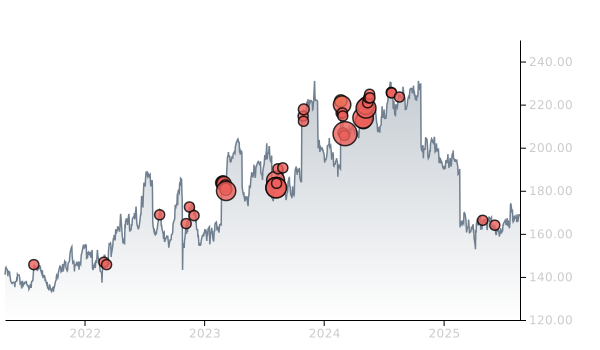
$FCN insiders have traded $FCN stock on the open market 1 times in the past 6 months. Of those trades, 1 have been purchases and 0 have been sales.
Here’s a breakdown of recent trading of $FCN stock by insiders over the last 6 months:
- STEVEN HENRY GUNBY (CEO, Chairman and President) purchased 7,500 shares for an estimated $1,133,400
To track insider transactions, check out Quiver Quantitative's insider trading dashboard.
$FCN Revenue
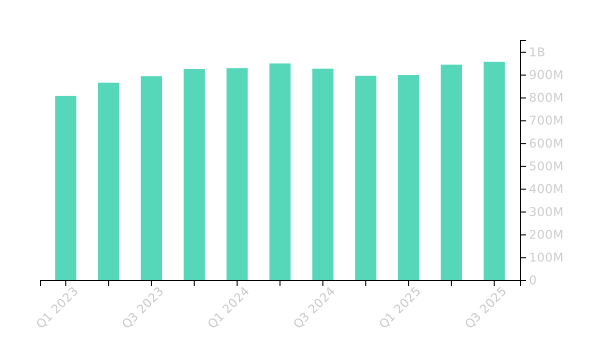
$FCN had revenues of $956.2M in Q3 2025. This is an increase of 3.26% from the same period in the prior year.
You can track FCN financials on Quiver Quantitative's FCN stock page.
$FCN Congressional Stock Trading
Members of Congress have traded $FCN stock 2 times in the past 6 months. Of those trades, 1 have been purchases and 1 have been sales.
Here’s a breakdown of recent trading of $FCN stock by members of Congress over the last 6 months:
- REPRESENTATIVE LISA C. MCCLAIN has traded it 2 times. They made 1 purchase worth up to $15,000 on 08/13 and 1 sale worth up to $15,000 on 09/11.
To track congressional stock trading, check out Quiver Quantitative's congressional trading dashboard.
$FCN Hedge Fund Activity
We have seen 171 institutional investors add shares of $FCN stock to their portfolio, and 280 decrease their positions in their most recent quarter.
Here are some of the largest recent moves:
- CITADEL ADVISORS LLC removed 699,246 shares (-89.4%) from their portfolio in Q3 2025, for an estimated $113,033,115
- MAWER INVESTMENT MANAGEMENT LTD. removed 470,522 shares (-12.3%) from their portfolio in Q3 2025, for an estimated $76,059,881
- BROWN ADVISORY INC removed 349,222 shares (-100.0%) from their portfolio in Q2 2025, for an estimated $56,399,353
- VICTORY CAPITAL MANAGEMENT INC removed 347,780 shares (-23.5%) from their portfolio in Q3 2025, for an estimated $56,218,637
- POINT72 ASSET MANAGEMENT, L.P. added 342,290 shares (+inf%) to their portfolio in Q3 2025, for an estimated $55,331,178
- NORGES BANK added 322,880 shares (+404.4%) to their portfolio in Q2 2025, for an estimated $52,145,120
- PRICE T ROWE ASSOCIATES INC /MD/ added 281,626 shares (+122.4%) to their portfolio in Q3 2025, for an estimated $45,524,842
To track hedge funds' stock portfolios, check out Quiver Quantitative's institutional holdings dashboard.
Full Release
Industry Leaders Point to Challenging Political and Economic Environment
Key Legislation Expected to Impact Supply Chain and Drug Costs
Recent M&A Momentum Offset by Challenging Fundraising Environment
Artificial Intelligence (AI) Seen as Key Investment Area
WASHINGTON, Dec. 16, 2025 (GLOBE NEWSWIRE) -- FTI Consulting, Inc. (NYSE: FCN) today announced findings from its fifth annual U.S. Healthcare & Life Sciences Industry Outlook 2026 , which revealed that leaders are less optimistic about the state of the industry, down 9% from last year’s survey .
The survey indicates that while optimism persists in some areas, industry leaders are navigating significant challenges within the capital markets, evolving political and regulatory landscapes, and have ongoing cybersecurity concerns.
“As we look towards 2026, life sciences companies face a complex landscape of shifting financial and regulatory factors, which demand strategic agility,” said Robert Stanislaro , Head of the Healthcare & Life Sciences’ Corporate Reputation offering within FTI Consulting’s Strategic Communications segment. “Organizations that prioritize scenario planning and incorporate those insights, as well as leverage AI to drive efficiencies, into future business plans will be best positioned to navigate the challenges and opportunities ahead.”
Policy and Regulatory Challenges
A year into President Trump’s second presidency, life sciences leaders remain divided (51% positive versus 49% negative) about his impact on the industry to-date. Notably, respondents view Secretary of Health and Human Services Robert F. Kennedy Jr. and Food and Drug Administration Commissioner Dr. Marty Markay somewhat more favorably, with 51% and 53% positive ratings. Policy concerns are also prominent, with 64% believing the One Big Beautiful Bill Act will increase out-of-pocket costs for patients, and 56% anticipating that President Trump’s Most Favored Nation policy will increase supply chain disruptions.
Artificial Intelligence Development & Usage
Despite economic headwinds, 59% of respondents plan to allocate additional budget to AI and large-language models in 2026. Organizations are expecting to implement AI across multiple functions, including for the development of internal content (41%), internal operations (38%), financial analysis (37%), patient support/hub services (34%), and personalized marketing (31%). In communications specifically, leaders see AI offering the greatest opportunities in social and digital communications (63%), media engagement (48%), issues management (48%), thought leadership (47%), and earnings/investor communications (45%).
Cybersecurity Concerns
The survey also reveals concerning trends in cybersecurity readiness. Nearly half (47%) of respondents perceive their organizations as vulnerable to cyber incidents. However, only 60% of respondents have a crisis communications plan in place, down from 68% in 2025, and participation in simulation exercises has dropped to 47% from 53% in 2025.
Transactions & Capital Markets Activity
While 65% of respondents expect M&A activity to be higher in 2026, only 54% of leaders are optimistic about increased IPO activity, representing a 7% drop from 2025. The fundraising environment is also predicted to be increasingly challenging, with only 28% of respondents believing that it will be easier to raise capital in 2026.
“Our findings reveal a life sciences industry that remains resilient but increasingly cautious as we enter 2026,” said Lauren Crawford Shaver , Americas Head of Healthcare & Life Sciences within FTI Consulting’s Strategic Communications segment. “While the majority of leaders maintain a sense of optimism, we're seeing notable shifts in sentiment around capital access, the political and regulatory climate, and desire to invest in new innovative technology such as AI.”
The full survey report is available here .
About the Survey
This research was conducted online by FTI Consulting’s Strategic Communications segment between September 10 and September 26, 2025, with 300 decision-makers in corporate communications, investor relations, public affairs, business development and marketing roles for healthcare and life sciences companies in the United States. Fifty-one percent of respondents represent large companies (with more than 250 employees), and roughly one quarter (28%) represent publicly listed companies with a weighted average $5 billion market cap.
About FTI Consulting
FTI Consulting, Inc. is a leading global expert firm for organizations facing crisis and transformation, with more than 8,100 employees located in 32 countries and territories as of September 30, 2025. In certain jurisdictions, FTI Consulting’s services are provided through distinct legal entities that are separately capitalized and independently managed. The Company generated $3.70 billion in revenues during fiscal year 2024. More information can be found at
www.fticonsulting.com
.
FTI Consulting, Inc.
555 12
th
Street NW
Washington, DC 20004
+1.202.312.9100
Investor Contact:
Mollie Hawkes
+1.617.747.1791
[email protected]
Media Contact:
Nick Emmons
+1.617.510.1676
[email protected]