


FTI Consulting's survey highlights lender caution in leveraged lending due to defaults, fraud concerns, and economic uncertainty.
Quiver AI Summary
FTI Consulting, Inc. has released its 2026 Leveraged Loan Market Survey, revealing a cautious outlook among lenders in the leveraged credit market despite solid performance in 2025. Key concerns include above-average loan defaults, rising fraud issues, and uncertainty regarding AI investments. The survey, conducted among various lenders, indicated that most expect an increase in loan defaults this year, while the anticipated cuts to the federal funds rate are expected to be limited. Economic growth expectations have also become more pessimistic, with many respondents predicting stagnation or contraction. While the likelihood of a recession is viewed as minor, a significant portion of respondents believe it remains a possibility. The survey reflects a mixture of cautious optimism and underlying worries about the economic environment, including concerns over consumer industry distress and potential risks associated with AI in financial markets.
Potential Positives
- The annual Leveraged Loan Market Survey provides valuable insights into lender perspectives, enhancing FTI Consulting's reputation as a thought leader in the leveraged lending space.
- The survey identifies key market trends, such as a cautious outlook on loan defaults and emerging concerns about fraud, which allows FTI Consulting to position itself as a trusted advisor amidst economic uncertainties.
- Despite the challenges highlighted in the survey, positive market momentum is noted, suggesting potential growth opportunities for FTI Consulting's investment and advisory services in leveraged finance.
- The firm’s extensive reach, with over 8,100 employees globally, demonstrates its capability to support clients in navigating complex market conditions effectively.
Potential Negatives
- Even though the leveraged credit market saw solid performance, lenders remain cautious due to above-average loan default volumes and heightened fraud concerns, indicating underlying weaknesses in the market.
- A significant portion of survey respondents (21%) expressed skepticism regarding AI's potential positive impact, viewing an AI investment crash as a major underestimated risk, which could reflect broader concerns about technological investments within the financial sector.
- Expectations for GDP growth are notably pessimistic, with 40% of respondents anticipating stagnation or negative growth, diverging from last year's more optimistic outlook and suggesting a wider economic challenge that could impact the company's outlook.
FAQ
What are the main findings of the 2026 Leveraged Loan Market Survey?
The survey highlights cautious lender sentiment due to high loan defaults, fraud concerns, and uncertain AI investment impact.
How do lenders view the risk of loan defaults in 2026?
Over three-quarters of lenders expect loan defaults and workouts to increase slightly or substantially compared to 2025.
What is the expectation for the Fed Funds rate in 2026?
Most respondents expect the Fed Funds rate to end between 3%-4%, with no more than two rate cuts predicted.
Are lenders concerned about a potential recession in 2026?
While 68% see a recession as unlikely, nearly one-third believe there is a material chance of a recession within the year.
How do lenders feel about AI's impact on the credit market?
53% believe AI will enhance information flow, but 21% fear an AI investment crash is an underestimated risk.
Disclaimer: This is an AI-generated summary of a press release distributed by GlobeNewswire. The model used to summarize this release may make mistakes. See the full release here.
$FCN Insider Trading Activity
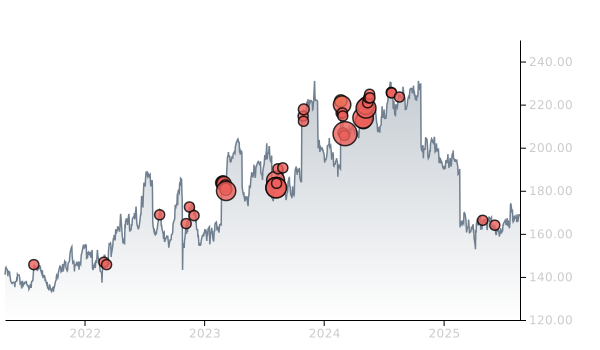
$FCN insiders have traded $FCN stock on the open market 1 times in the past 6 months. Of those trades, 1 have been purchases and 0 have been sales.
Here’s a breakdown of recent trading of $FCN stock by insiders over the last 6 months:
- STEVEN HENRY GUNBY (CEO, Chairman and President) purchased 7,500 shares for an estimated $1,133,400
To track insider transactions, check out Quiver Quantitative's insider trading dashboard.
$FCN Revenue
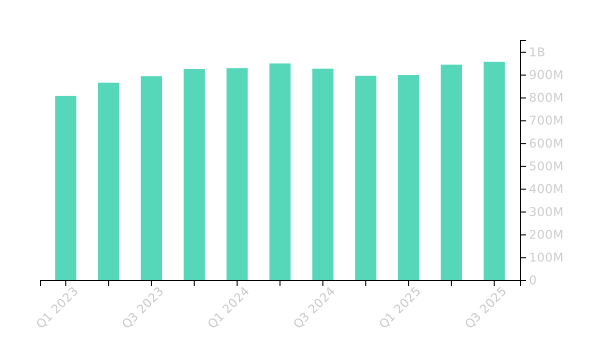
$FCN had revenues of $956.2M in Q3 2025. This is an increase of 3.26% from the same period in the prior year.
You can track FCN financials on Quiver Quantitative's FCN stock page.
$FCN Congressional Stock Trading
Members of Congress have traded $FCN stock 1 times in the past 6 months. Of those trades, 0 have been purchases and 1 have been sales.
Here’s a breakdown of recent trading of $FCN stock by members of Congress over the last 6 months:
- REPRESENTATIVE LISA C. MCCLAIN sold up to $15,000 on 09/11.
To track congressional stock trading, check out Quiver Quantitative's congressional trading dashboard.
$FCN Hedge Fund Activity
We have seen 193 institutional investors add shares of $FCN stock to their portfolio, and 235 decrease their positions in their most recent quarter.
Here are some of the largest recent moves:
- MAWER INVESTMENT MANAGEMENT LTD. removed 1,039,907 shares (-31.1%) from their portfolio in Q4 2025, for an estimated $177,647,312
- CITADEL ADVISORS LLC removed 699,246 shares (-89.4%) from their portfolio in Q3 2025, for an estimated $113,033,115
- VICTORY CAPITAL MANAGEMENT INC added 503,885 shares (+44.6%) to their portfolio in Q4 2025, for an estimated $86,078,674
- BLACK CREEK INVESTMENT MANAGEMENT INC. added 402,008 shares (+60.0%) to their portfolio in Q4 2025, for an estimated $68,675,026
- POINT72 ASSET MANAGEMENT, L.P. added 342,290 shares (+inf%) to their portfolio in Q3 2025, for an estimated $55,331,178
- UBS AM, A DISTINCT BUSINESS UNIT OF UBS ASSET MANAGEMENT AMERICAS LLC removed 328,946 shares (-76.7%) from their portfolio in Q4 2025, for an estimated $56,193,845
- M&T BANK CORP added 318,571 shares (+10081.4%) to their portfolio in Q4 2025, for an estimated $54,421,483
To track hedge funds' stock portfolios, check out Quiver Quantitative's institutional holdings dashboard.
Full Release
WASHINGTON , Feb. 17, 2026 (GLOBE NEWSWIRE) -- FTI Consulting, Inc. (NYSE: FCN) today announced the results of its 2026 Leveraged Loan Market Survey , which found that despite another solid year for leveraged credit, lenders remain cautious due to above average loan default volumes, heightened fraud concerns and uncertainty around AI investments.
“It wasn’t exactly an idyllic year for leveraged lenders. Loan default volumes remained above average, liability management exercises kept coming and heightened fraud concerns became a topic of conversation,” said Chuck Carroll , Leader of the Senior Lender Advisory practice at FTI Consulting. “New issuance volumes were also still dominated by refinancing activity and leveraged M&A activity. While the loan market for M&A was much improved thanks to some large value deals, it didn’t meet lofty volume expectations going into the year.”
The annual survey offers insight into bank and non-bank lenders’ perspectives on the state of U.S. leveraged lending and highlights expectations for leveraged credit market conditions in the year ahead.
The survey highlights clear lender concern about a consumer economy in distress. Retail and consumer products remained the industry sector perceived most likely to experience distress this year, while restaurants and dining moved into second place, followed by healthcare. Notably, real estate fell to seventh place this year compared to second place last year.
Headlines about alleged fraud in the lending sector also elevated concerns about incidents and detection. Only 21% of respondents said they were strongly confident in the current level of fraud risk oversight in the leveraged credit market, while 60% were somewhat confident and 19% were not confident.
Feelings about AI were complex and mixed. While 53% of respondents believe AI impacts over the next few years will improve information flow among involved parties, nearly a quarter of respondents (21%) believe an AI investment crash is the most underestimated financial market risk for 2026.
More key findings from the survey include:
- Loan Defaults Will Remain Elevated : More than three-quarters of respondents expect loan defaults and workouts will increase slightly (58%) or increase substantially (19%) in the year ahead compared to 2025 levels, while just 23% said default and workout activity would remain the same (18%) or be lower (5%). This response is more bearish than a year ago when 50% of respondents expected default activity to increase slightly (45%) or substantially (5%).
- Fed Funds Rate Cuts Expected to Moderate: Expectations of more rate cuts by the Fed have diminished following six rate cuts totaling 175 bps since September 2024. Nearly three-quarters of respondents (73%) expect the targeted Fed Funds rate to end the year between 3%-4%, implying no more than two rate cuts in 2026, while just 20% expect a Fed Funds rate below 3% by year end. Consequently, most respondents do not believe that recent calls for aggressive rate cuts from the Trump administration will materialize.
- Most Expect Weak GDP Growth : About 40% of respondents expect real domestic economic growth (“GDP”) to be stagnant (28%) or negative (12%) in 2026, while just 24% expect real GDP growth to exceed 2%. This response is much more pessimistic than last year when 62% of respondents expected GDP growth of at least 2% while just 12% expected economic stagnation (6%) or contraction (6%) in 2025.
-
Recession Is Unlikely But Not Improbable:
While 68% of respondents said the likelihood of a recession this year was minor (55%) or negligible (13%), nearly one-third of respondents said the chance of a U.S. recession in the next 12 months was material (28%) or likely (4%). This response pattern was consistent across bank and non-bank respondents and is notably more pessimistic than a year ago, when just 15% said a recession was material or likely.
Given the degree to which leveraged loan spreads have contracted since 2024, it is not surprising that most respondents in this year’s survey expect loan yields to widen slightly (50%) or materially (7%) in 2026 compared to 43% of respondents who said yields will contract slightly (41%) or materially (2%) this year.
“Positive market momentum has carried into 2026. Investors fear being left behind more than they fear stretched valuations and unfavorable risk/return profiles for many speculative-grade credits,” said Dave Katz , a Senior Managing Director in the Senior Lender Advisory practice within the Corporate Finance & Restructuring segment at FTI Consulting. “Investors appear to draw comfort from the last decade’s repeated demonstrations that market pullbacks consistently offered profitable entry points. Time will tell if that trend can continue.”
Survey Methodology
FTI Consulting surveyed large bank and non-bank lenders between November 18, 2025 and December 19, 2025, including commercial banks, investment banks, private credit platforms, CLOs and BDCs. Respondents included Chief Credit Officers, Workout Group Leaders, Managing Directors, Senior Vice Presidents, Executive Directors, Directors and Vice Presidents.
About FTI Consulting
FTI Consulting, Inc. is a leading global expert firm for organizations facing crisis and transformation, with more than 8,100 employees located in 32 countries and territories as of September 30, 2025. In certain jurisdictions, FTI Consulting’s services are provided through distinct legal entities that are separately capitalized and independently managed. The Company generated $3.70 billion in revenues during fiscal year 2024. More information can be found at
www.fticonsulting.com
.
FTI Consulting, Inc.
555 12
th
Street NW
Washington, DC 20004
+1.202.312.9100
Investor Contact:
Mollie Hawkes
+1.617.747.1791
[email protected]
Media Contact:
Nick Emmons
+1.617.510.1676
[email protected]