


FDA confirms bitopertin lowers PPIX but requires ongoing APOLLO study results for potential traditional approval.
Quiver AI Summary
The FDA has acknowledged that the clinical trials AURORA and BEACON provided sufficient evidence that bitopertin significantly reduces PPIX levels and supports the biomarker's use in treating erythropoietic protoporphyria (EPP). However, the FDA has issued a Complete Response Letter (CRL) for the New Drug Application for bitopertin, stating that results from the ongoing Phase 3 APOLLO study are necessary before making a final decision. Disc Medicine, which is developing bitopertin, expressed commitment to advancing the drug towards approval and highlighted the enthusiasm from the EPP community for the APOLLO trial, which is already fully enrolled, with topline data expected in Q4 2026. The company plans to respond to the CRL based on APOLLO results and is seeking to maintain an open dialogue with the FDA throughout the process.
Potential Positives
- FDA acknowledged substantial evidence from the AURORA and BEACON trials that bitopertin significantly lowers PPIX, indicating confidence in the drug's efficacy.
- The ongoing Phase 3 APOLLO study could potentially provide the basis for traditional approval, with topline data expected in Q4 2026, showing the company is progressing towards ultimate regulatory success.
- Disc Medicine has significant cash reserves of approximately $791 million, which provides financial stability and runway into 2029 for ongoing development efforts.
Potential Negatives
- FDA issued a Complete Response Letter (CRL) for the New Drug Application (NDA) for bitopertin, indicating that the application for accelerated approval has not been accepted.
- The ongoing Phase 3 APOLLO study has been described as critical for future approval, creating uncertainty around the timeline for bitopertin's potential market entry, which could be significantly delayed until mid-2027.
- The FDA determined that prior trial results did not sufficiently demonstrate the anticipated clinical benefits despite some evidence of lowering the PPIX biomarker, which could undermine confidence among stakeholders regarding the drug's efficacy.
FAQ
What did the FDA say about bitopertin's trials?
The FDA acknowledged that AURORA and BEACON trials showed bitopertin significantly lowers PPIX, but further evidence is needed.
What is the ongoing APOLLO study?
The APOLLO study is a Phase 3 clinical trial expected to provide data for traditional approval of bitopertin in EPP.
When will results from the APOLLO study be available?
Topline data from the APOLLO study is anticipated in Q4 2026.
What is the significance of the Complete Response Letter (CRL)?
The CRL indicates a delay in the approval process for bitopertin, requiring additional data from the APOLLO study.
How is Disc Medicine responding to the FDA feedback?
Disc Medicine plans to request a Type A meeting with the FDA to discuss the CRL and their strategy moving forward.
Disclaimer: This is an AI-generated summary of a press release distributed by GlobeNewswire. The model used to summarize this release may make mistakes. See the full release here.
$IRON Insider Trading Activity
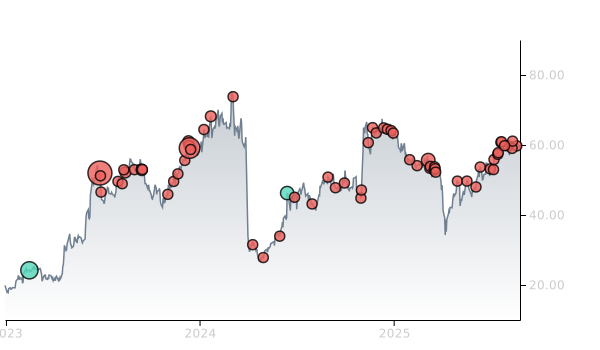
$IRON insiders have traded $IRON stock on the open market 63 times in the past 6 months. Of those trades, 0 have been purchases and 63 have been sales.
Here’s a breakdown of recent trading of $IRON stock by insiders over the last 6 months:
- DMI LLC AI sold 744,047 shares for an estimated $59,873,462
- KEVIN BITTERMAN has made 0 purchases and 47 sales selling 370,749 shares for an estimated $31,424,935.
- JOHN D QUISEL (Chief Executive Officer) has made 0 purchases and 4 sales selling 40,000 shares for an estimated $3,721,931.
- JONATHAN YEN-WEN YU (Chief Operating Officer) has made 0 purchases and 4 sales selling 30,000 shares for an estimated $2,540,922.
- WILLIAM JACOB SAVAGE (Chief Medical Officer) has made 0 purchases and 3 sales selling 13,093 shares for an estimated $1,194,372.
- RAHUL KHARA (Chief Legal Officer) has made 0 purchases and 4 sales selling 7,500 shares for an estimated $581,211.
To track insider transactions, check out Quiver Quantitative's insider trading dashboard.
$IRON Hedge Fund Activity
We have seen 110 institutional investors add shares of $IRON stock to their portfolio, and 54 decrease their positions in their most recent quarter.
Here are some of the largest recent moves:
- FMR LLC added 1,689,449 shares (+52.1%) to their portfolio in Q3 2025, for an estimated $111,638,789
- JANUS HENDERSON GROUP PLC removed 1,192,257 shares (-76.7%) from their portfolio in Q3 2025, for an estimated $78,784,342
- PARADIGM BIOCAPITAL ADVISORS LP removed 963,255 shares (-79.5%) from their portfolio in Q3 2025, for an estimated $63,651,890
- JPMORGAN CHASE & CO added 828,248 shares (+110.0%) to their portfolio in Q4 2025, for an estimated $65,771,173
- BAIN CAPITAL LIFE SCIENCES INVESTORS, LLC removed 583,500 shares (-100.0%) from their portfolio in Q3 2025, for an estimated $38,557,680
- JENNISON ASSOCIATES LLC added 532,079 shares (+inf%) to their portfolio in Q4 2025, for an estimated $42,252,393
- PICTET ASSET MANAGEMENT HOLDING SA added 390,811 shares (+10968.6%) to their portfolio in Q4 2025, for an estimated $31,034,301
To track hedge funds' stock portfolios, check out Quiver Quantitative's institutional holdings dashboard.
$IRON Analyst Ratings
Wall Street analysts have issued reports on $IRON in the last several months. We have seen 6 firms issue buy ratings on the stock, and 0 firms issue sell ratings.
Here are some recent analyst ratings:
- Wells Fargo issued a "Overweight" rating on 12/16/2025
- Truist Securities issued a "Buy" rating on 11/10/2025
- Stifel issued a "Buy" rating on 11/03/2025
- Morgan Stanley issued a "Overweight" rating on 10/30/2025
- Cantor Fitzgerald issued a "Overweight" rating on 10/17/2025
- Wedbush issued a "Outperform" rating on 10/17/2025
To track analyst ratings and price targets for $IRON, check out Quiver Quantitative's $IRON forecast page.
$IRON Price Targets
Multiple analysts have issued price targets for $IRON recently. We have seen 7 analysts offer price targets for $IRON in the last 6 months, with a median target of $114.0.
Here are some recent targets:
- Derek Archila from Wells Fargo set a target price of $109.0 on 12/16/2025
- Danielle Brill from Truist Securities set a target price of $114.0 on 11/10/2025
- Stephen Willey from Stifel set a target price of $125.0 on 11/03/2025
- Sean Laaman from Morgan Stanley set a target price of $115.0 on 10/30/2025
- Kristen Kluska from Cantor Fitzgerald set a target price of $153.0 on 10/17/2025
- David Nierengarten from Wedbush set a target price of $110.0 on 10/17/2025
- Michael Freeman from Raymond James set a target price of $108.0 on 10/17/2025
Full Release
- FDA acknowledged that AURORA and BEACON provided sufficient evidence that bitopertin significantly lowers PPIX and that there is a strong mechanistic and biological plausibility supporting the use of the PPIX biomarker in protoporphyria
- FDA indicated a need to see the results of the ongoing Phase 3 APOLLO study before making a decision
-
Ongoing Phase 3 APOLLO study potential to serve as basis for traditional approval; topline data anticipated Q4 2026
WATERTOWN, Mass., Feb. 13, 2026 (GLOBE NEWSWIRE) -- Disc Medicine, Inc. (NASDAQ:IRON), a biopharmaceutical company focused on the discovery, development, and commercialization of novel treatments for patients suffering from serious hematologic diseases, announced that the U.S. Food and Drug Administration (FDA) today issued a Complete Response Letter (CRL) for the New Drug Application (NDA) for bitopertin as a treatment for patients with erythropoietic protoporphyria (EPP). Bitopertin has been under review for accelerated approval and as part of the Commissioner’s National Priority Voucher (CNPV) pilot program.
Accelerated approval relies on (1) whether there is evidence of an effect on the proposed surrogate endpoint (% change in whole blood metal-free PPIX) and (2) whether the proposed surrogate endpoint, including the magnitude of change, is reasonably likely to predict a clinical benefit. On the first point, the FDA agreed that AURORA and BEACON provided sufficient evidence that bitopertin significantly lowers whole blood metal-free PPIX. On the second, based on review of AURORA and BEACON results, the FDA concluded that the trials did not show evidence of association between percent change in PPIX and sunlight exposure-based endpoints, as measured in the trials, despite the strong mechanistic and biological plausibility supporting the use of the PPIX biomarker in protoporphyria. The FDA indicated results of the APOLLO study could serve as evidence to support traditional approval.
“We are committed to delivering bitopertin to patients, knowing how critical this potentially disease-modifying therapy is to the EPP community. While our efforts at utilizing expedited pathways to get bitopertin to patients quickly have not come to fruition, we are continuing to pursue all avenues in support of FDA approval,” said John Quisel, J.D., Ph.D., President and Chief Executive Officer of Disc Medicine. “The CRL will delay the potential approval of bitopertin, but we have confidence in the ongoing APOLLO trial, for which we are seeing incredible enthusiasm from the EPP community. Confidence in our product and program guides our approach, and we will continue working closely with the FDA to support their review.”
Disc believes the issue raised is readily addressable, given the APOLLO study is already well underway with topline data expected in Q4. Disc plans to request a Type A meeting to review our approach with the FDA. A blinded sample size re-estimation of the APOLLO study was conducted in January and no modifications to sample size were needed based on statistical analysis. There has been significant patient and physician enthusiasm around the APOLLO trial, allowing Disc to complete trial enrollment in March 2026, several months earlier than expected. Upon completion of APOLLO, Disc would then file a response to the CRL and expect an updated FDA decision by mid-2027. Disc has approximately $791 million at December 31, 2025 in unaudited cash, cash equivalents, and marketable securities and maintains guidance of providing runway into 2029.
Disc Medicine will host a call for investors at 8 am ET on Tuesday, February 17 th to discuss this outcome. Please register for the event on the Events and Presentations page of Disc’s website ( https://ir.discmedicine.com/ ).
A copy of the CRL will be included in a Form 8-K to be filed with the Securities and Exchange Commission, which will be accessible on ir.discmedicine.com.
About Bitopertin
Bitopertin is an investigational, clinical-stage, orally administered inhibitor of glycine transporter 1 (GlyT1) that is designed to modulate heme biosynthesis. GlyT1 is a membrane transporter expressed on developing red blood cells and is required to supply sufficient glycine for heme biosynthesis and support erythropoiesis. Disc is developing bitopertin as a potential treatment for a range of hematologic diseases including erythropoietic porphyrias, where it has potential to be the first disease-modifying therapy. Bitopertin has been studied in multiple clinical trials in patients with EPP, including the Phase 2 open-label BEACON trial, the Phase 2 double-blind, placebo-controlled AURORA trial, an open-label extension HELIOS trial, and the confirmatory Phase 3 double-blind, placebo-controlled APOLLO trial.
Bitopertin is an investigational agent and is not approved for use as a therapy in any jurisdiction worldwide. Disc obtained global rights to bitopertin under a license agreement from Roche in May 2021.
About Disc Medicine
Disc Medicine (NASDAQ:IRON) is a biopharmaceutical company committed to discovering, developing, and commercializing novel treatments for patients who suffer from serious hematologic diseases. We are building a portfolio of innovative, potentially first-in-class therapeutic candidates that aim to address a wide spectrum of hematologic diseases by targeting fundamental biological pathways of red blood cell biology, specifically heme biosynthesis and iron homeostasis. For more information, please visit www.discmedicine.com .
Disc Cautionary Statement Regarding Forward-Looking Statements
This press release contains “forward-looking statements” within the meaning of the Private Securities Litigation Reform Act of 1995, including, but not limited to, express or implied statements regarding: the APOLLO clinical trial, including timing for completion and the results thereof; the future regulatory path for bitopertin with the FDA, including the potential for traditional approval, the timing of any such approval, and the potential for APOLLO to serve as the basis for any such approval; and our cash runway. The use of words such as, but not limited to, “believe,” “expect,” “estimate,” “project,” “intend,” “future,” “potential,” “continue,” “may,” “might,” “plan,” “will,” “should,” “seek,” “anticipate,” or “could” or the negative of these terms and other similar words or expressions that are intended to identify forward-looking statements. Forward-looking statements are neither historical facts nor assurances of future performance. Instead, they are based on Disc’s current beliefs, expectations and assumptions regarding the future of Disc’s business, future plans and strategies, clinical results and other future conditions. New risks and uncertainties may emerge from time to time, and it is not possible to predict all risks and uncertainties. No representations or warranties (expressed or implied) are made about the accuracy of any such forward-looking statements.
Disc may not actually achieve the plans, intentions or expectations disclosed in these forward-looking statements, and investors should not place undue reliance on these forward-looking statements. Actual results or events could differ materially from the plans, intentions and expectations disclosed in the forward-looking statements as a result of a number of material risks and uncertainties including but not limited to: the adequacy of Disc’s capital to support its future operations and its ability to successfully initiate and complete clinical trials; the nature, strategy and focus of Disc; the difficulty in predicting the time and cost of development of Disc’s product candidates; Disc’s plans to research, develop and commercialize its current and future product candidates; the timing of initiation of Disc’s planned preclinical studies and clinical trials; the timing of the availability of data from Disc’s clinical trials; Disc’s ability to identify additional product candidates with significant commercial potential and to expand its pipeline in hematological diseases; the timing and anticipated results of Disc’s preclinical studies and clinical trials and the risk that the results of Disc’s preclinical studies and clinical trials may not be predictive of future results in connection with future studies or clinical trials and may not support further development and marketing approval; and the other risks and uncertainties described in Disc’s filings with the Securities and Exchange Commission, including in the “Risk Factors” section of Disc’s Annual Report on Form 10-K for the year ended December 31, 2024, and in subsequent Quarterly Reports on Form 10-Q. Any forward-looking statement speaks only as of the date on which it was made. None of Disc, nor its affiliates, advisors or representatives, undertake any obligation to publicly update or revise any forward-looking statement, whether as result of new information, future events or otherwise, except as required by law.
Media Contact
Peg Rusconi
Deerfield Group
[email protected]
Investor Relations Contact
Christina Tartaglia
Precision AQ
[email protected]