


Exicure announces Phase 2 study results for burixafor, showing rapid cell mobilization in multiple myeloma and lymphoma patients.
Quiver AI Summary
Exicure, Inc. has published results from a Phase 2 clinical study of burixafor, a selective CXCR4 inhibitor, in the journal Annals of Hematology. The study, which involved 12 participants with multiple myeloma, non-Hodgkin's lymphoma, and Hodgkin disease undergoing autologous stem cell transplantation, found that 92% achieved the primary stem cell collection goal within two sessions, with rapid mobilization occurring within one hour of administration. Burixafor was well-tolerated, and the study highlighted its potential to enhance treatment logistics by allowing same-day leukapheresis. The findings suggest that burixafor could improve engagement in gene therapy and other applications requiring efficient cell collection. Exicure continues to develop burixafor, having recently completed another Phase 2 study evaluating its combination with propranolol to enhance mobilization efficacy.
Potential Positives
- Publication of positive results from a Phase 2 clinical study of burixafor in a reputable journal, enhancing credibility and visibility in the medical community.
- High efficacy demonstrated with 92% of participants achieving the primary endpoint, indicating strong potential for success in future clinical applications.
- Burixafor's rapid mobilization profile allows for same-day leukapheresis, potentially improving patient experience and reducing healthcare resource utilization.
- Positive topline data presented at key scientific meetings strengthens the case for burixafor's differentiation and effectiveness in stem cell mobilization for transplantation.
Potential Negatives
- Despite the publication of positive Phase 2 study results, the small sample size of only 12 participants raises concerns about the robustness and generalizability of the findings.
- The company did not provide any long-term efficacy data or information on the outcomes of subsequent studies, leaving uncertainty regarding the sustained benefits and safety of burixafor beyond the initial results.
- The description of only "two treatment-related adverse events" may downplay potential risks associated with burixafor, which could be revealed in larger or longer-term studies.
FAQ
What is burixafor and its role in hematologic diseases?
Burixafor is a highly selective CXCR4 inhibitor developed by Exicure to enhance stem cell mobilization for treating hematologic diseases.
What were the primary results of the Phase 2 study on burixafor?
In the Phase 2 study, 92% of participants met the endpoint of collecting sufficient CD34+ cells for transplant, with rapid mobilization observed.
How does burixafor compare to other CXCR4 inhibitors?
Burixafor demonstrates a significantly faster mobilization profile, peaking in one hour compared to 10-14 hours for other CXCR4 inhibitors.
What are the potential applications of burixafor beyond transplantation?
Burixafor's rapid CD34+ cell mobilization may benefit gene therapy, CAR-T, and other gene-editing workflows requiring efficient blood cell collection.
What future studies are planned for burixafor?
Exicure plans to conduct further studies on burixafor’s use in combination with treatments for multiple myeloma and other hematologic conditions.
Disclaimer: This is an AI-generated summary of a press release distributed by GlobeNewswire. The model used to summarize this release may make mistakes. See the full release here.
$XCUR Insider Trading Activity
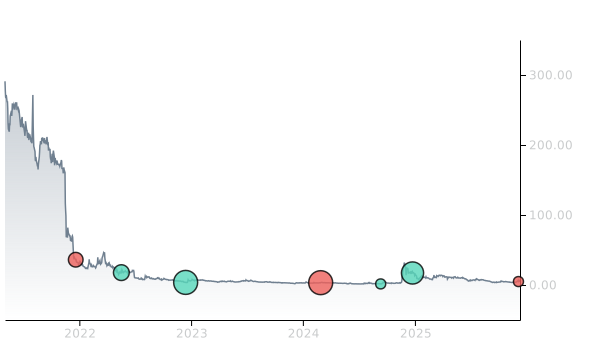
$XCUR insiders have traded $XCUR stock on the open market 4 times in the past 6 months. Of those trades, 0 have been purchases and 4 have been sales.
Here’s a breakdown of recent trading of $XCUR stock by insiders over the last 6 months:
- HITRON INC. EXICURE has made 0 purchases and 3 sales selling 1,734,386 shares for an estimated $7,804,737.
- INVESTMENT & SECURITIES CO., LTD. SANGSANGIN sold 433,332 shares for an estimated $3,774,321
To track insider transactions, check out Quiver Quantitative's insider trading dashboard.
$XCUR Hedge Fund Activity
We have seen 4 institutional investors add shares of $XCUR stock to their portfolio, and 4 decrease their positions in their most recent quarter.
Here are some of the largest recent moves:
- UBS GROUP AG removed 17,253 shares (-92.3%) from their portfolio in Q4 2025, for an estimated $93,511
- MILLENNIUM MANAGEMENT LLC removed 10,660 shares (-100.0%) from their portfolio in Q3 2025, for an estimated $43,599
- GEODE CAPITAL MANAGEMENT, LLC added 10,360 shares (+54.6%) to their portfolio in Q3 2025, for an estimated $42,372
- BLACKROCK, INC. added 2,682 shares (+87.9%) to their portfolio in Q3 2025, for an estimated $10,969
- MORGAN STANLEY added 1,443 shares (+235.8%) to their portfolio in Q3 2025, for an estimated $5,901
- TOWER RESEARCH CAPITAL LLC (TRC) added 1,057 shares (+108.4%) to their portfolio in Q3 2025, for an estimated $4,323
- BANK OF AMERICA CORP /DE/ removed 23 shares (-34.3%) from their portfolio in Q3 2025, for an estimated $94
To track hedge funds' stock portfolios, check out Quiver Quantitative's institutional holdings dashboard.
Full Release
REDWOOD CITY, Calif., Feb. 05, 2026 (GLOBE NEWSWIRE) -- Exicure, Inc. (Nasdaq: XCUR), a clinical-stage biotechnology company developing therapeutics for hematologic diseases, today announced the publication of results from a prior Phase 2 clinical study evaluating burixafor (GPC-100/TG-0054), a highly selective CXCR4 inhibitor, in the journal Annals of Hematology .
The manuscript, titled “ Burixafor, a CXCR4 Inhibitor with a Differentiated Kinetics Profile: Results of a Phase 2 Study for Rapid Cell Mobilization in Multiple Myeloma and Lymphoma Patients Undergoing Transplant ,” reports results from a 12-participant, multi-center, open-label Phase 2 study ( NCT02104427 ) evaluating burixafor in combination with granulocyte colony-stimulating factor (G-CSF) in patients with multiple myeloma (MM), non-Hodgkin’s lymphoma (NHL), and Hodgkin disease (HD) undergoing autologous stem cell transplantation (ASCT).
In the study, 11 of 12 participants (92%) met the primary endpoint of collecting ≥5.0 × 10⁶ CD34+ cells/kg within two leukapheresis sessions, with six participants achieving the target in a single session. Median time to neutrophil and platelet engraftment was 12 and 22 days, respectively. Burixafor was generally well tolerated, with only two treatment-related adverse events reported, both low grade.
Notably, peak mobilization of CD34+ cells occurred within one hour of burixafor administration, substantially faster than currently approved CXCR4 inhibitors, which typically peak 10-14 hours after dosing. This rapid mobilization profile enables same-day leukapheresis, offering the potential to simplify treatment logistics, reduce hospital resource utilization, and minimize patient burden.
In addition to robust stem cell mobilization, burixafor in combination with G-CSF led to marked increases in circulating white blood cell subsets, including lymphocytes. In participants with MM, lymphocyte counts increased by up to 11-fold within hours of burixafor administration, supporting potential applicability in gene therapy, CAR-T, and other gene-editing workflows that require efficient peripheral blood cell collection.
“ASCT remains a treatment cornerstone for multiple myeloma and certain lymphomas. Efficient mobilization of peripheral blood progenitor cells is critical to achieving reliable engraftment while minimizing patient burden and overall healthcare costs,” said Michael Schuster, MD, Clinical Professor of Medicine at Stony Brook University and a study author. “In this study, burixafor demonstrated enhanced mobilization kinetics that led to significantly faster attainment of stem cell collection goals, highlighting its differentiated profile and potential to meaningfully improve the efficiency of cell collection for ASCT. Beyond transplant, rapid and predictable mobilization of CD34-positive cells and lymphocytes may also be highly relevant for emerging gene-based and gene-editing approaches, including those being explored for conditions such as sickle cell disease.”
Exicure continues to advance burixafor’s clinical development and has recently completed an additional Phase 2 study evaluating burixafor in combination with G-CSF and propranolol in patients with multiple myeloma undergoing autologous hematopoietic cell transplantation ( NCT05561751 ). The addition of propranolol was informed by previously published preclinical data demonstrating functional crosstalk between CXCR4 and beta-adrenergic receptors, suggesting the potential for enhanced mobilization through dual pathway blockade. Positive topline data from this recent study were presented at the American Society of Hematology (ASH) Annual Meeting in December 2025 and the Tandem Meetings in February 2026, further supporting burixafor’s differentiated and rapid mobilization profile in the transplant setting.
About Exicure
Exicure, Inc. (Nasdaq: XCUR) is a clinical-stage biotechnology company developing therapies to address key challenges in hematologic diseases. The company’s lead program, burixafor (GPC-100), is a highly selective small molecule antagonist of CXCR4, a chemokine receptor that plays a central role in retaining hematopoietic stem cells in the bone marrow niche. By blocking CXCR4, burixafor may enhance stem cell mobilization into the peripheral blood to support collection and use in autologous stem cell transplantation (ASCT).
Burixafor is being evaluated for its potential to improve stem cell mobilization in multiple myeloma, sickle cell disease, and in support of cell and gene therapy. In addition, Exicure is planning a chemosensitization trial in acute myeloid leukemia (AML), leveraging burixafor’s ability to mobilize malignant cells from protective bone marrow niches into the peripheral blood, where they may be more effectively targeted by chemotherapy. Burixafor became part of Exicure’s pipeline following the company’s acquisition of GPCR Therapeutics, Inc. in January 2025. For more information, visit www.exicuretx.com .
Media Contact:
Sarah Ellinwood, PhD
Kendall Investor Relations
[email protected]