


Bempedoic acid is recommended by ACC for LDL-C reduction in diabetes and PAD, showing cardiovascular and limb benefits.
Quiver AI Summary
Esperion has announced the recognition of bempedoic acid as a key first-line therapy for lowering LDL cholesterol (LDL-C) in patients with peripheral artery disease (PAD) and diabetes, as outlined in the 2025 American College of Cardiology (ACC) Scientific Statement. The statement emphasizes the critical need for aggressive LDL-C reduction to improve cardiovascular and limb-related outcomes in high-risk patients. CEO Sheldon Koenig expressed confidence in the role of bempedoic acid in cardiovascular risk reduction and anticipates its endorsement in upcoming dyslipidemia treatment guidelines from ACC/American Heart Association in 2026. The ACC's recommendations support the drug's use alongside high-intensity statins and other therapies, particularly highlighting its effectiveness in reducing major adverse limb events by 36% compared to placebo in patients with PAD.
Potential Positives
- Bempedoic acid has been recognized as a first-line, evidence-based therapy for LDL-C lowering in patients with peripheral artery disease and diabetes by the American College of Cardiology, enhancing its credibility and market potential.
- The inclusion of bempedoic acid in the ACC's scientific statement underscores its significant role in reducing cardiovascular and limb risk in high-risk populations, which could lead to increased adoption by healthcare professionals.
- The anticipated positive evaluation of bempedoic acid in the upcoming U.S. dyslipidemia treatment guidelines indicates potential for wider utilization and validation in clinical practice.
- The data from the CLEAR Outcomes trial, presented at the AHA Scientific Sessions, highlights a significant reduction in major adverse limb events for patients treated with bempedoic acid, reinforcing its safety and efficacy profile.
Potential Negatives
- Inclusion of bempedoic acid in the ACC Scientific Statement does not guarantee its acceptance in future guidelines, which may diminish market expectations.
- Serious safety concerns highlighted, including risks of tendon rupture and hypersensitivity reactions that could affect patient adherence and overall perception of the drug.
- Adverse reactions reported during trials, such as hyperuricemia and renal impairment, may raise concerns about patient safety and could impact prescribing practices.
FAQ
What is bempedoic acid?
Bempedoic acid is a therapy used to lower LDL-C and reduce cardiovascular risk, particularly in patients with diabetes and peripheral artery disease.
How was bempedoic acid recognized by the ACC?
The American College of Cardiology highlighted bempedoic acid as a first-line therapy for LDL-C lowering in its 2025 scientific statement.
What are the key benefits of bempedoic acid?
Bempedoic acid has proven cardiovascular and limb benefits, helping to reduce major adverse limb events in high-risk patients.
Is bempedoic acid safe for patients?
Bempedoic acid is generally safe but may cause side effects like hyperuricemia, tendon rupture, and has contraindications for certain hypersensitivities.
What are the indications for NEXLIZET and NEXLETOL?
NEXLIZET and NEXLETOL are indicated to reduce LDL-C in adults who are unable to tolerate statin therapy and are at high cardiovascular risk.
Disclaimer: This is an AI-generated summary of a press release distributed by GlobeNewswire. The model used to summarize this release may make mistakes. See the full release here.
$ESPR Insider Trading Activity
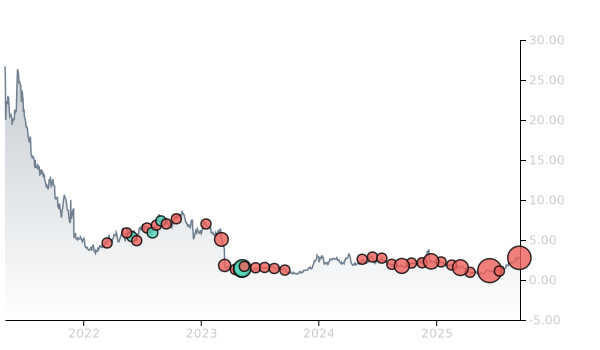
$ESPR insiders have traded $ESPR stock on the open market 9 times in the past 6 months. Of those trades, 0 have been purchases and 9 have been sales.
Here’s a breakdown of recent trading of $ESPR stock by insiders over the last 6 months:
- SHELDON L. KOENIG (President and CEO) has made 0 purchases and 2 sales selling 76,671 shares for an estimated $256,454.
- BENJAMIN HALLADAY (Chief Financial Officer) has made 0 purchases and 3 sales selling 14,394 shares for an estimated $46,702.
- BENJAMIN LOOKER (General Counsel) has made 0 purchases and 4 sales selling 15,336 shares for an estimated $46,215.
To track insider transactions, check out Quiver Quantitative's insider trading dashboard.
$ESPR Hedge Fund Activity
We have seen 106 institutional investors add shares of $ESPR stock to their portfolio, and 82 decrease their positions in their most recent quarter.
Here are some of the largest recent moves:
- BELLEVUE GROUP AG removed 9,694,064 shares (-100.0%) from their portfolio in Q2 2025, for an estimated $9,542,836
- NUVEEN, LLC added 3,288,456 shares (+778.1%) to their portfolio in Q3 2025, for an estimated $8,714,408
- WASATCH ADVISORS LP removed 3,278,404 shares (-31.7%) from their portfolio in Q3 2025, for an estimated $8,687,770
- MORGAN STANLEY added 3,000,138 shares (+284.2%) to their portfolio in Q3 2025, for an estimated $7,950,365
- AIGH CAPITAL MANAGEMENT LLC added 3,000,000 shares (+inf%) to their portfolio in Q3 2025, for an estimated $7,950,000
- INDABA CAPITAL MANAGEMENT, L.P. removed 3,000,000 shares (-100.0%) from their portfolio in Q3 2025, for an estimated $7,950,000
- MARSHALL WACE, LLP removed 2,790,813 shares (-52.5%) from their portfolio in Q3 2025, for an estimated $7,395,654
To track hedge funds' stock portfolios, check out Quiver Quantitative's institutional holdings dashboard.
$ESPR Analyst Ratings
Wall Street analysts have issued reports on $ESPR in the last several months. We have seen 1 firms issue buy ratings on the stock, and 0 firms issue sell ratings.
Here are some recent analyst ratings:
- Piper Sandler issued a "Overweight" rating on 11/25/2025
To track analyst ratings and price targets for $ESPR, check out Quiver Quantitative's $ESPR forecast page.
$ESPR Price Targets
Multiple analysts have issued price targets for $ESPR recently. We have seen 2 analysts offer price targets for $ESPR in the last 6 months, with a median target of $12.5.
Here are some recent targets:
- David Amsellem from Piper Sandler set a target price of $9.0 on 11/25/2025
- Joseph Pantginis from HC Wainwright & Co. set a target price of $16.0 on 09/19/2025
Full Release
– Bempedoic Acid Highlighted by ACC for LDL-C Lowering in Patients with Peripheral Artery Disease and Diabetes Based on Proven Cardiovascular and Limb Benefits –
ANN ARBOR, Mich., Dec. 19, 2025 (GLOBE NEWSWIRE) -- Esperion (NASDAQ: ESPR) welcomed the inclusion of bempedoic acid as a first-line, evidence-based therapy for LDL-C lowering for patients on maximally tolerated statins in the 2025 American College of Cardiology (ACC) Scientific Statement on Management of Peripheral Artery Disease (PAD) in Adults with Diabetes.
“We recognize the significance of the American College of Cardiology’s scientific statement highlighting the importance of aggressive LDL-C lowering in patients with diabetes and peripheral artery disease. The inclusion of bempedoic acid reinforces its important role as a proven, evidence-based therapy for reducing both cardiovascular and limb risk in high-risk populations,” said Sheldon Koenig, CEO of Esperion.
”This statement provides clinicians with valuable insight to help close treatment gaps. This scientific statement reinforces the valuable role bempedoic acid plays in cardiovascular risk reduction. As we anticipate the forthcoming U.S. dyslipidemia treatment guidelines from ACC/American Heart Association (AHA) in early 2026, it also strengthens our confidence that bempedoic acid will be included in those recommendations, consistent with its prominent endorsement in the European guidelines issued in August,” concluded Koenig.
Key ACC Recommendations for LDL-C Lowering in Adults with PAD and Diabetes
- Treatment of LDL-C to a target reduction > 50% and goal <55 mg/dL is recommended, using therapies with proven cardiovascular benefit.
- High-intensity statins, reinforced by ezetimibe, PCSK9 inhibitors, or bempedoic acid as needed, effectively reduce cardiovascular and limb risk.
The scientific statement, entitled “Management of peripheral artery disease in adults with diabetes: 2025 ACC scientific statement; a report of the American College of Cardiology,” was published in the Journal of the American College of Cardiology . The full scientific statement is available via open access here .
This scientific statement incorporates data from the 2024 AHA Scientific Sessions Featured Science Presentation “Bempedoic Acid and Limb Outcomes in Statin-Intolerant Patients with Peripheral Artery Disease” presented on behalf of all authors by Marc P. Bonaca, MD, MPH, FAHA, FACC, CPC Clinical Research with manuscript under review. The analysis focused on the incidence of major adverse limb events (MALE) in patients with pre-existing PAD enrolled in the CLEAR Outcomes trial. Bempedoic acid reduced MALE (e.g. worsening PAD symptoms leading to revascularization, chronic limb threatening ischemia, and acute limb ischemia events) by 36% compared to placebo and supports bempedoic acid as an oral, safe, and well tolerated option for lowering LDL-C and the risk of major adverse limb events in patients with PAD.
INDICATION
NEXLIZET and NEXLETOL are indicated:
-
The bempedoic acid component of NEXLIZET and NEXLETOL is indicated to reduce the risk of major adverse cardiovascular events (cardiovascular death, myocardial infarction, stroke, or coronary revascularization) in adults at increased risk for these events who are unable to take recommended statin therapy (including those not taking a statin).
- NEXLIZET, to reduce LDL-C in adults with hypercholesterolemia, including HeFH.
-
NEXLETOL, in combination with other LDL-C lowering therapies, or alone when concomitant LDL-C lowering therapy is not possible to reduce LDL-C in adults with hypercholesterolemia, including HeFH.
IMPORTANT SAFETY INFORMATION
NEXLIZET and NEXLETOL are contraindicated in patients with a prior hypersensitivity to bempedoic acid or ezetimibe or any of the excipients. Serious hypersensitivity reactions including anaphylaxis, angioedema, rash, and urticaria have been reported.
Hyperuricemia: Bempedoic acid, a component of NEXLIZET and NEXLETOL, may increase blood uric acid levels, which may lead to gout. Hyperuricemia may occur early in treatment and persist throughout treatment, returning to baseline following discontinuation of treatment. Assess uric acid levels periodically as clinically indicated. Monitor for signs and symptoms of hyperuricemia, and initiate treatment with urate-lowering drugs as appropriate.
Tendon Rupture: Bempedoic acid, a component of NEXLIZET and NEXLETOL, is associated with an increased risk of tendon rupture or injury. Tendon rupture may occur more frequently in patients over 60 years of age, in those taking corticosteroid or fluoroquinolone drugs, in patients with renal failure, and in patients with previous tendon disorders. Discontinue NEXLIZET or NEXLETOL at the first sign of tendon rupture. Consider alternative therapy in patients who have a history of tendon disorders or tendon rupture.
The most common adverse reactions in the primary hyperlipidemia trials of bempedoic acid, a component of NEXLIZET and NEXLETOL, in ≥2% of patients and greater than placebo were upper respiratory tract infection, muscle spasms, hyperuricemia, back pain, abdominal pain or discomfort, bronchitis, pain in extremity, anemia, and elevated liver enzymes.
Adverse reactions reported in ≥2% of patients treated with ezetimibe (a component of NEXLIZET) and at an incidence greater than placebo in clinical trials were upper respiratory tract infection, diarrhea, arthralgia, sinusitis, pain in extremity, fatigue, and influenza.
In the primary hyperlipidemia trials of NEXLIZET, the most commonly reported adverse reactions (incidence ≥3% and greater than placebo) observed with NEXLIZET, but not observed in clinical trials of bempedoic acid or ezetimibe, were urinary tract infection, nasopharyngitis, and constipation.
The most common adverse reactions in the cardiovascular outcomes trial for bempedoic acid, a component of NEXLIZET and NEXLETOL, at an incidence of ≥2% and 0.5% greater than placebo were hyperuricemia, renal impairment, anemia, elevated liver enzymes, muscle spasms, gout, and cholelithiasis.
Discontinue NEXLIZET or NEXLETOL when pregnancy is recognized unless the benefits of therapy outweigh the potential risks to the fetus. Because of the potential for serious adverse reactions in a breast-fed infant, breastfeeding is not recommended during treatment with NEXLIZET or NEXLETOL.
Report pregnancies to Esperion Therapeutics, Inc. Adverse Event reporting line at 1-833-377-7633.
Please see full Prescribing Information for NEXLIZET and NEXLETOL .
About Esperion Therapeutics
Esperion Therapeutics, Inc. is a commercial-stage biopharmaceutical company dedicated to developing and delivering innovative cardiometabolic and rare/orphan disease therapies. The Company leverages deep domain expertise in ACLY biology to develop and commercialize transformative medicines for patients worldwide. Esperion currently markets two oral, once-daily, non-statin therapies for patients struggling to maintain their low-density lipoprotein cholesterol (LDL-C) levels and are at risk of cardiovascular disease.
With a broad U.S. commercial infrastructure and global approvals across more than 40 countries, Esperion is well positioned to serve as a partner-of-choice for global innovators seeking U.S. market access through acquisition, in-license, co-promotion and revenue share opportunities. In tandem, the Company is advancing its leadership in ACLY biology to build a diversified pipeline of novel product candidates, including treatments for Primary Sclerosing Cholangitis and renal diseases. For more information, visit esperion.com and follow Esperion on LinkedIn and X .
Forward-Looking Statements
This press release contains forward-looking statements that are made pursuant to the safe harbor provisions of the federal securities laws, including statements regarding marketing strategy and commercialization plans, current and planned operational expenses, expected profitability, future operations, commercial products, clinical development, including the timing, designs and plans for the CLEAR Outcomes study and its results, plans for potential future product candidates, financial condition and outlook, including expected cash runway and profitability, and other statements containing the words “anticipate,” “believe,” “estimate,” “expect,” “intend,” “may,” “plan,” “predict,” “project,” “suggest,” “target,” “potential,” “will,” “would,” “could,” “should,” “continue,” and similar expressions. Any express or implied statements contained in this press release that are not statements of historical fact may be deemed to be forward-looking statements. Forward-looking statements involve risks and uncertainties that could cause Esperion’s actual results to differ significantly from those projected, including, without limitation, the net sales, profitability, and growth of Esperion’s commercial products, clinical activities and results, supply chain, commercial development and launch plans, the outcomes and anticipated benefits of legal proceedings and settlements, and the risks detailed in Esperion’s filings with the Securities and Exchange Commission. Any forward-looking statements contained in this press release speak only as of the date hereof, and Esperion disclaims any obligation or undertaking to update or revise any forward-looking statements contained in this press release, other than to the extent required by law.
Esperion Contact Information:
Investors:
Alina Venezia
[email protected]
(734) 887-3903
Media:
Tiffany Aldrich
[email protected]
(616) 443-8438