


Equifax Canada reports increased missed payments and rising consumer debt trends as the holiday season approaches.
Quiver AI Summary
Equifax Canada’s Q3 Market Pulse report reveals a notable increase in consumer financial stress, with 1.45 million Canadians missing credit payments in the third quarter, marking a rise of over 46,000 from the previous quarter. The national 90+ days non-mortgage delinquency rate increased to 1.63%, up 14% year-over-year, as total consumer debt reached $2.62 trillion. Younger consumers, particularly those aged 18-35, are facing the highest financial strain, with significant increases in missed payments and delinquency rates compared to older age groups. Urban centers like Toronto and Vancouver experienced higher delinquency rates, while the auto industry is grappling with challenges including rising prices and fraud. Although average credit card spending has grown, younger consumers showed some restraint in credit use, raising concerns about their financial well-being heading into the holiday season.
Potential Positives
- Total consumer debt in Canada rose to $2.62 trillion, indicating growth in the market and potential business opportunities for Equifax.
- New auto loan volumes increased by 4.8% year-over-year, suggesting a recovering automotive sector that could benefit Equifax's analytics services.
- Despite rising missed payments, improved overall card payment health signals a shift towards responsible credit use, potentially benefiting Equifax's risk assessment models.
Potential Negatives
- 1.45 million consumers missing credit payments in Q3 represents a significant rise, indicating increased financial distress among Canadians heading into the holiday season.
- The national non-mortgage delinquency rate increased to 1.63%, reflecting a 14% year-over-year rise, which may signal worsening economic conditions for consumers.
- High levels of missed payments, especially among younger demographics (1 in 20), suggest that financial instability is particularly acute among this age group, potentially impacting Equifax's credit reporting accuracy and market reputation.
FAQ
What are the latest consumer credit trends in Canada?
The Q3 Market Pulse report shows a rise in missed payments and increased consumer debt, reaching $2.62 trillion.
How many Canadians missed credit payments in Q3 2025?
Approximately 1.45 million consumers missed a credit payment in Q3 2025, increasing from the previous quarter.
Which age group is most affected by missed payments?
Consumers aged 18-35 are significantly impacted, with 1 in 20 missing a payment during Q3 2025.
How did credit card spending change in Q3 2025?
Inflation-adjusted card spending increased by 1.6%, particularly in Nunavut, Quebec, and New Brunswick.
What financial issues are younger consumers facing?
Younger consumers are experiencing increased financial stress and higher delinquency rates on non-mortgage debts.
Disclaimer: This is an AI-generated summary of a press release distributed by GlobeNewswire. The model used to summarize this release may make mistakes. See the full release here.
$EFX Insider Trading Activity
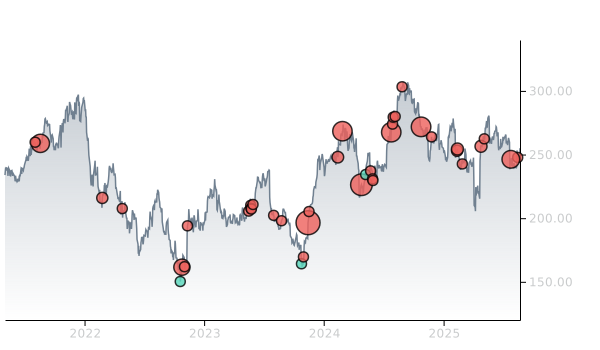
$EFX insiders have traded $EFX stock on the open market 22 times in the past 6 months. Of those trades, 0 have been purchases and 22 have been sales.
Here’s a breakdown of recent trading of $EFX stock by insiders over the last 6 months:
- MARK W BEGOR (CEO) has made 0 purchases and 19 sales selling 97,609 shares for an estimated $23,070,124.
- JOHN W JR GAMBLE (EVP, CFO & COO) has made 0 purchases and 2 sales selling 5,500 shares for an estimated $1,262,975.
- JAMIL FARSHCHI (EVP, Chief Technology Officer) sold 4,925 shares for an estimated $1,176,779
To track insider transactions, check out Quiver Quantitative's insider trading dashboard.
$EFX Hedge Fund Activity
We have seen 417 institutional investors add shares of $EFX stock to their portfolio, and 399 decrease their positions in their most recent quarter.
Here are some of the largest recent moves:
- BROWN ADVISORY INC added 1,736,373 shares (+3425.7%) to their portfolio in Q3 2025, for an estimated $445,431,765
- FMR LLC removed 1,211,261 shares (-40.0%) from their portfolio in Q3 2025, for an estimated $310,724,784
- UBS AM, A DISTINCT BUSINESS UNIT OF UBS ASSET MANAGEMENT AMERICAS LLC added 943,833 shares (+81.0%) to their portfolio in Q3 2025, for an estimated $242,121,479
- MORGAN STANLEY added 749,502 shares (+19.3%) to their portfolio in Q3 2025, for an estimated $192,269,748
- HARRIS ASSOCIATES L P added 725,901 shares (+14.2%) to their portfolio in Q3 2025, for an estimated $186,215,383
- GOLDMAN SACHS GROUP INC removed 336,966 shares (-30.5%) from their portfolio in Q3 2025, for an estimated $86,441,887
- VANGUARD GROUP INC added 316,048 shares (+2.1%) to their portfolio in Q3 2025, for an estimated $81,075,793
To track hedge funds' stock portfolios, check out Quiver Quantitative's institutional holdings dashboard.
$EFX Analyst Ratings
Wall Street analysts have issued reports on $EFX in the last several months. We have seen 9 firms issue buy ratings on the stock, and 0 firms issue sell ratings.
Here are some recent analyst ratings:
- RBC Capital issued a "Outperform" rating on 11/07/2025
- Stifel issued a "Buy" rating on 10/22/2025
- Needham issued a "Buy" rating on 10/21/2025
- Wells Fargo issued a "Overweight" rating on 10/15/2025
- UBS issued a "Buy" rating on 09/15/2025
- Baird issued a "Outperform" rating on 07/23/2025
- Oppenheimer issued a "Outperform" rating on 07/23/2025
To track analyst ratings and price targets for $EFX, check out Quiver Quantitative's $EFX forecast page.
$EFX Price Targets
Multiple analysts have issued price targets for $EFX recently. We have seen 17 analysts offer price targets for $EFX in the last 6 months, with a median target of $280.0.
Here are some recent targets:
- Keith Mackey from RBC Capital set a target price of $17.0 on 11/07/2025
- Jeffrey Silber from BMO Capital set a target price of $245.0 on 10/22/2025
- Shlomo Rosenbaum from Stifel set a target price of $253.0 on 10/22/2025
- Kyle Peterson from Needham set a target price of $295.0 on 10/21/2025
- Jason Haas from Wells Fargo set a target price of $285.0 on 10/15/2025
- Rayna Kumar from Oppenheimer set a target price of $271.0 on 10/13/2025
- Heather Balsky from B of A Securities set a target price of $250.0 on 10/03/2025
Full Release
Equifax Canada ® Market Pulse Quarterly Consumer Credit Trends and Insights
TORONTO, Nov. 26, 2025 (GLOBE NEWSWIRE) -- Equifax® Canada’s Q3 Market Pulse Quarterly Consumer Credit Trends and Insights shows a renewed rise in missed payments heading into the holidays, with 1.45 million consumers in Canada missing a credit payment in Q3, more than 46,000 higher than in Q2.
The national 90+ non-mortgage balance delinquency rate reached 1.63 per cent, up 14 per cent year-over-year. Total consumer debt climbed to $2.62 trillion (+3.4 per cent year-over-year), while average non-mortgage debt per consumer rose to $22,321, up $511 from a year ago.
“Earlier this year, we saw tentative signs of stabilization, however Q3 data indicated some renewed stress, especially in younger households and homeowners in urban centres,” said Rebecca Oakes, Vice-President, Advanced Analytics at Equifax Canada. “The holiday season is a time when credit card spending typically rises $300–$500 per consumer and previous Equifax data shows that missed card payments increase by roughly 7 per cent come January. Spending over the next few weeks will be a decisive moment for many consumers in Canada.”
Financial
stress
for younger consumers, especially in certain cities
Financial stress remains greatest among younger people (aged 18-35 years old) with 1 in 20 missing a credit payment during Q3. Among 26–35-year-olds, the 90+ days non-mortgage balance delinquency rate reached 2.45 per cent, up 20.51 per cent year-over-year. In addition, the delinquency rate for 18–25-year olds stood at 2.11 per cent, up 16.58 per cent year-over-year.
By contrast, older consumers in Canada recorded smaller increases, including 56–65 year olds at +9.95 per cent, and for the 65+ cohort at +4.36 per cent.
Several large urban centres posted increases in non-mortgage delinquency, including Toronto which reached 2.27 per cent (+19.58 per cent year-over-year); Vancouver at 1.27 per cent (+18.18 per cent); and Ottawa at 1.55 per cent (+17.61 per cent). Smaller increases were seen in Edmonton (+11.23 per cent) and Halifax (+12.51 per cent), as well as cities in the Prairies and Atlantic regions.
Missed payments
Missed payments were concentrated among non-mortgage households. Of the 1.45 million consumers who missed a payment, 84 per cent (about 1.21 million) did not hold a mortgage. For mortgage holders, roughly 1 in 35 missed a payment compared to 1 in 37 at the end of Q2.
“The data shows there are still emerging financial challenges for older consumers, especially those with a mortgage in cities such as Toronto,” added Oakes. “Mortgage payment shock is still contributing to rising missed payments on credit cards, personal loans, and even on mortgages themselves."
Credit use and card behaviour heading into year-end
Non-mortgage debt rose just over 5 per cent year-over-year, and although growth was slower than prior years, pick up in the housing market led to a $31.8 billion increase in mortgage balances versus Q2. Inflation-adjusted card spend increased 1.6 per cent, led by Nunavut (up 5.5 per cent), Quebec (up 4.0 per cent), and New Brunswick (up 2.8 per cent). Overall card payment health improved modestly—fewer consumers paid only the minimum and more consumers paid their balance in full—however those top line numbers mask a growing strain among younger consumers in Canada. Minimum-payer rates increased for consumers under 25, as well as consumers aged 26–35-years old, and those in higher-cost provinces such as Ontario and British Columbia.
“Since the pandemic, we’ve seen periods where consumers proactively curb credit use as finances tighten. We observed younger consumers pulling back on card spend last quarter, and it will be important to see whether that discipline holds through the holiday season,” concluded Oakes.
Consumers aged 46+ moved in the opposite direction with average card spending rising to $2,342 in Q3, up $48 year-over-year.
Auto industry facing new headwinds
The auto industry has experienced multiple challenges over recent years with rising vehicle prices and high interest rates curbing consumer demand during 2022 and 2023. In Q3 2025 renewed activity did continue with new auto loan volumes rising 4.8% compared to 12 months prior, however, auto lenders are facing an escalating threat from synthetic ID fraud leading to increasing levels of auto loan stacking losses. This type of fraud accounted for an estimated 1/3 of auto loans (over $10k) opened in Jan 2025 which missed payments in Q3 and is contributing towards an estimated $450 million loss for auto lenders per year.
Age Group Analysis – Debt & Overall Balance Delinquency Rates (excluding mortgages)
|
Average
Debt (Q3 2025) |
Average Debt Change
Year-over-Year (Q3 2025 vs. Q3 2024) |
90+ Delinquency
Rate ($) (Q3 2025) |
Delinquency Rate Change
Year-over-Year (Q3 2025 vs. Q3 2024) |
||
| 18-25 | $8,635 | 4.46% | 2.11% | 16.58% | |
| 26-35 | $17,603 | 0.68% | 2.45% | 20.51% | |
| 36-45 | $27,263 | 1.03% | 1.97% | 15.99% | |
| 46-55 | $34,987 | 1.95% | 1.43% | 14.13% | |
| 56-65 | $29,772 | 4.80% | 1.16% | 9.95% | |
| 65+ | $15,121 | 3.75% | 1.13% | 4.36% | |
| Canada | $22,321 | 2.34% | 1.63% | 14.17% | |
Major City Analysis – Debt & Overall Balance Delinquency Rates (excluding mortgages)
| City |
Average
Debt (Q3 2025) |
Average Debt Change
Year-over-Year (Q3 2025 vs. Q3 2024) |
90+ Delinquency
Rate ($) (Q3 2025) |
Delinquency Rate Change
Year-over-Year (Q3 2025 vs. Q3 2024) |
|
| Calgary | $24,451 | 1.89% | 1.81% | 13.65% | |
| Edmonton | $23,867 | 0.52% | 2.27% | 11.23% | |
| Halifax | $21,758 | 2.32% | 1.55% | 12.51% | |
| Montreal | $17,315 | 2.49% | 1.53% | 13.27% | |
| Ottawa | $19,818 | 1.27% | 1.55% | 17.61% | |
| Toronto | $21,523 | 3.12% | 2.27% | 19.58% | |
| Vancouver | $24,808 | 3.58% | 1.27% | 18.18% | |
| St. John's | $22,781 | 2.34% | 1.69% | 13.19% | |
| Fort McMurray | $37,830 |
-0.23%
|
2.44% | 8.32% | |
Province Analysis - Debt & Overall Balance Delinquency Rates (excluding mortgages)
| Province |
Average
Debt (Q3 2025) |
Average Debt Change
Year-over-Year (Q3 2025 vs. Q3 2024) |
90+ Delinquency
Rate ($) (Q3 2025) |
Delinquency Rate Change
Year-over-Year (Q3 2025 vs. Q3 2024) |
|
| Ontario | $22,938 | 2.29% | 1.80% | 20.06% | |
| Quebec | $19,496 | 2.47% | 1.10% | 6.09% | |
| Nova Scotia | $21,783 | 2.16% | 1.66% | 8.33% | |
| New Brunswick | $22,977 | 1.65% | 1.71% | 11.28% | |
| PEI | $24,365 | 3.84% | 1.26% | 16.88% | |
| Newfoundland | $25,385 | 2.48% | 1.60% | 12.17% | |
| Eastern Region | $21,848 | 2.51% | 1.59% | 16.11% | |
| Alberta | $24,790 | 0.95% | 2.00% | 10.86% | |
| Manitoba | $18,635 | 3.03% | 1.73% | 5.99% | |
| Saskatchewan | $23,733 | 1.40% | 1.73% | 2.84% | |
| British Columbia | $23,052 | 2.74% | 1.46% | 14.29% | |
| Western Region | $23,306 | 1.97% | 1.72% | 10.89% | |
| Canada | $22,321 | 2.34% | 1.63% | 14.17% | |
* Based on Equifax data for Q3 2025
About Equifax
At Equifax (NYSE: EFX), we believe knowledge drives progress. As a global data, analytics, and technology company, we play an essential role in the global economy by helping financial institutions, companies, employers, and government agencies make critical decisions with greater confidence. Our unique blend of differentiated data, analytics, and cloud technology drives insights to power decisions to move people forward. Headquartered in Atlanta and supported by nearly 15,000 employees worldwide, Equifax operates or has investments in 24 countries in North America, Central and South America, Europe, and the Asia Pacific region. For more information, visit
Equifax.ca
.
Contact:
Andrew Findlater
SELECT Public Relations
[email protected]
(647) 444-1197
Angie Andich
Equifax Canada Media Relations
[email protected]