

LEQEMBI® receives UK approval for once-monthly intravenous maintenance dosing for Alzheimer's disease after initial treatment.
Quiver AI Summary
Eisai Co., Ltd. and Biogen Inc. announced that their monoclonal antibody, LEQEMBI® (lecanemab), has received approval from the UK's Medicines and Healthcare products Regulatory Agency for once every four weeks intravenous maintenance dosing. This follows its earlier approval in August 2024 for treating mild cognitive impairment and mild dementia due to Alzheimer's disease in certain adult patients. After an initial 18-month treatment regimen, patients can switch to this maintenance dosing to slow the progression of Alzheimer's disease, which currently affects nearly a million people in the UK. LEQEMBI targets both amyloid plaques and protofibrils, factors believed to contribute to cognitive decline in Alzheimer's patients. The drug has been approved in 51 countries and is under review in nine others, with ongoing clinical trials assessing its efficacy in different stages of Alzheimer's disease.
Potential Positives
- LEQEMBI® has been approved for once every four weeks intravenous maintenance dosing in the UK, enhancing treatment options for Alzheimer's disease patients.
- This approval follows the previous recognition of LEQEMBI for treating mild cognitive impairment and mild dementia due to Alzheimer's disease, indicating confidence in its efficacy and safety.
- The transition to a maintenance dosing regimen may improve patient compliance and quality of life by offering less frequent dosing after initial treatment.
- LEQEMBI has been approved in a total of 51 countries, showcasing its widespread acceptance and potential for global impact in treating Alzheimer's disease.
Potential Negatives
- Approval for maintenance dosing may highlight the need for ongoing treatment, which could indicate limitations in the drug's long-term effectiveness or the potential for disease progression when therapy is halted.
- The press release contains multiple references to the risks and uncertainties associated with drug development and commercialization, which may signal concerns about the future success of lecanemab in the market.
- The need for ongoing regulatory review and the mention of risks tied to the efficacy of the drug could raise questions among investors regarding the stability and reliability of lecanemab's approval trajectory.
FAQ
What is LEQEMBI and its approved uses?
LEQEMBI (lecanemab) is an anti-amyloid antibody approved for treating mild cognitive impairment and mild dementia due to Alzheimer's disease in specific patients.
How often is LEQEMBI administered?
LEQEMBI is administered via intravenous infusion, initially every two weeks, transitioning to maintenance dosing every four weeks after 18 months.
Who can benefit from LEQEMBI treatment?
Patients who are apolipoprotein E ε4 heterozygotes or non-carriers and have mild cognitive impairment or mild dementia may benefit from LEQEMBI.
What role does LEQEMBI play in Alzheimer’s disease?
LEQEMBI targets both amyloid-beta plaques and protofibrils, helping to slow neurodegeneration and maintain cognitive function in Alzheimer's patients.
How is LEQEMBI being commercialized?
Eisai and Biogen co-commercialize LEQEMBI, with Eisai overseeing global development, regulatory submissions, and final decision-making authority.
Disclaimer: This is an AI-generated summary of a press release distributed by GlobeNewswire. The model used to summarize this release may make mistakes. See the full release here.
$BIIB Congressional Stock Trading
Members of Congress have traded $BIIB stock 1 times in the past 6 months. Of those trades, 1 have been purchases and 0 have been sales.
Here’s a breakdown of recent trading of $BIIB stock by members of Congress over the last 6 months:
- REPRESENTATIVE ROBERT BRESNAHAN purchased up to $15,000 on 05/15.
To track congressional stock trading, check out Quiver Quantitative's congressional trading dashboard.
$BIIB Insider Trading Activity
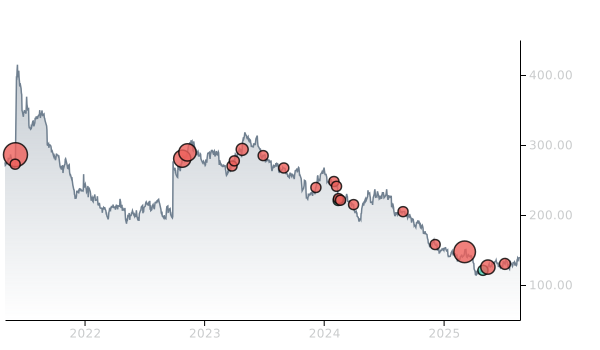
$BIIB insiders have traded $BIIB stock on the open market 3 times in the past 6 months. Of those trades, 0 have been purchases and 3 have been sales.
Here’s a breakdown of recent trading of $BIIB stock by insiders over the last 6 months:
- PRIYA SINGHAL (Head of Development) has made 0 purchases and 2 sales selling 4,323 shares for an estimated $549,552.
- RACHID IZZAR (Head of Global Product Strat.) sold 2,223 shares for an estimated $300,105
To track insider transactions, check out Quiver Quantitative's insider trading dashboard.
$BIIB Hedge Fund Activity
We have seen 428 institutional investors add shares of $BIIB stock to their portfolio, and 408 decrease their positions in their most recent quarter.
Here are some of the largest recent moves:
- POINT72 ASSET MANAGEMENT, L.P. added 3,424,470 shares (+840.9%) to their portfolio in Q2 2025, for an estimated $430,079,187
- T. ROWE PRICE INVESTMENT MANAGEMENT, INC. removed 1,265,814 shares (-47.6%) from their portfolio in Q2 2025, for an estimated $158,973,580
- BLACKROCK, INC. added 1,208,486 shares (+8.9%) to their portfolio in Q3 2025, for an estimated $169,284,718
- PRIMECAP MANAGEMENT CO/CA/ removed 847,425 shares (-5.4%) from their portfolio in Q3 2025, for an estimated $118,707,294
- AMUNDI removed 736,150 shares (-55.9%) from their portfolio in Q2 2025, for an estimated $92,453,078
- MARSHALL WACE, LLP added 721,706 shares (+434.9%) to their portfolio in Q3 2025, for an estimated $101,096,576
- BARCLAYS PLC added 561,769 shares (+70.4%) to their portfolio in Q3 2025, for an estimated $78,692,601
To track hedge funds' stock portfolios, check out Quiver Quantitative's institutional holdings dashboard.
$BIIB Analyst Ratings
Wall Street analysts have issued reports on $BIIB in the last several months. We have seen 4 firms issue buy ratings on the stock, and 0 firms issue sell ratings.
Here are some recent analyst ratings:
- Stifel issued a "Buy" rating on 11/06/2025
- RBC Capital issued a "Outperform" rating on 10/31/2025
- Jefferies issued a "Buy" rating on 09/25/2025
- HC Wainwright & Co. issued a "Buy" rating on 08/01/2025
To track analyst ratings and price targets for $BIIB, check out Quiver Quantitative's $BIIB forecast page.
$BIIB Price Targets
Multiple analysts have issued price targets for $BIIB recently. We have seen 9 analysts offer price targets for $BIIB in the last 6 months, with a median target of $157.0.
Here are some recent targets:
- Paul Matteis from Stifel set a target price of $202.0 on 11/06/2025
- William Pickering from Bernstein set a target price of $157.0 on 11/03/2025
- Brian Abrahams from RBC Capital set a target price of $210.0 on 10/31/2025
- Matthew Harrison from Morgan Stanley set a target price of $149.0 on 10/10/2025
- Andrew Tsai from Jefferies set a target price of $190.0 on 09/25/2025
- David Amsellem from Piper Sandler set a target price of $118.0 on 08/14/2025
- Geoff Meacham from Citigroup set a target price of $135.0 on 08/01/2025
Full Release
TOKYO and CAMBRIDGE, Mass., Nov. 13, 2025 (GLOBE NEWSWIRE) -- Eisai Co., Ltd. (Headquarters: Tokyo, CEO: Haruo Naito, “Eisai”) and Biogen Inc. (Nasdaq: BIIB, Corporate headquarters: Cambridge, Massachusetts, CEO: Christopher A. Viehbacher, “Biogen”) announced today that humanized anti- soluble aggregated amyloid-beta (Aβ) monoclonal antibody “LEQEMBI ® ” (generic name: lecanemab) has been approved for once every four weeks intravenous (IV) maintenance dosing by the Medicines and Healthcare products Regulatory Agency (MHRA) in the United Kingdom.
In August 2024, LEQEMBI was approved for the treatment of mild cognitive impairment (MCI) and mild dementia due to Alzheimer’s disease (AD) in adult patients that are apolipoprotein E ε4 (ApoE ε4)* heterozygotes or non-carriers in the United Kingdom. With this latest approval for IV maintenance dosing, after 18 months of a dosing regimen of 10 mg/kg once every two weeks patients may be transitioned to the maintenance dosing regimen of 10 mg/kg once every four weeks, or the regimen of 10 mg/kg once every two weeks may be continued.
AD is a progressive, relentless disease characterized by formation of protein deposits known as plaques made of amyloid-beta aggregates and neurofibrillary tangles made of tau protein in the brains of people living with AD. It is caused by a continuous underlying neurotoxic process that begins before amyloid plaque accumulation and continues after plaque removal. 1,2 The data show that amyloid-beta protofibrils and tau tangles play roles in the neurodegeneration process, 2,3 and only LEQEMBI fights AD in two ways – targeting both amyloid plaque and protofibrils**, which can impact tau downstream. Due to the reaccumulation of AD biomarkers and return to placebo rate of decline after therapy is stopped, 3-5 continuing maintenance treatment after the initial 18-month therapy is essential to slow the progression of AD and extend the therapeutic benefits, helping patients maintain who they are for longer.
In the United Kingdom, it is estimated that 982,000 people are living with dementia, 6 and AD is the cause in 60-70% of people with dementia. 7 These numbers are expected to rise, as the population ages. 6,7
Eisai serves as the lead for lecanemab’s development and regulatory submissions globally with Eisai and Biogen co-commercializing and co-promoting the product and Eisai having final decision-making authority.
* Apolipoprotein E is a protein involved in the metabolism of lipid in humans. It is implicated in AD. People with only one (heterozygous) or no copy (non-carriers) of the ApoE ε4 gene are less likely to experience ARIA than people with two ApoE ε4 copies (homozygous).
8
** Protofibrils are thought to be the most toxic Aβ species that contribute to brain damage in AD and play a major role in the cognitive decline of this progressive and devastating disease. Protofibrils can cause neuronal and synaptic damage in the brain, which can subsequently adversely affect cognitive function through multiple mechanisms.
3
The mechanism by which this occurs has been reported not only by increasing the formation of insoluble Aβ plaques, but also by directly damaging signaling between neurons and other cells. It is believed that reducing protofibrils may reduce neuronal damage and cognitive impairment, potentially slowing the progression of AD.
4
| MEDIA CONTACTS | |
|
Eisai Co., Ltd.
Public Relations Department +81 (0)3-3817-5120 Eisai Inc. (U.S.) Libby Holman + 1-201-753-1945 [email protected] |
Biogen Inc.
Madeleine Shin + 1-781-464-3260 [email protected] |
| INVESTOR CONTACTS | |
|
Eisai Co., Ltd.
Investor Relations Department +81 (0) 3-3817-5122 |
Biogen Inc.
Tim Power + 1-781-464-2442 [email protected] |
|
Notes to Editors
|
||
| 1. | About LEQEMBI (generic name: lecanemab) | |
|
Lecanemab is the result of a strategic research alliance between Eisai and BioArctic. It is a humanized immunoglobulin gamma (IgG1) monoclonal antibody directed against aggregated soluble (protofibril) and insoluble forms of amyloid-beta (Aβ). Lecanemab has been approved in 51 countries and is under regulatory review in 9 countries. Following the initial phase with treatment every two weeks for 18 months, intravenous (IV) maintenance dosing with treatment every four weeks was approved in the United Kingdom, the U.S, China and others, and applications have been filed in 4 countries and regions.
|
||
| LEQEMBI's approvals in these countries were based on Phase 3 data from Eisai's, global Clarity AD clinical trial, in which it met its primary endpoint and all key secondary endpoints with statistically significant results. The primary endpoint was the global cognitive and functional scale, Clinical Dementia Rating Sum of Boxes (CDR-SB). 1 The U.S. FDA approved Eisai’s Biologics License Application (BLA) for subcutaneous maintenance dosing with LEQEMBI IQLIK in August 2025. In September 2025, the rolling sBLA application to the U.S. FDA for the subcutaneous initiation dosing with LEQEMBI IQLIK was also initiated. | ||
| Since July 2020 the Phase 3 clinical study (AHEAD 3-45) for individuals with preclinical AD, meaning they are clinically normal and have intermediate or elevated levels of amyloid in their brains, is ongoing. AHEAD 3-45 is conducted as a public-private partnership between the Alzheimer's Clinical Trial Consortium that provides the infrastructure for academic clinical trials in AD and related dementias in the U.S, funded by the National Institute on Aging, part of the National Institutes of Health, Eisai and Biogen. Since January 2022, the Tau NexGen clinical study for Dominantly Inherited AD (DIAD), that is conducted by Dominantly Inherited Alzheimer Network Trials Unit (DIAN-TU), led by Washington University School of Medicine in St. Louis, is ongoing and includes lecanemab as the backbone anti-amyloid therapy. | ||
| 2. | About the Collaboration between Eisai and Biogen for AD | |
| Eisai and Biogen have been collaborating on the joint development and commercialization of AD treatments since 2014. Eisai serves as the lead of lecanemab development and regulatory submissions globally with Eisai and Biogen co-commercializing and co-promoting the product and Eisai having final decision-making authority. | ||
| 3. | About the Collaboration between Eisai and BioArctic for AD | |
| Since 2005, Eisai and BioArctic have had a long-term collaboration regarding the development and commercialization of AD treatments. Eisai obtained the global rights to study, develop, manufacture and market lecanemab for the treatment of AD pursuant to an agreement with BioArctic in December 2007. The development and commercialization agreement on the antibody lecanemab back-up was signed in May 2015. | ||
| 4. | About Eisai Co., Ltd. | |
| Eisai's Corporate Concept is "to give first thought to patients and people in the daily living domain, and to increase the benefits that health care provides." Under this Concept (also known as human health care ( hhc ) Concept), we aim to effectively achieve social good in the form of relieving anxiety over health and reducing health disparities. With a global network of R&D facilities, manufacturing sites and marketing subsidiaries, we strive to create and deliver innovative products to target diseases with high unmet medical needs, with a particular focus in our strategic areas of Neurology and Oncology. | ||
| In addition, we demonstrate our commitment to the elimination of neglected tropical diseases (NTDs), which is a target (3.3) of the United Nations Sustainable Development Goals (SDGs), by working on various activities together with global partners. | ||
| For more information about Eisai, please visit www.eisai.com (for global headquarters: Eisai. Co., Ltd.), us.eisai.com (for U.S. headquarters: Eisai, Inc.) or www.eisai.eu (for Europe, Middle East, Africa, Russia, Australia and New Zealand headquarters: Eisai Europe Ltd.), and connect with us on X ( global and U.S ), LinkedIn (for global , U.S. and EMEA ) and Facebook ( global ). | ||
| 5. | About Biogen | |
| Founded in 1978, Biogen is a leading biotechnology company that pioneers innovative science to deliver new medicines to transform patients’ lives and to create value for shareholders and our communities. We apply deep understanding of human biology and leverage different modalities to advance first-in-class treatments or therapies that deliver superior outcomes. Our approach is to take bold risks, balanced with return on investment to deliver long-term growth. | ||
| The company routinely posts information that may be important to investors on its website at www.biogen.com . Follow Biogen on social media – Facebook , LinkedIn , X , YouTube . | ||
Biogen Safe Harbor
This news release contains forward-looking statements, including about the potential clinical effects of lecanemab (LEQEMBI); the potential benefits, safety and efficacy of LEQEMBI; potential regulatory discussions, submissions and approvals and the timing thereof; the treatment of Alzheimer's disease; the anticipated benefits and potential of Biogen's collaboration arrangements with Eisai; the potential of Biogen's commercial business and pipeline programs, including lecanemab; and risks and uncertainties associated with drug development and commercialization. These forward-looking statements may be accompanied by such words as “aim,” “anticipate,” “believe,” “contemplate,” “continue,” “could,” “estimate,” “expect,” "forecast," “goal,” “guidance”, “hope,” ”intend,” “may,” “objective,” “plan,” “possible,” “potential,” “predict,” “project,” “prospect,” “should,” “target,” “will,” “would”: and other words and terms of similar meaning. Drug development and commercialisation involve a high degree of risk, and only a small number of research and development programmes result in commercialisation of a product. Results in early-stage clinical trials may not be indicative of full results or results from later stage or larger scale clinical trials and do not ensure regulatory approval. You should not place undue reliance on these statements. Given their forward-looking nature, these statements involve substantial risks and uncertainties that may be based on inaccurate assumptions and could cause actual results to differ materially from those reflected in such statements.
These forward-looking statements are based on management's current beliefs and assumptions and on information currently available to management. Given their nature, we cannot assure that any outcome expressed in these forward-looking statements will be realised in whole or in part. We caution that these statements are subject to risks and uncertainties, many of which are outside of our control and could cause future events or results to be materially different from those stated or implied in this document, including, among others, uncertainty of long-term success in developing, licensing, or acquiring other product candidates or additional indications for existing products; expectations, plans and prospects relating to product approvals, approvals of additional indications for our existing products, sales, pricing, growth, reimbursement and launch of our marketed and pipeline products; our ability to effectively implement our corporate strategy; the successful execution of our strategic and growth initiatives, including acquisitions; the risk that positive results in a clinical trial may not be replicated in subsequent or confirmatory trials or success in early stage clinical trials may not be predictive of results in later stage or large scale clinical trials or trials in other potential indications; risks associated with clinical trials, including our ability to adequately manage clinical activities, unexpected concerns that may arise from additional data or analysis obtained during clinical trials, regulatory authorities may require additional information or further studies, or may fail to approve or may delay approval of our drug candidates; the occurrence of adverse safety events, restrictions on use with our products, or product liability claims; and any other risks and uncertainties that are described in other reports we have filed with the U.S. Securities and Exchange Commission.
These statements speak only as of the date of this press release and are based on information and estimates available to us at this time. Should known or unknown risks or uncertainties materialise or should underlying assumptions prove inaccurate, actual results could vary materially from past results and those anticipated, estimated or projected. Investors are cautioned not to put undue reliance on forward-looking statements. A further list and description of risks, uncertainties and other matters can be found in our Annual Report on Form 10-K for the fiscal year ended December 31, 2024 and in our subsequent reports on Form 10-Q and Form 10-K, in each case including in the sections thereof captioned “Note Regarding Forward-Looking Statements” and “Item 1A. Risk Factors,” and in our subsequent reports on Form 8-K. Except as required by law, we do not undertake any obligation to publicly update any forward-looking statements whether as a result of any new information, future events, changed circumstances or otherwise.
Digital Media Disclosures
From time to time, we have used, or expect in the future to use, our investor relations website (investors.biogen.com), the Biogen LinkedIn account (linkedin.com/company/biogen-) and the Biogen X account (
https://x.com/biogen
) as a means of disclosing information to the public in a broad, non-exclusionary manner, including for purposes of the SEC’s Regulation Fair Disclosure (Reg FD). Accordingly, investors should monitor our investor relations website and these social media channels in addition to our press releases, SEC filings, public conference calls and websites, as the information posted on them could be material to investors.
References
- Eisai presents full results of lecanemab Phase 3 confirmatory Clarity AD study for early Alzheimer's disease at Clinical Trials on Alzheimer's Disease (CTAD) conference. Available at: https://www.eisai.co.jp/news/2022/news202285.html
- Hampel H, Hardy J, Blennow K, et al. The amyloid pathway in Alzheimer's disease. Mol Psychiatry. 2021;26(10):5481-5503.
- Amin L, Harris DA. Aβ receptors specifically recognize molecular features displayed by fibril ends and neurotoxic oligomers. Nat Commun . 2021;12:3451. doi:10.1038/s41467-021-23507-z
- Ono K, Tsuji M. Protofibrils of Amyloid-β are Important Targets of a Disease-Modifying Approach for Alzheimer's Disease. Int J Mol Sci. 2020;21(3):952. doi: 10.3390/ijms21030952. PMID: 32023927; PMCID: PMC7037706.
- Eisai presents long-term administration data of lecanemab at the Alzheimer's Association International Conference (AAIC) 2024. Available at: https://www.eisai.co.jp/ir/library/presentations/pdf/4523_240731_1.pdf
- Alzheimer’s Society. 2024. The economic impact of dementia. Available at: https://www.alzheimers.org.uk/about-us/policy-and-influencing/dementia-scale-impact-numbers . Last accessed: August 2024.
- World Health Organization. 2023. Dementia. Available at: https://www.who.int/news-room/fact-sheets/detail/dementia . Last accessed: August 2024
-
van Dyck, C.H., et al. Lecanemab in Early Alzheimer’s Disease.
New England Journal of Medicine.
2023;388:9-21. https://www.nejm.org/doi/full/10.1056/NEJMoa2212948.