


Phase 2 MaGic trial data shows promising results for claseprubart in generalized Myasthenia Gravis; Phase 3 trial planned for 2026.
Quiver AI Summary
Dianthus Therapeutics has reported positive results from the Phase 2 MaGic trial of claseprubart for generalized Myasthenia Gravis (gMG) at the AANEM Annual Meeting, highlighting significant declines in disease activity and supporting a potential 300mg/2mL dosing regimen every four weeks. Based on these encouraging findings, the company plans a Phase 3 clinical trial set to begin in 2026, which will include two treatment arms (300mg/2mL every two weeks and every four weeks) against a placebo, with specific inclusion criteria applied. Additionally, new preclinical analyses indicate potential advantages of upstream complement inhibition over traditional methods, reinforcing the therapeutic promise of claseprubart. Dianthus aims to address severe autoimmune conditions with this investigational therapy, which is not yet approved.
Potential Positives
- Positive Phase 2 trial results for claseprubart in generalized Myasthenia Gravis (gMG) indicate potential for effective treatment, as demonstrated by significant improvements in MG-ADL and QMG scores.
- Plans for a Phase 3 trial in gMG with multiple treatment arms signify the company's commitment to furthering clinical development and enhancing treatment options.
- Presentation at a respected medical conference by a Harvard Medical School doctor elevates the visibility and credibility of the company's research efforts.
- New preclinical data suggests an advantage of claseprubart’s mechanism of action over existing therapies, which could position it favorably in the market for autoimmune disease treatments.
Potential Negatives
- Phase 3 trial for claseprubart is scheduled to begin in 2026, indicating a lengthy timeline before potential commercialization of the drug.
- Claseprubart is still an investigational agent that has not received approval in any indication, potentially dampening investor confidence in the immediate future.
- Forward-looking statements indicate risks and uncertainties related to the clinical development timeline, including possible increased costs and delays in trials or regulatory approval.
FAQ
What are the key findings of the Phase 2 MaGic trial for claseprubart?
The trial showed a robust decline in MG-ADL scores and significant treatment effects for claseprubart in generalized Myasthenia Gravis.
When will the Phase 3 trial for claseprubart be initiated?
The Phase 3 trial for claseprubart in generalized Myasthenia Gravis is anticipated to start in 2026.
What are the new dosing options for claseprubart in future trials?
The upcoming Phase 3 trial will include treatment arms for 300mg/2mL Q2W and 300mg/2mL Q4W dosing.
How does claseprubart compare to traditional complement inhibitors?
Claseprubart targets upstream active C1s, which may offer enhanced efficacy benefits over downstream C5 inhibitors.
Where can I find additional information about Dianthus Therapeutics?
More details about Dianthus Therapeutics and claseprubart can be found on their official website or LinkedIn page.
Disclaimer: This is an AI-generated summary of a press release distributed by GlobeNewswire. The model used to summarize this release may make mistakes. See the full release here.
$DNTH Insider Trading Activity
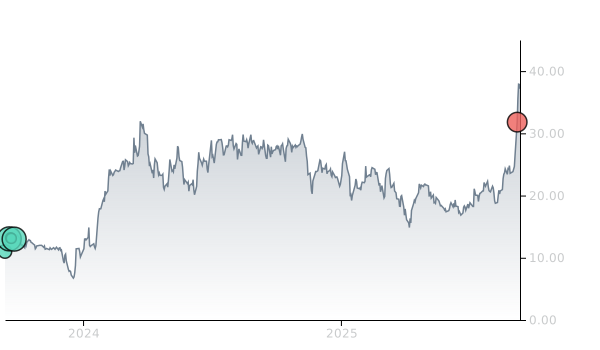
$DNTH insiders have traded $DNTH stock on the open market 1 times in the past 6 months. Of those trades, 0 have been purchases and 1 have been sales.
Here’s a breakdown of recent trading of $DNTH stock by insiders over the last 6 months:
- RYAN SAVITZ (CFO & CBO) sold 20,000 shares for an estimated $700,000
To track insider transactions, check out Quiver Quantitative's insider trading dashboard.
$DNTH Hedge Fund Activity
We have seen 51 institutional investors add shares of $DNTH stock to their portfolio, and 52 decrease their positions in their most recent quarter.
Here are some of the largest recent moves:
- VESTAL POINT CAPITAL, LP added 1,499,931 shares (+88.2%) to their portfolio in Q2 2025, for an estimated $27,943,714
- BAKER BROS. ADVISORS LP added 789,759 shares (+inf%) to their portfolio in Q2 2025, for an estimated $14,713,210
- VR ADVISER, LLC removed 744,373 shares (-42.7%) from their portfolio in Q2 2025, for an estimated $13,867,668
- JANUS HENDERSON GROUP PLC removed 683,616 shares (-100.0%) from their portfolio in Q2 2025, for an estimated $12,735,766
- BRAIDWELL LP removed 375,355 shares (-100.0%) from their portfolio in Q2 2025, for an estimated $6,992,863
- VANGUARD GROUP INC added 337,206 shares (+30.4%) to their portfolio in Q2 2025, for an estimated $6,282,147
- GOLDMAN SACHS GROUP INC added 291,162 shares (+396.5%) to their portfolio in Q2 2025, for an estimated $5,424,348
To track hedge funds' stock portfolios, check out Quiver Quantitative's institutional holdings dashboard.
$DNTH Analyst Ratings
Wall Street analysts have issued reports on $DNTH in the last several months. We have seen 8 firms issue buy ratings on the stock, and 0 firms issue sell ratings.
Here are some recent analyst ratings:
- Truist Securities issued a "Buy" rating on 10/14/2025
- Stifel issued a "Buy" rating on 09/12/2025
- Baird issued a "Outperform" rating on 09/09/2025
- Guggenheim issued a "Buy" rating on 09/09/2025
- Raymond James issued a "Outperform" rating on 09/09/2025
- HC Wainwright & Co. issued a "Buy" rating on 09/08/2025
- Wedbush issued a "Outperform" rating on 08/21/2025
To track analyst ratings and price targets for $DNTH, check out Quiver Quantitative's $DNTH forecast page.
$DNTH Price Targets
Multiple analysts have issued price targets for $DNTH recently. We have seen 8 analysts offer price targets for $DNTH in the last 6 months, with a median target of $64.0.
Here are some recent targets:
- Danielle Brill from Truist Securities set a target price of $56.0 on 10/14/2025
- Bill Maughan from Clear Street set a target price of $100.0 on 09/17/2025
- Laura Chico from Wedbush set a target price of $44.0 on 09/12/2025
- Alex Thompson from Stifel set a target price of $65.0 on 09/12/2025
- Steven Seedhouse from Raymond James set a target price of $63.0 on 09/09/2025
- Joel Beatty from Baird set a target price of $67.0 on 09/09/2025
- Yatin Suneja from Guggenheim set a target price of $100.0 on 09/09/2025
Full Release
Positive data from Phase 2 MaGic trial presented for claseprubart in generalized Myasthenia Gravis, including new open-label extension data further supporting potential for 300mg/2mL Q4W dosing
Phase 3 gMG trial planned to include QMG ≥ 10 screening criteria and two claseprubart treatment arms, 300mg/2mL Q2W and 300mg/2mL Q4W, vs. placebo anticipated to initiate in 2026
Additionally, new preclinical data highlight potential efficacy benefits of upstream (aC1s) vs. downstream (C5) complement inhibition
Virtual industry forum replay available
NEW YORK and WALTHAM, Mass., Oct. 29, 2025 (GLOBE NEWSWIRE) -- Dianthus Therapeutics, Inc. (Nasdaq: DNTH), a clinical-stage biotechnology company dedicated to developing next-generation therapies to transform the treatment of severe autoimmune diseases, today reviewed new data from the Phase 2 MaGic trial of claseprubart in generalized Myasthenia Gravis (gMG) presented during the Myasthenia Gravis Foundation of America (MGFA) Scientific Session of the American Association of Neuromuscular and Electromagnetic Medicine (AANEM) Annual Meeting .
During AANEM, Dr. Pushpa Narayanaswami, MD from Harvard Medical School presented the successful Phase 2 MaGic trial data for the first time at a medical conference. In addition, during a Virtual Industry Forum titled Upstream Targeting: Rethinking MG Treatment Through Active C1s Inhibition , new data were released, which included:
-
A robust MG-ADL decline at week 4 in the open-label extension (OLE) of -2.5 points and QMG score reduction of -3.2 points for patients on placebo during the RCT who received only two doses of claseprubart 600mg/4mL Q2W without a loading dose and achieved a PK level far below the steady state of 300mg/2mL Q2W, supporting potential for Q4W dosing of 300mg/2mL
-
A subgroup analysis of patients enrolled in the MaGic trial with a QMG score ≥10 at baseline which demonstrated an increase in MG-ADL treatment effect for 300mg/2mL Q2W to a 3-point difference from placebo
-
In vitro
data demonstrating the benefits of upstream (active C1s with claseprubart) vs. downstream (C5 with ravulizumab) inhibition in the prevention of pro-inflammatory split products C3a and C3b
“This post hoc analysis is driving our decision to add a QMG inclusion criteria and a 300mg/2mL S.C. Q4W arm, in addition to a Q2W arm, in our Phase 3 MG study,” said Simrat Randhawa, MD, MBA, Executive Vice President and Head of R&D of Dianthus Therapeutics. “Given the impressive Phase 2 data combined with the very encouraging post hoc data presented today, we are further motivated to rapidly proceed to Phase 3.”
The claseprubart data presented at AANEM and an archived webcast of the virtual industry forum titled Upstream Targeting: Rethinking MG Treatment Through Active C1s Inhibition, featuring an expert panel including Pushpa Narayanaswami, MD, Tuan Vu, MD, Stojan Peric, MD, PhD, Shahar Shelly, MD, are now available on the Dianthus Therapeutics website.
Agenda: Upstream Targeting: Rethinking MG Treatment Through Active C1s Inhibition
- Opening Remarks – Introduction to Dianthus Therapeutics and Claseprubart: Simrat Randhawa, MD, EVP and Head of R&D of Dianthus Therapeutics
- Clinical & Treatment Gaps: Tuan Vu, MD
- Panel Discussion Part 1: Clinical and Treatment Gaps
- C1s Inhibition Mechanism of Action (MoA) Animation
- Upstream Inhibition of Classical Pathway: Shahar Shelly, MD
- MaGic Phase 2 Data: Pushpa Narayanaswami, MD
- Panel Discussion Part 2: Feedback on MaGic Results and Potential of C1s Inhibition
- Closing Remarks – Phase 3 and Future Outlook: Simrat Randhawa, MD, EVP and Head of R&D of Dianthus Therapeutics
About Claseprubart (DNTH103)
Claseprubart is an investigational, clinical-stage, potent monoclonal antibody engineered to selectively target the classical pathway by inhibiting only the active form of the C1s protein, a clinically validated complement target. Claseprubart is enhanced with YTE half-life extension technology designed to enable a more convenient subcutaneous, infrequently dosed, self-administered injection. Additionally, selective inhibition of the classical complement pathway may lower patient risk of infection from encapsulated bacteria by preserving immune activity of the lectin and alternative pathways. As the classical pathway plays a significant role in disease pathology, claseprubart has the potential to be a best-in-class pipeline-in-a-product across a range of autoimmune disorders with high unmet need. Dianthus is building a neuromuscular franchise with claseprubart and expects to initiate a Phase 3 trial in gMG in 2026, the interim responder analysis of the Phase 3 CAPTIVATE trial in Chronic Inflammatory Demyelinating Polyneuropathy in 2H’26, and top-line data from the Phase 2 MoMeNtum trial in Multifocal Motor Neuropathy in 2H’26.
Claseprubart is an investigational agent that is not approved as a therapy in any indication in any jurisdiction worldwide.
About Dianthus Therapeutics
Dianthus Therapeutics, Inc. is a clinical-stage biotechnology company dedicated to developing next-generation therapies to transform the treatment of severe autoimmune diseases. Based in New York City and Waltham, Mass., Dianthus is comprised of an experienced team of biotech and pharma executives who aim to deliver transformative medicines for people living with severe autoimmune and inflammatory diseases.
To learn more, please visit www.dianthustx.com and follow us on LinkedIn .
Cautionary Statement Regarding Forward-Looking Statements
Certain statements in this press release, other than purely historical information, may constitute “forward-looking statements” within the meaning of the federal securities laws, including for purposes of the safe harbor provisions under the United States Private Securities Litigation Reform Act of 1995, express or implied statements regarding future plans and prospects, including statements regarding the expectations or plans for discovery, preclinical studies, clinical trials and research and development programs, in particular with respect to claseprubart, and any developments or results in connection therewith, including the target product profile and administration of claseprubart; the anticipated timing of the initiation and results from those studies and trials; expectations regarding the clinical trial design for the Phase 3 trial for claseprubart in gMG; expectations regarding the time period over which the Company’s capital resources are expected to be sufficient to fund its anticipated operations; and expectations regarding market size, patient population size, and potential opportunities for complement therapies, in particular with respect to claseprubart. Claseprubart is an investigational agent that is not approved as a therapy in any indication in any jurisdiction worldwide. The words “opportunity,” “potential,” “milestones,” “runway,” “will,” “anticipate,” “achieve,” “near-term,” “catalysts,” “pursue,” “pipeline,” “believe,” “continue,” “could,” “estimate,” “expect,” “intend,” “may,” “might,” “plan,” “possible,” “predict,” “project,” “should,” “strive,” “would,” “aim,” “target,” “commit,” and similar expressions (including the negatives of these terms or variations of them) generally identify forward-looking statements, but the absence of these words does not mean that statement is not forward looking.
Actual results could differ materially from those included in the forward-looking statements due to various factors, risks and uncertainties, including, but not limited to, that preclinical testing of claseprubart and data from clinical trials may not be predictive of the results or success of ongoing or later clinical trials, that the development of claseprubart or the Company's other compounds may take longer and/or cost more than planned, that the Company may be unable to successfully complete the clinical development of the Company’s compounds, that the Company may be delayed in initiating, enrolling or completing its planned clinical trials, and that the Company's compounds may not receive regulatory approval or become commercially successful products. These and other risks and uncertainties are identified under the heading "Risk Factors" included in the Company’s Annual Report on Form 10-K for the period ended December 31, 2024, and other filings that the Company has made and may make with the SEC in the future. Nothing in this press release should be regarded as a representation by any person that the forward-looking statements set forth herein will be achieved or that any of the contemplated results of such forward-looking statements will be achieved.
The forward-looking statements in this press release speak only as of the date they are made and are qualified in their entirety by reference to the cautionary statements herein. Dianthus undertakes no obligation to publicly update or revise any forward-looking statement, whether as a result of new information, future events or otherwise, except as required by law.
Contact
Jennifer Davis Ruff
Dianthus Therapeutics
[email protected]