


Datadog's report reveals operational complexity as a key barrier to scalable AI, emphasizing the need for better observability.
Quiver AI Summary
Datadog's 2026 State of AI Engineering report reveals that operational complexity, rather than model intelligence, has emerged as the main obstacle to scaling AI effectively. As AI is increasingly adopted, 69% of companies now utilize multiple models, which complicates production systems, leading to a 5% failure rate in model requests primarily due to capacity limits. The report indicates that the use of agent frameworks has significantly increased, although this adds to the complexity of managing AI systems. Datadog emphasizes that like early cloud adoption, organizations must prioritize operational control and AI observability to ensure reliability as they scale AI applications. Key insights include the need for real-time visibility across all components, as failures will stem from design issues rather than capabilities of the AI agents themselves.
Potential Positives
- Datadog emphasizes the growing importance of AI observability, indicating a significant market opportunity for their services as organizations increasingly rely on complex AI systems.
- The release highlights Datadog's insights from their State of AI Engineering 2026 report, showcasing their thought leadership and expertise in AI operational control and observability.
- Key findings illustrate a shift towards multi-model AI solutions and increasing complexity, suggesting that Datadog’s offerings are timely and relevant in addressing these challenges faced by businesses.
Potential Negatives
- High failure rates of AI model requests in production (around 5% fail), predominantly due to capacity limits, which could reflect poorly on Datadog's reliability as a service provider.
- The increasing operational complexity in AI systems as outlined in the report might deter potential customers from adopting Datadog’s solutions, highlighting a tougher competitive landscape.
- The emphasis on operational control needs suggests that Datadog's current offerings may not be sufficient to meet the emerging complexities of AI, potentially signaling a gap in their product effectiveness.
FAQ
What are the main challenges of AI adoption according to Datadog?
The primary challenge is operational complexity at scale, rather than model intelligence, as per Datadog's report.
How many companies use multiple AI models today?
Approximately 69% of companies now use three or more AI models in their operations.
What causes failures in AI model requests?
About 60% of AI model request failures are caused by capacity limits, leading to slowdowns and errors.
Why is observability crucial for scaling AI systems?
Observability is essential for real-time visibility and operational control, allowing teams to speed up deployment without sacrificing reliability.
How does Datadog contribute to AI observability?
Datadog provides a unified platform that integrates monitoring capabilities to enhance visibility and control over AI systems in production.
Disclaimer: This is an AI-generated summary of a press release distributed by GlobeNewswire. The model used to summarize this release may make mistakes. See the full release here.
$DDOG Insider Trading Activity
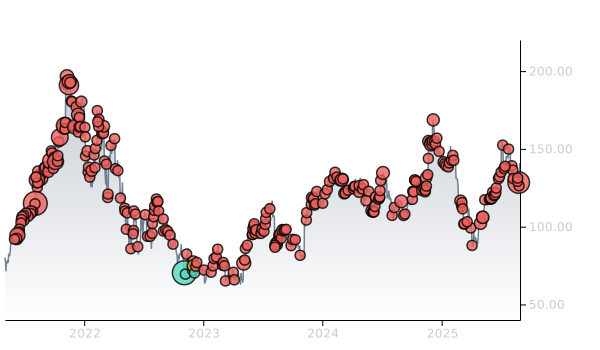
$DDOG insiders have traded $DDOG stock on the open market 172 times in the past 6 months. Of those trades, 0 have been purchases and 172 have been sales.
Here’s a breakdown of recent trading of $DDOG stock by insiders over the last 6 months:
- MATTHEW JACOBSON has made 0 purchases and 10 sales selling 436,116 shares for an estimated $87,067,465.
- ALEXIS LE-QUOC (Chief Technology Officer) has made 0 purchases and 59 sales selling 509,644 shares for an estimated $71,144,387.
- OLIVIER POMEL (Chief Executive Officer) has made 0 purchases and 40 sales selling 387,782 shares for an estimated $57,022,410.
- AMIT AGARWAL has made 0 purchases and 10 sales selling 100,000 shares for an estimated $12,338,110.
- ADAM BLITZER (Chief Operating Officer) has made 0 purchases and 14 sales selling 82,052 shares for an estimated $9,822,776.
- SEAN MICHAEL WALTERS (Chief Revenue Officer) has made 0 purchases and 8 sales selling 74,816 shares for an estimated $9,500,810.
- DAVID M OBSTLER (Chief Financial Officer) has made 0 purchases and 2 sales selling 52,570 shares for an estimated $6,412,279.
- SHARDUL SHAH has made 0 purchases and 19 sales selling 39,580 shares for an estimated $5,589,251.
- YANBING LI (Chief Product Officer) has made 0 purchases and 2 sales selling 29,738 shares for an estimated $3,609,854.
- KERRY ACOCELLA (General Counsel and Secretary) has made 0 purchases and 5 sales selling 26,609 shares for an estimated $3,343,168.
- MICHAEL JAMES CALLAHAN sold 12,500 shares for an estimated $2,343,375
- DAVID GALLOREESE (Chief People Officer) has made 0 purchases and 2 sales selling 13,262 shares for an estimated $1,588,677.
To track insider transactions, check out Quiver Quantitative's insider trading dashboard.
$DDOG Revenue
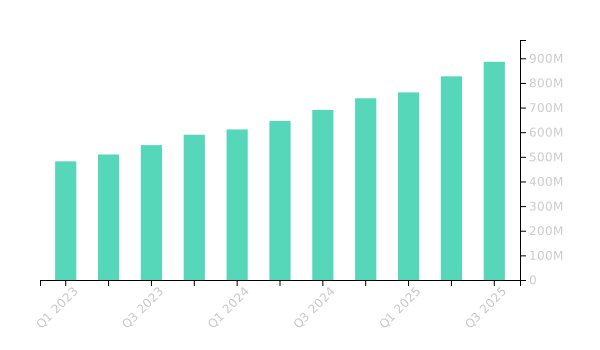
$DDOG had revenues of $953.2M in Q4 2025. This is an increase of 29.21% from the same period in the prior year.
You can track DDOG financials on Quiver Quantitative's DDOG stock page.
$DDOG Congressional Stock Trading
Members of Congress have traded $DDOG stock 4 times in the past 6 months. Of those trades, 2 have been purchases and 2 have been sales.
Here’s a breakdown of recent trading of $DDOG stock by members of Congress over the last 6 months:
- REPRESENTATIVE GILBERT RAY CISNEROS, JR. purchased up to $15,000 on 03/13.
- REPRESENTATIVE LISA C. MCCLAIN has traded it 3 times. They made 1 purchase worth up to $15,000 on 10/30 and 2 sales worth up to $30,000 on 10/31, 10/30.
To track congressional stock trading, check out Quiver Quantitative's congressional trading dashboard.
$DDOG Hedge Fund Activity
We have seen 565 institutional investors add shares of $DDOG stock to their portfolio, and 436 decrease their positions in their most recent quarter.
Here are some of the largest recent moves:
- BAILLIE GIFFORD & CO removed 7,451,970 shares (-65.3%) from their portfolio in Q4 2025, for an estimated $1,013,393,400
- UBS AM, A DISTINCT BUSINESS UNIT OF UBS ASSET MANAGEMENT AMERICAS LLC removed 7,143,493 shares (-76.4%) from their portfolio in Q4 2025, for an estimated $971,443,613
- SC US (TTGP), LTD. removed 2,389,407 shares (-100.0%) from their portfolio in Q4 2025, for an estimated $324,935,457
- JENNISON ASSOCIATES LLC added 2,316,994 shares (+43.7%) to their portfolio in Q4 2025, for an estimated $315,088,014
- FMR LLC added 1,858,769 shares (+11.4%) to their portfolio in Q4 2025, for an estimated $252,773,996
- CAPITAL INTERNATIONAL INVESTORS removed 1,836,151 shares (-85.1%) from their portfolio in Q4 2025, for an estimated $249,698,174
- JANUS HENDERSON GROUP PLC removed 1,768,493 shares (-21.9%) from their portfolio in Q4 2025, for an estimated $240,497,363
To track hedge funds' stock portfolios, check out Quiver Quantitative's institutional holdings dashboard.
$DDOG Analyst Ratings
Wall Street analysts have issued reports on $DDOG in the last several months. We have seen 21 firms issue buy ratings on the stock, and 0 firms issue sell ratings.
Here are some recent analyst ratings:
- BTIG issued a "Buy" rating on 02/13/2026
- Raymond James issued a "Outperform" rating on 02/11/2026
- Macquarie issued a "Outperform" rating on 02/11/2026
- Rosenblatt issued a "Buy" rating on 01/30/2026
- Mizuho issued a "Outperform" rating on 01/21/2026
- TD Cowen issued a "Buy" rating on 01/21/2026
- Keybanc issued a "Overweight" rating on 01/12/2026
To track analyst ratings and price targets for $DDOG, check out Quiver Quantitative's $DDOG forecast page.
$DDOG Price Targets
Multiple analysts have issued price targets for $DDOG recently. We have seen 30 analysts offer price targets for $DDOG in the last 6 months, with a median target of $177.5.
Here are some recent targets:
- Todd Coupland from CIBC set a target price of $215.0 on 04/20/2026
- Andrew Sherman from TD Cowen set a target price of $190.0 on 04/15/2026
- Gregg Moskowitz from Mizuho set a target price of $145.0 on 04/14/2026
- Howard Ma from Guggenheim set a target price of $175.0 on 04/09/2026
- Gil Luria from DA Davidson set a target price of $225.0 on 02/17/2026
- Dan Ives from Wedbush set a target price of $190.0 on 02/13/2026
- Gray Powell from BTIG set a target price of $170.0 on 02/13/2026
Full Release
NEW YORK, April 21, 2026 (GLOBE NEWSWIRE) -- As AI adoption accelerates, operational complexity – not model intelligence – is becoming the primary barrier to reliable AI at scale, according to new data from Datadog , Inc. (NASDAQ: DDOG), the AI-powered observability and security platform.
Datadog’s State of AI Engineering 2026 report, based on real-world data from thousands of organizations running AI in production, highlights a compounding complexity challenge as AI systems scale. Nearly seven in ten companies (69%) now use three or more models alongside increasingly complex agent workflows. Around 5% of AI model requests fail in production, with nearly 60% of those failures caused by capacity limits – leading to slowdowns, errors, and broken experiences in AI-powered applications.
Additional key findings:
- Multi-model is now the norm: OpenAI remains the most widely used provider at 63% share, alongside rising adoption of Google Gemini and Anthropic Claude which grew by 20 and 23 percentage points, respectively.
- Agent framework adoption doubled year-over-year, accelerating development but also introducing more moving parts into production systems.
-
The amount of data sent to AI models per request is also rising: the average number of tokens more than doubled for ‘median use’ teams (50th percentile of usage volume) and quadrupled for heavy users (90th percentile).
“AI is starting to look a lot like the early days of cloud,” said Yanbing Li, Chief Product Officer at Datadog. “The cloud made systems programmable but much more complex to manage. AI is now doing the same thing to the application layer. The companies that win won’t just build better models - they’ll build operational control around them. In this new era, AI observability becomes as essential as cloud observability was a decade ago.”
Speed Requires Control
Competitive pressure is accelerating AI deployment across startups and large enterprises alike. But as systems scale, speed without control creates risk. Failures are increasingly driven by system design, including fragmented workflows, excessive retries, and inefficient routing.
"The next wave of agent failures won't be about what agents can't do but what teams can't observe,” said Guillermo Rauch, CEO at Vercel , the company behind Next.js and a leading platform for building AI-powered web applications. “We built agentic infrastructure at Vercel because agents need the same production feedback loops as great software. Unlike traditional software, agents have control flow driven by the LLM itself, making observability not just useful, but essential.”
“Innovation alone isn’t enough,” added Li. “To scale AI with confidence, organizations need real-time visibility across the entire stack – from GPU utilization to model behavior to agent workflows. Visibility and operational control are what allow teams to move fast without sacrificing reliability or governance. At scale, how you operate AI may matter more than the models you choose.”
Read the full report - The State of AI Engineering 2026 - and learn how Datadog is investing in AI observability to help teams operate and scale AI systems in production here .
Report Methodology
Datadog analyzed anonymized usage data from thousands of customers using LLMs in production environments, with global coverage across industries and geographies.
About Datadog
Datadog is the AI-powered observability and security platform. Our SaaS platform integrates and automates infrastructure monitoring, application performance monitoring, log management, user experience monitoring, cloud security and many other capabilities to provide unified, real-time observability and security for our customers' entire technology stack. Datadog is used by organizations of all sizes and across a wide range of industries to enable digital transformation and cloud migration, drive collaboration among development, operations, security and business teams, accelerate time to market for applications, reduce time to problem resolution, secure applications and infrastructure, understand user behavior and track key business metrics.
Forward-Looking Statements
This press release may include certain “forward-looking statements” within the meaning of Section 27A of the Securities Act of 1933, as amended, or the Securities Act, and Section 21E of the Securities Exchange Act of 1934, as amended including statements on the benefits of new products and features. These forward-looking statements reflect our current views about our plans, intentions, expectations, strategies and prospects, which are based on the information currently available to us and on assumptions we have made. Actual results may differ materially from those described in the forward-looking statements and are subject to a variety of assumptions, uncertainties, risks and factors that are beyond our control, including those risks detailed under the caption “Risk Factors” and elsewhere in our Securities and Exchange Commission filings and reports, including the Quarterly Report on Form 10-Q filed with the Securities and Exchange Commission on February 18, 2026, as well as future filings and reports by us. Except as required by law, we undertake no duty or obligation to update any forward-looking statements contained in this release as a result of new information, future events, changes in expectations or otherwise.
Contact:
[email protected]