


In April, truckload rates rose due to fuel costs, while load volumes decreased across all equipment types.
Quiver AI Summary
In April 2026, truckload spot and contract rates increased primarily due to rising fuel costs, according to DAT Freight & Analytics. The DAT Truckload Volume Index indicated a decline in loads moved for van, refrigerated, and flatbed vehicle types. Despite the increase in national average spot truckload freight rates year over year—rising for vans to $2.67 per mile, reefers to $3.11, and flatbeds to $3.46—linehaul rates saw only modest changes. The average linehaul rates for vans, reefers, and flatbeds increased slightly, with only the flatbed showing a notable rise in demand. Fuel surcharges reached their highest levels since mid-2022, while the proximity of spot rates to contract rates tightened, contrasting the typical pattern seen during freight upcycles. This indicates a market under pressure, with smaller carriers exiting due to costs, and highlights that the recent rate increases largely reflect fuel price impacts rather than significant improvements in carrier margins.
Potential Positives
- National average spot truckload freight rates rose significantly year over year across all equipment types, indicating a robust pricing environment despite fuel cost pressures.
- DAT's Truckload Volume Index and analytics services provide critical market insights, reinforcing the company's position as a leader in freight analytics and logistics solutions.
- The company continues to innovate within the trucking and logistics sector, as highlighted by their integration of multiple advanced platforms and services for shippers and carriers.
Potential Negatives
- Despite an increase in average spot truckload freight rates, the growth was largely attributed to rising fuel costs rather than improved demand, indicating a lack of sustainable market recovery.
- The decline in the Truckload Volume Index (TVI) across all equipment types suggests weakening demand and potential issues in the trucking market, which could impact future revenue.
- The narrowing spread between spot and contract rates implies fewer trucks are available relative to demand, reflecting potential challenges in maintaining carrier margins amidst rising operating costs.
FAQ
What were the truckload spot rates in April 2026?
Truckload spot rates rose significantly in April 2026, driven primarily by higher fuel costs.
How did the DAT Truckload Volume Index perform in April?
The DAT Truckload Volume Index declined month-over-month for van, refrigerated, and flatbed equipment types.
What factors contributed to the rise in freight rates?
Freight rates increased due to higher fuel costs rather than a substantial increase in load demand.
How did the average linehaul rates change in April?
Average linehaul rates experienced modest increases, with the van rate rising to $1.96 per mile.
What is the relationship between spot and contract rates?
The spread between spot and contract rates tightened in April, indicating reduced availability of trucks relative to demand.
Disclaimer: This is an AI-generated summary of a press release distributed by GlobeNewswire. The model used to summarize this release may make mistakes. See the full release here.
$ROP Insider Trading Activity
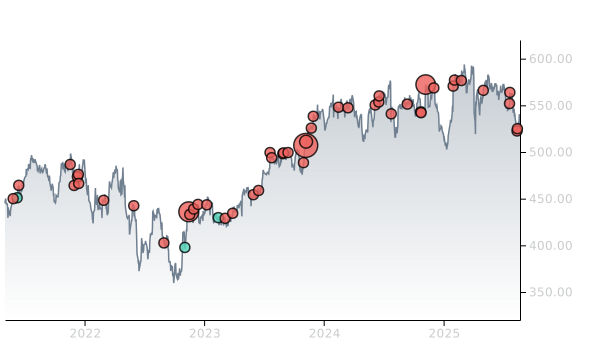
$ROP insiders have traded $ROP stock on the open market 2 times in the past 6 months. Of those trades, 1 have been purchases and 1 have been sales.
Here’s a breakdown of recent trading of $ROP stock by insiders over the last 6 months:
- JASON CONLEY (EVP, Chief Financial Officer) sold 6,000 shares for an estimated $2,673,390
- THOMAS PATRICK JR JOYCE purchased 1,400 shares for an estimated $501,844
To track insider transactions, check out Quiver Quantitative's insider trading dashboard. You can access data on insider stock transactions through the Quiver Quantitative API insider transaction endpoint.
$ROP Revenue
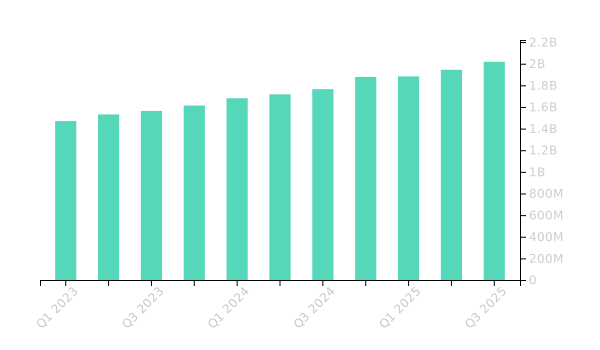
$ROP had revenues of $2.1B in Q1 2026. This is an increase of 11.29% from the same period in the prior year.
You can track ROP financials on Quiver Quantitative's ROP stock page.
You can access data on ROP stock through the Quiver Quantitative API.
$ROP Congressional Stock Trading
Members of Congress have traded $ROP stock 6 times in the past 6 months. Of those trades, 1 have been purchases and 5 have been sales.
Here’s a breakdown of recent trading of $ROP stock by members of Congress over the last 6 months:
- REPRESENTATIVE GILBERT RAY CISNEROS, JR. has traded it 3 times. They made 1 purchase worth up to $15,000 on 04/14 and 2 sales worth up to $65,000 on 03/13, 02/10.
- REPRESENTATIVE JARED MOSKOWITZ has traded it 3 times. They made 0 purchases and 3 sales worth up to $45,000 on 02/27.
To track congressional stock trading, check out Quiver Quantitative's congressional trading dashboard. You can access data on congressional stock trades through the Quiver Quantitative API Congress trades endpoint.
$ROP Hedge Fund Activity
We have seen 501 institutional investors add shares of $ROP stock to their portfolio, and 837 decrease their positions in their most recent quarter.
Here are some of the largest recent moves:
- WINDACRE PARTNERSHIP LLC added 4,401,900 shares (+142.2%) to their portfolio in Q1 2026, for an estimated $1,557,656,334
- DODGE & COX added 3,343,694 shares (+inf%) to their portfolio in Q1 2026, for an estimated $1,183,199,558
- ROCKEFELLER CAPITAL MANAGEMENT L.P. removed 3,258,577 shares (-99.1%) from their portfolio in Q1 2026, for an estimated $1,153,080,057
- T. ROWE PRICE INVESTMENT MANAGEMENT, INC. removed 2,249,991 shares (-77.7%) from their portfolio in Q4 2025, for an estimated $1,001,538,493
- WELLINGTON MANAGEMENT GROUP LLP added 2,060,245 shares (+339.5%) to their portfolio in Q1 2026, for an estimated $729,038,295
- MORGAN STANLEY removed 1,788,910 shares (-53.0%) from their portfolio in Q1 2026, for an estimated $633,023,692
- HARRIS ASSOCIATES L P added 1,729,546 shares (+inf%) to their portfolio in Q1 2026, for an estimated $612,017,147
To track hedge funds' stock portfolios, check out Quiver Quantitative's institutional holdings dashboard. You can access data on hedge funds moves and 13F filings through the Quiver Quantitative API 13F endpoint.
$ROP Analyst Ratings
Wall Street analysts have issued reports on $ROP in the last several months. We have seen 3 firms issue buy ratings on the stock, and 3 firms issue sell ratings.
Here are some recent analyst ratings:
- Truist Securities issued a "Buy" rating on 01/28/2026
- Barclays issued a "Underweight" rating on 01/28/2026
- Citigroup issued a "Buy" rating on 01/28/2026
- Mizuho issued a "Underperform" rating on 01/28/2026
- JP Morgan issued a "Underweight" rating on 01/28/2026
- Piper Sandler issued a "Overweight" rating on 11/20/2025
To track analyst ratings and price targets for $ROP, check out Quiver Quantitative's $ROP forecast page.
$ROP Price Targets
Multiple analysts have issued price targets for $ROP recently. We have seen 13 analysts offer price targets for $ROP in the last 6 months, with a median target of $450.0.
Here are some recent targets:
- Clarke Jeffries from Piper Sandler set a target price of $540.0 on 04/24/2026
- Deane Dray from RBC Capital set a target price of $407.0 on 04/24/2026
- Julian Mitchell from Barclays set a target price of $373.0 on 04/24/2026
- Jon Vruwink from Baird set a target price of $470.0 on 04/24/2026
- Joe Ritchie from Goldman Sachs set a target price of $440.0 on 01/29/2026
- Brad Reback from Stifel set a target price of $385.0 on 01/28/2026
- Stephen Tusa from JP Morgan set a target price of $397.0 on 01/28/2026
Full Release
PORTLAND, Ore., May 18, 2026 (GLOBE NEWSWIRE) -- Truckload spot and contract rates climbed sharply in April, but the gains came almost entirely from higher fuel costs, reported DAT Freight & Analytics , provider of the industry's leading load board and freight analytics.
The DAT Truckload Volume Index (TVI), an indicator of loads moved in April, declined month over month for van, refrigerated, and flatbed equipment types:
- Van TVI: 251, down 3% from March, up 2% year over year
- Reefer TVI: 183, down 9% from March, up 1% year over year
-
Flatbed TVI: 306, down 3% from March, up 3% year over year
Modest movement in linehaul rates
Driven largely by fuel costs, national average spot truckload freight rates rose in April and were significantly higher year over year:
- Van: $2.67 per mile, up 15 cents from March and 71 cents higher year over year
- Reefer: $3.11 per mile, up 14 cents from March and 83 cents higher year over year
-
Flatbed: $3.46 per mile, up 37 cents from March and 94 cents higher year over year
Linehaul rates—the portion of the spot rate that excludes fuel—moved modestly. The average van linehaul rate rose 5 cents to $1.96 per mile; reefer increased 4 cents to $2.34; and flatbed climbed 25 cents to $2.61. The flatbed increase was the only move large enough to suggest a meaningful rise in demand.
“Fuel was the story in April,” said Dean Croke, principal industry analyst at DAT. “Linehaul rates barely moved in van and reefer, and the volume of loads moved fell across the board. Small carriers continue to exit the market under sustained cost pressure. That’s not what a demand-based truckload freight recovery looks like.”
Per-mile fuel surcharges in April hit their highest monthly averages since July 2022:
- Van: 71 cents, up from 61 cents in March
- Reefer: 77 cents, up from 67 cents
-
Flatbed: 85 cents, up from 73 cents
Spot-contract rate spread narrowed in April
National average contract freight rates also increased in April, although spot market rates continued to rise faster across most equipment types:
- Van: $2.85 per mile, up 13 cents from March
- Reefer: $3.22 per mile, up 12 cents
-
Flatbed: $3.71 per mile, up 28 cents
Spot-to-contract spreads have compressed substantially since late 2025 and have remained in a tight range through April. The average spot van rate was 18 cents higher than the contract rate, down from 20 cents in March. The reefer spread was 11 cents, down from 13 cents, while the flatbed spread narrowed to 25 cents from 34 cents in March.
“In a typical freight upcycle, strong demand for truckload services pushes spot rates above contract rates,” said Croke. “What we’re seeing now is different. Spreads are tightening because there are simply fewer trucks available relative to demand, while much of the recent rate increase is being absorbed by fuel costs instead of improving carrier margins.”
For previous TVI reports, visit: https://www.dat.com/news-releases
About the Truckload Volume Index
The DAT Truckload Volume Index measures monthly changes in loads with a pickup date during that month. A baseline of 100 equals the number of loads moved in January 2015, based on data from DAT RateView, part of the DAT iQ freight analytics platform, which tracks rates paid on actual shipments. Benchmark spot rates reflect invoice data for hauls of 250 miles or more, offering a consistent view of truckload demand and spot rate trends across the United States and Canada.
About DAT Freight & Analytics
DAT Freight & Analytics operates the DAT One truckload freight marketplace; Convoy Platform, an automated freight-matching technology; DAT iQ analytics service; Trucker Tools load-visibility platform; and Outgo factoring and financial services for truckers. Shippers, transportation brokers, carriers, news organizations, and industry analysts rely on DAT for market trends and data insights, informed by nearly 700,000 daily load posts and a database exceeding $1 trillion in freight market transactions.
Founded in 1978, DAT is a business unit of Roper Technologies (Nasdaq: ROP), a constituent of the Nasdaq 100, S&P 500, and Fortune 1000. Headquartered in Portland, Oregon, DAT continues to set the standard for innovation in the trucking and logistics industry. Visit dat.com for more information.
Media contacts:
Georgia Jablon
DAT Freight & Analytics
904-305-6454;
[email protected]
Stephen Petit
SiefkesPetit Communications
425-443-8976;
[email protected]
A photo accompanying this announcement is available at https://www.globenewswire.com/NewsRoom/AttachmentNg/fcc5b0a2-a23a-4be6-acb9-0dd57ee915af .