


Celldex presented Phase 2 trial results showing barzolvolimab's effective retreatment for ColdU and SD at AAAAI 2026.
Quiver AI Summary
Celldex announced positive results from a Phase 2 Open Label Extension study of barzolvolimab, a novel monoclonal antibody targeting mast cells, during a late-breaking poster presentation at the AAAAI meeting in Philadelphia. The study showed that retreatment with barzolvolimab after symptom recurrence rapidly improved urticaria control in patients with Cold Urticaria (ColdU) and Symptomatic Dermographism (SD). Out of 121 patients treated in the study, high rates of complete response were observed, with 62% of ColdU patients and 60% of SD patients achieving complete responses after re-treatment. The findings support barzolvolimab's potential as a best-in-class treatment for chronic urticarias, highlighting its ability to provide flexible and effective care, which is consistent with real-world treatment patterns. Celldex is also conducting a global Phase 3 trial to further evaluate the efficacy and safety of barzolvolimab in patients unresponsive to standard antihistamine treatment.
Potential Positives
- Presentation of new positive data from the Phase 2 Open Label Extension study demonstrates that barzolvolimab can provide rapid improvement in urticaria control upon retreatment, highlighting its effectiveness in real-world treatment scenarios.
- Barzolvolimab achieved high complete response rates of 62% for ColdU and 60% for SD during retreatment, comparable to initial treatment responses, indicating its potential as a durable treatment option.
- The robust safety profile of barzolvolimab, consistent with previous studies, supports confidence in its ongoing development as a significant therapeutic option for chronic urticarias where currently no approved therapies are available.
- Initiation of a global Phase 3 trial (EMBARQ-ColdU and SD) reflects Celldex's commitment to advancing barzolvolimab further in clinical development, potentially positioning it as a first-in-class treatment.
Potential Negatives
- Presentation of data in a late-breaking format at a major conference may indicate urgency or concern over the results, potentially signaling that the findings needed more immediate attention or validation.
- Delayed entry into the Open Label Extension (OLE) for patients previously treated with barzolvolimab compared to those on placebo could raise questions about the drug's effectiveness during the main study.
- Challenges highlighted in the release regarding the uncertainties of progressing from Phase 2 to Phase 3 trials, including potential regulatory hurdles and competition, may cast doubt on the future success of barzolvolimab's approval and commercialization.
FAQ
What is barzolvolimab and its purpose?
Barzolvolimab is a humanized monoclonal antibody targeting mast cells, aimed at treating ColdU and SD.
What are ColdU and SD?
Cold Urticaria (ColdU) and Symptomatic Dermographism (SD) are chronic inducible urticarias characterized by hives triggered by specific stimuli.
What were the results of the Phase 2 study?
The study showed that barzolvolimab re-treatment led to high complete response rates of 62% for ColdU and 60% for SD.
How well was barzolvolimab tolerated?
Barzolvolimab was well tolerated with a safety profile consistent with previous studies, showing no new safety concerns.
What is the relevance of the late-breaking presentation?
The late-breaking presentation showcased significant new data supporting flexible and intermittent treatment options for patients with ColdU and SD.
Disclaimer: This is an AI-generated summary of a press release distributed by GlobeNewswire. The model used to summarize this release may make mistakes. See the full release here.
$CLDX Insider Trading Activity
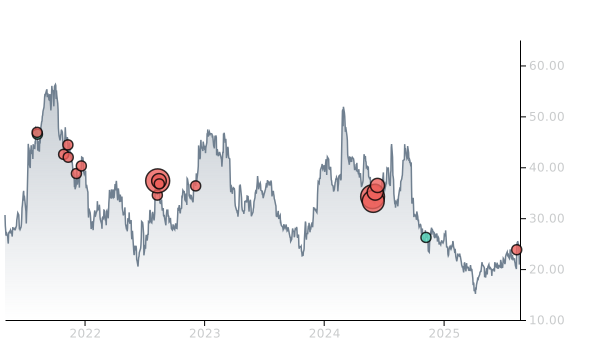
$CLDX insiders have traded $CLDX stock on the open market 2 times in the past 6 months. Of those trades, 0 have been purchases and 2 have been sales.
Here’s a breakdown of recent trading of $CLDX stock by insiders over the last 6 months:
- RICHARD M. WRIGHT sold 49,298 shares for an estimated $1,183,176
- FREDDY A. JIMENEZ (SVP & GENERAL COUNSEL) sold 4,166 shares for an estimated $121,209
To track insider transactions, check out Quiver Quantitative's insider trading dashboard.
$CLDX Hedge Fund Activity
We have seen 80 institutional investors add shares of $CLDX stock to their portfolio, and 103 decrease their positions in their most recent quarter.
Here are some of the largest recent moves:
- WELLINGTON MANAGEMENT GROUP LLP added 2,279,605 shares (+39.3%) to their portfolio in Q4 2025, for an estimated $61,914,071
- POINT72 ASSET MANAGEMENT, L.P. removed 2,135,585 shares (-54.8%) from their portfolio in Q4 2025, for an estimated $58,002,488
- BRAIDWELL LP added 1,266,420 shares (+214.0%) to their portfolio in Q4 2025, for an estimated $34,395,967
- STATE STREET CORP added 555,579 shares (+19.5%) to their portfolio in Q4 2025, for an estimated $15,089,525
- ADAR1 CAPITAL MANAGEMENT, LLC added 537,325 shares (+491.0%) to their portfolio in Q4 2025, for an estimated $14,593,747
- COMMODORE CAPITAL LP removed 463,335 shares (-15.3%) from their portfolio in Q4 2025, for an estimated $12,584,178
- DIMENSIONAL FUND ADVISORS LP added 394,633 shares (+153.5%) to their portfolio in Q4 2025, for an estimated $10,718,232
To track hedge funds' stock portfolios, check out Quiver Quantitative's institutional holdings dashboard.
$CLDX Analyst Ratings
Wall Street analysts have issued reports on $CLDX in the last several months. We have seen 1 firms issue buy ratings on the stock, and 1 firms issue sell ratings.
Here are some recent analyst ratings:
- Mizuho issued a "Outperform" rating on 10/21/2025
- Barclays issued a "Underweight" rating on 10/13/2025
To track analyst ratings and price targets for $CLDX, check out Quiver Quantitative's $CLDX forecast page.
$CLDX Price Targets
Multiple analysts have issued price targets for $CLDX recently. We have seen 4 analysts offer price targets for $CLDX in the last 6 months, with a median target of $55.0.
Here are some recent targets:
- Alex Thompson from Stifel set a target price of $68.0 on 02/26/2026
- Etzer Darout from Barclays set a target price of $24.0 on 12/17/2025
- Joseph Catanzaro from Mizuho set a target price of $48.0 on 10/21/2025
- Edward Nash from Canaccord Genuity set a target price of $62.0 on 09/17/2025
Full Release
- Late breaking Poster Presentation at AAAAI -
- Ability to retreat facilitates a real-world paradigm in which treatment for ColdU and SD may be intermittent with barzolvolimab -
HAMPTON, N.J., March 01, 2026 (GLOBE NEWSWIRE) -- Celldex (NASDAQ:CLDX) presented new positive data from the Phase 2 ColdU and SD Open Label Extension (OLE), highlighting that retreatment with barzolvolimab leads to rapid improvement in urticaria control after symptom recurrence. Barzolvolimab is a humanized monoclonal antibody with a completely novel mechanism of action that uniquely targets the root cause of ColdU and SD—the mast cell. The data were shared today in a late breaking poster presentation at the 2026 American Academy of Allergy, Asthma & Immunology's (AAAAI) Annual Meeting being held in Philadelphia, PA. The data were presented by Jonathan A. Bernstein, MD, trial investigator and Professor of Clinical Medicine in the Department of Internal Medicine at the University of Cincinnati College of Medicine.
“Patients and physicians need treatment options that provide durable, symptom-free complete response and the potential for flexibility that reflects real world treatment paradigms,” said Diane Young, MD, Senior Vice President and Chief Medical Officer of Celldex. “We previously presented data in chronic spontaneous urticaria showing that up to 41% of patients continued to experience a complete response seven months after receiving their final dose on study. The data presented today from our inducible urticaria study demonstrate that when disease symptoms do recur, patients can be retreated and, importantly, achieve the same high levels of complete response they experienced on initial treatment. We believe barzolvolimab’s unique mechanism of action, which targets the root cause of these forms of chronic urticaria—the mast cell, drives this effect and supports barzolvolimab’s profile as a best-in-class, best-in-disease potential treatment option for patients with chronic urticarias.”
In the main portion of the Phase 2 study, 193 patients with ColdU (n=96) or SD (n=97) received 150 mg Q4W, 300 mg Q8W barzolvolimab, or placebo for 20 weeks. Patients with disease recurrence during the main study follow-up period qualified for the OLE. 121 patients entered the OLE, 61 patients with ColdU and 60 patients with SD, and 116 patients completed treatment in the OLE. Patients treated with placebo in the main study entered the OLE faster than patients treated with barzolvolimab (median time of 56 days versus 105 days from last dose in main study).
Barzolvolimab re-treatment achieved similar profound efficacy to first exposure in patients with ColdU and SD.
- With barzolvolimab re-treatment, 62% of patients with ColdU and 60% of patients with SD had a complete response at Week 20 in the OLE. These findings are consistent with the complete response rates in these patients to their initial treatment of 66% for ColdU and 49% for SD at Week 20 in the main study.
- Among patients with ColdU who achieved a complete response in the main study (n = 22), in the OLE, 82% of these patients achieved a complete response again and 95% achieved complete or partial response at Week 20.
- Among patients with SD who achieved a complete response in main study (n = 21), in the OLE, 86% of these patients achieved a complete response again and 100% achieved either a complete or partial response at Week 20.
- Marked, rapid reduction in critical temperature and friction thresholds were observed upon re-treatment,
- Barzolvolimab re-treatment resulted in clinically meaningful improvements in urticaria control, achieving a high rate of well controlled disease: up to 68% of patients with ColdU and 69% of patients with SD.
- Barzolvolimab was well tolerated with a safety profile consistent with prior studies,
- The ability to re-treat facilitates a real-world paradigm in which treatment for CIndU may be intermittent.
- A global Phase 3 trial (EMBARQ-ColdU and SD) ( NCT07266402 ) designed to establish the efficacy and safety of barzolvolimab in adult patients with ColdU and SD who remain symptomatic despite H1 antihistamine treatment initiated in late 2025 and is enrolling patients.
About Chronic Inducible Urticaria (CIndU), Cold Urticaria (ColdU), Symptomatic Dermographism (SD)
CIndU is characterized by the occurrence of hives or wheals that have an attributable trigger associated with them. ColdU symptoms include itching, burning wheals/hives and angioedema when skin is exposed to cold temperatures. SD symptoms include the development of wheals in response to stroking, scratching or rubbing of the skin. For these diseases, mast cell activation leading to release of soluble mediators is thought to be the driving mechanism leading to the wheals and other symptoms. There are currently no approved therapies for chronic inducible urticarias other than antihistamines and patients attempt to manage symptoms associated with their disease through avoidance of triggers.
About Barzolvolimab
Barzolvolimab is a humanized monoclonal antibody with a novel mechanism of action that targets mast cells by binding with high specificity to a unique part of the KIT receptor and potently inhibiting its activity. The KIT receptor is abundantly expressed by mast cells and critical for their function and survival. Mast cells are drivers of inflammatory responses such as hypersensitivity and allergic reactions and, in certain inflammatory diseases, such as chronic urticarias, mast cell activation plays a central role in the onset and progression of the disease. Based on data from robust, randomized, placebo controlled Phase 2 studies, barzolvolimab has significant potential as a first-in-class and best-in-disease treatment option for patients with chronic spontaneous urticaria (CSU), cold urticaria (ColdU) and symptomatic dermographism (SD). Barzolvolimab is currently being studied in Phase 3 studies in CSU and ColdU/SD and Phase 2 studies in prurigo nodularis (PN) and atopic dermatitis (AD), with additional indications planned for the future.
About Celldex
Celldex is pioneering new horizons in immunology to deliver life-changing therapies. We are relentless in our pursuit of novel antibody-based treatments that engage the human immune system and directly affect critical pathways to improve the lives of patients with allergic, inflammatory and autoimmune disorders.
Visit
www.celldex.com
.
Forward Looking Statement
This release contains "forward-looking statements" made pursuant to the safe harbor provisions of the Private Securities Litigation Reform Act of 1995. These statements are typically preceded by words such as "believes," "expects," "anticipates," "intends," "will," "may," "should," or similar expressions. These forward-looking statements reflect management's current knowledge, assumptions, judgment and expectations regarding future performance or events. Although management believes that the expectations reflected in such statements are reasonable, they give no assurance that such expectations will prove to be correct or that those goals will be achieved, and you should be aware that actual results could differ materially from those contained in the forward-looking statements. Forward-looking statements are subject to a number of risks and uncertainties, including, but not limited to, our ability to successfully complete research and further development and commercialization of Company drug candidates, including barzolvolimab (also referred to as CDX-0159) and CDX-622, in current or future indications; the uncertainties inherent in clinical testing and accruing patients for clinical trials; our limited experience in bringing programs through Phase 3 clinical trials; our ability to manage and successfully complete multiple clinical trials and the research and development efforts for our multiple products at varying stages of development; the availability, cost, delivery and quality of clinical materials produced by our own manufacturing facility or supplied by contract manufacturers, who may be our sole source of supply; the timing, cost and uncertainty of obtaining regulatory approvals; the failure of the market for the Company's programs to continue to develop; our ability to protect the Company's intellectual property; the loss of any executive officers or key personnel or consultants; competition; changes in the regulatory landscape or the imposition of regulations that affect the Company's products; our ability to continue to obtain capital to meet our long-term liquidity needs on acceptable terms, or at all, including the additional capital which will be necessary to complete the clinical trials that we have initiated or plan to initiate; and other factors listed under "Risk Factors" in our annual report on Form 10-K and quarterly reports on Form 10-Q.
All forward-looking statements are expressly qualified in their entirety by this cautionary notice. You are cautioned not to place undue reliance on any forward-looking statements, which speak only as of the date of this release. We have no obligation, and expressly disclaim any obligation, to update, revise or correct any of the forward-looking statements, whether as a result of new information, future events or otherwise.
Company Contact
Sarah Cavanaugh
Senior Vice President, Corporate Affairs & Administration
(508) 864-8337
[email protected]
Patrick Till
Meru Advisors
(484) 788-8560
[email protected]