


Cassava Sciences announces $31.25 million settlement in securities litigation, allowing focus on developing TSC-related epilepsy treatment.
Quiver AI Summary
Cassava Sciences, Inc. has reached a definitive agreement to settle a consolidated securities class action lawsuit in the U.S. District Court for the Western District of Texas, resolving claims related to the company’s common stock from September 14, 2020, to October 12, 2023. The settlement, which totals $31.25 million, aims to fully release all claims asserted by current and former shareholders but does not imply any admission of wrongdoing by Cassava. The company had already accounted for this amount in its financials for the second quarter of 2025. Following this agreement, Cassava intends to focus its efforts on developing simufilam, a potential treatment for Tuberous Sclerosis Complex-related epilepsy. The company is preparing for a Phase 2 proof-of-concept study in collaboration with the TSC Alliance and other experts in the field.
Potential Positives
- Cassava Sciences has reached a definitive agreement to settle significant litigation, allowing the company to focus on its core mission and operational activities.
- The settlement of $31.25 million resolves all claims related to the previously disclosed securities class action, providing clarity and stability for investors.
- Cassava expresses commitment to advancing the development of simufilam, a potential treatment for Tuberous Sclerosis Complex-related epilepsy, demonstrating ongoing innovation in addressing CNS disorders.
- The company has a Phase 2 proof-of-concept study planned for simufilam, indicating continued progress in its research and development pipeline.
Potential Negatives
- The company is paying $31.25 million to settle a significant class action litigation, indicating potential past legal and ethical issues that could damage its reputation.
- The settlement does not imply an admission of fault, which may leave the market uncertain about the legitimacy of the allegations against the company.
- Potentially negative investor sentiment due to a large financial settlement that could affect the company's resources for ongoing drug development projects.
FAQ
What lawsuit has Cassava Sciences resolved?
Cassava Sciences has resolved a consolidated securities class action litigation in the U.S. District Court for Texas.
How much will Cassava pay in the settlement?
The company will pay $31.25 million to completely settle the claims related to the lawsuit.
What is the timeframe of the class action settlement?
The settlement covers all actions by purchasers of common stock between September 14, 2020, and October 12, 2023.
Is the settlement an admission of wrongdoing by Cassava?
No, the settlement is not an admission of fault or wrongdoing by Cassava Sciences, Inc.
What is simufilam developed for?
Simufilam is an investigational treatment aimed at addressing TSC-related epilepsy and other central nervous system disorders.
Disclaimer: This is an AI-generated summary of a press release distributed by GlobeNewswire. The model used to summarize this release may make mistakes. See the full release here.
$SAVA Insider Trading Activity
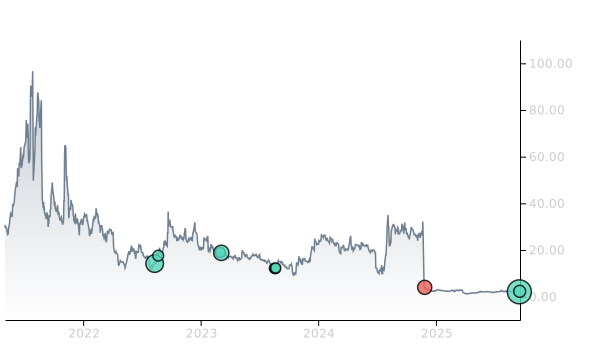
$SAVA insiders have traded $SAVA stock on the open market 8 times in the past 6 months. Of those trades, 8 have been purchases and 0 have been sales.
Here’s a breakdown of recent trading of $SAVA stock by insiders over the last 6 months:
- RICHARD BARRY (President & CEO) has made 7 purchases buying 468,498 shares for an estimated $1,166,904 and 0 sales.
- ROBERT EUGENE JR ANDERSON purchased 8,600 shares for an estimated $24,940
To track insider transactions, check out Quiver Quantitative's insider trading dashboard.
$SAVA Hedge Fund Activity
We have seen 40 institutional investors add shares of $SAVA stock to their portfolio, and 83 decrease their positions in their most recent quarter.
Here are some of the largest recent moves:
- MARSHALL WACE, LLP added 1,989,572 shares (+2774.3%) to their portfolio in Q3 2025, for an estimated $5,789,654
- 683 CAPITAL MANAGEMENT, LLC added 425,000 shares (+inf%) to their portfolio in Q3 2025, for an estimated $1,236,750
- CHARLES SCHWAB INVESTMENT MANAGEMENT INC removed 239,241 shares (-90.2%) from their portfolio in Q3 2025, for an estimated $696,191
- TANG CAPITAL MANAGEMENT LLC removed 232,747 shares (-97.1%) from their portfolio in Q3 2025, for an estimated $677,293
- JACOBS LEVY EQUITY MANAGEMENT, INC added 224,658 shares (+inf%) to their portfolio in Q3 2025, for an estimated $653,754
- JPMORGAN CHASE & CO removed 191,622 shares (-25.3%) from their portfolio in Q3 2025, for an estimated $557,620
- CUBIST SYSTEMATIC STRATEGIES, LLC removed 159,613 shares (-51.5%) from their portfolio in Q3 2025, for an estimated $464,473
To track hedge funds' stock portfolios, check out Quiver Quantitative's institutional holdings dashboard.
$SAVA Analyst Ratings
Wall Street analysts have issued reports on $SAVA in the last several months. We have seen 1 firms issue buy ratings on the stock, and 0 firms issue sell ratings.
Here are some recent analyst ratings:
- LUCID CAPITAL MARKETS issued a "Buy" rating on 10/06/2025
To track analyst ratings and price targets for $SAVA, check out Quiver Quantitative's $SAVA forecast page.
Full Release
AUSTIN, Texas, Dec. 23, 2025 (GLOBE NEWSWIRE) -- Cassava Sciences, Inc. (NASDAQ: SAVA, “Cassava”, the “Company”), a biotechnology company focused on developing novel, investigational treatments for central nervous system (CNS) disorders such as Tuberous Sclerosis Complex (TSC)-related epilepsy, today announced that it has reached a definitive agreement to resolve the previously disclosed consolidated securities class action litigation pending in the United States District Court for the Western District of Texas Austin Division ( In re Cassava Sciences, Inc. Securities Litigation, No. 1:21-cv-00751-DAE ) (the “Consolidated Securities Action”). This lawsuit was originally filed in 2021.
Under the agreement, Cassava will pay $31.25 million to achieve a complete settlement and release of all claims and causes of action that have been or could be asserted by the plaintiffs and the plaintiff class, which is defined as all purchasers or acquirers of Company common stock or call options on Company common stock or sellers of put options on Company common stock between September 14, 2020 and October 12, 2023 (subject to certain exclusions). The court will decide whether later-filed securities class action litigation should be consolidated into the Consolidated Securities Action. The settlement is not an admission of fault or wrongdoing by the Company.
Cassava fully reserved a loss contingency of $31.25 million in the second quarter of 2025 relating to the Consolidated Securities Action.
“We are pleased to announce that we have reached an agreement to resolve our most significant, legacy litigation,” said Rick Barry, President and Chief Executive Officer of Cassava. “With this agreement, we can dedicate our attention and resources to the continued development of simufilam as a potential treatment for TSC-related epilepsy.”
About Simufilam
Simufilam is a proprietary, investigational oral small molecule believed to modulate activity of the filamin A protein, which regulates diverse aspects of neuronal development 1 .
About Cassava Sciences, Inc.
Cassava Sciences, Inc. (NASDAQ: SAVA), is a biotechnology company focused on developing novel, investigational treatments, including simufilam, for central nervous system disorders, such as tuberous sclerosis complex (TSC)-related epilepsy, and potentially other indications. Simufilam is a proprietary, investigational oral small molecule believed to modulate activity of the filamin A protein, which regulates diverse aspects of neuronal development 1 . The Company is planning a Phase 2 proof-of-concept study to evaluate simufilam in patients with TSC-related epilepsy, collaborating closely with the TSC Alliance and key opinion leaders. The program is based on a method of treatment patent issued in 2025 and in-licensed from Yale University. Cassava is based in Austin, Texas.
For more information, please visit: https://www.CassavaSciences.com
References:
-
Zhang L, Bartley CM, Gong X, Hsieh, LS.; LinTV, Feliciano DM, Bordey A. "MEK-ERK1/2-Dependent FLNA Overexpression Promotes Abnormal Dendritic Patterning in Tuberous Sclerosis Independent of mTOR. Neuron (2014) 84 (1), 78-91.
DOI: 10.1016/j.neuron.2014.09.009
For More Information Contact:
Investors
Sandya von der Weid
[email protected]
Company
Eric Schoen, Chief Financial Officer
(512) 501-2450
[email protected]
[email protected]
Cautionary Note Regarding Forward-Looking Statements:
This news release contains forward-looking statements that may include but are not limited to statements regarding: the potential resolution of certain securities litigation and our loss contingency estimates related thereto, plans to conduct clinical studies with simufilam, our plans to conduct additional preclinical studies of simufilam relating to seizures in TSC, the potential for simufilam as a treatment for TSC-related epilepsy and other potential indications, the timing of anticipated milestones, the timing of payment of an estimated loss contingency related to the settlement of the Consolidated Securities Action, recorded in second quarter 2025, and expected cash balances and cash use in future periods. These statements may be identified by words such as “anticipate”, “before”, “believe”, “could”, “expect”, “forecast”, “intend”, “may”, ”pending”, “plan”, “possible”, “potential”, “prepares for”, “will”, and other words and terms of similar meaning.
Such statements are based on our current expectations and projections about future events. Such statements speak only as of the date of this news release and are subject to a number of risks, uncertainties and assumptions, including, but not limited to, those risks relating to the ability to advance preclinical and clinical studies related to TSC-related epilepsy, and other potential indications, the ability to successfully carry out the Company’s obligations under the Yale License Agreement, the ability to initiate an initial proof-of-concept study of simufilam in TSC-related epilepsy, and other risks inherent in drug discovery and development or specific to Cassava Sciences, Inc., as described in the section entitled “Risk Factors” in our Annual Report on Form 10-K for the year ended December 31, 2024 and Quarterly Report on Form 10-Q for the period ended September 30, 2025, and subsequent reports to be filed with the SEC. The foregoing sets forth many, but not all, of the factors that could cause actual results to differ from expectations in any forward-looking statement. In light of these risks, uncertainties and assumptions, the forward-looking statements and events discussed in this news release are inherently uncertain and may not occur, and actual results could differ materially and adversely from those anticipated or implied in the forward-looking statements. Accordingly, you should not rely upon forward-looking statements as predictions of future events. Except as required by law, we disclaim any intention or responsibility for updating or revising any forward-looking statements. For further information regarding these and other risks related to our business, investors should consult our filings with the SEC, which are available on the SEC's website at www.sec.gov .
All of our pharmaceutical assets under development are investigational product candidates. These have not been approved for use in any medical indication by any regulatory authority in any jurisdiction and their safety, efficacy or other desirable attributes, if any, have not been established in any patient population. Consequently, none of our product candidates is approved or available for sale anywhere in the world.
Our clinical results from earlier-stage clinical trials or preclinical studies may not be indicative of future results from later-stage or larger scale clinical trials and do not ensure regulatory approval. You should not place undue reliance on these statements or any scientific data we present or publish.
We are in the business of new drug discovery and development. Our research and development activities are long, complex, costly and involve a high degree of risk. Holders of our common stock should carefully read our Annual Report on Form 10-K and subsequent Quarterly Reports on Form 10-Q in their entirety, including the risk factors therein. Because risk is fundamental to the process of drug discovery and development, you are cautioned to not invest in our publicly traded securities unless you are prepared to sustain a total loss of the money you have invested.