


TransCon PTH shows sustained efficacy and safety in hypoparathyroidism patients over three and a half years, enhancing quality of life.
Quiver AI Summary
Ascendis Pharma announced results from its Phase 3 PaTHway Trial, demonstrating that long-term treatment with TransCon PTH (palopegteriparatide) effectively managed hypoparathyroidism over three and a half years. The study included 82 adults, achieving an 86% response rate for a multi-component endpoint and 89% completion rate of the trial. Patients experienced significant improvements in quality of life and key biochemical markers, with notable increases in kidney function and stabilization of serum calcium and phosphate levels. The treatment was well-tolerated with no new safety concerns, and all patients remained independent from conventional therapy. These findings underscore the potential of TransCon PTH to alleviate the burdens of hypoparathyroidism.
Potential Positives
- Long-term treatment with TransCon PTH demonstrated sustained efficacy and safety over three and a half years in adults with hypoparathyroidism.
- 86% of patients achieved a positive response on a multi-component endpoint, indicating significant effectiveness in normalizing calcium levels without conventional therapy.
- 89% of patients completed the trial, reflecting strong retention and satisfaction with the treatment.
- TransCon PTH treatment was well-tolerated, with no new safety signals, and no patients developed anti-PTH antibodies during the trial period.
Potential Negatives
- None
FAQ
What are the main results of the Phase 3 PaTHway Trial for TransCon PTH?
The trial showed sustained efficacy, with 86% of patients responding positively and significant improvements in quality of life.
How long was the treatment duration in the study?
The treatment duration in the study was three and a half years, demonstrating long-term benefits for patients with hypoparathyroidism.
What improvements did patients experience with TransCon PTH?
Patients reported improvements in their physical and cognitive symptoms, kidney function, quality of life, and bone health after treatment.
What is the safety profile of TransCon PTH?
The treatment was well-tolerated, with no new safety signals and most adverse events being mild or moderate in severity.
What is hypoparathyroidism and its causes?
Hypoparathyroidism is an endocrine disorder caused by low levels of parathyroid hormone, often due to surgery, autoimmune issues, or genetic factors.
Disclaimer: This is an AI-generated summary of a press release distributed by GlobeNewswire. The model used to summarize this release may make mistakes. See the full release here.
$ASND Insider Trading Activity
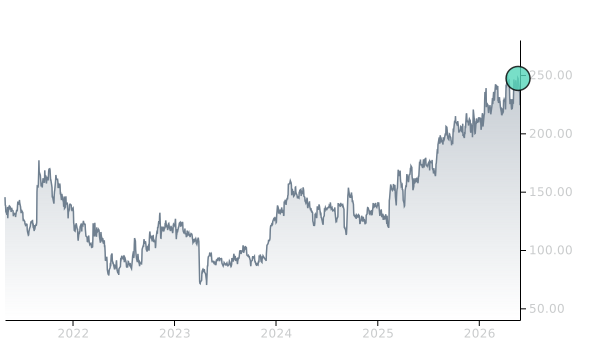
$ASND insiders have traded $ASND stock on the open market 7 times in the past 6 months. Of those trades, 7 have been purchases and 0 have been sales.
Here’s a breakdown of recent trading of $ASND stock by insiders over the last 6 months:
- JEAN JACQUES BIENAIME has made 5 purchases buying 900 shares for an estimated $206,682 and 0 sales.
- SCOTT THOMAS SMITH (EVP & Chief Financial Officer) has made 2 purchases buying 350 shares for an estimated $77,730 and 0 sales.
To track insider transactions, check out Quiver Quantitative's insider trading dashboard. You can access data on insider stock transactions through the Quiver Quantitative API insider transaction endpoint.
$ASND Hedge Fund Activity
We have seen 144 institutional investors add shares of $ASND stock to their portfolio, and 191 decrease their positions in their most recent quarter.
Here are some of the largest recent moves:
- T. ROWE PRICE INVESTMENT MANAGEMENT, INC. removed 1,586,394 shares (-59.5%) from their portfolio in Q4 2025, for an estimated $338,282,656
- PRICE T ROWE ASSOCIATES INC /MD/ removed 1,570,260 shares (-100.0%) from their portfolio in Q1 2026, for an estimated $359,165,569
- CAPITAL INTERNATIONAL INVESTORS removed 1,105,100 shares (-36.1%) from their portfolio in Q1 2026, for an estimated $252,769,523
- CAPITAL WORLD INVESTORS added 900,517 shares (+inf%) to their portfolio in Q1 2026, for an estimated $205,975,253
- CITADEL ADVISORS LLC removed 519,516 shares (-100.0%) from their portfolio in Q1 2026, for an estimated $118,828,894
- SUSQUEHANNA INTERNATIONAL GROUP, LLP removed 442,889 shares (-94.0%) from their portfolio in Q1 2026, for an estimated $101,302,000
- WESTFIELD CAPITAL MANAGEMENT CO LP removed 372,256 shares (-7.2%) from their portfolio in Q1 2026, for an estimated $85,146,114
To track hedge funds' stock portfolios, check out Quiver Quantitative's institutional holdings dashboard. You can access data on hedge funds moves and 13F filings through the Quiver Quantitative API 13F endpoint.
$ASND Analyst Ratings
Wall Street analysts have issued reports on $ASND in the last several months. We have seen 1 firms issue buy ratings on the stock, and 0 firms issue sell ratings.
Here are some recent analyst ratings:
- B of A Securities issued a "Buy" rating on 01/30/2026
To track analyst ratings and price targets for $ASND, check out Quiver Quantitative's $ASND forecast page.
$ASND Price Targets
Multiple analysts have issued price targets for $ASND recently. We have seen 10 analysts offer price targets for $ASND in the last 6 months, with a median target of $308.5.
Here are some recent targets:
- Eric Joseph from Citigroup set a target price of $355.0 on 05/19/2026
- Josh Schimmer from Evercore ISI Group set a target price of $329.0 on 05/15/2026
- Eliana Merle from Barclays set a target price of $345.0 on 05/11/2026
- Derek Archila from Wells Fargo set a target price of $326.0 on 05/08/2026
- Tazeen Ahmad from B of A Securities set a target price of $292.0 on 04/16/2026
- Yun Zhong from Wedbush set a target price of $273.0 on 04/09/2026
- Kelly Shi from Jefferies set a target price of $290.0 on 03/16/2026
Full Release
- Multi-organ system and quality-of-life benefits sustained through three and a half years
- 86% response rate for the multi-component endpoint
-
89% of patients completed the three-and-a-half-year trial
COPENHAGEN, Denmark, June 13, 2026 (GLOBE NEWSWIRE) -- Ascendis Pharma A/S (Nasdaq: ASND) today announced Week 182 data from its completed Phase 3 PaTHway Trial showing that long-term treatment with TransCon PTH (palopegteriparatide) demonstrated sustained efficacy and safety in adults with hypoparathyroidism. Over the three-and-a-half-year duration of the trial, TransCon PTH replicated the systemic actions of endogenous PTH, with a balanced, beneficial impact on the main target organ systems – CNS, kidney, small intestine, and bone – as demonstrated by improved quality of life and normalized and stable urine calcium, serum calcium, serum phosphate, and bone mineral density. These benefits were sustained while enabling independence from conventional therapy with active vitamin D and calcium.
“With its unique ability to replicate the systemic actions of endogenous parathyroid hormone, TransCon PTH has successfully addressed the physical and psychological burdens of hypoparathyroidism for the majority of treated patients,” said Aliya Khan, M.D., Clinical Professor of Medicine, Division of Endocrinology & Geriatrics, and Director of the Calcium Disorders Clinic at McMaster University in Canada. “These Phase 3 data reinforce the rapid and sustained benefits seen throughout clinical trials of TransCon PTH, including compelling improvements in quality of life reported by patients previously limited by the fatigue, cognitive challenges, and reduced physical functioning and well-being that are the hallmarks of this disease.”
Highlights of Week 182 Results from the Phase 3 PaTHway Trial
-
86% of patients were responders for the multi-component endpoint of (1) serum calcium in the normal range, (2) taking no active vitamin D, and (3) taking ≤600 mg/day of calcium.
- 89% of patients had normal albumin-adjusted serum calcium levels and a mean value of 8.8 mg/dL.
- 100% of patients achieved independence from active vitamin D, defined as not taking calcitriol or alfacalcidol.
- 96% of patients achieved independence from therapeutic doses of calcium, defined as taking < 600 mg/day of calcium.
- Significant improvements in kidney function were maintained, with mean (SE) eGFR of 80.2 (1.8) mL/min/1.73 m 2 at Week 182, reflecting a mean (SE) increase of 11.0 (1.4) mL/min/1.73 m 2 from baseline. Among patients randomized to TransCon PTH, eGFR increased from baseline through Week 38 and stabilized thereafter. After initiation of open-label treatment at Week 26, patients who had been receiving placebo in the double-blind period experienced a similar increase in eGFR. Following these eGFR increases, mean eGFR values were maintained through Week 182, in contrast to the expected typical age-related decline in eGFR in adults. i
- Mean 24-hour urine calcium decreased substantially, normalized within 26 weeks, and remained normal through Week 182.
- As measured by Hypoparathyroidism Patient Experience Scales (HPES), patients reported improvements in symptoms and health-related quality of life across all domains. Hypoparathyroidism-related physical and cognitive symptoms and impacts on physical functioning and daily life improved rapidly with TransCon PTH treatment and were maintained through Week 182.
- As measured by SF-36, all subscale scores and component summary scores demonstrated rapid and clinically meaningful improvements with TransCon PTH treatment which were sustained through Week 182.
- Mean BMD Z-scores (matched for age and sex) corrected from high baseline levels through Week 26 and remained above 0 through Week 182.
- In the trial, TransCon PTH treatment was generally well-tolerated, with no new safety signals identified. Treatment-emergent adverse events (AEs) were mostly mild or moderate, and no discontinuations were related to study drug.
-
Over three and a half years of treatment, no patients developed anti-PTH antibodies.
“Regardless of disease origin, TransCon PTH has normalized key biochemistries and skeletal health while significantly improving kidney function and quality of life beginning at the earliest timepoints and continuing through multiple years of treatment,” said Aimee Shu, M.D., Executive Vice President, Chief Medical Officer at Ascendis Pharma. “We remain committed to continuing our work to advance treatment options for patients around the world living with this often-debilitating chronic disease.”
The PaTHway Trial of 82 adults with hypoparathyroidism (85% post-surgical, 15% non-surgical) included a 26-week randomized, double-blind, placebo-controlled period followed by a 156-week open-label extension (OLE) period, and measured a wide array of clinical, biochemical, and quality of life endpoints, consistent with the breadth of negative long-term impacts experienced by patients with hypoparathyroidism. Seventy-three of the original 82 patients enrolled (89%) completed the three-and-a-half-year trial. Endpoints included independence from conventional therapy (defined as < 600 mg/day of calcium and no active vitamin D) and maintenance of normocalcemia (8.3 to 10.6 mg/dL). Renal function was assessed by estimated glomerular filtration rate (eGFR). Bone mineral density (BMD) measured by DXA scan was assessed at baseline and regular intervals through Week 182. Hypoparathyroidism-related symptoms and functional impacts were measured using the HPES. Health-related quality of life was measured using the 36-Item Short Form Survey (SF-36 version 2). Safety assessments included treatment-emergent AEs and 24-hour urine calcium excretion.
TransCon PTH is a prodrug of PTH (1-34), administered once daily, designed to provide stable levels of active PTH within the physiological range for 24 hours/day, approved as YORVIPATH ® in the United States, European Union, European Economic Area, and certain other jurisdictions as a treatment for adults with hypoparathyroidism.
A slide presentation with these data will be made available on the Investor Relations & News section of the Ascendis Pharma website: https://investors.ascendispharma.com .
About Hypoparathyroidism
Hypoparathyroidism is an endocrine disease caused by insufficient levels of parathyroid hormone (PTH), the primary regulator of calcium and phosphate balance in the body, acting directly on bone and kidney and indirectly on the intestine. Individuals with hypoparathyroidism may experience a range of severe and potentially life-threatening short-term and long-term complications, including neuromuscular irritability, renal complications, extra-skeletal calcifications, and cognitive impairment. Post-surgical hypoparathyroidism accounts for the majority of cases (70-80%), while other etiologies include autoimmune, idiopathic, and genetic causes, including ADH1.
About Ascendis Pharma A/S
Ascendis Pharma is a global biopharmaceutical company focused on applying our innovative TransCon technology platform to make a meaningful difference for patients. Guided by our core values of Patients, Science, and Passion, and following our algorithm for product innovation, we apply TransCon to develop new therapies that demonstrate best-in-class potential to address unmet medical needs. Ascendis is headquartered in Copenhagen, Denmark, and has additional facilities in Europe and the United States. Please visit
ascendispharma.com
to learn more.
Forward-Looking Statements
This press release contains forward-looking statements that involve substantial risks and uncertainties. All statements, other than statements of historical facts, included in this press release regarding Ascendis’ future operations, plans and objectives of management are forward-looking statements within the meaning of Section 27A of the Securities Act of 1933, as amended, and Section 21E of the Securities Exchange Act of 1934, as amended. Examples of such statements include, but are not limited to, statements relating to (i) TransCon PTH’s ability to replicate endogenous parathyroid hormone and address the physical and psychological burdens of hypoparathyroidism, (ii) Ascendis’ commitment to continuing its work to advance treatment options for patients around the world with hypoparathyroidism, (iii) Ascendis’ ability to apply its TransCon technology platform to make a meaningful difference for patients and (iv) Ascendis’ use of TransCon to create new and potentially best-in-class therapies to address unmet medical needs. Ascendis may not actually achieve the plans, carry out the intentions or meet the expectations or projections disclosed in the forward-looking statements and you should not place undue reliance on these forward-looking statements. Actual results or events could differ materially from the plans, intentions, expectations and projections disclosed in the forward-looking statements. Various important factors could cause actual results or events to differ materially from the forward-looking statements that Ascendis makes, including, without limitation: dependence on third‑party manufacturers, distributors, and service providers for Ascendis’ products and product candidates; risks related to regulatory review and approval, including the possibility of delays, requests for additional data or analyses, restrictions or limitations on use, approval with labeling that is more limited than expected, or failure to obtain approval in the United States, European Union, or other jurisdictions; clinical development risks, including that results from ongoing or future trials may not confirm earlier data; unforeseen safety or efficacy findings in development programs or on‑market products; manufacturing, supply chain, quality, or logistics issues that could delay development or commercialization; unforeseen expenses related to commercialization of any approved Ascendis products; unforeseen research and development or selling, general and administrative expenses and other costs impacting Ascendis’ business generally; market acceptance, pricing, and reimbursement challenges, including payer coverage decisions and health technology assessments; competitive developments, including new or improved therapies; intellectual property protection, freedom‑to‑operate, and litigation risks; Ascendis’ ability to obtain additional funding, if needed, to support its business activities; cybersecurity, data privacy, and information technology disruptions; and the impact of international economic, political, legal, compliance, public health, and business factors, including tariffs, trade policies, currency fluctuations, and geopolitical events. For a further description of the risks and uncertainties that could cause actual results to differ from those expressed in these forward-looking statements, as well as risks relating to Ascendis’ business in general, see Ascendis’ Annual Report on Form 20-F filed with the U.S. Securities and Exchange Commission (SEC) on February 11, 2026, and Ascendis’ other future reports filed with, or submitted to, the SEC. Forward-looking statements do not reflect the potential impact of any future licensing, collaborations, acquisitions, mergers, dispositions, joint ventures, or investments that Ascendis may enter into or make. Ascendis does not assume any obligation to update any forward-looking statements, except as required by law.
Ascendis, Ascendis Pharma, the Ascendis Pharma logo, TransCon, and YORVIPATH ® are trademarks owned by the Ascendis Pharma group. © June 2026 Ascendis Pharma A/S.
| Investor Contact: | Media Contact: |
| Chad Fugere | Melinda Baker |
| Ascendis Pharma | Ascendis Pharma |
| +1 (650) 519-7494 | +1 (650) 709-8875 |
i Guppy M et al. BMJ Open . 2024;14(11):e089783. doi:10.1136/bmjopen-2024-089783