


Applied Materials unveils advanced systems enhancing 2nm GAA transistor performance through precision engineering, improved etching, and innovative materials.
Quiver AI Summary
Applied Materials has unveiled new chipmaking systems designed to enhance the energy-efficient performance of Gate-All-Around (GAA) transistors at and below 2nm technology nodes. Key innovations include the Viva™ radical treatment system, which achieves atomic-level precision in smoothing silicon nanosheets to improve electron mobility and transistor performance; the Sym3™ Z Magnum™ etch system, which creates highly precise 3D trench profiles for improved silicon nanosheet uniformity; and the Spectral™ atomic layer deposition system, which replaces traditional tungsten contacts with molybdenum to significantly lower electrical resistance. These advancements are critical for meeting the demands of next-generation AI computing, allowing leading chip manufacturers to enhance the performance and efficiency of their products as they move toward volume production of 2nm-class chips.
Potential Positives
- The introduction of new chipmaking systems enhances the energy-efficient performance of Gate-All-Around (GAA) transistors, meeting growing demands in AI computing.
- The Viva™ system enables atomic-level precision in smoothing GAA silicon nanosheets, significantly improving transistor performance for enhanced speed and energy efficiency.
- The Sym3™ Z Magnum™ etch system achieves precise trench profiles, crucial for maintaining transistor performance as technology scales down to 2nm and beyond.
- The Spectral™ ALD system reduces contact resistance with the selective deposition of molybdenum, significantly improving chip performance and energy efficiency compared to traditional tungsten contacts.
Potential Negatives
- Failure to address potential challenges or limitations of the new technologies, leaving questions about their long-term reliability and effectiveness in real-world applications.
- Dependence on significant adoption by leading foundry-logic manufacturers, which may not be guaranteed given the competitive nature of the semiconductor industry.
- Absence of specific financial projections or expected market impact related to the new systems, which may raise concerns among investors about the immediate benefits of these innovations.
FAQ
What are the new chipmaking systems introduced by Applied Materials?
Applied Materials introduced new deposition, etch, and materials modification systems that enhance the performance of logic chips at 2nm and beyond.
How does the Viva™ system improve GAA transistor performance?
The Viva™ system provides angstrom-level precision in treating nanosheet surfaces, enhancing electron mobility and overall transistor efficiency.
What benefits does the Sym3™ Z Magnum™ etch system offer?
The Sym3™ Z Magnum™ etch system enables precise trench creation, enhancing nanosheet uniformity and boosting transistor speed and performance.
Why is molybdenum preferred over tungsten in contacts for next-gen chips?
Molybdenum can be thinner than tungsten while effectively conducting electrons, reducing contact resistance and improving overall chip performance.
How are these technologies impacting AI chip development?
The new systems are crucial for energy-efficient computing, enabling the development of powerful AI chips by enhancing fundamental transistor performance.
Disclaimer: This is an AI-generated summary of a press release distributed by GlobeNewswire. The model used to summarize this release may make mistakes. See the full release here.
$AMAT Insider Trading Activity
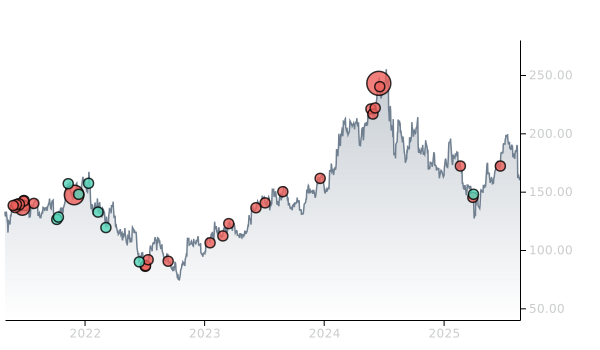
$AMAT insiders have traded $AMAT stock on the open market 3 times in the past 6 months. Of those trades, 0 have been purchases and 3 have been sales.
Here’s a breakdown of recent trading of $AMAT stock by insiders over the last 6 months:
- TERI A. LITTLE (SVP, CLO) has made 0 purchases and 2 sales selling 8,000 shares for an estimated $1,889,262.
- ADAM SANDERS (Corp. Controller & CAO) sold 609 shares for an estimated $155,620
To track insider transactions, check out Quiver Quantitative's insider trading dashboard.
$AMAT Revenue
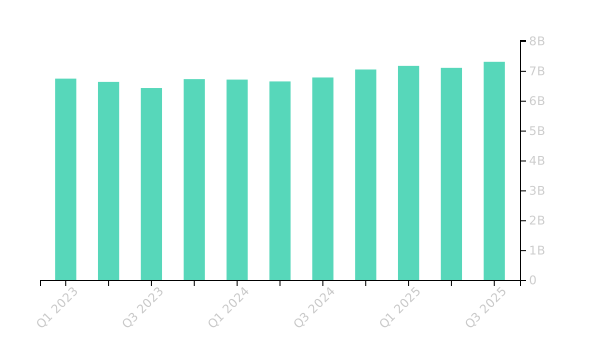
$AMAT had revenues of $6.8B in Q4 2025. This is a decrease of -3.48% from the same period in the prior year.
You can track AMAT financials on Quiver Quantitative's AMAT stock page.
$AMAT Congressional Stock Trading
Members of Congress have traded $AMAT stock 2 times in the past 6 months. Of those trades, 2 have been purchases and 0 have been sales.
Here’s a breakdown of recent trading of $AMAT stock by members of Congress over the last 6 months:
- SENATOR MARKWAYNE MULLIN purchased up to $50,000 on 12/29.
- REPRESENTATIVE DAN NEWHOUSE purchased up to $15,000 on 08/18.
To track congressional stock trading, check out Quiver Quantitative's congressional trading dashboard.
$AMAT Hedge Fund Activity
We have seen 1,090 institutional investors add shares of $AMAT stock to their portfolio, and 1,184 decrease their positions in their most recent quarter.
Here are some of the largest recent moves:
- UBS AM, A DISTINCT BUSINESS UNIT OF UBS ASSET MANAGEMENT AMERICAS LLC added 16,986,059 shares (+1334.4%) to their portfolio in Q3 2025, for an estimated $3,477,725,719
- CAPITAL RESEARCH GLOBAL INVESTORS added 10,305,182 shares (+225.4%) to their portfolio in Q3 2025, for an estimated $2,109,882,962
- KINGSTONE CAPITAL PARTNERS TEXAS, LLC removed 4,819,994 shares (-100.0%) from their portfolio in Q3 2025, for an estimated $986,845,571
- PRICE T ROWE ASSOCIATES INC /MD/ removed 3,932,086 shares (-46.4%) from their portfolio in Q3 2025, for an estimated $805,055,287
- AMERIPRISE FINANCIAL INC added 3,583,751 shares (+40.1%) to their portfolio in Q3 2025, for an estimated $733,737,179
- COATUE MANAGEMENT LLC added 3,349,048 shares (+inf%) to their portfolio in Q3 2025, for an estimated $685,684,087
- SANDERS CAPITAL, LLC added 3,280,730 shares (+42.6%) to their portfolio in Q3 2025, for an estimated $671,696,660
To track hedge funds' stock portfolios, check out Quiver Quantitative's institutional holdings dashboard.
$AMAT Analyst Ratings
Wall Street analysts have issued reports on $AMAT in the last several months. We have seen 16 firms issue buy ratings on the stock, and 0 firms issue sell ratings.
Here are some recent analyst ratings:
- Morgan Stanley issued a "Overweight" rating on 02/02/2026
- Deutsche Bank issued a "Buy" rating on 01/23/2026
- Needham issued a "Buy" rating on 01/20/2026
- RBC Capital issued a "Outperform" rating on 01/15/2026
- Barclays issued a "Overweight" rating on 01/15/2026
- B. Riley Securities issued a "Buy" rating on 12/18/2025
- UBS issued a "Buy" rating on 11/25/2025
To track analyst ratings and price targets for $AMAT, check out Quiver Quantitative's $AMAT forecast page.
$AMAT Price Targets
Multiple analysts have issued price targets for $AMAT recently. We have seen 25 analysts offer price targets for $AMAT in the last 6 months, with a median target of $350.0.
Here are some recent targets:
- Srini Pajjuri from RBC Capital set a target price of $385.0 on 02/10/2026
- Atif Malik from Citigroup set a target price of $400.0 on 02/04/2026
- Shane Brett from Morgan Stanley set a target price of $364.0 on 02/02/2026
- Vijay Rakesh from Mizuho set a target price of $370.0 on 01/28/2026
- Melissa Weathers from Deutsche Bank set a target price of $390.0 on 01/23/2026
- Charles Shi from Needham set a target price of $390.0 on 01/20/2026
- Steve Barger from Keybanc set a target price of $380.0 on 01/16/2026
Full Release
- New chipmaking systems boost the energy-efficient performance of Gate-All-Around transistors and wiring at 2nm and beyond
- Viva™ pure radical treatment smoothens GAA silicon nanosheets with atomic-level precision to increase transistor performance
- Sym3™ Z Magnum™ conductor etch system delivers angstrom-level 3D trench profile control to increase silicon nanosheet uniformity and performance
- Spectral™ atomic layer deposition system replaces today’s tungsten transistor contacts with molybdenum, a new contact metal that lowers electrical resistance at the critical link between transistors and the copper wiring network
-
The new systems are now being used by multiple leading foundry-logic manufacturers
SANTA CLARA, Calif., Feb. 10, 2026 (GLOBE NEWSWIRE) -- Applied Materials, Inc., the leader in materials engineering for the semiconductor industry, today introduced new deposition, etch and materials modification systems that boost the performance of leading-edge logic chips at 2nm and beyond. The technologies supercharge AI compute through atomic-scale improvements to the most fundamental electronic building block – the transistor.
The transition to Gate-All-Around (GAA) transistors is a major industry inflection and a critical enabler of the energy-efficient computing needed to deliver more powerful AI chips. As 2nm-class GAA chips ramp to volume production this year, Applied is introducing new material innovations to enhance next-generation GAA transistors for angstrom nodes. The combined impact of the new chipmaking systems contributes a significant portion of the total energy-efficient performance gains of GAA process node transitions.
“The rapid progress of AI is pushing compute performance to the limit, and breakthroughs in computing begin with the transistor,” said Dr. Prabu Raja, President of the Semiconductor Products Group at Applied Materials. “To keep pace in the angstrom era, Applied is delivering materials engineering breakthroughs that improve energy-efficient compute. Together, these new systems extend Applied’s longstanding leadership in driving major transistor and wiring inflections, while helping customers accelerate their chip roadmaps to keep up with the blistering pace of AI.”
New Viva™ Radical Treatment System Enables Precision Engineering of GAA Transistor Nanosheets
At the heart of GAA transistors are horizontal stacks of current-carrying “nanosheets.” Made of ultra-thin silicon just a few nanometers wide, the physical features of these nanosheets must be exceptionally well defined to ensure that each one acts as an efficient conducting path for charge carriers. Of crucial importance is the surface condition of these nanosheets, as even atomic-scale roughness or contamination can significantly impact their electrical properties and, ultimately, the overall chip performance. A pristine, highly uniform nanosheet surface dramatically enhances the channel’s electron mobility, which plays a central role in determining how fast transistors can switch on and off, resulting in faster, more energy-efficient transistors engineered to meet the demands of next-generation AI chips.
The Applied Producer™ Viva™ radical treatment system delivers angstrom-level precision engineering of these nanosheet surfaces. At the core of Viva is a patented delivery architecture that generates ultra-pure radical species. The technique combines Applied’s remote plasma source with other hardware innovations to filter out high-energy charged ions that can damage the surface structure. The concentrated neutral radicals create a more gentle, damage-free treatment environment, enabling uniform surface treatments in deeply buried transistor structures.
The Viva system is being adopted by leading logic chipmakers for advanced channel engineering at 2nm and beyond process nodes.
The new Viva system has additional applications across both logic and memory. When combined with the Applied Producer Pyra™ thermal annealing process , the supplemental radical treatment further reduces the resistance of conducting copper wires, promising to extend the use of copper in the lower metal layers of the most advanced nodes.
New Sym3™ Z Magnum™ Etch System Creates Angstrom-Level 3D Trenches with Enhanced Plasma Control
The vertical 3D architecture of GAA transistors requires chipmakers to carve deep, narrow trenches with exceptional precision. These features must maintain uniform depth, straight sidewalls, and flat, rectangular bottoms, since even small variations can impact transistor speed, power efficiency and overall performance. As nodes shrink, this precision has made advanced plasma etch indispensable.
Today Applied is introducing the
Centris™ Sym3™ Z Magnum™ etch system
– the newest member of the Sym3 Z family. The Sym3 Z platform brought pulsed voltage technology (PVT) into high-volume production, using microsecond-scale ion control to create the high-aspect-ratio features in GAA transistors. It has achieved broad adoption, with tool-of-record status in 2nm logic manufacturing and more than 250 chambers in the field.
To extend scaling, Sym3 Z Magnum debuts a breakthrough second-generation pulsed voltage technology (PVT2). PVT2 not only eliminates the traditional tradeoff between ion directionality and near-wafer plasma control, it also enables independent ion-angle and ion-energy tuning. These capabilities deliver far more defined ion trajectories directly to the wafer surface. By pairing PVT2 with the system’s new source technology, Sym3 Z Magnum produces clean, precise trenches that enable uniform nanosheets, faster switching, and higher-quality epitaxy – boosting transistor speed and overall chip performance.
Beyond angstrom-class logic, Sym3 Z Magnum advances DRAM and high-bandwidth memory (HBM) technologies by delivering the precise profiles needed for denser arrays and taller stacks. Its broad applications drive rapid adoption among leading chipmakers and strengthen Applied’s leadership in advanced etch.
New Spectral™ ALD System Lowers Contact Resistance with Selective Deposition of Molybdenum
Delivering more powerful AI requires innovation beyond the transistor device. As scaling continues below 2nm, the tiny metal contacts that link each transistor to the wiring network become ever thinner, contributing significantly to the chip’s total resistance and creating a bottleneck to performance and energy efficiency. At these nanoscale dimensions, traditional tungsten contacts face challenges in their ability to efficiently conduct electrons. Molybdenum – a metal that can be made thinner while preserving efficient electron flow – has emerged as a promising alternative for next-generation contacts at angstrom nodes.
The Applied Centris™ Spectral™ Molybdenum ALD* system selectively deposits monocrystalline molybdenum, reducing critical contact resistance by as much as 15 percent beyond today’s industry benchmark – the Applied Endura™ Volta™ Selective Tungsten system . Since these contacts form the smallest connections between interconnects and transistors, maintaining low resistance is critical to ensure maximum chip performance and energy efficiency.
Spectral represents a new series of ALD tools that feature state-of-the-art quad reactor design with precision chemical delivery, a variety of plasma and thermal processing capabilities, and specialized hardware for both temporal and spatial ALD operation – providing the ability to create a breadth of advanced films to power advanced AI chips.
The Spectral system is being adopted by leading logic chipmakers at 2nm and below process nodes. An animation of the system’s capabilities can be viewed here .
A media kit with additional information on the Viva, Sym3 Z and Spectral systems is available on the Applied Materials website .
*ALD = Atomic Layer Deposition
About Applied Materials
Applied Materials, Inc. (Nasdaq: AMAT) is the leader in materials engineering solutions that are at the foundation of virtually every new semiconductor and advanced display in the world. The technology we create is essential to advancing AI and accelerating the commercialization of next-generation chips. At Applied, we push the boundaries of science and engineering to deliver material innovation that changes the world. Learn more at
www.appliedmaterials.com
.
Contact:
Ricky Gradwohl
(Media) 408.235.4676
Mike Sullivan
(Financial Community) 408.986.7977
A photo accompanying this announcement is available at https://www.globenewswire.com/NewsRoom/AttachmentNg/50ebed0d-d115-420d-a789-f7f1d4261cdd