

The Willis Political Risk Survey reveals tariffs pose greater risks than international conflict for businesses in 2026.
Quiver AI Summary
The ninth annual Political Risk Survey Report by Willis indicates that political risks linked to economic policy, particularly tariffs, are more concerning for businesses than international conflicts. Released amidst Middle East tensions, the survey found that 61% of respondents prioritize managing the effects of rising tariffs over potential violent conflicts, with many reporting negative financial impacts due to tariffs. The report also noted a significant rise in political risk and trade credit loss, with companies increasingly drawn to political risk insurance as a safeguard. Additionally, concerns around economic coercion and gray-zone aggression are prevalent, with a notable emphasis on risks stemming from domestic government policies. As highlighted by Sam Wilkin of Willis, the complexity of global political risks extends beyond traditional conflict zones, reflecting a more intricate and unstable international landscape.
Potential Positives
- Willis, a WTW business, has highlighted significant trends in political risk management, positioning the company as a thought leader in the field.
- The increase in demand for political risk and trade credit insurance suggests a growing market opportunity for WTW's services, potentially leading to increased revenue.
- The report emphasizes key findings that can serve as valuable insights for clients, reinforcing WTW’s commitment to providing data-driven solutions in a changing geopolitical landscape.
Potential Negatives
- 61% of respondents reported negative financial impacts from tariffs, highlighting significant vulnerabilities in business operations linked to political and economic policies.
- 39% of companies indicated higher risks due to policy choices of their home government, suggesting potential instability and added challenges for corporate strategies.
- The report reveals that political risk is becoming less about specific unstable regions and more about a broad, unstable global order, indicating potential long-term challenges for businesses adapting to this environment.
FAQ
What are the main findings of the Political Risk Survey Report 2026?
The report highlights that tariffs are viewed as the top political risk, with significant financial impacts reported by companies.
How do tariffs compare to international conflict in political risk?
Respondents identified tariffs as a more pressing concern than international violent conflict in managing political risks.
What percentage of companies experienced negative impacts from tariffs?
61% of companies reported experiencing negative financial impacts due to rising tariffs.
What is gray-zone aggression, according to the survey?
Gray-zone aggression includes economic coercion and retaliation, which businesses identified as a major area of concern.
How important is political risk insurance for companies?
Interest in political risk and trade credit insurance has increased, reflecting a trend toward managing geopolitical risks more effectively.
Disclaimer: This is an AI-generated summary of a press release distributed by GlobeNewswire. The model used to summarize this release may make mistakes. See the full release here.
$WTW Insider Trading Activity
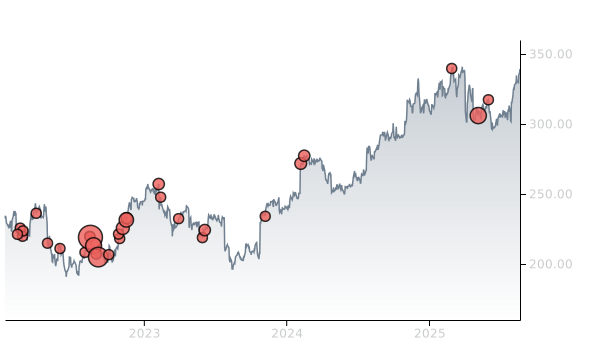
$WTW insiders have traded $WTW stock on the open market 2 times in the past 6 months. Of those trades, 1 have been purchases and 1 have been sales.
Here’s a breakdown of recent trading of $WTW stock by insiders over the last 6 months:
- MATTHEW FURMAN (General Counsel) sold 3,000 shares for an estimated $912,008
- LUCY CLARKE (President of Risk & Broking) purchased 1,896 shares for an estimated $499,340
To track insider transactions, check out Quiver Quantitative's insider trading dashboard. You can access data on insider stock transactions through the Quiver Quantitative API insider transaction endpoint.
$WTW Revenue
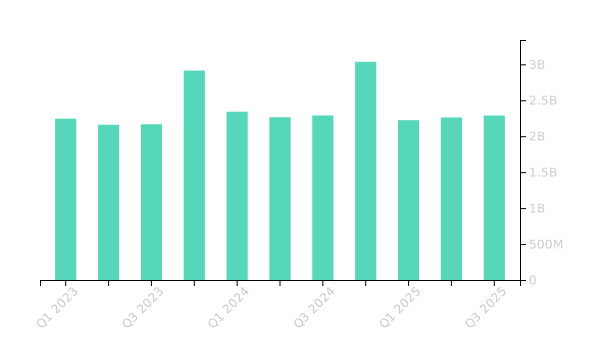
$WTW had revenues of $2.4B in Q1 2026. This is an increase of 8.5% from the same period in the prior year.
You can track WTW financials on Quiver Quantitative's WTW stock page.
You can access data on WTW stock through the Quiver Quantitative API.
$WTW Hedge Fund Activity
We have seen 304 institutional investors add shares of $WTW stock to their portfolio, and 408 decrease their positions in their most recent quarter.
Here are some of the largest recent moves:
- DODGE & COX added 3,293,334 shares (+90.7%) to their portfolio in Q4 2025, for an estimated $1,082,189,552
- HARRIS ASSOCIATES L P added 1,318,482 shares (+30.7%) to their portfolio in Q4 2025, for an estimated $433,253,185
- FMR LLC removed 1,119,109 shares (-33.6%) from their portfolio in Q4 2025, for an estimated $367,739,217
- UBS AM, A DISTINCT BUSINESS UNIT OF UBS ASSET MANAGEMENT AMERICAS LLC added 866,006 shares (+inf%) to their portfolio in Q4 2025, for an estimated $284,569,571
- BANK OF MONTREAL /CAN/ added 817,301 shares (+657.3%) to their portfolio in Q4 2025, for an estimated $268,565,108
- BLACKROCK, INC. removed 794,851 shares (-8.6%) from their portfolio in Q4 2025, for an estimated $261,188,038
- T. ROWE PRICE INVESTMENT MANAGEMENT, INC. removed 476,225 shares (-16.8%) from their portfolio in Q4 2025, for an estimated $156,487,535
To track hedge funds' stock portfolios, check out Quiver Quantitative's institutional holdings dashboard. You can access data on hedge funds moves and 13F filings through the Quiver Quantitative API 13F endpoint.
$WTW Analyst Ratings
Wall Street analysts have issued reports on $WTW in the last several months. We have seen 2 firms issue buy ratings on the stock, and 1 firms issue sell ratings.
Here are some recent analyst ratings:
- BMO Capital issued a "Outperform" rating on 05/01/2026
- Barclays issued a "Underweight" rating on 01/08/2026
- Keefe, Bruyette & Woods issued a "Outperform" rating on 01/06/2026
To track analyst ratings and price targets for $WTW, check out Quiver Quantitative's $WTW forecast page.
$WTW Price Targets
Multiple analysts have issued price targets for $WTW recently. We have seen 13 analysts offer price targets for $WTW in the last 6 months, with a median target of $347.0.
Here are some recent targets:
- Matthew Heimermann from Citigroup set a target price of $300.0 on 05/06/2026
- Yaron Kinar from Mizuho set a target price of $338.0 on 05/05/2026
- Brian Meredith from UBS set a target price of $400.0 on 05/04/2026
- Michael Zaremski from BMO Capital set a target price of $300.0 on 05/01/2026
- David Motemaden from Evercore ISI Group set a target price of $360.0 on 05/01/2026
- Paul Newsome from Piper Sandler set a target price of $283.0 on 05/01/2026
- Joshua Shanker from B of A Securities set a target price of $347.0 on 04/14/2026
Full Release
LONDON, May 12, 2026 (GLOBE NEWSWIRE) -- Political risks driven by economic policy still outweigh those from international conflict, according to the ninth annual Political Risk Survey Report by Willis, a WTW business (NASDAQ: WTW).
Despite the survey being issued as the conflict in the Middle East broke out, respondents selected tariffs over international violent conflict as a top political risk, with 61% believing the impacts of rising tariffs are the most difficult to manage. 61% also reported that their company had experienced a negative financial impact from tariffs.
Other key findings include:
- Political risk and trade credit loss uptick: The share of respondents reporting credit and political risk insurable losses from geopolitical causes is the second highest in the nine years of the survey. For the third year running, related losses amounted to more than $250 million, and interest in political risk and trade credit insurance as a means of managing geopolitical risk has ticked up.
- Extreme responses: 39% of companies said they face higher risks because of the policy choices of their home government. 84% said they are either actively preparing for, or considering preparing for, a future in which “Eastern” and “Western” portions of the global business may need to be structurally independent.
-
Gray-zone aggression:
Economic coercion or retaliation, such as official or unofficial sanctions, threats or tariffs, or export embargoes for key commodities was ranked as the greatest gray-zone aggression related area of concern by 61% of firms, the second largest group of respondents. Attacks on infrastructure such as cutting undersea cables, destroying pipelines, disrupting power stations, arson in warehouses and other acts of this nature continue to be the top concern for 65% of respondents.
Sam Wilkin, Director of Political Risk Analytics at Willis said: “It’s surprising that while conflict in the Middle East dominates the headlines, the effects of tariffs continue to dominate business concerns. But this finding is in keeping with other trends portrayed by our survey sample. The political risk map of 2026 is not simply a map of war zones. It is a map of contested systems – trade systems, technology systems, information systems and domestic political systems. For globalised business, political risk is becoming less about exposure to a handful of unstable places, and more about exposure to an increasingly unstable world order. This report shines a light on what companies find hardest to manage in this geopolitical landscape that is changing so fundamentally.”
The complete report can be downloaded here .
The research includes a survey of 57 companies and in-depth, anonymised interviews with 15 participating companies.
About WTW
At WTW (NASDAQ: WTW), we provide data-driven, insight-led solutions in the areas of people, risk and capital. Leveraging the global view and local expertise of our colleagues serving 140 countries and markets, we help organizations sharpen their strategy, enhance organizational resilience, motivate their workforce and maximize performance.
Working shoulder to shoulder with our clients, we uncover opportunities for sustainable success—and provide perspective that moves you. Learn more at wtwco.com.
Media Contacts
Lauren David
Jo Barrett