


Global health insurance costs are projected to rise by 10.3% in 2026, driven by healthcare inflation and regional factors.
Quiver AI Summary
According to WTW's 2026 Global Medical Trends report, global health insurance costs are projected to rise by 10.3% in the upcoming year, continuing a trend of significant increases seen in the previous years. The report indicates the highest anticipated cost rise in the Asia Pacific region at 14.0%, while Latin America is expected to experience a sharp increase from 10.5% to 11.9%. The Middle East and Africa will see costs grow at 11.3%, while North America and Europe will see slight declines in their growth rates. Major drivers of these rising costs include new medical technologies, declining public health systems, and advancements in pharmaceuticals, with cancer being identified as the most significant condition impacting medical expenses worldwide. Employers are encouraged to strategically manage healthcare costs by investing in employee education and preventive programs, particularly focusing on prevalent diseases such as cancer.
Potential Positives
- WTW's 2026 Global Medical Trends report indicates a comprehensive analysis of rising global healthcare costs, positioning the company as a thought leader in the health insurance industry.
- The report highlights significant trends affecting healthcare costs, including the investment in new medical technologies and AI, which can potentially lead to long-term cost reductions for employers.
- With an extensive participation of 346 leading health insurers from 82 countries in the survey, WTW's findings are backed by a robust data set, enhancing the credibility of their insights.
- Insight into regional variations in healthcare costs enables WTW to provide targeted solutions to multinational employers, thus strengthening their consulting services in health benefits management.
Potential Negatives
- The projected global rise in health insurance costs by over 10% for 2026 could indicate significant financial strain on employers and consumers, potentially leading to reduced access to healthcare services.
- The report highlights persistent elevated cost trends that are expected to last for more than three years, suggesting ongoing challenges for the health insurance industry and employers alike.
- The emphasis on increasing cancer and cardiovascular conditions, particularly among younger populations, raises concerns about public health and the long-term viability of healthcare systems.
FAQ
What are the projected global health insurance cost increases for 2026?
The average cost of medical health benefits is projected to rise by 10.3% globally in 2026.
Which region is experiencing the highest healthcare cost increases?
The Asia Pacific region is expected to see the highest cost increase at 14.0% in 2026.
What factors are driving the rise in healthcare costs?
High medical costs, new medical technologies, and advancements in pharmaceuticals are key drivers of rising healthcare costs.
How does cancer impact medical claims costs globally?
Cancer is the leading condition driving medical costs globally, with a significant increase in incidences among individuals under 40.
What strategies can employers use to manage healthcare cost inflation?
Employers can invest in employee education, prevention programs, and optimize mental health coverage to manage costs effectively.
Disclaimer: This is an AI-generated summary of a press release distributed by GlobeNewswire. The model used to summarize this release may make mistakes. See the full release here.
$WTW Congressional Stock Trading
Members of Congress have traded $WTW stock 2 times in the past 6 months. Of those trades, 0 have been purchases and 2 have been sales.
Here’s a breakdown of recent trading of $WTW stock by members of Congress over the last 6 months:
- REPRESENTATIVE VAL T. HOYLE sold up to $15,000 on 09/23.
- REPRESENTATIVE GILBERT RAY CISNEROS, JR. sold up to $15,000 on 06/26.
To track congressional stock trading, check out Quiver Quantitative's congressional trading dashboard.
$WTW Insider Trading Activity
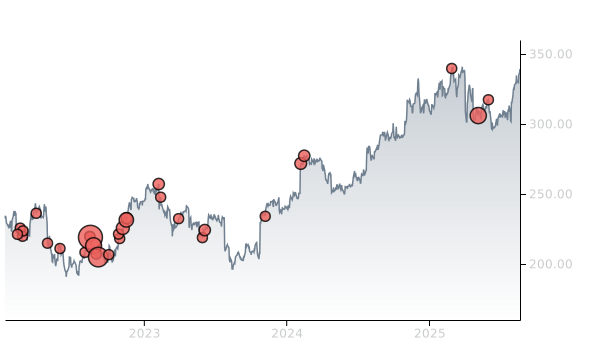
$WTW insiders have traded $WTW stock on the open market 1 times in the past 6 months. Of those trades, 0 have been purchases and 1 have been sales.
Here’s a breakdown of recent trading of $WTW stock by insiders over the last 6 months:
- ANDREW JAY KRASNER (Chief Financial Officer) sold 1,600 shares for an estimated $505,200
To track insider transactions, check out Quiver Quantitative's insider trading dashboard.
$WTW Hedge Fund Activity
We have seen 345 institutional investors add shares of $WTW stock to their portfolio, and 378 decrease their positions in their most recent quarter.
Here are some of the largest recent moves:
- DODGE & COX added 1,278,423 shares (+inf%) to their portfolio in Q2 2025, for an estimated $391,836,649
- T. ROWE PRICE INVESTMENT MANAGEMENT, INC. removed 981,804 shares (-34.4%) from their portfolio in Q2 2025, for an estimated $300,922,926
- SOUNDWATCH CAPITAL LLC removed 890,015 shares (-100.0%) from their portfolio in Q3 2025, for an estimated $307,455,681
- PRICE T ROWE ASSOCIATES INC /MD/ added 834,093 shares (+449.9%) to their portfolio in Q2 2025, for an estimated $255,649,504
- ALLIANCEBERNSTEIN L.P. added 462,249 shares (+80.2%) to their portfolio in Q2 2025, for an estimated $141,679,318
- FMR LLC removed 423,399 shares (-10.9%) from their portfolio in Q2 2025, for an estimated $129,771,793
- COMMONWEALTH OF PENNSYLVANIA PUBLIC SCHOOL EMPLS RETRMT SYS added 301,493 shares (+1320.9%) to their portfolio in Q2 2025, for an estimated $92,407,604
To track hedge funds' stock portfolios, check out Quiver Quantitative's institutional holdings dashboard.
$WTW Analyst Ratings
Wall Street analysts have issued reports on $WTW in the last several months. We have seen 6 firms issue buy ratings on the stock, and 0 firms issue sell ratings.
Here are some recent analyst ratings:
- TD Cowen issued a "Buy" rating on 11/10/2025
- Piper Sandler issued a "Overweight" rating on 10/31/2025
- Wells Fargo issued a "Overweight" rating on 10/08/2025
- Evercore ISI Group issued a "Outperform" rating on 10/01/2025
- Keefe, Bruyette & Woods issued a "Outperform" rating on 09/29/2025
- Raymond James issued a "Strong Buy" rating on 09/22/2025
To track analyst ratings and price targets for $WTW, check out Quiver Quantitative's $WTW forecast page.
$WTW Price Targets
Multiple analysts have issued price targets for $WTW recently. We have seen 10 analysts offer price targets for $WTW in the last 6 months, with a median target of $377.5.
Here are some recent targets:
- Andrew Kligerman from TD Cowen set a target price of $391.0 on 11/10/2025
- Meyer Shields from Keefe, Bruyette & Woods set a target price of $373.0 on 11/04/2025
- Paul Newsome from Piper Sandler set a target price of $356.0 on 10/31/2025
- Elyse Greenspan from Wells Fargo set a target price of $382.0 on 10/08/2025
- Brian Meredith from UBS set a target price of $398.0 on 10/08/2025
- David Motemaden from Evercore ISI Group set a target price of $387.0 on 10/01/2025
- C. Gregory Peters from Raymond James set a target price of $400.0 on 09/22/2025
Full Release
NEW YORK, Nov. 11, 2025 (GLOBE NEWSWIRE) -- Global health insurance costs are projected to rise by over 10% again next year, as healthcare inflation continues to rise following steep cost increases in recent years, according to WTW’s 2026 Global Medical Trends report .
The survey of health insurers found that the average cost of medical health benefits will increase by 10.3% globally next year. This follows rises of 10% in 2025 and 9.5% in 2024.
Regionally, the highest cost increases are expected in Asia Pacific at 14.0% while Latin America is anticipating the sharpest acceleration in costs, from 10.5% this year to 11.9% expected in 2026.
The Middle East and Africa will also see above average healthcare cost increases at 11.3%, while medical inflation is expected to fall slightly in North America, from 9.4% to 9.2%, and in Europe from 8.3% to 8.2%. In the US, the healthcare cost is projected at 9.6% in 2026, which is slightly down from 9.7% in 2025 but still significantly higher than 7.6% in 2024.
According to WTW’s research, over half (55%) of insurers that expect higher trends expect these elevated levels to persist for more than three years, driven by high medical costs, regional pressures on pharmacy and outpatient services and global structural factors.
These include new medical technologies, cited as the top reason for increased costs with three-quarters (74%) of insurers naming it as the primary driver of medical inflation. Followed by the decline of public health systems (52%) and advancements in pharmaceuticals (49%), both of which reflect deeper systemic shifts in healthcare delivery and innovation.
“Despite variations in healthcare provision in different countries and regions around the world, rising medical costs are a consistent trend for all,” said Linda Pham, global health and risk leader for Integrated and Global Solutions, WTW. “One glimmer of hope for employers is that investment in technologies, including AI, is leading to higher costs at the moment but following this phase new technologies hold the promise of reducing healthcare cost trends in the longer term.”
From a disease-based perspective, cancer is the leading condition driving medical costs globally. It is named as the fastest growing and most expensive diagnosis for insurers in nearly every region, cited by 57% of insurers globally. Three-quarters of insurers also observed an increase in cancer incidence among individuals under the age of 40.
Cardiovascular conditions (50%) are also growing significantly and rank second among the conditions driving medical claims costs, with behavioral health issues (37%) ranked third.
“The challenge of navigating healthcare inflation for multinational employers requires strategic management,” said Courtney Stubblefield, managing director, Health & Benefits, WTW. “This can include investing in education for employees on the use of health benefits, raising awareness of prevention programs for prevalent diseases like cancer, optimizing mental health coverage, and introducing flexibility of benefits. Through careful management and applying both a short- and longer-term lens to their approach, employers can make sure they are getting the most out of their healthcare benefits while managing cost inflation.”
Figure 1. Global medical trends (gross) 2024-2026, globally and by region
|
2024
|
2025
|
2026 (projected) | ||||
| Global † |
9.5%
|
10.0%
|
10.3%
|
|||
| Latin America † |
9.6%
|
10.5%
|
11.9%
|
|||
| North America |
7.4%
|
9.4%
|
9.2%
|
|||
| Asia Pacific |
11.8%
|
13.2%
|
14.0%
|
|||
| Europe † |
9.4%
|
8.3%
|
8.2%
|
|||
| Middle East and Africa † |
8.5%
|
10.3%
|
11.3%
|
|||
† Global, Latin America, Europe and Middle East and Africa numbers exclude Argentina, Turkey, Egypt, Nigeria and Zimbabwe (excluded due to volatile inflationary environments)
About the survey
WTW conducted its 2026 Global Medical Trends Survey between June and July 2025. A total of 346 leading health insurers representing 82 countries participated in our survey. In addition to submissions from insurers, we received input from WTW local brokers representing 54 countries. The combined data covers 91 countries.
About WTW
At WTW (NASDAQ: WTW), we provide data-driven, insight-led solutions in the areas of people, risk and capital. Leveraging the global view and local expertise of our colleagues serving 140 countries and markets, we help organizations sharpen their strategy, enhance organizational resilience, motivate their workforce and maximize performance.
Working shoulder to shoulder with our clients, we uncover opportunities for sustainable success—and provide perspective that moves you. Learn more at wtwco.com.
Media contacts
Ileana Feoli
[email protected]
Stacy Bronstein
[email protected]