


Telitacicept significantly improved disease activity in systemic lupus erythematosus, achieving better responses than placebo in a Phase 3 trial.
Quiver AI Summary
Vor Bio announced positive results from a Phase 3 study of telitacicept for systemic lupus erythematosus (SLE) in China, published in The New England Journal of Medicine. The trial met its primary endpoint, showing that 67.1% of patients receiving telitacicept experienced significant improvements in disease activity compared to 32.7% on placebo. This dual inhibition of BAFF and APRIL suggests telitacicept could serve as a new standard of care, offering a transformative approach to autoimmune diseases. The study, which involved 335 patients, reported additional benefits including a longer median time to flare and reductions in glucocorticoid use. Overall, these findings highlight the potential of telitacicept to redefine lupus treatment.
Potential Positives
- Trial met primary endpoint with statistically significant improvement in disease activity, showing 67.1% of patients responded to telitacicept compared to 32.7% with placebo.
- Publication of trial results in The New England Journal of Medicine highlights the rigorous clinical research and global acceptance of the study, enhancing the company’s credibility.
- Telitacicept demonstrated a dual inhibitory mechanism that could redefine treatment approaches for systemic lupus erythematosus, potentially establishing it as a new standard of care.
Potential Negatives
- Forward-looking statements indicate uncertainty, suggesting that the anticipated outcomes regarding telitacicept may not materialize, which could impact investor confidence.
- The reliance on data reported by a collaborator, RemeGen, raises questions about the independence and integrity of the study results.
- Significant adverse events, such as upper respiratory tract infections occurring more frequently in the telitacicept group, may raise safety concerns among potential users and healthcare providers.
FAQ
What is telitacicept and its significance in lupus treatment?
Telitacicept is a novel therapy designed to inhibit BAFF and APRIL, showing potential as a disease-modifying treatment for systemic lupus erythematosus.
How effective was telitacicept in the Phase 3 study?
The study reported a 67.1% response rate in patients receiving telitacicept, compared to 32.7% with placebo, indicating statistically significant improvement.
What were the safety findings related to telitacicept?
Safety findings were consistent with prior studies, with fewer serious adverse events and high rates of upper respiratory tract infections among patients.
How does telitacicept compare to current lupus treatments?
Telitacicept more than doubled the clinical response compared to standard treatments, demonstrating its potential to redefine lupus management internationally.
What are the future prospects for telitacicept?
Telitacicept is being pursued for broader approval globally, with ongoing clinical trials in various regions including the US, Europe, and Asia-Pacific.
Disclaimer: This is an AI-generated summary of a press release distributed by GlobeNewswire. The model used to summarize this release may make mistakes. See the full release here.
$VOR Insider Trading Activity
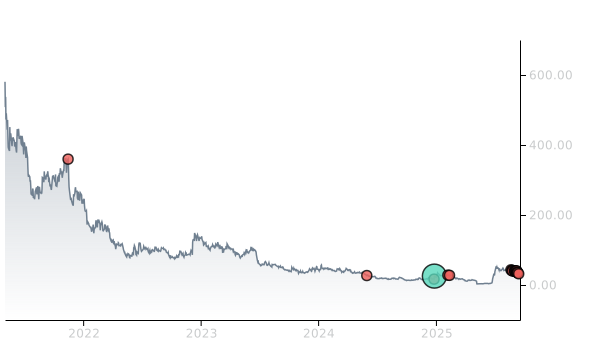
$VOR insiders have traded $VOR stock on the open market 34 times in the past 6 months. Of those trades, 0 have been purchases and 34 have been sales.
Here’s a breakdown of recent trading of $VOR stock by insiders over the last 6 months:
- INTERCHANGE LLC REPROGRAMMED has made 0 purchases and 34 sales selling 6,553,834 shares for an estimated $24,198,185.
To track insider transactions, check out Quiver Quantitative's insider trading dashboard.
$VOR Hedge Fund Activity
We have seen 16 institutional investors add shares of $VOR stock to their portfolio, and 28 decrease their positions in their most recent quarter.
Here are some of the largest recent moves:
- FMR LLC removed 4,329,810 shares (-67.4%) from their portfolio in Q2 2025, for an estimated $7,014,292
- UBS GROUP AG added 1,523,181 shares (+18015.2%) to their portfolio in Q2 2025, for an estimated $2,467,553
- HRT FINANCIAL LP added 474,575 shares (+inf%) to their portfolio in Q2 2025, for an estimated $768,811
- SCIENTECH RESEARCH LLC added 403,859 shares (+inf%) to their portfolio in Q2 2025, for an estimated $654,251
- SUSQUEHANNA INTERNATIONAL GROUP, LLP removed 384,293 shares (-100.0%) from their portfolio in Q2 2025, for an estimated $622,554
- JANE STREET GROUP, LLC added 330,857 shares (+169.9%) to their portfolio in Q2 2025, for an estimated $535,988
- MAI CAPITAL MANAGEMENT removed 284,711 shares (-98.7%) from their portfolio in Q2 2025, for an estimated $461,231
To track hedge funds' stock portfolios, check out Quiver Quantitative's institutional holdings dashboard.
$VOR Analyst Ratings
Wall Street analysts have issued reports on $VOR in the last several months. We have seen 1 firms issue buy ratings on the stock, and 0 firms issue sell ratings.
Here are some recent analyst ratings:
- HC Wainwright & Co. issued a "Buy" rating on 08/14/2025
To track analyst ratings and price targets for $VOR, check out Quiver Quantitative's $VOR forecast page.
$VOR Price Targets
Multiple analysts have issued price targets for $VOR recently. We have seen 4 analysts offer price targets for $VOR in the last 6 months, with a median target of $4.5.
Here are some recent targets:
- Jack Allen from Baird set a target price of $64.0 on 10/15/2025
- Swayampakula Ramakanth from HC Wainwright & Co. set a target price of $3.0 on 08/14/2025
- David Nierengarten from Wedbush set a target price of $0.4 on 06/26/2025
- Silvan Tuerkcan from JMP Securities set a target price of $6.0 on 05/09/2025
Full Release
Trial met primary endpoint achieving statistically significant improvement in disease activity, with 67.1% of patients responding with telitacicept versus 32.7% with placebo
Dual inhibition of BAFF and APRIL validated as a transformative B-cell approach, highlighting telitecicept’s potential as a disease-modifying therapy for systemic lupus erythematosus
BOSTON, Oct. 16, 2025 (GLOBE NEWSWIRE) -- Vor Bio (Nasdaq: VOR), a clinical-stage biotechnology company transforming the treatment of autoimmune diseases, today announced that results from a Phase 3 study in China evaluating telitacicept in systemic lupus erythematosus (SLE) sponsored by its collaborator, RemeGen Co., Ltd., (HKEX: 9995, SHA: 688331), were published in The New England Journal of Medicine (NEJM).
“We are humbled by what these results represent for patients and the scientific community, and by the recognition that comes with their publication in The New England Journal of Medicine , which underscores the global acceptance of the quality and rigor of clinical research emerging from China. For the first time, a therapy in a Phase 3 trial is delivering more than double the clinical response seen with the current standard of care in lupus. These data present a compelling case for potentially broadening telitacicept’s use as a new standard of care worldwide,” said Jean-Paul Kress, M.D., Chief Executive Officer and Chairman of Vor Bio. “Lupus has challenged researchers and clinicians for decades. To see a dual BAFF/APRIL approach deliver this level of efficacy, durability, and consistency across multiple indications, while maintaining a favorable safety profile, affirms our belief that telitacicept has the potential to redefine how autoimmune diseases are treated.”
“These data support the central role of B-cells in the pathobiology of lupus. By targeting both BAFF and APRIL, it was possible to achieve excellent clinical results that suggest the effective restoration of immune balance in at least some of the patients. With this mechanism of action, telitacicept could significantly reduce the burden of lupus,” said Ronald van Vollenhoven, M.D., Ph.D., Professor of Rheumatology at Amsterdam University Medical Center. “This approach could represent an important new addition to the therapeutic landscape for lupus.”
The study, conducted at 42 hospitals in China, evaluated telitacicept in 335 patients with active SLE despite standard therapy. The study met its primary endpoint with 67.1% of patients who received telitacicept achieving a modified SLE Responder Index-4 (SRI-4) response compared with 32.7% on placebo (P<0.001) at week 52. More telitacicept-treated patients met a modified SRI-4 response as early as week 4 than those who received placebo. This difference was sustained at week 52.
Improvements were also seen across multiple secondary measures:
- Disease activity: At week 52 SELENA-SLEDAI score reduction from baseline of ≥4 points occurred in 70.1% of the telitacicept group versus 40.5% of placebo patients. The mean change in SELENA-SLEDAI score was -4.95 for telitacicept versus -1.0 for placebo. SELENA-SLEDAI is a 24-item weighted lupus activity score that ranges from 0-105 with higher scores indicating greater disease activity.
- Physician’s Global Assessment: Greater reductions were observed with telitacicept (-0.79 vs. -0.40).
- Time to SLE flare : Median time to flare was 198 days on telitacicept versus 115 days on placebo.
- Steroid dose reduction: The proportion pf patients taking ≤7.5mg/day of glucocorticoid (or prednisone equivalent) or with ≥25% reduction in glucocorticoid dose from baseline over weeks 44-52 was 44.9% in the telitacicept group versus 34.7% for placebo.
-
Kidney involvement:
Among patients with baseline proteinuria, more achieved clinically meaningful reductions (71.8% vs. 55.1% on placebo).
Safety findings were consistent with previous studies. The most common drug-related adverse events were upper respiratory tract infection (31.7% vs. 19.0% on placebo), injection-site reactions (12.6% vs. 0.6% on placebo), and reductions in immunoglobulin levels. Serious adverse events occurred less frequently with telitacicept (7.2% vs. 14.3% on placebo).
About Systemic Lupus Erythematosus (SLE)
SLE is a chronic, systemic autoimmune disease that can affect multiple organs and lead to irreversible damage. More than half of patients develop organ injury within 2–6 years of diagnosis. Despite available therapies, including glucocorticoids, antimalarials, immunosuppressants, and biologics, many patients continue to experience active disease, underscoring the urgent need for new treatment options.
About Telitacicept
Telitacicept is a novel, investigational recombinant fusion protein designed to treat autoimmune diseases by selectively inhibiting BLyS (BAFF) and APRIL - two cytokines essential to B cell and plasma cell survival. This dual-target mechanism reduces autoreactive B cells and autoantibody production, key drivers of autoimmune pathology. In a Phase 3 clinical trial in generalized myasthenia gravis in China, telitacicept demonstrated a placebo adjusted 4.83-point improvement in MG-ADL (Myasthenia Gravis Activities of Daily Living scale) at 24 weeks, the primary endpoint of the trial.
Telitacicept is approved in China for systemic lupus erythematosus (SLE), rheumatoid arthritis (RA), and generalized myasthenia gravis (gMG). A global Phase 3 clinical trial in gMG is currently underway across the United States, Europe, South America, and Asia-Pacific to support potential approval in the United States, Europe, and Japan.
About Vor Bio
Vor Bio is a clinical-stage biotechnology company transforming the treatment of autoimmune diseases. The Company is focused on rapidly advancing telitacicept, a novel dual-target fusion protein, through Phase 3 clinical development and potential commercialization to address serious autoantibody-driven conditions worldwide. For more information visit
www.vorbio.com
.
Forward-Looking Statements
This press release contains forward-looking statements within the meaning of the Private Securities Litigation Reform Act of 1995. The words “aim,” “anticipate,” “can,” “continue,” “could,” “design,” “enable,” “expect,” “initiate,” “intend,” “may,” “on-track,” “ongoing,” “plan,” “potential,” “should,” “target,” “update,” “will,” “would,” and similar expressions are intended to identify forward-looking statements, although not all forward-looking statements contain these identifying words. Forward-looking statements in this press release include Vor Bio’s statements regarding
telitecicept’s potential to be a disease-modifying therapy and reduce the burden of systemic lupus erythematosus and to redefine how autoimmune diseases are treated; the potential of the results of the Phase 3 study of telitacicept in systemic lupus erythematosus to broaden telitacicept’s use as a new standard of care worldwide; and the potential of the BAFF - APRIL dual-target mechanism to be an important new addition to the therapeutic landscape for lupus.
Vor Bio may not actually achieve the plans, intentions, or expectations disclosed in these forward-looking statements, and you should not place undue reliance on these forward-looking statements. Actual results or events could differ materially from the plans, intentions and expectations disclosed in these forward-looking statements as a result of various factors, including the data for our product candidates may not be sufficient for obtaining regulatory approval to commercialize products; we may not be able to execute our business plans, including meeting our planned clinical and regulatory milestones and timelines, and possible limitations of financial and other resources. These and other risks are described in greater detail under the caption “Risk Factors” included in Vor Bio’s most recent annual or quarterly report and in other reports it has filed or may file with the Securities and Exchange Commission. The results of the clinical trial described in this press release is based on information reported by RemeGen; Vor Bio has not independently verified this data.
Any forward-looking statements contained in this press release speak only as of the date hereof, and Vor Bio expressly disclaims any obligation to update any forward-looking statements, whether because of new information, future events or otherwise, except as may be required by law. Vor
Media & Investor Contacts:
Carl Mauch
[email protected]
Sarah Spencer
[email protected]