


Viasat's report highlights consumer demand for satellite services, revealing opportunities and challenges for mobile network operators globally.
Quiver AI Summary
Viasat, Inc. has released a new report indicating a growing demand for direct-to-device (D2D) satellite connectivity, which presents both new revenue opportunities and competitive challenges for Mobile Network Operators (MNOs). Conducted by GSMA Intelligence, the survey included over 12,000 mobile phone users and revealed that more than a third of consumers frequently lose mobile service, leading over 60% to be willing to pay more for satellite services. Notably, the willingness to pay is higher in developing markets like India and Indonesia compared to developed economies. The report emphasizes that MNOs risk losing market share if they do not offer satellite services, as many consumers would switch providers for better coverage. Awareness of satellite features varies significantly by region, posing a marketing challenge for operators. Industry leaders, including Viasat executives, stress the importance of adapting quickly to this trend to secure customer loyalty and foster economic growth through improved connectivity.
Potential Positives
- Viasat's new report highlights significant consumer demand for direct-to-device satellite connectivity, indicating a strong market opportunity for mobile network operators.
- The findings suggest that over 60% of consumers are willing to pay extra for satellite-enabled services, demonstrating a potential revenue increase for telecommunications providers.
- India shows particularly high willingness to spend more on satellite services, suggesting a lucrative market for Viasat and its partners to explore.
- The data reveals that nearly 50% of consumers would switch providers for better satellite coverage, indicating a critical opportunity for MNOs to enhance customer loyalty and competitiveness.
Potential Negatives
- Providers that do not opt to offer satellite services could face a risk of market share erosion, with nearly 47% of consumers indicating they would switch operators for better coverage.
- The report highlights a 'marketing gap' challenge for mobile network operators, suggesting that over-promising satellite services could lead to consumer disappointment in regions where high-data-rate applications are not yet available.
- Viasat's report indicates significant consumer frustration with mobile blackspots, which may reflect negatively on their current partnerships and service offerings in the market.
FAQ
What is the main finding of Viasat's new report on satellite connectivity?
The report reveals rising demand for direct-to-device satellite connectivity, creating new revenue opportunities for Mobile Network Operators (MNOs).
How many consumers are willing to pay more for satellite services?
Over 60% of consumers globally are prepared to pay extra for satellite-enabled services on their smartphones.
Which regions show the highest willingness to pay for satellite services?
High-growth regions like India and Indonesia show the most willingness, with 89% and 82% respectively.
What challenge do Mobile Network Operators face according to the report?
Operators risk losing market share if they do not offer satellite services, as 47% of consumers might switch providers for better coverage.
How does regional awareness impact satellite service adoption?
Awareness of satellite-enabled features varies significantly by region, influencing consumer interest and potential service uptake.
Disclaimer: This is an AI-generated summary of a press release distributed by GlobeNewswire. The model used to summarize this release may make mistakes. See the full release here.
$VSAT Insider Trading Activity

$VSAT insiders have traded $VSAT stock on the open market 5 times in the past 6 months. Of those trades, 0 have been purchases and 5 have been sales.
Here’s a breakdown of recent trading of $VSAT stock by insiders over the last 6 months:
- RICHARD A BALDRIDGE sold 100,000 shares for an estimated $3,099,900
- SHAWN LYNN DUFFY (SVP, Chief Accounting Officer) sold 50,000 shares for an estimated $1,643,950
- GARRETT L. CHASE (SVP, Chief Financial Officer) sold 25,000 shares for an estimated $833,250
- BENJAMIN EDWARD PALMER (President, Maritime) sold 2,780 shares for an estimated $100,260
- ROBERT JAMES BLAIR (SVP, General Counsel) sold 2,269 shares for an estimated $80,792
To track insider transactions, check out Quiver Quantitative's insider trading dashboard.
$VSAT Revenue
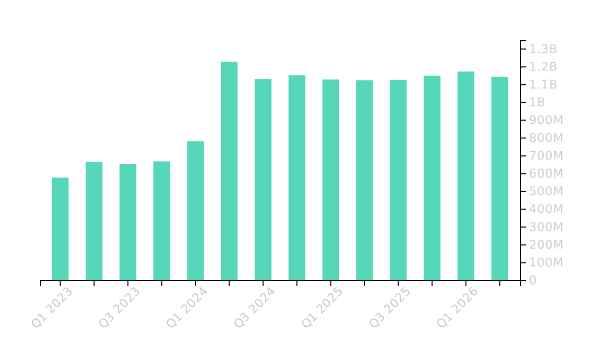
$VSAT had revenues of $1.1B in Q2 2026. This is an increase of 1.66% from the same period in the prior year.
You can track VSAT financials on Quiver Quantitative's VSAT stock page.
$VSAT Congressional Stock Trading
Members of Congress have traded $VSAT stock 1 times in the past 6 months. Of those trades, 0 have been purchases and 1 have been sales.
Here’s a breakdown of recent trading of $VSAT stock by members of Congress over the last 6 months:
- REPRESENTATIVE DEBBIE WASSERMAN SCHULTZ sold up to $15,000 on 07/18.
To track congressional stock trading, check out Quiver Quantitative's congressional trading dashboard.
$VSAT Hedge Fund Activity
We have seen 185 institutional investors add shares of $VSAT stock to their portfolio, and 152 decrease their positions in their most recent quarter.
Here are some of the largest recent moves:
- BAUPOST GROUP LLC/MA removed 9,190,728 shares (-100.0%) from their portfolio in Q3 2025, for an estimated $269,288,330
- WARBURG PINCUS LLC removed 8,390,687 shares (-100.0%) from their portfolio in Q2 2025, for an estimated $122,504,030
- BLACKROCK, INC. added 5,071,706 shares (+34.6%) to their portfolio in Q3 2025, for an estimated $148,600,985
- ONTARIO TEACHERS PENSION PLAN BOARD removed 4,795,334 shares (-100.0%) from their portfolio in Q2 2025, for an estimated $70,011,876
- CARRONADE CAPITAL MANAGEMENT, LP added 2,572,692 shares (+inf%) to their portfolio in Q3 2025, for an estimated $75,379,875
- FULLER & THALER ASSET MANAGEMENT, INC. added 2,492,626 shares (+inf%) to their portfolio in Q3 2025, for an estimated $73,033,941
- MILLENNIUM MANAGEMENT LLC removed 2,126,633 shares (-96.4%) from their portfolio in Q3 2025, for an estimated $62,310,346
To track hedge funds' stock portfolios, check out Quiver Quantitative's institutional holdings dashboard.
$VSAT Analyst Ratings
Wall Street analysts have issued reports on $VSAT in the last several months. We have seen 3 firms issue buy ratings on the stock, and 1 firms issue sell ratings.
Here are some recent analyst ratings:
- Barclays issued a "Underweight" rating on 10/01/2025
- Needham issued a "Buy" rating on 08/06/2025
- William Blair issued a "Outperform" rating on 08/04/2025
- Deutsche Bank issued a "Buy" rating on 06/17/2025
To track analyst ratings and price targets for $VSAT, check out Quiver Quantitative's $VSAT forecast page.
$VSAT Price Targets
Multiple analysts have issued price targets for $VSAT recently. We have seen 4 analysts offer price targets for $VSAT in the last 6 months, with a median target of $34.0.
Here are some recent targets:
- Philip Cusick from JP Morgan set a target price of $50.0 on 11/11/2025
- Ryan Koontz from Needham set a target price of $45.0 on 11/11/2025
- Mathieu Robilliard from Barclays set a target price of $23.0 on 10/01/2025
- Edison Yu from Deutsche Bank set a target price of $16.0 on 06/17/2025
Full Release
CARLSBAD., Calif., Dec. 03, 2025 (GLOBE NEWSWIRE) -- Viasat, Inc. (NASDAQ: VSAT), a global leader in satellite communications, today launched a new report revealing that rising demand for direct-to-device (D2D) satellite connectivity could open new revenue streams for Mobile Network Operators (MNOs) — while posing a significant competitive challenge.
The report – The Great Connectivity Convergence: NTN in Consumer Mobile – was conducted by GSMA Intelligence and surveyed more than 12,000 mobile phone users across 12 markets. The report asked customers about satellite services, which complement terrestrial mobile networks to extend network coverage and deliver reliable service in hard-to-reach areas. Together, they enable operators to offer connectivity everywhere. The results revealed that, on average, more than a third of consumers report losing access to basic mobile cellular services at least twice a month.
Perhaps as a result, more than 60% of consumers globally are prepared to pay extra for satellite-enabled services on their smartphones. Appetite varies by market, with high-growth regions like India (89%) and Indonesia (82%) more willing to pay than those in more developed economies such as the U.S. (56%) and France (48%).
Rising demand and revenue potential
This enthusiasm translates into revenue potential for telco providers. On average, globally, consumers who are willing to pay more would be happy to spend 5-7% more on their current phone bill per month. Of all countries surveyed, India presents a particularly compelling case: with an average willingness-to-pay of 9% more on current monthly spend.
According to the report, despite a lower Average Revenue Per User (ARPU) of $2.35 in India - contrasting with the U.S.'s $45.57 -remains a crucial opportunity for MNOs: when taking into account lager population sizes and higher willingness to pay, lower-ARPU markets represent substantial growth opportunities if commercial strategies are tailored effectively.
Providers that do not opt to offer satellite services could face risk of market share erosion. Nearly half (47%) of survey respondents state they would switch to a different operator if outdoor smartphone services in areas outside coverage were included in their subscription.
‘Marketing gap’ could prove a challenge for telcos
Awareness of satellite-enabled features, the report shows, seems heavily influenced by regional market conditions. In India, for example, 74% of consumers are aware of these features — almost 50 points higher than in Japan.
In less economically developed markets, consumers show disproportionately stronger enthusiasm for higher-data-rate applications like web browsing and video calls via satellite. This pattern is reversed in more developed economies, where interest is focused more on messaging and SOS services.
As a result, MNOs could face a ‘marketing gap’: striking a balance between harnessing excitement without over-promising more data-rich services which are not yet available, especially in emerging markets.
Andy Kessler, Vice President Viasat Enterprise, said: “This data highlights frustration with mobile blackspots and shows that consumers are willing to pay or even switch providers for reliable coverage. This means the industry is reaching an inflection point – MNOs need to move fast to harness the excitement over satellite services to secure loyalty and generate revenue. This is about more than providing a feature upgrade – it can be an essential tool for digital inclusion, safety, and economic growth. We’re excited to be forging partnerships within the ecosystem to help make it a reality for millions more users.”
Tim Hatt, Head of Research & Consulting, GSMA Intelligence, said: “Six in ten say they’re willing to pay extra for D2D services, and nearly half would switch provider to get them, a decisive signal of demand and a clear revenue runway for operators. With satellite services aligned to 3GPP standards and moving from trials to commercial reality, the race is on to deliver D2D at scale, first messaging and voice, then data – so operators can differentiate on reach, resilience and customer trust.”
About the report
Viasat and
GSMA Intelligence
surveyed 12,390 mobile phone users about their existing terrestrial coverage, their awareness and interest in satellite services, and their willingness to pay for these services and to switch mobile network providers to access these services.
From May to June 2025, we surveyed over 1,000 people in each market, covering Australia, Brazil, Canada, France, Germany, India, Indonesia, Italy, Japan, South Africa, the United Kingdom (UK), and the United States of America (USA).
GSMA Intelligence undertook a survey with these same parameters in 2024. Throughout the report data has been compared between both years to reach insights into how key elements have developed in the past year.
About Viasat
Viasat is a global communications company that believes everyone and everything in the world can be connected. With offices in 24 countries around the world, our mission shapes how consumers, businesses, governments and militaries around the world communicate and connect. Viasat is developing the ultimate global communications network to power high-quality, reliable, secure, affordable, fast connections to positively impact people’s lives anywhere they are - on the ground, in the air or at sea, while building a sustainable future in space. In May 2023, Viasat completed its acquisition of Inmarsat, combining the teams, technologies and resources of the two companies to create a new global communications partner. Learn more at
www.viasat.com
, the
Viasat News Room
or follow us on
LinkedIn
,
X
,
Instagram
,
Facebook
,
Bluesky
,
Threads
, and
YouTube
.
Copyright © 2025 Viasat, Inc. All rights reserved. Viasat, the Viasat logo and the Viasat Signal are registered trademarks in the U.S. and in other countries of Viasat, Inc. All other product or company names mentioned are used for identification purposes only and may be trademarks of their respective owners.
About GSMA Intelligence
GSMA Intelligence is the definitive source of global mobile operator data, analysis and forecasts, and publisher of authoritative industry reports and research. It is the most accurate and complete set of industry metrics available, comprising tens of millions of individual data points, updated daily. GSMA Intelligence is relied on by leading operators, vendors, regulators, financial institutions and third-party industry players, to support strategic decision-making and long-term investment planning. For more information, visit gsmaintelligence.com
Viasat, Inc. Contacts
Richard Jones – External Communications, Viasat Enterprise,
[email protected]
Lisa Curran/Peter Lopez, Investor Relations,
[email protected]