


U.S. property and casualty insurers reported a $63 billion underwriting gain in 2025, attributed to low catastrophe losses and pricing discipline.
Quiver AI Summary
On March 25, 2026, Verisk and the American Property Casualty Insurance Association released preliminary results for U.S. property and casualty insurance underwriting in 2025, highlighting a substantial improvement with an estimated net underwriting gain of $63 billion, up from $23 billion in 2024 and a loss of $22 billion in 2023. This gain was attributed to significantly lower catastrophe losses, particularly a nearly 90% decline in hurricane-related claims due to limited landfall, rather than a systemic change in risk exposure. While premium growth slowed and certain lines like commercial liability continued to face challenges, personal auto insurance showed core improvements. Despite overall positive results, experts noted ongoing pressures from rising costs, legal system challenges, and persistent catastrophe variability, indicating that 2025 may serve as a reset rather than a new industry norm.
Potential Positives
- The U.S. property and casualty insurance industry experienced a significant net underwriting gain of approximately $63 billion in 2025, a substantial improvement from the $23 billion gain in 2024 and a reversal from the $22 billion loss in 2023.
- Net written premiums grew by 4.8% to $971 billion, indicating robust market demand and positive growth trends within the industry.
- The combined ratio improved to 92.9%, down from 96.6% in 2024, reflecting enhanced underwriting performance and operational efficiency among insurers.
- Policyholders’ surplus increased to $1.2 trillion from $1.1 trillion in 2024, indicating a stronger financial position for insurers and greater capacity to absorb losses in the future.
Potential Negatives
- Net income after taxes declined by 12.6 percent, indicating a significant reduction in overall profitability for the company.
- Despite an improvement in underwriting results, the positive gains were primarily attributed to an unusual lack of catastrophe losses rather than sustainable improvement in risk management or underwriting practices.
- Premium growth decelerated significantly from 8.8 percent in 2024 to just 4.8 percent in 2025, reflecting potential challenges in attracting new business and maintaining competitive pricing.
FAQ
What were the 2025 underwriting results for U.S. P&C insurers?
The U.S. P&C insurers posted an estimated net underwriting gain of approximately $63 billion in 2025.
How did the combined ratio change in 2025?
The combined ratio improved to 92.9 percent in 2025, down from 96.6 percent in 2024.
What factors contributed to the 2025 underwriting gain?
The substantial underwriting gain was largely due to a near-record low combined ratio and low catastrophe losses in 2025.
How did hurricane claims affect the insurance industry in 2025?
Hurricane-related claims decreased by nearly 90 percent in 2025, significantly reducing overall catastrophe losses.
What challenges does the P&C insurance industry face moving forward?
Challenges include ongoing catastrophe variability, moderating rate momentum, and elevated legal system costs impacting underwriting discipline.
Disclaimer: This is an AI-generated summary of a press release distributed by GlobeNewswire. The model used to summarize this release may make mistakes. See the full release here.
$VRSK Insider Trading Activity
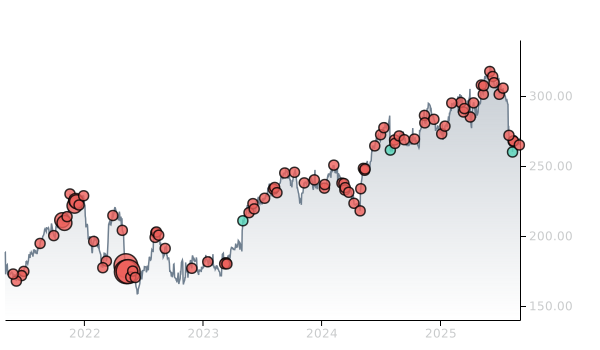
$VRSK insiders have traded $VRSK stock on the open market 11 times in the past 6 months. Of those trades, 5 have been purchases and 6 have been sales.
Here’s a breakdown of recent trading of $VRSK stock by insiders over the last 6 months:
- LEE SHAVEL (Chief Executive Officer) has made 0 purchases and 2 sales selling 2,200 shares for an estimated $480,766.
- ELIZABETH MANN (Chief Financial Officer) has made 0 purchases and 4 sales selling 1,300 shares for an estimated $285,512.
- GREGORY HENDRICK has made 2 purchases buying 1,000 shares for an estimated $198,150 and 0 sales.
- KIMBERLY S STEVENSON purchased 1,000 shares for an estimated $179,200
- JEFFREY J DAILEY purchased 500 shares for an estimated $108,515
- SABRA R. PURTILL purchased 450 shares for an estimated $98,077
To track insider transactions, check out Quiver Quantitative's insider trading dashboard.
$VRSK Revenue
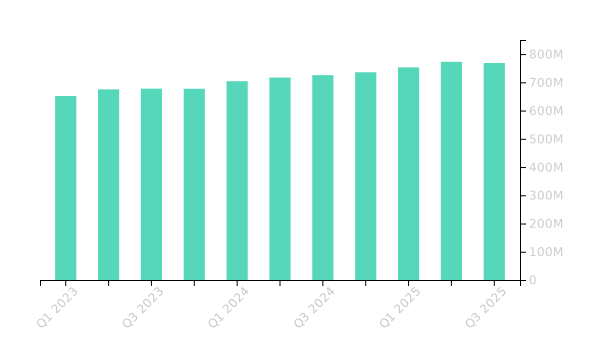
$VRSK had revenues of $778.8M in Q4 2025. This is an increase of 5.87% from the same period in the prior year.
You can track VRSK financials on Quiver Quantitative's VRSK stock page.
$VRSK Congressional Stock Trading
Members of Congress have traded $VRSK stock 6 times in the past 6 months. Of those trades, 2 have been purchases and 4 have been sales.
Here’s a breakdown of recent trading of $VRSK stock by members of Congress over the last 6 months:
- REPRESENTATIVE GILBERT RAY CISNEROS, JR. has traded it 4 times. They made 2 purchases worth up to $30,000 on 02/10, 11/18 and 2 sales worth up to $30,000 on 01/09, 12/19.
- REPRESENTATIVE RICK LARSEN sold up to $15,000 on 01/07.
- REPRESENTATIVE JULIE JOHNSON sold up to $15,000 on 11/03.
To track congressional stock trading, check out Quiver Quantitative's congressional trading dashboard.
$VRSK Hedge Fund Activity
We have seen 487 institutional investors add shares of $VRSK stock to their portfolio, and 579 decrease their positions in their most recent quarter.
Here are some of the largest recent moves:
- UBS AM, A DISTINCT BUSINESS UNIT OF UBS ASSET MANAGEMENT AMERICAS LLC removed 3,979,155 shares (-74.3%) from their portfolio in Q4 2025, for an estimated $890,097,181
- CAPITAL INTERNATIONAL INVESTORS added 3,013,400 shares (+1200.9%) to their portfolio in Q4 2025, for an estimated $674,067,446
- FMR LLC removed 1,738,173 shares (-40.1%) from their portfolio in Q4 2025, for an estimated $388,811,918
- D. E. SHAW & CO., INC. added 1,157,181 shares (+60.2%) to their portfolio in Q4 2025, for an estimated $258,849,817
- MASSACHUSETTS FINANCIAL SERVICES CO /MA/ removed 665,802 shares (-25.9%) from their portfolio in Q4 2025, for an estimated $148,933,249
- MACKENZIE FINANCIAL CORP removed 615,341 shares (-86.5%) from their portfolio in Q4 2025, for an estimated $137,645,628
- MILLENNIUM MANAGEMENT LLC removed 559,893 shares (-88.0%) from their portfolio in Q4 2025, for an estimated $125,242,465
To track hedge funds' stock portfolios, check out Quiver Quantitative's institutional holdings dashboard.
$VRSK Analyst Ratings
Wall Street analysts have issued reports on $VRSK in the last several months. We have seen 5 firms issue buy ratings on the stock, and 1 firms issue sell ratings.
Here are some recent analyst ratings:
- JP Morgan issued a "Overweight" rating on 10/30/2025
- Wells Fargo issued a "Overweight" rating on 10/30/2025
- Barclays issued a "Overweight" rating on 10/30/2025
- RBC Capital issued a "Outperform" rating on 10/30/2025
- Rothschild & Co issued a "Sell" rating on 10/16/2025
- Seaport Global issued a "Buy" rating on 10/01/2025
To track analyst ratings and price targets for $VRSK, check out Quiver Quantitative's $VRSK forecast page.
$VRSK Price Targets
Multiple analysts have issued price targets for $VRSK recently. We have seen 10 analysts offer price targets for $VRSK in the last 6 months, with a median target of $235.0.
Here are some recent targets:
- Jason Haas from Wells Fargo set a target price of $240.0 on 03/02/2026
- C. Gregory Peters from Raymond James set a target price of $260.0 on 03/02/2026
- David Motemaden from Evercore ISI Group set a target price of $216.0 on 02/19/2026
- Andrew Steinerman from JP Morgan set a target price of $220.0 on 02/19/2026
- Ashish Sabadra from RBC Capital set a target price of $230.0 on 02/19/2026
- Andre Benjamin from Goldman Sachs set a target price of $206.0 on 02/19/2026
- Toni Kaplan from Morgan Stanley set a target price of $270.0 on 12/17/2025
Full Release
JERSEY CITY, N.J., March 25, 2026 (GLOBE NEWSWIRE) -- Today, preliminary U.S. property and casualty (P&C) insurance underwriting results for full year 2025 were released by Verisk (Nasdaq: VRSK), a leading strategic data analytics and technology partner to the global insurance industry, and the American Property Casualty Insurance Association (APCIA), the primary national trade association for home, auto and business insurers.
According to key financial indicators for private U.S. P&C insurers, the industry posted an estimated net underwriting gain of approximately $63 billion. This represents a significant improvement over the $23 billion underwriting gain in 2024, and the $22 billion underwriting loss recorded in 2023.
“The industry delivered one of its strongest underwriting results in years in 2025, supported by a near-record low combined ratio, but that outcome was driven more by unusually low catastrophe losses rather than a fundamental shift in industry risk,” said Saurabh Khemka, president of Verisk Underwriting Solutions. “A near 90 percent decline in hurricane-related claims in 2025 materially reduced catastrophe losses, an improvement that reflects limited U.S. landfall rather than a change in underlying exposure.”
Khemka added: “Still, some lines, including personal auto, showed core improvements following strong rate action and tighter underwriting discipline, while workers’ compensation continued to deliver consistently favorable results. At the same time, overall premium growth decelerated and commercial liability continued to weigh on overall performance. Taken together, these dynamics make 2025 a reset after several years of volatility, not a new normal. Ongoing catastrophe variability, moderating rate momentum and elevated legal system costs mean underwriting discipline remains critical heading into 2026 and beyond. That reality is already playing out this year, as recent tornado and hail events serve as an early reminder of the volatility that continues to define catastrophe risk.”
2025 Full-Year Underwriting Results
- W ritten premiums : Net written premiums grew 4.8 percent to $971 billion, compared to $927 billion in 2024.
- Earned premiums: Net earned premiums rose 6.3 percent to $953 billion, compared to $896 billion in 2024.
- Underwriting gain: The U.S. insurance industry posted an estimated net underwriting gain of $63 billion, an improvement over the $23 billion gain in 2024.
- Incurred losses and loss adjustment expenses : Incurred losses and loss adjustment expenses decreased 0.4 percent, compared to a 2.3 percent rise in 2024.
- Combined r atio : The combined ratio improved to 92.9 percent, down from 96.6 percent in 2024.
- Surplus: Policyholders’ surplus increased to $1.2 trillion from $1.1 trillion in 2024.
- Realized c apital g ains: Realized capital gains continued to decline to $23 billion, compared to $79 billion in 2024. Adjusting for the capital gains realized by one insurer in recent years, overall investment gains were in line with historical averages, although up from 2022 and 2023.
- Net income : Net income after taxes declined to $148 billion from $169 billion in 2024, a $21 billion decline.
“Industry results continued to stabilize in 2025. Incurred losses were largely flat, reflecting the unusual lack of hurricanes making landfall in the United States,” said Robert Gordon, senior vice president, policy, research and international at APCIA. “Consumers benefited from the slow-down in insurance cost-drivers, as net written premium growth slowed from 8.8 percent in 2024 to 4.8 percent. Personal and commercial insurance spending declined in 2025 relative to total consumer spending and gross industrial output, respectively. Insurers’ net income declined by 12.6 percent, partly reflecting reduced realized capital gains. Market performance varied significantly by state and line of business. For example, homeowners and auto insurance losses and rates in Florida in 2025 declined significantly following legal system abuse reform, while loss ratios nationwide for contractor’s liability remained elevated. Legal system abuse continues to challenge commercial liability lines, with significant adverse reserve additions for recent years continuing in commercial auto liability and other liability. While industry premium growth significantly slowed in 2025, particularly in personal lines, losses will continue to face long-term pressures from continuing inflation, demographic shifts, natural disaster severity and legal system abuse.”
Continued pressure s on the horizon
Escalating material and labor costs continue to drive higher repair and replacement expenses, particularly for roofs, while underinsurance and rising claim severity complicate loss outcomes, coverage gaps and add pressure to loss costs. At the same time, frequent and intense hail and severe convective storms are expanding exposure beyond traditional geographies. As a result, recent profitability should be viewed against a backdrop of persistent and evolving risk as the industry moves through 2026 and beyond.
Note: The results above are based on annual statements filed with insurance regulators by private property/casualty insurers domiciled in the United States, including reinsurers, excess and surplus insurers, and domestic insurers owned by foreign parents, and excluding state funds for workers' compensation and other residual market insurers, the National Flood Insurance Program, and foreign insurers. The figures are consolidated estimates based on reports accounting for about 97.8 percent of all business written by U.S. property/casualty insurers. All figures are net of reinsurance unless otherwise noted and occasionally may not balance due to rounding. Net i nvestment result s displayed are post-tax .
###
About Verisk
Verisk (Nasdaq: VRSK) is a leading strategic data analytics and technology partner to the global insurance industry. It empowers clients to strengthen operating efficiency, improve underwriting and claims outcomes, combat fraud and make informed decisions about global risks, including climate change, catastrophic events, sustainability and political issues. Through advanced data analytics, software, scientific research and deep industry knowledge, Verisk helps build global resilience for individuals, communities and businesses. With teams across more than 20 countries, Verisk consistently earns certification by
Great Place to Work
. For more,
visit Verisk.com
and the
Verisk Newsroom
.
About APCIA
The American Property Casualty Insurance Association (APCIA) is the primary national trade association for home, auto, and business insurers. APCIA promotes and protects the viability of private competition for the benefit of consumers and insurers, with a legacy dating back 150 years. APCIA members represent all sizes, structures, and regions protecting families, communities, and businesses in the U.S. and across the globe.