


Younger Canadians increasingly rely on credit amid rising inflation, with many adjusting spending habits and facing financial concerns.
Quiver AI Summary
Younger Canadians, particularly Gen Z and Millennials, are increasingly planning to take on more credit due to financial strains from rising costs of living. According to the TransUnion Q4 2025 Canada Consumer Pulse Study, 47% of Gen Z and 31% of Millennials express intentions to apply for new credit, as over 84% of Canadians identify inflation as a primary financial concern. More than half feel their incomes aren't keeping pace with inflation, and many have modified their shopping habits, focusing on discounts and more affordable retailers. While 82% believe access to credit is essential for financial goals, only 56% feel they have enough access, highlighting a gap in credit availability. Additionally, many Canadians are dealing with increasing bills, with 25% unable to pay at least one current financial obligation, further underscored by concerns about potential recession.
Potential Positives
- TransUnion positioned as the credit bureau of choice in Canada, indicating strong brand recognition and trust within the financial services sector.
- Over half of Canadians (82%) recognize that access to credit is vital for achieving financial goals, highlighting the importance of TransUnion’s role in facilitating credit services.
- TransUnion's focus on educating Canadians about credit access and fraud prevention showcases its commitment to consumer protection and financial literacy.
Potential Negatives
- High levels of financial distress: 25% of Canadians reported being unable to pay at least one bill in full, indicating significant financial strain on consumers
- Consumer pessimism: Nearly one-third (31%) of Canadians are pessimistic about their household finances in the next year, suggesting a lack of confidence in economic recovery
- Fraud vulnerabilities: A significant number of Canadians (46%) reported being targeted by fraud, with younger demographics being particularly affected, posing risks to the company’s reputation as a credit provider in securing consumer trust
FAQ
What percentage of Canadians plan to take on more credit?
Approximately 21% of Canadians plan to apply for new credit or refinance existing credit within the next year.
How many Canadians are concerned about inflation impacting their finances?
84% of surveyed Canadians report that inflation for everyday goods is among their top three financial concerns.
What financial changes have Canadians made in response to inflation?
67% have sought out sales and discounts more frequently, and 51% have cut back on discretionary spending.
How many Canadians believe they can access the credit they need?
Only 56% of Canadians feel they have sufficient access to credit and lending products to achieve financial goals.
What financial concerns are younger Canadians facing?
47% of Gen Z and 31% of Millennials plan to take on more credit as they struggle to pay their bills.
Disclaimer: This is an AI-generated summary of a press release distributed by GlobeNewswire. The model used to summarize this release may make mistakes. See the full release here.
$TRU Insider Trading Activity
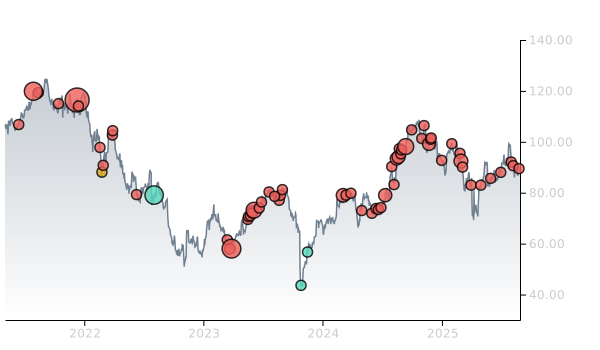
$TRU insiders have traded $TRU stock on the open market 13 times in the past 6 months. Of those trades, 0 have been purchases and 13 have been sales.
Here’s a breakdown of recent trading of $TRU stock by insiders over the last 6 months:
- STEVEN M CHAOUKI (President, US Markets) has made 0 purchases and 6 sales selling 6,000 shares for an estimated $510,740.
- HEATHER J RUSSELL (EVP, Chief Legal Officer) sold 5,337 shares for an estimated $480,383
- TIFFANI CHAMBERS (EVP, Chief Operations Officer) sold 4,318 shares for an estimated $371,348
- JENNIFER A. WILLIAMS (SVP, Chief Accounting Officer) has made 0 purchases and 3 sales selling 1,972 shares for an estimated $178,935.
- TODD C. SKINNER (President, International) has made 0 purchases and 2 sales selling 1,000 shares for an estimated $83,390.
To track insider transactions, check out Quiver Quantitative's insider trading dashboard.
$TRU Revenue
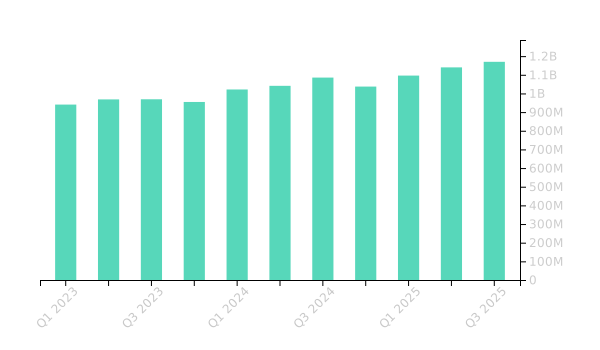
$TRU had revenues of $1.2B in Q3 2025. This is an increase of 7.79% from the same period in the prior year.
You can track TRU financials on Quiver Quantitative's TRU stock page.
$TRU Hedge Fund Activity
We have seen 304 institutional investors add shares of $TRU stock to their portfolio, and 251 decrease their positions in their most recent quarter.
Here are some of the largest recent moves:
- BLACKROCK, INC. added 8,447,859 shares (+79.3%) to their portfolio in Q3 2025, for an estimated $707,761,627
- MASSACHUSETTS FINANCIAL SERVICES CO /MA/ removed 4,445,484 shares (-19.6%) from their portfolio in Q3 2025, for an estimated $372,442,649
- STATE STREET CORP added 2,600,425 shares (+62.2%) to their portfolio in Q3 2025, for an estimated $217,863,606
- INVESCO LTD. added 2,059,177 shares (+355.9%) to their portfolio in Q3 2025, for an estimated $172,517,849
- T. ROWE PRICE INVESTMENT MANAGEMENT, INC. added 1,803,849 shares (+34.3%) to their portfolio in Q3 2025, for an estimated $151,126,469
- CITADEL ADVISORS LLC removed 1,655,703 shares (-71.3%) from their portfolio in Q3 2025, for an estimated $138,714,797
- EGERTON CAPITAL (UK) LLP added 1,465,050 shares (+inf%) to their portfolio in Q3 2025, for an estimated $122,741,889
To track hedge funds' stock portfolios, check out Quiver Quantitative's institutional holdings dashboard.
$TRU Analyst Ratings
Wall Street analysts have issued reports on $TRU in the last several months. We have seen 4 firms issue buy ratings on the stock, and 0 firms issue sell ratings.
Here are some recent analyst ratings:
- BMO Capital issued a "Outperform" rating on 10/24/2025
- Needham issued a "Buy" rating on 10/24/2025
- JP Morgan issued a "Overweight" rating on 10/24/2025
- Wells Fargo issued a "Overweight" rating on 07/25/2025
To track analyst ratings and price targets for $TRU, check out Quiver Quantitative's $TRU forecast page.
$TRU Price Targets
Multiple analysts have issued price targets for $TRU recently. We have seen 8 analysts offer price targets for $TRU in the last 6 months, with a median target of $106.0.
Here are some recent targets:
- Toni Kaplan from Morgan Stanley set a target price of $120.0 on 12/17/2025
- Toni Kaplan from Goldman Sachs set a target price of $86.0 on 10/24/2025
- Kyle Peterson from Needham set a target price of $115.0 on 10/24/2025
- Andrew Steinerman from JP Morgan set a target price of $107.0 on 10/24/2025
- Ryan Griffin from BMO Capital set a target price of $105.0 on 10/24/2025
- Rayna Kumar from Oppenheimer set a target price of $93.0 on 10/13/2025
- Jason Haas from Wells Fargo set a target price of $118.0 on 07/25/2025
Full Release
-
Younger Canadians plan to take on more credit (47% of Gen Zs and 31% of Millennials) as they struggle more than other generations to pay their bills.
-
84% of surveyed Canadians said inflation for everyday goods is in their top three financial concerns; among all surveyed, 53% feel their household income is not keeping pace with inflation.
-
85% said they changed shopping habits in the past three months in response to the current economic environment; among all surveyed, 67% sought out sales and discounts more frequently during that timeframe.
-
18% do not believe they would be approved for a new credit or lending product.
TORONTO, Jan. 13, 2026 (GLOBE NEWSWIRE) -- Canadians’ optimism about their finances waned as the cost of living continues to rise. Over half (53%) said their household income isn’t keeping pace with inflation, according to TransUnion’s (NYSE: TRU) Q4 2025 Canada Consumer Pulse Study . Nearly one-third (31%) are pessimistic about their household finances in the next 12 months, a three percentage point drop from Q3 2025. At the same time, 25% of Canadians reported they’re unable to pay at least one of their current bills or loans in full. This strain persists despite 20% saying their income rose in the past three months, while 64% reported no change and 16% experienced a decline.
Among those who reported being unable to pay at least one of their currents bills and loans in full, nearly two thirds (63%) said that it was their credit card payments or personal loans that they would not be able to pay in full, followed by student loans (55%) and then mortgages (45%). These findings underscore the growing strain on affordability and the difficult financial choices many Canadians face.
“Affordability continues to be a concern for many Canadians as economic uncertainty impacts financial decision making,” said Matt Fabian, director of financial services research and consulting at TransUnion Canada. “While many are taking proactive steps to be financially resilient, there are significant sections of the population who continue to struggle with staying on top of debt payments while navigating rising costs.”
Canadians Brace for A Recession
More than one in four (27%) Canadians believe the country is currently in a recession, while another 32% expect one within the next 12 months. A vast majority who said we’re either currently in a recession or will be in one in the next 12 months (84%) reported preparing for a possible recession. The most common stated actions include:
- Reducing spending (61%)
- Building up savings (38%)
- Paying down debt (28%)
- Ensuring credit report is accurate (9%)
- Changing jobs (8%)
- Requesting credit limit increases (7%)
-
Taking on new credit (5%)
Canadians Adjust Spending Habits to Help Weather Economic Instability
Economic uncertainty could be leading many Canadians to adjust their spending habits to stay on budget. Of those surveyed, over two thirds (67%) said they looked for sales and discounts more frequently in the past three months due to the current economic environment. Other adjustments made include:
- Shopping more frequently at more affordable retailers (44%)
- Buying more generic or store brands (41%)
- Using more coupons (31%)
- Taking advantage of credit card offers for special discounts more often (18%)
Canadians Report Cutting Discretionary Spending and Plan to Put Less Towards Retirement Funds
Only 15% of those surveyed said they have not changed their shopping habits in the past three months due to the current economic environment. Among all surveyed, more than half (51%) said they cut back on discretionary spending like dining out, travel and entertainment in the last three months, while nearly one in five (19%) expect to decrease their contributions to retirement funds or investments in the next three months, indicating a shift toward prioritizing essential goods. This comes as over half (53%) of surveyed Canadians reported concerns with not setting aside enough money for retirement in the next three to five years.
Canadians See Credit as Key to Financial Goals – But Access Falls Short for Many
With cost-of-living top of mind, a vast majority of surveyed Canadians (82%) said that access to credit and lending products is important to achieving their financial goals. However, only 56% believe they have sufficient access, underscoring the need to close the gap faced by the underserved credit population.
One in Five Canadians Plan to Take on More Credit
Just over 1 in 5 Canadians (21%) plan to apply for new credit or refinance existing credit within the next year, with younger consumers leading the way. Nearly half of Gen Z (47%) and 31% of Millennials reported intentions to obtain new or refinance credit.
Additional TransUnion data outside of this survey shows Millennials now account for 38% of Canada’s total outstanding debt – approximately $988 billion. Overall, among those planning to apply for new credit or refinance existing credit in the next year, nearly half (47%) plan to apply for a new credit card and 23% say they’ll increase limits on existing credit cards. Other anticipated actions include applying for a buy now, pay later loan, applying for a new car loan or lease, or refinancing a mortgage or (all 20%).
“We’re seeing a continued trend of Canadians turning to credit cards to aid in their cashflow,” said Fabian. “As inflation places additional strain on Canadians’ wallets, many consumers may be looking for increased liquidity to help balance their budgets and may see credit as a useful tool to help them do so.”
Nearly One in Five Canadians Don’t Think They Would Get Approved for New Credit
Nearly one in five (18%) of Canadians surveyed do not believe they would be approved for a new credit or lending product if they needed one, despite most viewing credit access as essential for achieving financial goals.
Moreover, just over 20% of Canadians who intended to apply for new or refinance existing credit ultimately chose not to. Of this group, nearly a quarter (24%) cited concerns about rejection due to their credit history, while 26% stated they believed it would be rejected due to their income or employment status.
Young Consumers Report Being Targeted by Fraud the Most as Tactics Evolve
Newer technologies like AI have enabled fraudsters to deploy new scams and impersonation tactics. Nearly half (46%) of Canadians surveyed reported being targeted by email, online, phone call or text message fraud in the past three months.
Of those that report being targeted, 7% said they fell victim to the fraud attempt, up one percentage point year-over-year. Younger Canadians appear to be the most vulnerable, with 54% of Gen Z indicating they had been targeted—the highest among surveyed generations. As a digital-first generation, Gen Z is likely more exposed to online fraud than other generations.
Among all surveyed, the most common tactics reported by those who said they were targeted in the last three months were:
- Phishing (fraudulent emails, websites, social posts, QR codes, etc. meant to steal data) – 43%
- Smishing (fraudulent text messages meant to trick a person into revealing personal data) – 41%
-
Vishing (fraudulent phone calls meant to trick a person into revealing personal data) – 41%
Despite these risks, over a third of Canadians (36%) said they took no action to address cybersecurity concerns in the past 60 days. Of those, nearly half (48%) said they did nothing because they didn’t know what steps to take, underscoring the need for continued education to help protect Canadians against fraud.
About TransUnion (NYSE: TRU)
TransUnion is a global information and insights company with over 13,000 associates operating in more than 30 countries, including Canada, where we’re the credit bureau of choice for the financial services ecosystem and most of Canada’s largest banks. We make trust possible by ensuring each person is reliably represented in the marketplace. We do this by providing an actionable view of consumers, stewarded with care.
Through our acquisitions and technology investments we have developed innovative solutions that extend beyond our strong foundation in core credit into areas such as marketing, fraud, risk and advanced analytics. As a result, consumers and businesses can transact with confidence and achieve great things. We call this Information for Good® — and it leads to economic opportunity, great experiences and personal empowerment for millions of people around the world.
For more information visit, transunion.ca .
For more information or to request an interview, contact:
Contact:
Katie Duffy
E-mail:
[email protected]
Telephone:
+1 647-772-0969