


TransUnion's research reveals a K-shaped divergence in U.S. consumer credit, with super prime borrowers thriving while non-prime struggle.
Quiver AI Summary
TransUnion's latest research highlights a K-shaped divergence in the U.S. consumer credit market, revealing that while overall credit conditions remain stable, a growing divide exists between consumers in super prime and non-prime tiers. From late 2019 to late 2025, the super prime segment saw a significant increase of 15 million consumers, indicating improving financial health among higher credit-quality borrowers. Conversely, non-prime consumers continue to struggle, with rising debt loads and increasing financial pressure. Average debt-to-income ratios are significantly higher among non-prime tiers, pointing to greater strain on their finances. Although lenders have not retreated from extending credit to non-prime consumers, they are managing risk carefully, leading to a nuanced lending landscape where demand remains high, but financial vulnerabilities persist among lower-tier borrowers.
Potential Positives
- TransUnion's research highlights a significant increase in the super prime credit tier, with 15 million consumers moving into the lowest-risk category since Q4 2019, indicating overall improvement in consumer credit quality.
- The Q1 2026 Credit Industry Insights Report shows that bankcard originations reached a new high, up 13.0% year-over-year, reflecting both lender confidence and strong consumer demand for credit products.
- Personal loan originations also hit a record 7.6 million in Q4 2025, representing a 21.7% increase year-over-year, underscoring ongoing growth in consumer lending driven by diverse borrower profiles.
- TransUnion's ability to adapt to market changes by ensuring credit access for non-prime consumers while managing risk highlights its robust approach to maintaining financial services amidst economic pressures.
Potential Negatives
- Despite an overall increase in the super prime credit population, the press release highlights a troubling financial strain on non-prime consumers, many of whom are experiencing increased debt burdens and rising debt-to-income ratios.
- The increase in delinquencies, such as the borrow level delinquency rate rising to 2.53%, indicates a potential deterioration in consumer financial health, which could reflect poorly on the company's risk assessment and forecasting capabilities.
- The divergence between super prime and non-prime segments may suggest a concerning trend for future credit access and stability, especially if economic pressures continue to impact lower-tier consumers disproportionately.
FAQ
What does the latest TransUnion research reveal about U.S. consumer credit trends?
TransUnion's research highlights a K-shaped divergence in the U.S. credit market with super prime consumers thriving while non-prime consumers face increasing financial stress.
How have credit scores changed from 2019 to 2025?
Between Q4 2019 and Q4 2025, the super prime credit score population grew by 15 million, while middle-risk and non-prime tiers declined.
What are the implications of rising debt for non-prime consumers?
Non-prime consumers are facing greater financial strains due to rising debt burdens and increasing debt-to-income ratios, impacting their financial health.
How are lenders responding to non-prime credit access?
Lenders have continued to extend credit to non-prime consumers while carefully managing risk through controlled credit lines and adjusted lending strategies.
What are the current trends in mortgage and auto loan originations?
Mortgage originations rebounded due to refinancing, while auto loan originations declined, reflecting affordability challenges amid rising monthly payments.
Disclaimer: This is an AI-generated summary of a press release distributed by GlobeNewswire. The model used to summarize this release may make mistakes. See the full release here.
$TRU Insider Trading Activity
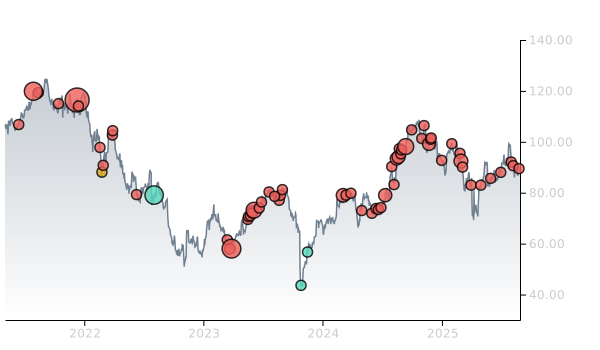
$TRU insiders have traded $TRU stock on the open market 13 times in the past 6 months. Of those trades, 0 have been purchases and 13 have been sales.
Here’s a breakdown of recent trading of $TRU stock by insiders over the last 6 months:
- STEVEN M CHAOUKI (President, US Markets) has made 0 purchases and 5 sales selling 13,000 shares for an estimated $983,420.
- HEATHER J RUSSELL (EVP, Chief Legal Officer) has made 0 purchases and 2 sales selling 6,050 shares for an estimated $473,303.
- TIFFANI CHAMBERS (EVP, Chief Operations Officer) sold 4,318 shares for an estimated $371,348
- TODD C. SKINNER (President, International) has made 0 purchases and 4 sales selling 2,000 shares for an estimated $157,385.
- JENNIFER A. WILLIAMS (SVP, Chief Accounting Officer) sold 1,679 shares for an estimated $134,320
To track insider transactions, check out Quiver Quantitative's insider trading dashboard. You can access data on insider stock transactions through the Quiver Quantitative API.
$TRU Revenue
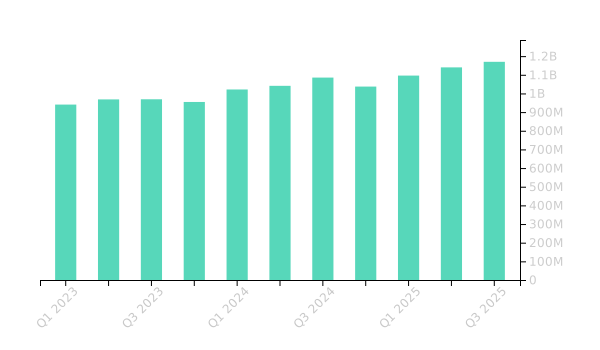
$TRU had revenues of $1.2B in Q1 2026. This is an increase of 13.69% from the same period in the prior year.
You can track TRU financials on Quiver Quantitative's TRU stock page.
$TRU Hedge Fund Activity
We have seen 275 institutional investors add shares of $TRU stock to their portfolio, and 311 decrease their positions in their most recent quarter.
Here are some of the largest recent moves:
- DODGE & COX added 9,842,006 shares (+inf%) to their portfolio in Q4 2025, for an estimated $843,952,014
- INDEPENDENT FRANCHISE PARTNERS LLP added 4,561,619 shares (+99.7%) to their portfolio in Q4 2025, for an estimated $391,158,829
- FARALLON CAPITAL MANAGEMENT LLC removed 4,057,075 shares (-85.7%) from their portfolio in Q4 2025, for an estimated $347,894,181
- UBS AM, A DISTINCT BUSINESS UNIT OF UBS ASSET MANAGEMENT AMERICAS LLC removed 3,759,939 shares (-76.3%) from their portfolio in Q4 2025, for an estimated $322,414,769
- APG ASSET MANAGEMENT N.V. removed 3,389,850 shares (-96.7%) from their portfolio in Q4 2025, for an estimated $290,679,637
- VICTORY CAPITAL MANAGEMENT INC removed 3,188,762 shares (-97.6%) from their portfolio in Q4 2025, for an estimated $273,436,341
- FMR LLC added 2,792,325 shares (+166.4%) to their portfolio in Q4 2025, for an estimated $239,441,868
To track hedge funds' stock portfolios, check out Quiver Quantitative's institutional holdings dashboard. You can access data on hedge funds moves and 13F filings through the Quiver Quantitative API.
$TRU Analyst Ratings
Wall Street analysts have issued reports on $TRU in the last several months. We have seen 1 firms issue buy ratings on the stock, and 0 firms issue sell ratings.
Here are some recent analyst ratings:
- Needham issued a "Buy" rating on 02/13/2026
To track analyst ratings and price targets for $TRU, check out Quiver Quantitative's $TRU forecast page.
$TRU Price Targets
Multiple analysts have issued price targets for $TRU recently. We have seen 9 analysts offer price targets for $TRU in the last 6 months, with a median target of $88.0.
Here are some recent targets:
- Kyle Peterson from Needham set a target price of $95.0 on 04/29/2026
- Andrew Steinerman from JP Morgan set a target price of $90.0 on 04/29/2026
- Sean Kennedy from Mizuho set a target price of $80.0 on 04/16/2026
- Kevin Mcveigh from UBS set a target price of $69.0 on 04/13/2026
- Toni Kaplan from Morgan Stanley set a target price of $100.0 on 03/11/2026
- Toni Kaplan from Goldman Sachs set a target price of $80.0 on 02/17/2026
- Jason Haas from Wells Fargo set a target price of $90.0 on 02/13/2026
Full Release
CHICAGO, April 30, 2026 (GLOBE NEWSWIRE) -- New TransUnion (NYSE: TRU) research confirms that the U.S. consumer credit market is increasingly splitting along a K‑shaped path, with the riskiest and least risky credit tiers experiencing the most pronounced shifts in credit use. While credit conditions have remained stable overall, and improved for a large segment of consumers, others are struggling in the face of rising expenses and increasing debt. TransUnion released the research in conjunction with its Q1 2026 Credit Industry Insights Report (CIIR) .
As the divergence between super prime and non-prime consumers becomes more pronounced, it is unfolding differently across the credit spectrum. At the top, the super prime segment continues to expand, with the population growing by 15 million consumers between Q4 2019 and Q4 2025 as more individuals migrate into the lowest-risk credit tier. This upward shift reflects strengthening credit profiles and improving financial health among higher credit-quality borrowers.
|
Six Years Later: The Percentage of Consumers in the Super Prime Credit Risk Tier has Grown Since 2019 While Subprime has Seen Recent Gains
|
|||||
| Risk Tier / Period | Q4 2019 | Q4 2022 | Q4 2025 |
Change
Q4 2019 – Q4 2025 |
Change
Q4 2022 – Q4 2025 |
| Super Prime | 36.9% | 38.2% | 40.7% | +380 basis points (bps) | +250 bps |
| Prime Plus | 17.4% | 18.3% | 16.8% | -60 bps | -150 bps |
| Prime | 17.2% | 17.4% | 15.6% | -160 bps | -180 bps |
| Near Prime | 13.5% | 12.3% | 12.1% | -140 bps | -20 bps |
| Subprime | 15.1% | 13.8% | 14.8% | -30 bps | +100 bps |
| Source: TransUnion US consumer credit database | |||||
Meanwhile, middle-risk tiers such as prime plus, prime and near-prime have all experienced notable declines since 2019. In contrast, the share of subprime borrowers has remained relatively stable, while many of these consumers face mounting pressure on household balance sheets. Many non-prime consumers – those in the subprime and near-prime risk tiers – are carrying higher debt loads, with rising debt-to-income ratios that point to potential financial strain. Together, these trends underscore a bifurcating credit landscape, one in which financial resilience continues to strengthen at the top, while vulnerability is increasing among consumers already facing greater economic challenges.
“The credit market has diverged over the past several years, and that divide is becoming increasingly evident in consumer risk profiles,” said Jason Laky, executive vice president and head of financial services at TransUnion. “As super prime consumers gain ground, with more consumers moving into that highest-scoring tier, many below‑prime borrowers are taking on higher debt loads, increasing their reliance on credit and showing early signs of performance stress at a time when affordability pressures remain elevated.”
Rising Debt Burdens Intensify Financial Strain for Non-Prime Consumers
Affordability challenges shape outcomes across the credit spectrum, but they weigh most heavily on non-prime consumers. Since Q4 2019, debt loads have risen across all risk tiers, driven by increased borrowing in part fueled by higher everyday expenses. These growing balances and the resulting debt service obligations constrain household cash flow and reduce financial flexibility. Super prime consumers recorded the largest percentage increase in total debt, with average balances rising 25%, while subprime consumers followed closely at 23% despite having far less financial liquidity. Yet, their much smaller increase in debt-to-income (DTI) indicates that super prime is far better positioned to manage these higher levels of debt.
The DTI ratio is a personal finance measure that compares an individual’s total monthly debt payments to their gross monthly income, expressed as a percentage. It offers a critical snapshot of financial health and debt management capacity. Because fewer non-prime consumers are homeowners than super prime consumers, excluding mortgage debt and focusing on non-mortgage DTI yields a more effective comparison across risk tiers.
Non-mortgage DTI increased across all credit segments, but non-prime consumers experienced the steepest rise. Between Q4 2019 and Q4 2025, non-mortgage DTI – which includes other debt types such as credit cards, auto loans, personal loans and student loans – grew by an average of 29 basis points (bps) among super prime consumers. By comparison, near-prime consumers saw a 176 bps increase, while subprime consumers experienced a 143 bps rise. Given that non-prime consumers already carried significantly higher DTI levels, these increases are exacerbating existing financial pressures.
“These trends point to two very different credit environments,” said Michele Raneri, vice president and head of U.S. research and consulting at TransUnion. “Super prime consumers generally remain well positioned to manage affordability challenges, while those in non‑prime risk tiers face growing stress as required payments consume an increasing share of their income.”
|
Non-mortgage DTI is Higher For Those in Non-Prime Tiers, and Growing More Quickly
|
|||
| Risk Tier / Period | Q4 2019 | Q4 2025 | Change |
| Super Prime | 5.1% | 5.4% | +29 bps |
| Near Prime | 14.7% | 16.5% | +176 bps |
| Subprime | 12.8% | 14.3% | +143 bps |
| Source: TransUnion US consumer credit database | |||
How Lenders Are Preserving Non‑Prime Credit Access While Managing Risk
Despite these challenges, non‑prime consumers continue to have access to new credit accounts. Bankcard lending illustrates this trend clearly: from Q3 2019 to Q3 2025, the share of subprime originations increased by 220 bps, signaling that lenders have continued to serve this segment rather than retreat from it. The largest gains occurred among deep subprime consumers, those with credit scores below 549, whose share of originations rose by 320 bps over the same period. These shifts point to sustained demand and measured lender participation despite a more challenging credit environment.
At the same time, lenders have taken a deliberate approach to risk management by adjusting the structure of credit extended across risk tiers. Credit lines have emerged as a key lever in this effort. While super prime consumers benefited from an 11.5% increase in new bankcard credit lines, reaching $12,511 by Q3 2025, growth among subprime segments remained more modest. Deep subprime new card credit lines rose 5.5% to $678, while high subprime consumers saw a 7.1% increase to $1,034. These differences illustrate how lenders continue to extend access to credit while carefully calibrating risk exposure.
“In an environment where non‑prime consumers continue to need access to credit, it is critical for lenders to use every tool and data asset available to them to manage risk responsibly,” continued Raneri. “Leveraging comprehensive insights, such as those provided by TransUnion credit solutions, helps ensure the right lending option is extended to the right consumer while protecting portfolio performance.”
Evidence of these dynamics is reflected throughout TransUnion’s Q1 2026 Credit Industry Insights Report. Across major lending categories, recent activity highlights a market moving in two directions at once: sustained momentum among higher credit‑quality borrowers alongside increasing strain for more vulnerable segments. At the same time, lenders continue to respond with measured adjustments, balancing credit availability with disciplined exposure management amid persistent macroeconomic pressures.
To learn more about the latest consumer credit trends, register for the Q1 2026 Quarterly Credit Industry Insights Report webinar . Read on for more specific insights about credit cards, personal loans, auto loans and mortgages.
Bankcard originations reach a new high as delinquencies tick up
Q1 2026 CIIR Credit Card Summary
-
Bankcard originations rose 13.0% year-over-year (YoY) to 21.9 million in Q4 2025,
marking a fifth straight quarterly increase, driven largely by subprime and super prime growth. This represents the strongest annual gain since Q2 2022 and represents a record quarterly origination level. Super prime alone accounted for a record 5.5 million cards issued.
-
Total balances grew 4.6% YoY in Q1 2026 to $1.12 trillion.
At the consumer level, balance growth was restrained, with average consumer balances up only 2.3% YoY.
-
90+ Days Past Due (DPD) borrower delinquencies rose 10 bps YoY to 2.53% in Q1 2026,
roughly in line with levels two years ago. While borrower-level delinquency increased slightly, the percentage of delinquent balances fell YoY, likely due to growth in below‑prime originations, which typically have lower credit lines.
Instant Analysis
“Origination volumes reached their highest levels at the end of last year driven by subprime and super prime tiers, reflecting lender confidence and consumer demand for new bankcards. Bankcard balance growth has remained remarkably consistent over the last year, thanks to robust new account openings and smaller credit limits on new accounts, which have kept the delinquency rate relatively flat over the past three years."
- Paul Siegfried, senior vice president, credit card business leader at TransUnion
|
Q1 2026 Credit Card Trends
|
||||
| Credit Card Lending Metric (Bankcard) | Q1 2026 | Q1 2025 | Q1 2024 | Q1 2023 |
| Number of Credit Cards (Bankcards) | 583.2 million | 563.0 million | 543.1 million | 523.2 million |
| Borrower-Level Delinquency Rate (90+ DPD) | 2.53 % | 2.43% | 2.55% | 2.26% |
| Total Credit Card Balances | $1.12 Trillion | $1.07 Trillion | $1.02 Trillion | $916.8 billion |
| Average Debt Per Borrower | $ 6,519 | $6,371 | $6,218 | $5,733 |
| Number of Consumers Carrying a Balance | 175.4 million | 172.0 million | 169.0 million | 165.3 million |
| Prior Quarter Originations* | 21.9 million | 19.4 million | 19.3 million | 20.6 million |
| Average New Account Credit Lines* | $ 5,559 | $5,612 | $5,628 | $5,421 |
Source: TransUnion U.S. Consumer Credit Database
*Note: Originations are viewed one quarter in arrears to account for reporting lag.
Click here
for a credit card industry infographic. For more credit card industry information,
click here
for episodes of
Extra Credit: A Card and Banking Podcast by TransUnion
.
Unsecured personal loan originations hit a new high as super prime and subprime lead
Q1 2026 CIIR Unsecured Personal Loan Summary
-
In Q4 2025, personal loan originations hit a record 7.6 million, up 21.7% YoY
, driven disproportionately by subprime borrowers managing cash‑flow stress and super prime borrowers consolidating balances or financing larger purchases.
-
Outstanding personal loan balances hit a record $277 billion in Q1 2026
, as lenders gave larger loans to prime and above consumers, and as subprime participation surged, albeit with lower loan amounts to control for risk.
-
60+ DPD balance delinquency decreased 2 bps to 2.04% versus the prior year
. This reflects tighter risk controls and more super prime lending, and contrasts with consumer delinquency rising to 3.98%.
Instant Analysis
“Unsecured personal lending continues to grow, but the expansion has become more targeted. Lenders are reaching more consumers, especially at both ends of the credit spectrum, while managing risk through smaller balances and tighter controls, particularly in subprime. That discipline is evident in performance. While consumer delinquency has risen, corresponding balance‑weighted risk decreased, even as households face sustained affordability pressures.”
- Josh Turnbull, senior vice president, consumer lending business leader at TransUnion
|
Q1 2026 Unsecured Personal Loan Trends
|
||||
| Personal Loan Metric | Q1 2026 | Q1 2025 | Q1 2024 | Q1 2023 |
| Total Balances | $277 billion | $253 billion | $245 billion | $225 billion |
| Number of Unsecured Personal Loans | 32.6 million | 29.8 million | 28.1 million | 26.9 million |
| Number of Consumers with Unsecured Personal Loans | 26.4 million | 24.6 million | 23.5 million | 22.4 million |
| Borrower-Level Delinquency Rate (60+ DPD) | 3.98 % | 3.49% | 3.75% | 3.91% |
| Average Debt Per Borrower | $ 11,768 | $11,631 | $11,829 | $11,281 |
| Average Account Balance | $ 8,493 | $8,496 | $8,737 | $8,356 |
| Prior Quarter Originations* | 7.6 million | 6.3 million | 5.0 million | 5.2 million |
Source: TransUnion U.S. Consumer Credit Database
*Note: Originations are viewed one quarter in arrears to account for reporting lag
.
Mortgage originations rebound on refinancing while delinquency trends persist
Q1 2026 CIIR Mortgage Loan Summary
-
Q4 2025 originations posted double
‑
digit YoY growth
, rising 12.8% to 1.39 million. Refinance activity drove gains, with rate‑and‑term refinances up 90% YoY and cash‑out refinances up 28%. Gen Z originations increased 27.3% YoY, outpacing the percentage increases of Millennials and all other generations.
-
Q4 2025 home equity originations increased 12.3%
YoY to 623K. HELOCs led growth, climbing 20% YoY to 322K, while HELOANs rose 5% to 301K, resulting in an even product mix.
-
Consumer-level mortgage delinquencies (60+ DPD) edged up to 1.57% in Q4 2025
, marking the 16th consecutive quarter of YoY increases. FHA loans continued to account for the largest share, comprising nearly half of delinquent mortgages.
Instant Analysis
“Mortgage demand rebounded in Q4 2025, with refinancing accounting for a growing share in response to lower mortgage interest rates, though rising rates in early 2026 may temper activity. Meanwhile, higher delinquencies highlight a bifurcated environment where borrower mix shifts and evolving risk dynamics warrant disciplined, ongoing credit monitoring by lenders.”
— Satyan Merchant, senior vice president, automotive and mortgage business leader, TransUnion
| Q1 2026 Mortgage Trends | ||||
| Mortgage Lending Metric | Q1 2026 | Q1 2025 | Q1 2024 | Q1 2023 |
| Number of Mortgage Loans | 54.6 million | 54.3 million | 54.0 million | 52.9 million |
| Consumer-Level Delinquency Rate (60+ DPD) | 1.57 % | 1.37% | 1.15% | 0.90% |
| Prior Quarter Originations* | 1.4 million | 1.2 million | 1.0 million | 1.0 million |
|
Average Loan Amounts
of New Mortgage Loans* |
$ 385,703 | $362,088 | $322,263 | $327,050 |
| Average Balance per Consumer | $ 270,387 | $264,590 | $258,330 | $253,514 |
| Total Balances of All Mortgage Loans | $12.9 trillion | $12.5 trillion | $12.2 trillion | $11.8 trillion |
Source: TransUnion U.S. Consumer Credit Database
*
Originations are viewed one quarter in arrears to account for reporting lag.
Click here
for a mortgage industry infographic.
Click here
for additional mortgage industry metrics.
Auto delinquency growth moderates despite rising monthly payments
Q1 2026 CIIR Auto Loan Summary
-
Auto loan originations declined 0.92% in Q4 2025,
with volumes still roughly 10% below pre‑pandemic Q4 2019 levels. Super‑prime originations fell 5.4% YoY, while prime‑plus declined 2.9%.
-
Average monthly payments continued to rise alongside higher financing amounts.
New‑vehicle loan payments increased 4.3% YoY to $786, and used‑vehicle payments rose 2.9% to $536. Amounts financed climbed 6.6% YoY for new vehicles to $45,028 and 5.0% for used vehicles to $27,232.
-
Consumer
‑
level 60+ DPD delinquency edged up to 1.57% in Q1 2026.
YoY growth continued to moderate, with the 1 bps increase following a 6 bps rise in Q1 2025 and a 16 bps increase in Q1 2024.
Instant Analysis
“Year-over-year originations dipped, reflecting a combination of affordability pressures and pull-forward demand ahead of the September 2025 EV tax credit expiration. Delinquencies continued to rise slightly, but the slowing pace of growth is encouraging, even as affordability remains a challenge amid higher vehicle prices, higher financing costs and increased total cost of ownership.”
- Satyan Merchant, senior vice president, automotive and mortgage business leader at TransUnion
|
Q1 2026 Auto Loan Trends
|
||||
| Auto Lending Metric | Q1 2026 | Q1 2025 | Q1 2024 | Q1 2023 |
| Total Auto Loan Accounts | 79.1 million | 80.0 million | 80.1 million | 80.1 million |
| Prior Quarter Originations 1 | 6.2 million | 6.2 million | 5.8 million | 5.8 million |
| Average Monthly Payment NEW 2 | $ 786 | $754 | $745 | $741 |
| Average Monthly Payment USED 2 | $ 536 | $521 | $520 | $520 |
| Average Balance per Consumer | $ 24,925 | $24,413 | $24,035 | $23,214 |
| Average Amount Financed on New Auto Loans 2 | $ 45,028 | $42,257 | $41,209 | $41,524 |
| Average Amount Financed on Used Auto Loans 2 | $ 27,232 | $25,925 | $25,675 | $26,292 |
| Consumer-Level Delinquency Rate (60+ DPD) | 1.57 % | 1.56% | 1.50% | 1.34% |
Source: TransUnion U.S. Consumer Credit Database
1
Note: Originations are viewed one quarter in arrears to account for reporting lag.
2
Data from S&P Global MobilityAutoCreditInsight, Q1 2026 data only through February.
For more information about the report, please register for the Q1 2026 Credit Industry Insight Report webinar .
About TransUnion (NYSE: TRU)
TransUnion is a global information and insights company with over 13,000 associates operating in more than 30 countries. We make trust possible by ensuring each person is reliably represented in the marketplace. We do this with a Tru™ picture of each person: an actionable view of consumers, stewarded with care. Through our acquisitions and technology investments we have developed innovative solutions that extend beyond our strong foundation in core credit into areas such as marketing, fraud, risk and advanced analytics. As a result, consumers and businesses can transact with confidence and achieve great things. We call this Information for Good® — and it leads to economic opportunity, great experiences and personal empowerment for millions of people around the world.
http://www.transunion.com/business
| Contact | Dave Blumberg |
| TransUnion | |
| [email protected] | |
| Telephone | 312-972-6646 |