


A Raymond James survey reveals 88% of business owners plan financial exits within a decade, emphasizing comprehensive wealth planning.
Quiver AI Summary
A Raymond James survey of over 500 privately held business owners indicates a significant trend toward financial exit strategies, with 88% planning to partially or fully transition their businesses within the next decade. Bill Seugling, a senior vice president at Raymond James, highlights that divesting a business involves transformative planning tailored to owners’ unique circumstances, including retirement, reinvestment, or legacy concerns. Key findings show that a large portion of owners—56%—aim to transition their stakes within five years, while many have already developed transition plans. The survey also reveals that business owners frequently have significant wealth tied up in their companies, emphasizing the need for long-term personal wealth planning and diversification. Future growth is a priority for many, with 85% anticipating the need for additional capital, primarily from private equity or traditional loans. Interestingly, while owners prioritize market expansion and economic conditions for future success, people-centric issues, such as talent retention, receive less emphasis, suggesting a potential disconnect in strategic planning. For further details, visit Raymond James' website.
Potential Positives
- 88% of business owners plan to financially exit their business within the next decade, indicating a strong market demand for wealth management services.
- 85% of respondents have a transition plan in place, highlighting the company's role in facilitating successful business transitions.
- 44% of business owners having their wealth tied up in their businesses underlines the importance of comprehensive wealth planning, positioning Raymond James as a key advisor in this space.
- 85% of owners anticipate needing additional capital for future growth, suggesting opportunities for Raymond James to provide financial services and support to these businesses.
Potential Negatives
- Survey results reveal a critical need for wealth planning among business owners, indicating that many may be unprepared for their financial future as 88% plan to exit their business within the next decade.
- High asset concentration among owners (44% have more than half their wealth tied up in their businesses) suggests a potential risk for their financial stability if transitions are not managed effectively.
- Responses indicate that people-centric factors, such as talent retention and leadership development, are considered less critical to business success, highlighting a potential disconnect between strategic ambitions and the necessary human capital to achieve them.
FAQ
What percentage of business owners plan to exit their business in the next decade?
88% of business owners intend to financially exit their business, either partially or fully, within the next decade.
How many business owners have a transition plan in place?
85% of surveyed business owners reported having a transition plan, ensuring a smooth handoff of their business.
What is the key factor influencing the future success of businesses?
22% of business owners identified expansion into new markets as a critical factor for their business's future success.
How significant is asset concentration for business owners?
Nearly 44% of business owners say their business accounts for more than half of their personal wealth, highlighting asset concentration.
What are common sources of growth capital for business owners?
Common sources include private equity (52%), traditional bank loans (50%), and personal funds (43%), among others.
Disclaimer: This is an AI-generated summary of a press release distributed by GlobeNewswire. The model used to summarize this release may make mistakes. See the full release here.
$RJF Insider Trading Activity
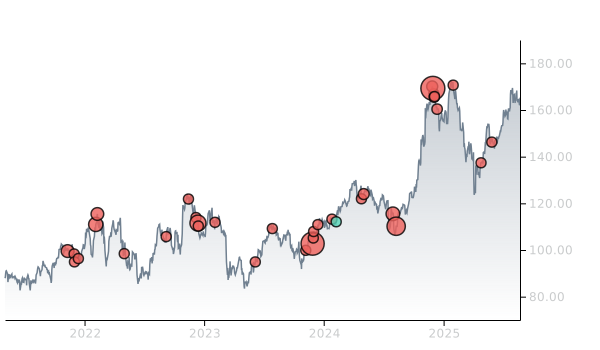
$RJF insiders have traded $RJF stock on the open market 3 times in the past 6 months. Of those trades, 0 have been purchases and 3 have been sales.
Here’s a breakdown of recent trading of $RJF stock by insiders over the last 6 months:
- PAUL C REILLY (Executive Chair) has made 0 purchases and 3 sales selling 130,687 shares for an estimated $21,321,441.
To track insider transactions, check out Quiver Quantitative's insider trading dashboard.
$RJF Revenue
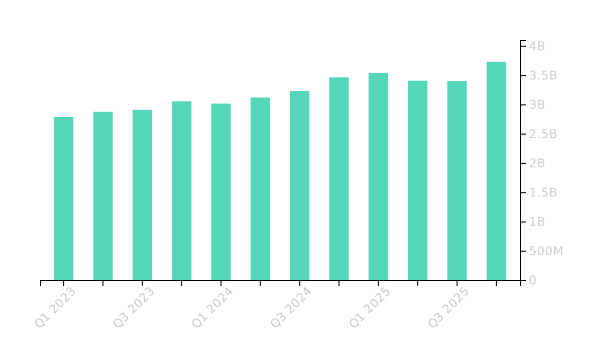
$RJF had revenues of $3.7B in Q4 2025. This is an increase of 7.65% from the same period in the prior year.
You can track RJF financials on Quiver Quantitative's RJF stock page.
$RJF Hedge Fund Activity
We have seen 387 institutional investors add shares of $RJF stock to their portfolio, and 377 decrease their positions in their most recent quarter.
Here are some of the largest recent moves:
- MILLENNIUM MANAGEMENT LLC added 1,334,567 shares (+1846.2%) to their portfolio in Q3 2025, for an estimated $230,346,264
- UBS AM, A DISTINCT BUSINESS UNIT OF UBS ASSET MANAGEMENT AMERICAS LLC added 1,068,064 shares (+58.2%) to their portfolio in Q3 2025, for an estimated $184,347,846
- WELLINGTON MANAGEMENT GROUP LLP removed 550,333 shares (-5.8%) from their portfolio in Q3 2025, for an estimated $94,987,475
- T. ROWE PRICE INVESTMENT MANAGEMENT, INC. removed 539,509 shares (-12.9%) from their portfolio in Q3 2025, for an estimated $93,119,253
- BLACKROCK, INC. removed 429,798 shares (-2.9%) from their portfolio in Q3 2025, for an estimated $74,183,134
- MORGAN STANLEY added 421,357 shares (+18.7%) to their portfolio in Q3 2025, for an estimated $72,726,218
- AMERICAN CENTURY COMPANIES INC removed 403,785 shares (-58.7%) from their portfolio in Q3 2025, for an estimated $69,693,291
To track hedge funds' stock portfolios, check out Quiver Quantitative's institutional holdings dashboard.
$RJF Analyst Ratings
Wall Street analysts have issued reports on $RJF in the last several months. We have seen 1 firms issue buy ratings on the stock, and 0 firms issue sell ratings.
Here are some recent analyst ratings:
- JMP Securities issued a "Market Outperform" rating on 10/23/2025
To track analyst ratings and price targets for $RJF, check out Quiver Quantitative's $RJF forecast page.
$RJF Price Targets
Multiple analysts have issued price targets for $RJF recently. We have seen 12 analysts offer price targets for $RJF in the last 6 months, with a median target of $180.0.
Here are some recent targets:
- Michael Cyprys from Morgan Stanley set a target price of $187.0 on 12/22/2025
- Michael Brown from UBS set a target price of $176.0 on 12/11/2025
- Mark McLaughlin from B of A Securities set a target price of $196.0 on 12/10/2025
- Kyle Voigt from Keefe, Bruyette & Woods set a target price of $181.0 on 10/23/2025
- Brennan Hawken from BMO Capital set a target price of $182.0 on 10/23/2025
- Devin Ryan from JMP Securities set a target price of $190.0 on 10/23/2025
- Michael Cho from JP Morgan set a target price of $180.0 on 10/23/2025
Full Release
St. Petersburg, Fla., Dec. 30, 2025 (GLOBE NEWSWIRE) -- A new Raymond James survey of more than 500 owners of privately held businesses asked how they’re approaching their livelihoods, their futures and the places where the two intersect. The resulting data reveals the coming need for a comprehensive wealth plan for many as 88% plan to financially exit their business, either partially or fully, within the next decade.
“Divesting a business is more than a transaction, it’s a transformation,” said Bill Seugling, senior vice president, head of Raymond James Global Wealth Solutions. “With so much of their lives tied to an enterprise, business owners need strategies that dig deep. Regardless of whether the goal is retirement, reinvestment or legacy, owners can turn a business transition into an opportunity to secure their future and preserve what matters most.”
Key findings include:
- Owners who are already envisioning an exit don’t see it as an ending: Even after transitioning some or all of their financial stake, one-third will continue working at their current business while 30% intend to invest in or acquire a new one.
- 20% plan to retire.
- A majority of respondents won’t look far for a successor as 35% of owners will transition their business to a family member while another 23% will tap a nonfamily internal stakeholder.
The survey further explores how business owners are preparing for the future of their companies and personal wealth, uncovering the unique challenges of converting what is likely their largest asset into realized personal wealth.
Asset concentration
Business owners often have significant personal wealth tied up in their companies. This concentration underscores the importance of long-term personal wealth planning and diversification.
- Nearly half of respondents (44%) said their business accounts for more than half their wealth, while nine in 10 said it represents at least a quarter.
Transition timeline
- More than half (56%) plan to fully or partially transition their financial stake within the next five years and a vast majority (88%) plan to do so within 10 years.
- Notably, 85% of respondents report having a transition plan in place, highlighting the significance of managing challenges and preparing for a smooth handoff.
“The time to plan is now, especially for those business owners whose transition timeline is within the next five years,” said Bonnie Harper, vice president, Private Wealth Consulting at Raymond James. “It’s important to have a personal wealth plan that ensures the effort you’ve invested in your business becomes the foundation for the life you envision."
Growth capital needs
85% of owners anticipate needing additional capital to power future business growth. When asked to identify all sources they would consider for growth capital, respondents selected:
- Private equity (52%)
- Traditional/bank loan (50%)
- Personal funds (43%)
- Securities based line of credit (43%)
- Personal loan (40%)
To choose the best source, owners must weigh the trade-offs for their business and desired outcome, including whether they’re willing to share control with outside investors or wish to transition the business to a family member or key employees.
Future plans
Looking ahead, 35% of owners intend to transition their business to a family member. Among owners of businesses valued at more than $15 million, that figure rises to 44%.
Thoughtful and timely planning holds extra importance in this type of transition given familial dynamics and nonfamily internal stakeholders. These leadership changes could not only redefine ownership structures but may also trigger a large intergenerational wealth transfer.
Future business success
When asked what would impact the future success of their business:
- 22% of business owners identified expansion into new markets as a critical factor.
- Economic environment ranked second at 17%.
- 15% of owners said demand for service/product.
- People-centric factors, including hiring/retaining people (12%) and readiness of next generation leadership (11%) ranked at the bottom of the list.
While respondents see external forces like market expansion and economic conditions as critical to future success, people-centric priorities, such as talent retention and leadership development, ranked lower, signaling a potential gap between strategic growth ambitions and the human capital needed to sustain them.
For more information on how business owners are planning for their business and financial futures, visit www.raymondjames.com/business-wealth .
Methodology
This poll was conducted between April 7-18, 2025, among a national sample of 540 business owners. Interviews were conducted online and the data were weighted to approximate a target sample of adults based on gender, educational attainment, age, race and region. Results from the full survey have a margin of error of +/- 4 percentage points.
Business owners are classified as those who are 18+ in the United States, who work in the private sector or are self-employed and have an ownership stake of 5+ years at a privately held company with 6-1,000 employees.
About Raymond James Financial, Inc.
Raymond James Financial, Inc. (NYSE: RJF) is a leading diversified financial services company providing private client group, capital markets, asset management, banking and other services to individuals, corporations and municipalities. Total client assets are $1.77 trillion. Public since 1983, the firm is listed on the New York Stock Exchange under the symbol RJF. Additional information is available at www.raymondjames.com .